


don Giuseppe Nespeca
Giuseppe Nespeca è architetto e sacerdote. Cultore della Sacra scrittura è autore della raccolta "Due Fuochi due Vie - Religione e Fede, Vangeli e Tao"; coautore del libro "Dialogo e Solstizio".
Young and articulate Church
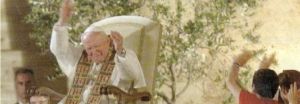
Dear young people!
1. I come to you to announce the next World Youth Day. As I write these words, the memory is still fresh of the last Youth Day, culminating in the unforgettable meeting at Santiago de Compostela where, together with many of you, I went on pilgrimage. That was an ecclesial event of great importance, an exceptional witness of faith on the part of thousands of young people from every continent, an intense moment of evangelization. At Santiago, the Church presented once again to the world her youthful image, full of joy, of hope and of enthusiasm in the faith. The Santiago event was a great gift for the Church; I would even venture to say, for society as a whole. For this I shall never cease to thank Our Lord.
The theme of the last Youth Day, as you will remember, was centred on Christ. This year, instead, I should like to propose that you reflect on the theme of the Church. The correlation is not haphazard. Between Christ and his Church there is a very close and deep organic relationship. Christ lives in the Church, the Church is the mystery of Christ living and working among us, as St Paul says: "Christ in you, the hope of glory" (Col 1:27); and again: "You are the body of Christ and individually members of it" (1Co 12: 27).
On the occasion of this V World Youth Day, I want therefore to invite you all to a new discovery of the Church and of your mission in the Church, as young people.
The Church of Christ is a fascinating and wonderful reality. She is ancient, being almost two thousand years old, but, at the same time, forever young, thanks to the Holy Spirit working within her. The Church is young because her message of salvation is young, that is, relevant for all times. That is why there is a dialogue of such importance between the Church and youth: "The Church has so much to talk about with youth and youth have so much to share with the Church. This mutual dialogue, by taking place with great cordiality, clarity and courage ... will be a source of richness and youthfulness for the Church ...", as I wrote in the Apostolic Exhortation Christifideles Laici (n. 46). I should like the V Day to contribute towards developing this dialogue both at the level of the Church’s life and in the existence of each one of you.
2. In the Bible, among the many images expressing the mystery of the Church, we find also the image of the vine (cf. Jer 2:21; Is 5:1-7). The Church is the vine planted by the Lord himself, a vine that rejoices in his special love.
In John’s Gospel, Christ explains the fundamental principle of the life of this vine when He says: "I am the vine, you are the branches" (Jn 15:5). These are the very words that I have chosen as theme for the next World Youth Day. And so, I appeal to all of you: Young people, be living branches in the Church, be branches laden with fruit!
To be living branches in the vineyard of the Church means above all to be in living communion with Christ the vine. The branches are not self-sufficient; they are totally dependent on the vine. In the vine is the source of their life. Likewise, in Baptism, each one of us was grafted onto Christ, and received the free gift of new life. To be living branches, you must live this reality of your Baptism, deepening every day your communion with the Lord, by listening to his Word and obeying it, by participating in the Eucharist and the sacrament of Reconciliation, and by speaking personally with Our Lord in prayer. Jesus says: "He who abides in me and I in him bears much fruit, for apart from me you can do nothing" (Jn 15:5).
To be living branches in the vineyard of the Church also means accepting a commitment in the ecclesial community and in society. The Second Vatican Council explains this very clearly: "As in the structure of a living body no member is merely passive, but each has a share in the functioning as well as in the life of the body: so too, in the Body of Christ, which is the Church, ‘the whole body ... when each part is working properly, makes bodily growth’ (Eph 4:16)" (Apostolicam Actuositatem, 2). We all share, according to our particular vocations, in the mission of Christ and of his Church. Ecclesial communion is a missionary communion.
The Church needs many labourers. For this V World Day, Christ himself extends to you young people a great invitation: "You go into my vineyard too" (Mt 20:4).
The Church is an organic communion, in which each one has his or her own place and his or her own task. You young people have also your own place. A very important one. On the threshold of the year Two Thousand, the Church feels called by the Lord to an ever more intense effort of evangelization; she has special need of you, of your dynamism, your authenticity, your ardent will to grow, the freshness of your faith. So, place your youthful talents unreservedly at the service of the Church, with the generosity that is characteristic of your age. Take your place in the Church. It is not merely the place of objects of pastoral care. It is above all one of active protagonists in the Church’s mission (cf.
Christifideles Laici, 46). The Church is yours. More still, you yourselves are the Church!
For her part, the Church has so much to offer to you young people. We are witnessing today a very significant phenomenon. After a period of distrust and indifference with regard to the Church, many young people are now rediscovering the Church as a sure and faithful guide, as an indispensable point of communion with God and with their brothers and sisters, as an area of spiritual growth and commitment. This is a most eloquent sign. Many of you are no longer content just with belonging to the Church formally, statistically. They are looking for something more.
Special opportunities for rediscovering the Church and ecclesial commitment are found in associations, movements and the various ecclesial communities for youth. Today, indeed, we speak of a "new era of group endeavours" within the Church (cf.
Christifideles Laici , 29). This is an immense treasure and a precious gift of the Holy Spirit, for which we should be most grateful.
"You go into my vineyard too" (Mt 20: 4). The vineyard of the Church also needs special labourers, serving her in a specific way, with the radicalism of the Gospel, consecrating their whole life to her service. I refer to priestly and religious vocations, and also to the vocations of consecrated lay people in the world. I am sure that many of you, as you meditate on the mystery of the Church, will hear in the depths of your soul the call of Christ: "You go into my vineyard too ...". If you hear this voice addressed to you personally, do not hesitate to answer "yes" to Our Lord. Do not be afraid. Total service of Christ and his Church is a wonderful vocation and a magnificent gift. Christ will help you.
This, in broad outline, is the substance of the theme for the next World Day, a day for rediscovering the Church.
3. The V World Youth Day 1990 will be celebrated on Palm Sunday in each of your dioceses.
It is precisely the diocesan Church that you must discover. The Church is not an abstract and disembodied reality. On the contrary, it is a very concrete reality: precisely, a diocesan Church gathered around the Bishop, successor of the Apostles. It is also the parish Church that you must discover, its life, its needs and the many communities that exist and work within it. You will bring to this Church the joy and the enthusiasm you have experienced in world-wide encounters like that of Santiago and in the meetings of the movements and associations to which you belong. In this concrete Church you young people must be living and fruitful branches; you must, that is, be conscious and responsible sharers in its mission. Welcome this Church with all its spiritual riches; welcome it in the person of your Bishops, of the Priests, of the Religious and also of your brothers and sisters in the faith; welcome it with faith and with filial love.
The World Day, as you see, is not only a festival, but also a serious spiritual commitment. To be able to gather its fruits, it is necessary to follow a path of preparation under the guidance of your Pastors in the dioceses, in the parishes, in the associations, the movements and the ecclesial communities for youth. Try to know the Church better: her nature, her two thousand years of history, and her present situation. Try to discover your place in the Church and your mission as young people.
In this spiritual journey you can be helped by my Apostolic Exhortation Christifideles Laici (1988), dedicated precisely to meditation on the vocation and mission of the lay faithful in the Church and in the world. I invite your Pastors to help you in gaining a better understanding of its message.
I entrust the process of spiritual preparation and the actual celebration of the forthcoming World Youth Day 1990 to the special intercession of Our Lady. May She, whom we venerate as Mother of the Church, be your Teacher and Guide in this renewal of your ecclesial commitment.
To all of you I send, affectionately, my Blessing.
From the Vatican, 26 November 1989, Solemnity of O.L. Jesus Christ, King of the Universe.
[Pope John Paul II, Message for the III. World Youth Day]
United with Him in a new way
Today’s Gospel shows us Jesus during the Last Supper, in the moment He knows His death is close at hand. His ‘hour’ has come. For it is the last time He is with His disciples, and now He wants to impress firmly a fundamental truth in their minds: even when He will no longer be physically present in the midst of them, they will still be able to remain united to Him in a new way, and thus bear much fruit. Everyone can be united to Jesus in a new way. If, on the contrary, one should lose this unity with Him, this union with Him, would become sterile, or rather, harmful to the community. And to express this reality, this new way of being united to Him, Jesus uses the image of the vine and the branches: Just “as a branch cannot bear fruit by itself, unless it abides in the vine, neither can you, unless you abide in me. I am the vine, you are the branches” (Jn 15:4-5). With this image He teaches us how to abide Him, to be united to Him, even though He is not physically present.
Jesus is the vine, and through Him — like the sap in the tree — the very love of God, the Holy Spirit is passed to the branches. Look: we are the branches, and through this parable, Jesus wants us to understand the importance of remaining united to him. The branches are not self-sufficient, but depend totally on the vine, in which the source of their life is found. So it is with us Christians. Grafted by Baptism in Christ, we have freely received the gift of new life from Him; and thanks to the Church we are able to remain in vital communion with Christ. We must remain faithful to Baptism, and grow in intimacy with the Lord through prayer, listening and docility to His Word — read the Gospel —, participation in the Sacraments, especially the Eucharist and Reconciliation.
When one is intimately united to Jesus, he enjoys the gifts of the Holy Spirit, which are — as St Paul tells us — “love, joy, peace, patience, kindness, generosity, faithfulness, gentleness, self-control” (Gal 5:22). These are the gifts that we receive if we remain united in Jesus; and therefore a person who is so united in Him does so much good for neighbour and society, is a Christian person. In fact, one is recognized as a true Christian by this attitude, as a tree is recognized by its fruit. The fruits of this profound union with Christ are wonderful: our whole person is transformed by the grace of the Spirit: soul, understanding, will, affections, and even body, because we are united body and soul. We receive a new way of being, the life of Christ becomes our own: we are able to think like Him, to act like Him, to see the world and the things in it with the eyes of Jesus. And so we are able to love our brothers, beginning with the poorest and those who suffer the most, as He did and love them with His heart, and so bear fruits of goodness, of charity, and of peace in the world.
Each one of us is a branch of the one vine; and all of us together are called to bear the fruits of this common membership in Christ and in the Church. Let us entrust ourselves to the intercession of the Virgin Mary, so that we might be able to be living branches in the Church and witness to our faith in a consistent manner — consistency of one’s own life and thought, of life and faith — knowing that all of us, according to our particular vocations, participate in the one saving mission of Christ.
[Pope Francis, Regina Coeli 3 May 2015]
New Creation, from Listening
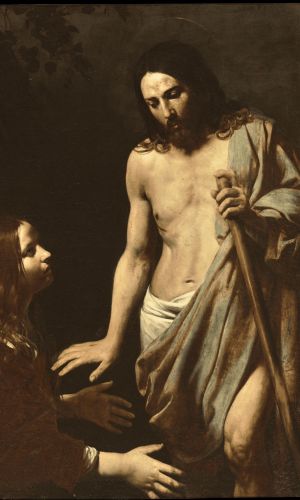
(Jn 20:1-2.11-18)
Mk tells of a young man dressed in white, Mt of an angel, Lk of two men dressed in white, Jn of two angels.
The stories on the annunciation and on the heralds of the Resurrection do not fit together according to our way of telling.
To avoid a limited view on the victory of Life, it is appropriate to understand that we are not celebrating an apparition of the Risen One, but his Manifestation [Greek text].
He does not appear only to some - to others He does not: manifests itself. We experience Him.
And there is a new Creation: now we do not recognize Jesus when we see, but when we listen Him (v.16).
The Lord makes himself seen not in the moment of the vision, but in the time of the Word, of the personal Appeal that «turns» the gaze from the irrelevant direction of travel that clings to the image of "yesterday".
The experience of the living Christ excludes the memories to be kept crying.
It is a current and well-founded relationship, convincing, multifaceted and accessible - direct.
The very observance of ancient law [v.1: in the particular case, the sabbath] seems to delay the experience of the disruptive force of rebirth, in the Spirit.
Gradually, in the communities those personal primordial energies were being reactivated that not even the blackmail, intimidation and marginalization of the institutional apparatus could touch.
The faithful were on the virtuous and exciting wave of a further fundamental change: now they felt «brothers» of the Risen One (v.17).
The ‘discipleship’ relation (Jn 13:13) growing in ‘friendship’ (Jn 15,15) were becoming that of the blood relatives who felt they were ‘sons’.
[Jn 1,11-12: «He came among his own, and his own did not welcome him. But to those who received him he gave them power to become sons of God; to those who believe in his Name» - that is: adhering to all his word, story and action; also problematic, painful, denouncing].
Thus began the explicit Announcement, despite the fact that the truly vital and increasingly determined part of the "church" proved to be that wich was peripheral and came from the pagans [in the figure of Mary Magdalene].
Woman: authentic Assembly in the Spirit.
An endless field of humiliated people, who nevertheless in the Risen Christ «see themselves within» and are unblocked; by acquiring new breath, overcoming discouragement, disorientation, uncertainty.
Even today, the search for our Guide can also arise from the sense of loss, or from the beatings suffered - but it is marked by Easter encounters and stages of new awareness.
New Listens, which break the reassurances. The Risen is a radical novelty: a wound inside and an impulse.
Only in the experience of ‘being reborn by transmitting Him’, is the Spirit unleashed that thrills and charges - and the Living One does not remain a stranger or someone of whom we have already made up an idea.
There is an unprecedented situation.
But who notices? In spite of the neglect they suffer, only the bridal souls catch it - the very ones who are disregarded.
[st Mary Magdalene, July 22]
New Creation, from Listening

Fossilised in reminiscences, or Announced by Brethren
(Jn 20:1-2.11-18)
"In those days, in Israel, the testimony of women could not have official, juridical value, but women experienced a special bond with the Lord, which is fundamental for the concrete life of the Christian community, and this always, in every age, not only at the beginning of the Church's journey" [Pope Benedict, Regina Coeli 9 April 2012].
Mk tells of a young man dressed in white, Mt of an angel, Lk of two men dressed in white, Jn of two angels.
The accounts of the annunciation and the heralds of the resurrection do not fit together according to our way of telling.
In order to avoid a limited view of the victory of Life, it should be understood that we are not celebrating the week of the apparitions of the Risen One, but of his Manifestations [Greek text].
He does not just appear to some - to others he does not (depending on the lottery): he Manifests himself. We experience him.
And there is a new Creation: now one does not recognise Jesus when one sees him, but when one hears him (v.16).
The Lord makes Himself seen not in the moment of vision, but in the time of the Word, of the personal call that makes one "turn" the ancient gaze from the irrelevant direction that clings to the image of "yesterday".
The experience of the living Christ excludes memories to be wept over.
It is current and grounded, convincing, multifaceted and accessible - direct. Definitely better than that offered later by the apostles, without pierced hearts (or proclamations).
But the face-to-face still remained closed, to the extent that one seemed to be looking for deceased or distant museum pieces - to be found almost as before and at best kept without too many shocks.
Conditioned by too 'usual' expectations, we would pretend to trace Jesus to the wrong campsites and places. But in Jn the Ascension is placed on the same day as Easter (v.17).
The very observance of archaic religious law [v.1: in the particular case, the Sabbath] seems to delay the experience of the disruptive power of rebirth, in the Spirit.
Gradually, those primordial personal energies were being reactivated in the early communities that not even the blackmail, intimidation and marginalisation of the institutional apparatus could touch.
The Incarnation was continuing, unfolding in the believers; awakening in them new creative states.
The believers were on the virtuous and exciting wave of a further fundamental change: they now felt themselves to be 'brothers' of the Risen One (v.17).
The relationship of 'discipleship' (Jn 13:13) grown into 'friendship' (Jn 15:15) became that of kinsmen who felt like 'sons'.
[Jn 1:11-12: "He came among his own, and his own received him not. But to those who received him he gave power to become children of God; to those who believe in his Name" - that is, they adhere to his entire word, event and action; even problematic, painful, denunciation].
Thus began the explicit proclamation, despite the fact that the part of the 'church' that was really vital and increasingly determined proved to be the peripheral and from the pagans [in the figure of Mary Magdalene].
It wanted the reviving redemption, and thus pointed the right way to the assembly leaders themselves.
The Judeo-Christian community of the apostles was in fact all out for compromise with the distant and conflicting religious institution, that of power, which had wanted to destroy the Master.
The 'apostolic' hard core always lags behind and needs to be evangelised: only she who feels she is a nothing (vv.2.18) converts him. And when she becomes aware that the reign of dead things will no longer greet her.
Woman: Authentic assembly in the Spirit.
A boundless field of the humiliated, which nevertheless in the Risen Christ "sees itself" and is unblocked; it acquires new breath, overcomes discouragement, disorientation, uncertainty.
Still filled with Infinity, like pilgrims, dreamers from below and from the periphery seek their way.
They activate themselves with passion, to rekindle and resonate every fold of the human being - previously commanded by a world of calculated alternatives.
It is again the experience of "Mary of Magdala", who, by gaining confidence, can complete the perceptions and thoughts of even the top of the class.
The Risen One is always somewhere else... than what the expert or an average religious soul not ready for change expects.
His Person has unforeseen, unconventional and unconventional physiognomies - like life, all to be discovered.
They are unseen profiles - to be grasped and internalised, sometimes almost without struggle.
Only a call by name - his direct Word, the personal Appeal - makes us realise that by external influence we were perhaps chasing a Lord [of the past, or fashionable] too recognisable, to be commemorated as before.
To be carried in our saddlebags as always, with closed and normal love, the child of sorrow.The search for our Rabbuni may also arise from a sense of loss, or from the beatings suffered - but it is marked by Easter encounters and stages of new awareness.
New hearings, which shatter reassurances.
He remains a lukewarm stranger - at room temperature - for those who allow themselves to be influenced by limited (packaged) ideas and pretend to understand him with knowledge, recognise him with their eyes, or use him as a sleeping pill.
The Risen One is radical novelty: wounded within and impetus. A journey that welcomes and takes on the whole of humanity and history.
He acts in us by shattering all security; the very security that still does not let us out of the small circle.
And while labouring in the tension of the ungraspable [which cannot be made one's own] it is in the emotion of perceiving the treasures of atypical and personal intuitions that regenerated life attracts and opens wide, amazes.
It is only in the experience of being reborn by passing it on that the Spirit is unleashed and charged - and the Living One does not remain a stranger or someone of whom one has already had an idea.
"I have sought and seen the Lord!" [v.18: sense of the Greek text].
One does not experience Christ with intimism, nor with reminiscences and trinkets; not even in a cerebral way or by being content to fulfil pious memorial offices on the body.
There is an unprecedented situation.
But who notices? In spite of the neglect they endure, only the soulless - the disregarded.
To internalise and live the message:
What transmutation took place in you and your neighbour when you accepted the Call and the invitation to the Announcement?
How did the Person of Christ make you aware that you are fully wanted: inalienable subject, by Name?
Personal Manifestation: a law we find carved into many pages of the Gospels. But... soft happiness or wave sweeping over everything?
In these weeks our reflection moves, so to speak, in the orbit of the paschal mystery. Today we meet the one who, according to the Gospels, first saw the risen Jesus: Mary Magdalene. The Sabbath rest had recently ended. On the day of the passion, there had been no time to complete the funeral rites; therefore, in that dawn filled with sadness, the women go to Jesus' tomb with perfumed ointments. The first to arrive is her: Mary of Magdala, one of the disciples who had accompanied Jesus all the way from Galilee, putting herself at the service of the nascent Church. Her journey to the tomb mirrors the fidelity of so many women who are devoted for years to the paths of cemeteries, in memory of someone who is no longer there. The most authentic bonds are not broken even by death: there are those who continue to love, even if the loved one is gone forever.
The Gospel (cf. Jn 20:1-2, 11-18) describes Mary Magdalene by making it immediately clear that she was not a woman of easy enthusiasm. In fact, after the first visit to the tomb, she returns disappointed to the place where the disciples were hiding; she reports that the stone has been moved from the entrance of the tomb, and her first hypothesis is the simplest that can be formulated: someone must have stolen Jesus' body. So the first announcement that Mary brings is not that of the resurrection, but of a theft that unknown persons have perpetrated, while the whole of Jerusalem slept.
Then the gospels tell of a second journey of the Magdalene to Jesus' tomb. She was stubborn! She went, she returned ... because she was not convinced! This time her pace is slow, very heavy. Mary suffers doubly: first of all for the death of Jesus, and then for the inexplicable disappearance of his body.
It is while she is bending over by the tomb, her eyes full of tears, that God surprises her in the most unexpected way. The evangelist John emphasises how persistent her blindness is: she does not notice the presence of two angels questioning her, nor does she become suspicious when she sees the man behind her, whom she thinks is the guardian of the garden. Instead, she discovers the most shocking event in human history when she is finally called by name: "Mary!" (v. 16).
How beautiful it is to think that the first appearance of the Risen One - according to the gospels - happened in such a personal way! That there is someone who knows us, who sees our suffering and disappointment, and is moved by us, and calls us by name. It is a law that we find carved into many pages of the gospel. Around Jesus there are many people who seek God; but the most prodigious reality is that, much earlier, there is first of all God who cares for our lives, who wants to lift them up, and to do this he calls us by name, recognising the personal face of each one. Every man is a story of love that God writes on this earth. Each one of us is a story of God's love. Each one of us God calls by name: he knows us by name, he looks at us, he waits for us, he forgives us, he has patience with us. Is this true or not? Each one of us has this experience.
And Jesus calls her: "Mary!': the revolution of his life, the revolution destined to transform the existence of every man and woman, begins with a name that echoes in the garden of the empty tomb. The Gospels describe to us Mary's happiness: Jesus' resurrection is not a joy given with an eyedropper, but a cascade that invests one's whole life. Christian existence is not woven with soft happiness, but with waves that sweep over everything. Try to think too, right now, with the baggage of disappointments and defeats that each of us carries in our hearts, that there is a God close to us who calls us by name and says: "Get up, stop crying, because I have come to set you free!" This is beautiful.
Jesus is not one who adapts to the world, tolerating that death, sadness, hatred, the moral destruction of people endure in it... Our God is not inert, but our God - allow me the word - is a dreamer: he dreams of the transformation of the world, and he has realised it in the mystery of the Resurrection.
Mary would like to embrace her Lord, but He is now oriented to the heavenly Father, while she is sent to take the proclamation to her brothers and sisters. And so that woman, who before meeting Jesus was at the mercy of the Evil One (cf. Lk 8:2), has now become an apostle of the new and greater hope. May her intercession help us to live this experience too: in the hour of weeping, and in the hour of abandonment, listen to the Risen Jesus who calls us by name, and with a heart full of joy go and proclaim: "I have seen the Lord!" (v. 18). I have changed my life because I have seen the Lord! I am now different from before, I am a different person. I have changed because I have seen the Lord. This is our strength and this is our hope.
[Pope Francis, General Audience 17 May 2017]
Announcing the Eternal Living One

The Gospel accounts that mention the appearances of the Risen One usually end with the invitation to overcome every uncertainty, to confront the event with the Scriptures, to proclaim that Jesus, beyond death, is alive for ever, a source of new life for all who believe in him.
This is what happened, for example, in the case of Mary Magdalene (cf. Jn 20: 11-18), who found the tomb open and empty and immediately feared that the body of the Lord had been taken away. The Lord then called her by name and at that point a deep change took place within her: her distress and bewilderment were transformed into joy and enthusiasm. She promptly went to the Apostles and announced to them: "I have seen the Lord" (Jn 20: 18).
Behold: those who meet the Risen Jesus are inwardly transformed; it is impossible "to see" the Risen One without "believing" in him. Let us pray that he will call each one of us by name and thus convert us, opening us to the "vision" of faith.
Faith is born from the personal encounter with the Risen Christ and becomes an impulse of courage and freedom that makes one cry to the world: "Jesus is risen and alive for ever".
This is the mission of the Lord's disciples in every epoch and also in our time: "If, then, you have been raised with Christ", St Paul exhorts us, "seek the things that are above.... Set your minds on things that are above, not on things that are on earth" (Col 3: 1-2). This does not mean cutting oneself off from one's daily commitments, neglecting earthly realities; rather, it means reviving every human activity with a supernatural breath, it means making ourselves joyful proclaimers and witnesses of the Resurrection of Christ, living for eternity (cf. Jn 20: 25; Lk 24: 33-34).
[Pope Benedict, General Audience 19 April 2006]
Personally
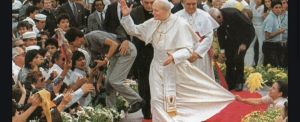
On 22 July we celebrate the memorial of St Mary Magdalene, disciple of the Lord and first witness of the Resurrection. The story of St Mary of Magdala shows how decisive it is for each one of us to meet Christ personally. It is Christ who understands the human heart. It is he who can satisfy its hopes and longings and give answers to the concerns and the difficulties that humanity today faces in its daily endeavours.
[Pope John Paul II, Angelus 22 July 2001]
Stubborn Apostle of Hope
Today we meet the one who, according to the Gospels, was the first to see the Risen Christ: Mary Magdalene. The Sabbath had ended not long before. On the day of the Passion, there had not been enough time to complete the funeral rites. For this reason, at that sorrow-filled dawn, the women went to Jesus’ tomb with aromatic oils. The first to arrive was Mary Magdalene. She was one of the disciples who had accompanied Jesus from Galilee, putting herself at the service of the burgeoning Church. Her walk to the sepulchre mirrors the fidelity of many women who spend years in the small alleyways of cemeteries remembering someone who is no longer there. The most authentic bonds are not broken even in death: there are those who continue loving even if their loved one is gone forever.
The Gospel describes Magdalene by immediately highlighting that she was not a woman easily given to enthusiasm (cf. Jn 20:1-2, 11-18). In fact, after her visit to the sepulchre, she returns disappointed to the Apostles’ hiding place. She tells them that the stone has been removed from the entrance to the sepulchre, and her first hypothesis is the simplest that one could formulate: someone must have stolen Jesus’ body. Thus, the first announcement that Mary makes is not the one of the Resurrection, but of a theft perpetrated by persons unknown while all Jerusalem slept.
The Gospels then tell of Magdalene’s second visit to Jesus’ sepulchre. She was stubborn! She went, she returned ... because she was not convinced! This time her step is slow and very heavy. Mary suffers twice as much: first for the death of Jesus, and then for the inexplicable disappearance of his body.
It is as she is stooping near the tomb, her eyes filled with tears, that God surprises her in the most unexpected way. John the Evangelist stresses how persistent her blindness is. She does not notice the presence of the two angels who question her, and she does not become suspicious even when she sees the man behind her, whom she believes is the custodian of the garden. Instead, she discovers the most overwhelming event in the history of mankind when she is finally called by her name: “Mary!” (v. 16).
How nice it is to think that the first apparition of the Risen One — according to the Gospels — took place in such a personal way! To think that there is someone who knows us, who sees our suffering and disappointment, who is moved with us and calls us by name. It is a law which we find engraved on many pages of the Gospel. There are many people around Jesus who search for God, but the most prodigious reality is that, long before that, in the first place there is God, who is concerned about our life, who wants to raise it, and to do this, he calls us by name, recognizing the individual face of each person. Each person is a love story that God writes on this earth. Each one of us is God’s love story. He calls each of us by our name: he knows us by name; he looks at us; he waits for us; he forgives us; he is patient with us. Is this true or not true? Each of us experiences this.
And Jesus calls her: “Mary!”: the revolution of her life, the revolution destined to transform the life of every man and every woman begins with a name which echoes in the garden of the empty sepulchre. The Gospels describe Mary’s happiness. Jesus’ Resurrection is not a joy which is measured with a dropper, but a waterfall that cascades over life. Christian life is not woven of soft joys, but of waves which engulf everything. You too, try to imagine, right now, with the baggage of disappointments and failures that each of us carries in our heart, that there is a God close to us who calls us by name and says to us: ‘Rise, stop weeping, for I have come to free you!”. This is beautiful.
Jesus is not one who adapts to the world, tolerating in it the persistence of death, sadness, hatred, the moral destruction of people.... Our God is not inert, but our God — allow me to say — is a dreamer: he dreams of the transformation of the world, and accomplished it in the mystery of the Resurrection.
Mary would like to embrace her Lord, but he is already oriented towards the heavenly Father, whereas she is sent to carry the news to the brethren. And so that woman, who, before encountering Jesus, had been at the mercy of evil (cf. Lk 8:2) now becomes the Apostle of the new and greatest hope. May her intercession also help us live this experience: in times of woe and in times of abandonment, to listen to the Risen Jesus who calls us by name and, with a heart full of joy, to go forth and proclaim: “I have seen the Lord!” (v. 18). I have changed my life because I have seen the Lord! I am now different than before. I am another person. I have changed because I have seen the Lord. This is our strength and this is our hope. Thank you.
[Pope Francis, General Audience 17 May 2017]
How to rebuild the Temple?
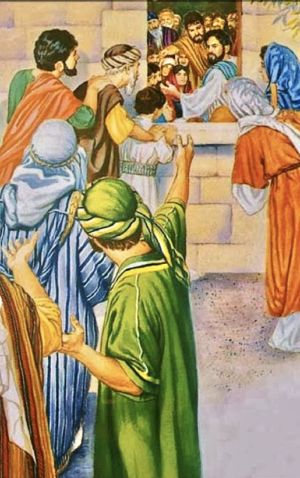
The Lord wants new people, who listen
(Mt 12:46-50)
In the life of those who are challenged by the relationship of Faith, to become blood relatives of the Father (according to the Spirit) is fundamental Perceive [in profound sense of Listening - not so much materially "seeing"].
It is not worth the «staying outside», or wanting to "speak" directly, to "convince" the Lord (vv.46-47).
It is necessary to intuit and grasp: a path to encounter one’s own intimate layers of being, the truth of inclinations, and of life.
It is decisive to welcome a satiating Word, which becomes language and culture, which has creative power: given to the ears and discovered inside. Captured in personal history and reality, and transmitted again.
To depart from this founding Core and Eros means detaching from oneself, dispersing oneself in rivulets that do not belong to us, failing into the void [’emptiness’ not understood as a deep energetic state, which prepares new developments].
Paradoxically, both our Freedom and the Salvation of the world are the result of an Obedience - but not external, or others.
It is rather tuning in to the part of the Logos within us that is blooming; really "perfect". No conditioning model.
No a priori correction, nor forcing according to prejudice: rather, an eternal Metamorphosis - accompanied by the Verbum Domini, which mysteriously guides Exodus into Exodus.
No configured customary expectation would join us full communion with the divine spark and fullness in each and everyone.
Realization of the kingdom and of every day - even out of time.
To know Christ closely it is not enough to look at him and be taken by sympathy, cultural ties, or religious emotion.
It is the Listening that connects and establishes intimate constraints which do not extinguish - a friendship of engaging harmony with the Master.
Around Jesus the Word of God creates a new Family, with bonds of spiritual kinship closer than what the clan attachment offered.
The Lord wants other people, born precisely from Perception.
The union is no longer reserved and exclusive; it becomes accessible to anyone and in any condition - even if he/her were "blind" outside, unable to see what is at hand.
Everyone is a Church, House of the Father, and thus realize God’s Dream of living with men and walking alongside.
He dwells among us and in us. In his Word, without more "distances".
In this way, all our actions must aim for this purpose: to form the Temple of God, his lineage, the Body of the living Christ.
To achieve this complete goal, essential means is to host the Vocation that transforms us, a much more permanent, sensitive and energetic foundation of any feeling, connection, or emotion.
Indispensable is not an (initial) experience of enthusiasm, but the custody of the Call that interprets life and becomes mentality, dynamism inside that leads us.
And flows into suburban paths.
There is yet other Temple to be built.
[Tuesday 16th wk. in O.T. July 21, 2026]
How can we rebuild the Temple?
The Lord wants new people, who listen
(Mt 12:46–50)
In the life of anyone called to a relationship of faith, in order to become kin to the Father according to the Spirit, it is essential to perceive [in the profound sense of ‘listening’ – not so much ‘seeing’ directly in a physical sense].
Nor is it enough simply to ‘stand on the sidelines’, or to seek to ‘speak’ directly in order to ‘convince’ the Lord (vv. 46–47).
It is necessary to intuit and grasp: a journey to encounter the deepest layers of one’s being, the truth of one’s inclinations, and of life itself.
It is crucial to receive a Word that satisfies, which becomes language and culture, and which possesses creative power: given to our ears and discovered within. Grasped within our personal history and reality, and passed on once more.
To turn away from this Word and this founding Eros is to detach oneself from one’s true self, to scatter into streams that do not belong to us, to plunge into the void [‘void’ not understood as a profound energetic state that prepares the way for new developments].
Paradoxically, both our Freedom and the Salvation of the world are the fruit of Obedience – but not an external obedience, nor one imposed by others.
Rather, it is a matter of attuning ourselves to the part of the Logos within us that is blossoming; truly ‘perfect’. No conditioning model.
No a priori correction, nor coercion based on prejudice: rather, an eternal Metamorphosis – accompanied by the Word, which mysteriously guides us from Exodus to Exodus.
No pre-determined cultural expectation could ever lead to full communion with the great divine spark and fullness within each and every one of us.
The realisation of the Kingdom in every day – even beyond time.
To know Christ intimately, it is not enough merely to look at him and be moved by sympathy or religious emotion.
It is Listening that forges and establishes intimate bonds—which never fade—of captivating harmony with the Master.
Around Jesus, the Word of God creates a new Family, with bonds of spiritual kinship closer than those offered by clan ties.
The Lord desires a different kind of people, born precisely from Perception-premonition.
This union is no longer reserved or exclusive; it becomes accessible to anyone, whatever their circumstances – even if they are ‘blind’ to the outside world, unable to perceive what lies within their grasp.
Each person is the Church, the Father’s House, and thus can fulfil God’s Dream of dwelling amongst humankind and walking alongside them.
He dwells amongst us and within us. In his Word, with no ‘distances’ any longer.
In this way, all our actions must be directed towards this aim: to form the Temple of God, his household, the Body of the living Christ.
To reach this fulfilment, the essential means is to embrace the Vocation that transforms us, a foundation far deeper than any bond or emotion.
What is indispensable is not an (initial) experience of enthusiasm, but rather the safeguarding of the Call that gives meaning to life and becomes a mindset, an inner dynamism that guides us and leads us onto paths to the peripheries.
In ancient Israel, the basis of social coexistence was the extended family. Clans and communities guaranteed protection both for individual households and for individuals.
That bond of genuine solidarity ensured ownership of the land – which gave a sense of freedom – and served as a vehicle for cultural transmission, for the sense of being a people, and for spirituality itself.
Defending the coexistence that guaranteed their collective identity was tantamount to defending the First Covenant.
But in Palestine at the time of Jesus, clan life and the wider community life were in decline.
The excessive taxes payable to collaborationist governments and the Temple, the inevitable rise in the number of people forced to sell themselves into slavery to pay off debts, perhaps the more individualistic mindset of the Hellenistic world, imperial threats, and the obligation to welcome, feed and harbour Roman troops [who often took advantage even of the community’s most vulnerable members], all exacerbated the problems of survival.
In addition to this, the strictness of the purity laws was a further factor in their marginalisation, alongside the growing belief – typical of religions – that there was a link between divine curse and a state of poverty.
Concerns about material well-being and the protection of the individual family accentuated their detachment from communal life.
Jesus wanted to broaden once more the narrow confines of the small household community, and extend them to the great family of the Kingdom of God.
A comparison with the parallel passages of this episode reveals that Jesus had difficulties with his blood relatives.
They tended to try to bring him back within the bounds of tradition, out of fear of reprisals and because they regarded him as an extremist (perhaps even unbalanced).
The Risen One broadens the concept of Family and challenges the bonds that distance us from our identity, character and mission – whether these obstacles are posed by his own family, by Peter, by the disciples, by the powerful, or by the leaders of the official religion.
As mentioned above, at a time of political subjugation and rigid, legalistic religious ideology, the core values of the clan and the community were being eroded due to social and economic collapse.
This situation of external control – social and ideological enslavement – prevented people from coming together and sharing, forcing them to confine themselves to individual problems and the concerns of their own exclusive lineage.
[This was the situation in Jesus’ time, yet these aspects are not entirely alien to us, even from the perspective of certain ‘charisms’ defined in excessive detail, and of realities already established in the local area].
For the new Kingdom to manifest itself, the idea of communal living had to transcend the narrow confines of the individual and the tiny domestic hearth – including from a cultural perspective.
There was a need for a stimulus that would open the way to community life – understood in the spirit of the Beatitudes, for a conviviality of differences; even in actual, indeed harsh, cohabitation.
Even today, in this time of global crisis, the goal is an existence no longer marred by withdrawal, nor compromised by immediate necessities, disembodied fantasies, or ingrained patterns.
There is an urgent need for a new vision of the universal Family, one that transcends the limitations of habitual micro-relationships [namely, those of a group, a movement or even a denomination].
The world we are preparing will no longer make free participation, tolerant and concrete exchange, or the overcoming of domestication so difficult.
A new vision of universal Kinship, which fosters exchange and transcendence.
There is a very different Temple to be built.
To internalise and live out the message:
Do your family and your church group encourage an enlightened listening to the Gospel and ‘putting the Word into practice’, or do they merely offer you ready-made, pre-packaged ‘pills’?
Do they help you, or do they close you off from engaging with different ideas, from becoming aware of yourself, of those far away, and of the wealth of resources available—whether your own or those of others?
Mary Church

From this child, a new light issues forth, shining in the darkness of the night, as we can see in so many paintings depicting Christ’s Nativity. Henceforth, it is from him that blessing comes, from his name – Jesus, meaning “God saves” – and from his human face, in which God, the almighty Lord of heaven and earth, chose to become incarnate, concealing his glory under the veil of our flesh, so as to reveal fully to us his goodness (cf. Tit 3:4).
The first to be swept up by this blessing was Mary the virgin, the spouse of Joseph, chosen by God from the first moment of her existence to be the mother of his incarnate Son. She is the “blessed among women” (Lk 1:42) – in the words of Saint Elizabeth’s greeting. Her whole life was spent in the light of the Lord, within the radius of his name and of the face of God incarnate in Jesus, the “blessed fruit of her womb”. This is how Luke’s Gospel presents her to us: fully intent upon guarding and meditating in her heart upon everything concerning her son Jesus (cf. Lk 2:19, 51). The mystery of her divine motherhood that we celebrate today contains in superabundant measure the gift of grace that all human motherhood bears within it, so much so that the fruitfulness of the womb has always been associated with God’s blessing. The Mother of God is the first of the blessed, and it is she who bears the blessing; she is the woman who received Jesus into herself and brought him forth for the whole human family. In the words of the liturgy: “without losing the glory of virginity, [she] brought forth into the world the eternal light, Jesus Christ our Lord” (Preface I of the Blessed Virgin Mary).
Mary is the mother and model of the Church, who receives the divine Word in faith and offers herself to God as the “good soil” in which he can continue to accomplish his mystery of salvation. The Church also participates in the mystery of divine motherhood, through preaching, which sows the seed of the Gospel throughout the world, and through the sacraments, which communicate grace and divine life to men. The Church exercises her motherhood especially in the sacrament of Baptism, when she generates God’s children from water and the Holy Spirit, who cries out in each of them: “Abba, Father!” (Gal 4:6). Like Mary, the Church is the mediator of God’s blessing for the world: she receives it in receiving Jesus and she transmits it in bearing Jesus. He is the mercy and the peace that the world, of itself, cannot give, and which it needs always, at least as much as bread.
[Pope Benedict, homily, 1 January 2012]
The sower is Jesus. With this image, we can see that he presents himself as one who does not impose himself, but rather offers himself. He does not attract us by conquering us, but by donating himself: he casts seeds. With patience and generosity, he spreads his Word, which is not a cage or a trap, but a seed which can bear fruit (Pope Francis)
Il seminatore è Gesù. Notiamo che, con questa immagine, Egli si presenta come uno che non si impone, ma si propone; non ci attira conquistandoci, ma donandosi: butta il seme. Egli sparge con pazienza e generosità la sua Parola, che non è una gabbia o una trappola, ma un seme che può portare frutto (Papa Francesco)
The Church desires to give thanks to the Most Holy Trinity for the "mystery of woman" and for every woman - for that which constitutes the eternal measure of her feminine dignity, for the "great works of God", which throughout human history have been accomplished in and through her (Mulieris Dignitatem n.31)
La Chiesa desidera ringraziare la Santissima Trinità per il «mistero della donna», e, per ogni donna - per ciò che costituisce l'eterna misura della sua dignità femminile, per le «grandi opere di Dio» che nella storia delle generazioni umane si sono compiute in lei e per mezzo di lei (Mulieris Dignitatem n.31)
Simon, a Pharisee and rich 'notable' of the city, holds a banquet in his house in honour of Jesus. Unexpectedly from the back of the room enters a guest who was neither invited nor expected […] (Pope Benedict)
Simone, fariseo e ricco “notabile” della città, tiene in casa sua un banchetto in onore di Gesù. Inaspettatamente dal fondo della sala entra un’ospite non invitata né prevista […] (Papa Benedetto)
God excludes no one […] God does not let himself be conditioned by our human prejudices (Pope Benedict)
Dio non esclude nessuno […] Dio non si lascia condizionare dai nostri pregiudizi (Papa Benedetto)
«The Russian mystics of the first centuries of the Church gave advice to their disciples, the young monks: in the moment of spiritual turmoil take refuge under the mantle of the holy Mother of God». Then «the West took this advice and made the first Marian antiphon “Sub tuum Praesidium”: under your cloak, in your custody, O Mother, we are sure there» (Pope Francis)
«I mistici russi dei primi secoli della Chiesa davano un consiglio ai loro discepoli, i giovani monaci: nel momento delle turbolenze spirituali rifugiatevi sotto il manto della santa Madre di Dio». Poi «l’occidente ha preso questo consiglio e ha fatto la prima antifona mariana “Sub tuum praesidium”: sotto il tuo mantello, sotto la tua custodia, o Madre, lì siamo sicuri» (Papa Francesco)
The Cross of Jesus is our one true hope! That is why the Church “exalts” the Holy Cross, and why we Christians bless ourselves with the sign of the cross. That is, we don’t exalt crosses, but the glorious Cross of Christ, the sign of God’s immense love, the sign of our salvation and path toward the Resurrection. This is our hope (Pope Francis)
La Croce di Gesù è la nostra unica vera speranza! Ecco perché la Chiesa “esalta” la santa Croce, ed ecco perché noi cristiani benediciamo con il segno della croce. Cioè, noi non esaltiamo le croci, ma la Croce gloriosa di Gesù, segno dell’amore immenso di Dio, segno della nostra salvezza e cammino verso la Risurrezione. E questa è la nostra speranza (Papa Francesco)
In the divine attitude justice is pervaded with mercy, whereas the human attitude is limited to justice. Jesus exhorts us to open ourselves with courage to the strength of forgiveness, because in life not everything can be resolved with justice. We know this (Pope Francis)








duevie.art
don Giuseppe Nespeca
Tel. 333-1329741
Disclaimer
Questo blog non rappresenta una testata giornalistica in quanto viene aggiornato senza alcuna periodicità. Non può pertanto considerarsi un prodotto editoriale ai sensi della legge N°62 del 07/03/2001.
Le immagini sono tratte da internet, ma se il loro uso violasse diritti d'autore, lo si comunichi all'autore del blog che provvederà alla loro pronta rimozione.
L'autore dichiara di non essere responsabile dei commenti lasciati nei post. Eventuali commenti dei lettori, lesivi dell'immagine o dell'onorabilità di persone terze, il cui contenuto fosse ritenuto non idoneo alla pubblicazione verranno insindacabilmente rimossi.