


don Giuseppe Nespeca
Giuseppe Nespeca è architetto e sacerdote. Cultore della Sacra scrittura è autore della raccolta "Due Fuochi due Vie - Religione e Fede, Vangeli e Tao"; coautore del libro "Dialogo e Solstizio".
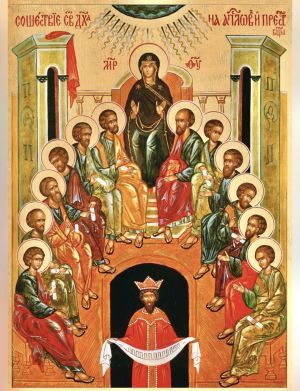
Pentecost Sunday (year A) [24 May 2026]
First Reading from the Acts of the Apostles (2:1–11)
Jerusalem is not only the city where Jesus instituted the Eucharist, but the city where he rose from the dead and where the Spirit was poured out upon humanity. In Christ’s time, the Jewish feast of Pentecost was of the utmost importance because it was the feast of the giving of the Law, one of the three annual feasts for which people made a pilgrimage to Jerusalem. The list of all the nationalities gathered in Jerusalem for the occasion is proof of this. Jerusalem was therefore teeming with people from all over, thousands of devout Jews, some of whom had travelled from far away. It was the year of Jesus’ death, but who among them knew this? I have deliberately said ‘the death’ of Jesus, without mentioning his resurrection, because for the time being his resurrection was still confidential news. These were people who had come from all over and who had perhaps never even heard of a certain Jesus of Nazareth.
They came to Jerusalem in the fervour, faith and enthusiasm of a pilgrimage to renew the Covenant with God. For the disciples, however, this feast of Pentecost, fifty days after his resurrection, is unlike any other, for to them nothing is as it was before; yet this does not mean they expect what is about to happen. To help us understand clearly what is happening, Luke recounts it by carefully evoking three passages from the Old Testament: first, the giving of the Law at Sinai; second, a word from the prophet Joel; third, the episode of the Tower of Babel. First, let us begin with Sinai: the tongues of fire at Pentecost, the sound ‘like a mighty wind’, bring to mind what had happened at Sinai, when God gave the tablets of the Law to Moses, as we read in the Book of Exodus (19:16–19). By drawing a parallel with the event at Sinai, Saint Luke wants us to understand that this Pentecost, that year, is much more than a traditional pilgrimage: it is a new Sinai. Just as God had given his Law to his people to teach them how to live within the Covenant, so now God gives his own Spirit to his people. Now God’s Law, which is the only means of living truly free and happy, is no longer written on tablets of stone but on tablets of flesh, in the heart of man, to borrow an image from Ezekiel. Secondly, Luke wished to evoke a word of the prophet Joel: “I will pour out my Spirit upon all flesh” (3:1–2), says God; “all flesh” meaning every human being. In Luke’s view, these Jews from every nation under heaven, as he calls them, symbolise the whole of humanity for whom Joel’s prophecy is finally fulfilled. This means that the famous, long-awaited “Day of the Lord” has arrived. Thirdly, we can summarise the story of Babel in two acts: Act 1, all people spoke the same language: they had the same speech and the same words, and they decided to undertake a great project that would mobilise all their energies: the construction of an immense tower. Act 2: God intervenes to put a stop to it: He scatters them across the face of the earth and confuses their languages. From then on, people will no longer understand one another. Unless one wishes to judge God’s intentions, it is impossible to imagine that he acted for any reason other than our happiness. Therefore, if God intervenes, it is to spare humanity a false path: the path of a single mindset, of a single project; something like ‘my children, you seek unity, and that is good; but do not go astray: unity does not lie in uniformity. True unity in love can only be found in diversity’. The account of Pentecost in Luke fits well within the narrative of Babel: at Babel, humanity learns diversity; at Pentecost, it learns unity in diversity: now all the nations under heaven hear the one message proclaimed in their various languages: the wonders of God.
Note: The first reading and the psalm are common to the feasts of Pentecost across the three liturgical years. However, the second reading and the Gospel vary each year.
Responsorial Psalm (103/104)
Read in its entirety, this psalm offers thirty-six verses of pure praise, of wonder at the works of God. It is not surprising that it is proposed to us for the feast of Pentecost, given that Luke, in the Acts of the Apostles, recounts that on the morning of Pentecost the Apostles, filled with the Holy Spirit, began to proclaim the wonders of God in every language. One might observe that to marvel at creation there is no need to have faith, and in every civilisation one finds magnificent poems on the beauties of nature. In Egypt, on the tomb of a Pharaoh, a poem written by the famous Pharaoh Akhenaten was discovered: a hymn to the Sun-God. Amenhotep IV lived around 1350 BC, at a time when the Jews were probably in Egypt and would have known this poem. There are similarities in style and vocabulary between the Pharaoh’s poem and Psalm 103/104. The language of wonder is the same across all latitudes, but what is interesting are the differences, which are the hallmark of the Revelation given to the people of the Covenant. The first difference, and it is essential to the faith of Israel, is that God alone is God; there is no other God but him; and therefore the sun is not a god. The Bible puts the sun and the moon in their place: they are not gods but merely luminaries, creatures themselves: one of the verses of the psalm states this clearly: “You, God, have made the moon to mark the seasons and the sun that knows the hour of its setting.” There are verses not chosen for the feast of Pentecost which clearly present God as the sole Lord of Creation, and a wholly regal vocabulary is used: God is presented as a magnificent, majestic and victorious King. A second distinctive feature of the Bible: creation is only good, and one hears an echo of the poem in Genesis which repeats tirelessly, like a refrain, “And God saw that it was good!”. Psalm 103/104 evokes all the elements of creation with the same wonder: I rejoice in the Lord, and the psalmist adds, in a verse we do not hear this Sunday: “I will sing to the Lord as long as I live, I will sing hymns to my God as long as I exist…” Yet evil is not ignored: the end of the psalm clearly evokes it and hopes for its disappearance; but the people of the Old Testament had understood that evil is not God’s doing, for the whole of creation is good. And we know that one day God will remove all evil from the earth: the King who triumphs over the elements will overcome everything that stands in the way of human happiness. A third distinctive feature of the faith of Israel: creation is an enduring relationship between the Creator and his creatures. When we say in the Creed, “I believe in God the Almighty, Creator of heaven and earth”, we are not merely affirming our faith in an initial act of God, but we acknowledge ourselves to be in a relationship of dependence on him, and the psalm expresses this very well: “All wait for you… Hide your face: they fail; take away their breath: they die and return to their dust. Send forth your Spirit, they are created, and you renew the face of the earth.” Another distinctive feature of the faith of Israel is that at the summit of creation stands man, created to be the king of creation, filled with the very breath of God. And this is what we celebrate at Pentecost: the Spirit of God within us vibrates in his presence, and the psalmist sings, “Let the Lord rejoice in his works… I will rejoice in the Lord.” Finally, and this is very important, in Israel every reflection on creation is set within the perspective of the Covenant: having experienced God’s work of liberation, they meditated on creation in the light of this experience, and in this psalm we find traces of this: first of all, the name of God used here is the famous four-letter name, YHWH, which we translate as Lord, the revelation of the God of the Covenant.
Furthermore, “Lord, my God, how great you are!” The expression “my God” with the possessive is always a reference to the Covenant, since God’s plan in this Covenant was precisely stated in the formula “You shall be my people and I shall be your God”. This promise is fulfilled in the gift of the Spirit “to every person”, as the prophet Joel says. Now, every person is invited to receive the gift of the Spirit to truly become a child of God.
Second Reading from the First Letter of Saint Paul to the Corinthians (12:3b-7, 12-13)
Paul defines the Church as the place where “to each is given a manifestation of the Spirit for the common good”, not therefore for our own vanity, but for the good of all. And it is a free gift for all, just as the members of the body are freely at the service of the whole body. The work of the Spirit in the world resembles an immense mosaic with different pieces held together and united by the invisible action of the Spirit. As communities multiply, the mosaic spreads like wildfire and becomes ever more harmonious. In these communities, Jews and Gentiles, slaves and free men, break down the barriers of prejudice and division, recognising one another as brothers and sisters, members of a single body thanks to the one Baptism that incorporates us all into Christ. Paul certainly had good reasons to insist on unity, for the Christians in Corinth were of such diverse origins—Jews or Gentiles with conflicting sensitivities and religious traditions—and at times the early believers found it difficult to accept the newcomers. To place Jews and pagans on the same religious footing, given the weight that the election of Israel must have carried in Paul’s eyes, was nonetheless very bold! These issues and difficulties, present and highlighted by Paul in the Corinthian community, have not been absent over the centuries and persist even today within the Church. The law that animates believers is always the word of Jesus, who urged the apostles: “You know that the rulers of the nations lord it over them, and the great ones exercise authority over them. It shall not be so among you.” (Mt 20:25–26). Paul sees the Church not as a pyramid, but as a crowd gathered around Jesus Christ, the one Master, and, furthermore, as a living body made up of all the baptised, where those in authority do not view it as superiority, but as a mission in the service of all. Diversity becomes a mutual gift for everyone: “There are different charisms,” observes the Apostle, “and to each is given a manifestation of the Spirit for the common good.” Our differences thus become riches, and it is precisely through them that unity is built—a unity that is never uniformity, or worse, standardisation. Herein lies one of the great messages of Pentecost, where all the different languages come together to sing the same song, “the wonders of God”. Since then, the Church has sought to overcome differences in sensibility by learning to live through the labour of reconciliation, sustained by the Spirit given to us at Pentecost, the Spirit of love, forgiveness and reconciliation. The capacity for reconciliation and mutual respect is a true sign of the Spirit’s action and a witness that the world awaits: “By this everyone will know that you are my disciples: if you have love for one another,” said Jesus at the Last Supper (Jn 13:35). Unity in diversity is a beautiful challenge that we can overcome only because the Spirit has been given to us: the same Spirit, the Spirit of Love that unites the Father and the Son. From the lesson of Babel we understand that unity does not lie in uniformity, and from Pentecost we understand that true unity in love can only be found in diversity and is always a gift of the Spirit and an image on earth of the Trinitarian communion, the perichoresis between the Father, the Son and the Holy Spirit.
From the Gospel according to John (20:19–23)
To impart the Holy Spirit to his disciples, Jesus breathes on them; this brings to mind the famous phrase from the Book of Genesis, chapter 2: ‘The Lord God breathed into the man’s nostrils the breath of life, and the man became a living being’. And Psalm 103/104, which we also hear on this feast of Pentecost, comments on the text of Creation by singing: Send forth your Spirit, and all things shall be created. Now, it is the evening of Easter and Jesus takes up this gesture of the Creator. We can understand why Saint John notes: “It was the evening of that day, the first of the week”, a way of saying that it is the first day of the new creation. The Jews often recalled the creation that God had accomplished in seven days, as we read in the first chapter of Genesis, and awaited the eighth day, that of the Messiah. In his own way, John tells us: the eighth day has come and it is a true re-creation of humanity. Let us take up three phrases from the account of Pentecost that John offers us here. The first: “As the Father has sent me, so I send you”; the second: “He breathed on them and said: Receive the Holy Spirit”; and the third: “Whose sins you forgive are forgiven them”. The first and third phrases express a mission; the second speaks of the gift, namely the Holy Spirit given to fulfil the mission received. And this mission consists in “forgiving sins”. “As the Father has sent me, so I send you”. Jesus is the one sent by the Father, and we, who are sent by Jesus, have the same mission as him. This speaks to our responsibility, the trust placed in us, and concerns all the baptised, since the Church has always deemed it appropriate to confirm all the baptised. Jesus’ mission, to limit ourselves to the Gospel of John, is to take away the sin of the world, indeed to “eradicate” the sin of the world, being the Lamb of God, the one who takes away the sin of the world, as John the Baptist had prophesied. The Lamb, meek and humble of heart in the face of his executioners according to the prophecy of Isaiah 52–53, is the Paschal Lamb, who seals with his life the liberation of God’s people. Beyond the liberation of the chosen people from slavery in Egypt, the Gospel speaks to us of liberation from sin, hatred and violence. Jesus thus presents his mission: “God so loved the world that he gave his only Son, so that everyone who believes in him might not perish but might have eternal life.” We must keep these words of the Lord in mind to understand the phrase in today’s text that is not immediately clear: “Whose sins you forgive, they are forgiven; whose sins you do not forgive, they are not forgiven.” Or, according to another version, “Whose sins you remit, they are remitted; whose sins you do not remit, they are not remitted.” The first part of the sentence presents no difficulty, but the second may not be easily understood. It is impossible to think that God, who is Father, could fail to forgive us. The Old Testament had already highlighted that God’s forgiveness even precedes our repentance, for in God forgiveness is not a one-off act but defines his very being. God is gift and forgiveness. The hallmark of mercy is God’s bending down towards the wretched—that is, towards all of us. The power given to the disciples—indeed, the mission entrusted to them—is to communicate and pass on God’s forgiveness. Consequently, there is the terrible responsibility, expressed in the second part of the sentence, not merely to speak the word of God’s forgiveness, but to do everything possible so that the world does not ignore this forgiveness and thus fall prey to despair. God’s forgiveness, proclaimed through words and concrete actions, makes us ‘living forgiveness’, apostles of Divine Mercy. At Pentecost, God breathes the words of forgiveness, and the Holy Spirit continues to breathe words and gestures of forgiveness into our spirit, making us ‘lambs of God’ with the power to overcome the spiral of hatred and violence. “I am sending you out like lambs among wolves” to respond to violence and hatred with non-violence, meekness and forgiveness, thus hastening the arrival of the day when all humanity will live immersed in love and forgiveness: it will be the triumph of Divine Mercy!
+Giovanni D’Ercole
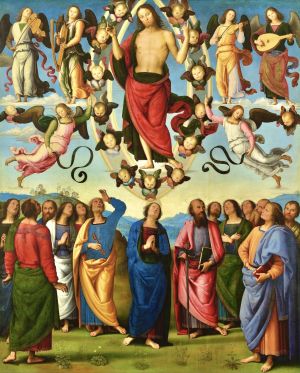
Ascension of the Lord (year A) and VII Easter Sunday [Thursday 14 May 2026]
First Reading from the Acts of the Apostles (1:1–11)
The opening verses serve as a bridge between the Acts of the Apostles and the Gospel of Luke, which is also dedicated to a certain Theophilus. One begins where the other ends, namely with the account of Jesus’ Ascension, even though the two accounts do not agree on everything. The Gospel recounts Jesus’ mission and preaching; the second is dedicated to the mission and preaching of the Apostles, hence the name “Acts of the Apostles”. The parallel can be taken further: the Gospel begins and ends in Jerusalem, the centre of the Jewish world and of the First Covenant; the Acts begin in Jerusalem, because the New Covenant is a continuation of the First, but they end in Rome, the crossroads of all the roads of the then-known world: the New Covenant now extends beyond the borders of Israel. For Luke, it is clear that this expansion is the work of the Holy Spirit. It is the very Spirit of Jesus and will be the inspiration of the Apostles from Pentecost onwards, so much so that the Acts are often called “the Gospel of the Spirit”. Just as Jesus had prepared for his mission with forty days in the desert after his Baptism, so too does he prepare the Church for forty days: “For forty days he appeared to them and spoke about the kingdom of God”. During a final meal, he gives his instructions: a command, a promise, a sending forth on mission. The command is almost surprising: to wait and not to move. “He instructed them not to leave Jerusalem, but to wait for the fulfilment of the Father’s promise.” That the Father’s promises would be fulfilled in Jerusalem certainly did not surprise the Eleven, all of whom were Jews, for the entire preaching of the prophets assigned Jerusalem a decisive role in the fulfilment of God’s plan. Luke specifies the content of the promise: “John baptised with water, but you will be baptised in the Holy Spirit in a few days’ time.” The apostles had in mind the prophecies of Joel: “I will pour out my Spirit upon all people” (Joel 3:1–2), and of Zechariah: “On that day there shall be a fountain opened for the house of David and for the inhabitants of Jerusalem, to cleanse them from sin and impurity” (Zech 13:1) and Ezekiel: “I will sprinkle clean water upon you, and you shall be cleansed… I will give you a new heart, and I will put a new spirit within you… I will put my Spirit within you” (Ezek 36:25–27).
The apostles’ question “Lord, is this the time when you will restore the kingdom to Israel?” shows that they had clearly understood that the famous Day of the Lord had dawned. Jesus’ reply should not surprise us: God calls upon human cooperation to bring about his plan, and the salvation of God, which has come through Jesus Christ, calls upon people to enter into it. For this to happen, people must know of it, and from this arises the mission and responsibility of the Apostles. The Spirit is given to them for this purpose: “You will receive power when the Holy Spirit comes upon you, and you will be my witnesses.” This means that between the gift of the Spirit and the definitive coming of the Kingdom there is an interval which is the time of witness: an interval that is all the longer the more the message is to be brought to all humanity. “You will be my witnesses in Jerusalem, throughout Judea and Samaria, and to the ends of the earth.” The Book of Acts follows this plan exactly. Just as on Easter morning “two men in dazzling robes” had torn the women away from their contemplation, saying, “Why do you seek the living among the dead? He is not here; he has risen”, so on the day of the Ascension two men in white robes do the same with the Apostles: “Men of Galilee, why do you stand gazing into the sky? This Jesus, who has been taken up from you into heaven, will come in the same way as you saw him go into heaven”. He will return, we are certain of it, and that is why we say at every Eucharist: “As we await the fulfilment of our blessed hope and the coming of our Saviour Jesus Christ”. In the Bible, the cloud is the visible sign of God’s presence, as at the crossing of the Red Sea or at the Transfiguration. The cloud that hides Jesus from human sight is the sign that he has now entered God’s realm: his physical and visible presence thus ceases to inaugurate his spiritual presence. It is impossible to reconstruct exactly what happened between Jesus’ Resurrection, on Easter night, and the day he definitively left his apostles to return to the Father. In Luke’s accounts, in both the Gospel and the Acts of the Apostles, the two narratives are very similar: Jesus’ departure takes place near Jerusalem, for the Gospel speaks of Bethany and the Acts of the Mount of Olives; in both, Luke specifies that Jesus instructs the disciples not to leave Jerusalem before they have received the Holy Spirit. The only difference concerns the timing: in the Gospel, it seems that the departure takes place on Easter evening itself; after appearing to the disciples on the road to Emmaus, they return to Jerusalem to tell the Eleven everything; and it is whilst they are talking together that Jesus appears, stays with them, and explains the Scriptures; then he leads them to Bethany and there disappears from their sight for good. In Acts, however, Luke specifies that forty days elapsed between Easter and the Ascension; and this is why we celebrate the the Ascension forty days after Easter. In the other Gospels there is almost nothing on this: in Matthew there is no account of the Ascension, but only an appearance of Jesus to two women who had gone to the tomb and then to the disciples in Galilee, during which he utters the phrase with which his Gospel concludes: “ Go therefore and make disciples of all nations, baptising them in the name of the Father and of the Son and of the Holy Spirit’ John gives a more detailed account of several appearances of the Risen One, one to Mary Magdalene and three to the disciples, the last by the Sea of Tiberias; but he does not recount the Ascension. As for Mark, he recounts the appearance to Mary Magdalene, then to two disciples who were going out into the countryside, and finally to the Eleven. Jesus sends them to preach the Gospel to the whole world, and Mark concludes by saying: “The Lord Jesus, after speaking to them, was taken up into heaven and sat at the right hand of God” . These differences between the Gospels prove that their details do not aim at historical or geographical reality: Matthew has his reasons for speaking of Galilee. Luke, on the other hand, has his own reasons for emphasising Jerusalem, because it was there that Jesus told them to wait for the gift of the Spirit, and Luke’s Gospel ends with Jesus’ final instruction: “And behold, I am sending upon you the one whom my Father has promised; but you must remain in the city until you are clothed with power from on high” (Lk 24:49).
Responsorial Psalm (46/47)
Here Israel sings and acclaims God as its king, and this is not surprising; but what is even more astonishing is that it says God is the king of the whole earth. Now, this was not always the view in Israel. Before the Babylonian Exile, none of the kings of Israel imagined that God was the Lord of the entire universe. This means that the psalm was composed late in the history of the chosen people. I shall focus on the first statement: God is the king of Israel. For a long period of biblical history, Israel had kings, like its neighbouring peoples, but its conception of kingship was unique, and this distinctiveness persisted throughout its history. In Israel, the king could never claim to be the highest authority in the land and did not hold absolute power, for God remained the sovereign. In other words, the true king in Israel was none other than God Himself. The king, for example, could not interpret the laws as he pleased and had, like everyone else, to submit to the Law of God given to Moses on Mount Sinai. According to the Book of Deuteronomy, he was required to read the entire Law every day of his life. Even whilst sitting on the throne, he was, in principle, merely an executor of God’s commands conveyed by the prophets. In the Books of Kings, in fact, we often see one king or another seeking the consent of the prophet of the day before going into battle or even, in David’s case, before undertaking the construction of the Temple. And on several occasions we see the prophets intervening freely in the lives of the kings and sometimes violently criticising their behaviour. The affirmation of God’s sovereignty was even a hindrance to the establishment of the monarchy. One recalls the very violent reaction of the prophet Samuel, in the time of the Judges, when the leaders of the tribes of Israel came to tell him that they wanted a king ‘to be like the other nations’. To desire to be ‘like the other nations’ when one had the honour of being the people chosen by God for the covenant was, in his eyes, a true blasphemy. He eventually yielded to the insistence of the tribal leaders, but not without warning them that they were bringing ruin upon themselves. And when he anointed the first king, Saul, he took care to specify that he was becoming the head of God’s inheritance. The people remained God’s people and not the king’s, and the king was but a servant of God. And throughout the monarchy in Israel, the prophets took it upon themselves to remind the kings of this fundamental truth. To the extent that the Books of Kings, when recounting the successive reigns, have but one criterion of judgement: the faithfulness of each king to God’s will. One phrase recurs constantly: ‘Such-and-such a king did what was right in the eyes of the Lord’, or conversely, ‘Such-and-such a king did what was evil in the eyes of the Lord’. It is therefore in honour of God himself that our psalm deploys here the entire vocabulary otherwise reserved for the kings of the earth. The very word ‘awesome’ is a compliment; it is a common term in courtly language and is reassuring: the enemies are warned, our king will be invincible. In every line of this psalm, it is clear that we are speaking of the God of Sinai, the Lord, who is acclaimed as God and King of the entire universe. This universal dimension is very much present in the psalm, to the point of stating that “God reigns over the pagan nations”. Now, the discovery of monotheism dates only to the Babylonian Exile: until then, the people of Israel were not yet monotheists. To be monotheists means to affirm that there is only one God, the same for the entire cosmos and humanity. Before the Exile, this was not the case: it is said that Israel was ‘monolatristic’; that is, it recognised for itself a single God, the God of the Sinai Covenant. But it believed that other peoples had their own gods. This psalm was therefore probably composed after the return from the Exile, and it was not in the throne room that these acclamations resounded, but in the rebuilt Temple of Jerusalem. Even now, the Jews already imagine the Day when God will finally be recognised for what He is, the Father of all goodness. We Christians, in turn, take up this psalm. And the phrase “God ascends amidst the acclamations” is most fitting for the celebration of the Ascension of Jesus Christ. Even though Christ’s kingship has not yet been fully realised and the evangelists do not recount any coronation ceremony for Christ. All the more reason to pay Jesus this magnificent tribute now, which merely anticipates the last day when all the children of God, finally gathered together, will sing: “All you peoples, clap your hands! Acclaim God with shouts of joy”
Second Reading from the Letter of Saint Paul the Apostle to the Ephesians (1:17–23)
The Letter to the Ephesians is divided into two parts: in chapters 1–3 there is a lengthy contemplation of God’s plan, and in chapters 4–6 an exhortation to the baptised to conform their lives to this mystery. For the feast of the the Ascension, the liturgy offers a passage from the first part in Year A and from the second part in Year B. The first part begins with a lengthy blessing formula in the Jewish style, which in our Christian liturgy we might call a ‘preface’, and it concerns God’s ‘merciful plan’ (Eph 1:3–6). The baptised already share in this mysterious plan of God which, one day, will be extended to all humanity. And Paul speaks of the privilege of us Christians who, having heard the word of truth, that is, the Gospel, have received the seal of the Holy Spirit, a pledge of our inheritance, whilst we await full redemption. We find all these terms in today’s reading, but in the form of a prayer, generally known as the ‘prayer for enlightenment’, since it takes the light of God to penetrate even a little into this mystery: “May he enlighten the eyes of your heart so that you may understand to what hope he has called you, what treasure of glory his inheritance among the saints holds…” And we know full well that the understanding of which he speaks is not a matter of reason but of the heart, a profound openness to being taught and enlightened. And Paul, as a Jew, knows full well that God’s wisdom is inaccessible to man unless God himself reveals himself to him: “May the God of our Lord Jesus Christ, the Father of glory, give you a spirit of wisdom and revelation for a deeper knowledge of him.” And what lies at the end of this knowledge towards which we are journeying? An inheritance of inestimable value, says Paul. The word “inheritance” in verse 18, and indeed in verse 14, recurs frequently in the Bible: in the Old Testament it refers to the land promised by God to the faithful. The same term is taken up in the New Testament, particularly in Paul’s letters, to denote the Kingdom and eternal life. For example: “The Spirit himself testifies with our spirit that we are children of God. And if we are children, we are also heirs: heirs of God, joint-heirs with Christ’ (Rom 8:16–17). ‘Giving thanks with joy to the Father who has qualified you to share in the inheritance of the saints in the light’ (Col 1:12). ‘ All nations are called, in Christ Jesus, to share in the same inheritance, to form the same body and to be partakers of the same promise through the Gospel” (Eph 3:8). James also develops this theme: “Has not God chosen those who are poor in the eyes of the world, who are rich in faith and heirs of the Kingdom, promised to those who love him?” (Jas 2:5) . And the Letter to the Hebrews, for its part, often takes up the theme: “God, who in times past spoke to our ancestors many times and in various ways through the prophets, has in these last days spoken to us through his Son, whom he appointed heir of all things and through whom he also made the world” (Heb 1:1–2); and a little further on: “That those who have been called may receive the eternal inheritance that was promised” (Heb 9:15) For, and this is the profound reason for Paul’s wonder, the Lord’s disciples are already associated with the triumph of their risen Master. Nothing in this world need frighten them any longer, for death has been conquered and the gates to eternal life are open. The work that God accomplishes in the hearts of believers is a true inner resurrection.
From the Gospel according to Matthew 28:16–20
Here is Jesus’ farewell discourse, after the Resurrection, in Galilee, commonly called the ‘crossroads of the Gentiles’, the ‘Galilee of the nations’, for the Apostles’ mission now concerns ‘all nations’ . The Gospel of Matthew seems to end abruptly: but in reality, the adventure is just beginning. It is like a film in which the word “THE END” appears on a road stretching out towards infinity. For it is precisely towards infinity that Jesus sends them: the immensity of the world and the infinity of the ages. “Go… Make disciples of all nations… Until the end of the world.” But were the disciples ready for such a mission? If Jesus were a business leader, he could not risk entrusting the future of his enterprise to collaborators like these, who seem not to have fully absorbed all the training he had provided over months. They are mistaken about the objective, the timing, and the nature of the enterprise. They even go so far as to doubt the reality they are experiencing, for Matthew clearly states, “some, however, doubted” (Mt 28:17). The mission entrusted to them, fraught with risks, is to promote a message that still surprises them. Folly, the wise would say; the wisdom of God, Saint Paul would reply. This is certainly no trivial undertaking: it surpasses everything the human spirit can imagine or conceive. It is a matter of communication between God and humankind. He who kindled the spark entrusts to his disciples the task of spreading the fire: “Go! Make disciples of all nations: baptise them in the name of the Father and of the Son and of the Holy Spirit”. “In the name of the Father and of the Son and of the Holy Spirit”: we do not often have the opportunity to dwell on this extraordinary formula of our faith. It is, in fact, the first formulation of the mystery of the Trinity: the expression “in the name of”, common in the Bible, signifies that there is indeed one God; at the same time, the three Persons are named and clearly distinguished: “ In the name of the Father, and of the Son, and of the Holy Spirit”. If we recall that, in the Bible, the Name is the person, and that to baptise etymologically means “to immerse”, this means that Baptism literally immerses us in the Trinity. We understand Jesus’s peremptory command to his disciples: “Go”; there is urgency. How can we not be eager to see all humanity take advantage of this offer? At the same time, it must be said that this formula, so familiar to us, was a true revolution for the generation of Christ! Proof of this is that when the apostles Peter and John healed the lame man at the Beautiful Gate, the authorities immediately asked: “By what power or in whose name have you done this?” (Acts 4:7), because it was not permitted to invoke any name other than that of God. Jesus speaks precisely of God, but his statement mentions three persons, whereas God was one; the prophets had made this clear enough. The Jews’ misunderstanding of Christ’s followers is recorded here; persecution was inevitable. Jesus knows this, and he had warned them on the last evening: “ They will expel you from the synagogues; indeed, the hour is coming when whoever kills you will think they are offering worship to God, that is, they will think they are defending God’s honour (Jn 16:2)… And Jesus added: ‘They will do this because they have not known either the Father or me’ (Jn 16:3). The mission entrusted to the apostles truly seems like madness; but they are not alone, and this must never be forgotten. Insofar as our commitment is not our own but His, we have no reason to worry about the results: “All authority in heaven and on earth has been given to me. Go!” (Mt 28:18–19). In other words, it is we who go, but it is he who has all power. It is said that a few days after his election, John XXIII received a visit from a friend: “Most Holy Father,” he said, “how heavy the task must be!” John XXIII replied: “It’s true, in the evening, when I lie down, I think: ‘Angelo, you are the Pope,’ and I struggle to fall asleep; but after a few minutes I say to myself: ‘Angelo, how stupid you are, you are not the one in charge of the Church, it is the Holy Spirit.’ Then I turn over and fall asleep!” For us too, evangelisation must be our passion, not our anguish. Jesus made it quite clear: “All authority in heaven and on earth has been given to me.” This sentence alone sums up the life of Christ: this takes place on a mountain, we do not know which one, but it evokes both the Mount of Temptation and the Mount of Transfiguration. On the Mount of Temptation, Jesus refused to receive power over creation from anyone other than the Father: “The devil took him up to a very high mountain and showed him all the kingdoms of the world and their splendour, and said to him: “All these things I will give you if you will fall down and worship me.” Then Jesus answered him, ‘Be gone, Satan! For it is written: “You shall worship the Lord your God, and him alone shall you serve”’ (cf. Mt 4:8–10). This power, which Jesus did not claim nor purchase, is given to him by the Father. And now this power is in our hands! “All authority in heaven and on earth has been given to me. Go! And Jesus adds, ‘I am with you always, even to the end of the age.’ The God of Presence revealed to Moses in the burning bush, the Emmanuel – which means ‘God with us’ – promised by Isaiah, are one in the Spirit of love that unites them. Ours is the mission to reveal to the world this loving presence of the Triune God.
Seventh Sunday in Easter (year A) [17 May 2026]
First Reading from the Acts of the Apostles (1:12–14)
The first sentence of the text sums up in a few words a crucial stage in the lives of the early Christians. For us it is the Ascension and we have made it a feast day, but, originally, was it not rather a day of mourning, a day of great departure? After the horror of Jesus’ Passion and death, after the splendour of the Resurrection, here they were, orphaned forever. But precisely for this reason they are closer to us, and their attitude can guide our own. Let us therefore look closely at their actions. Jesus had given them instructions: not to leave Jerusalem and to wait there for the gift of the Holy Spirit. Here is the account from the Acts: ‘While he was at table with them, he ordered them not to leave Jerusalem, but to wait for the fulfilment of the Father’s promise. “‘What,’ he said, ‘you have heard from me: John baptised with water, but you will be baptised in the Holy Spirit in a few days’” . And on the very day of his departure, on the Mount of Olives, he repeated: “You will receive power when the Holy Spirit comes upon you, and you will be my witnesses in Jerusalem, throughout Judea and Samaria, and to the ends of the earth.” I dwell on this expression “the power of the Spirit”, which should reassure us in every circumstance. And Luke recounts: “Having said this, whilst they were looking on, he was lifted up, and a cloud took him from their sight.” Obviously, they obeyed the Master’s command. It is therefore no surprise to find them in Jerusalem shortly afterwards; Luke notes that the Mount of Olives is very close to the city: the distance does not exceed what is known as the ‘Sabbath journey’, that is, the maximum distance one may travel without violating the Sabbath rest; it was just under a kilometre, two thousand cubits, and a cubit, as the name suggests, is the length of the forearm, about fifty centimetres. But why does Luke give this precise measurement? Are we to infer that it was the Sabbath? Or, by emphasising the proximity of the Mount of Olives, does Luke wish to suggest that everything is fulfilled in Jerusalem? It is there that God’s plan is fulfilled: there the Son was glorified, there the Covenant between God and humanity was renewed, there the Spirit will be given. It is in the holy city, therefore, that the life of the nascent Church begins; and Luke lists those who make up the group: the Eleven, some women, including Mary, the mother of Jesus, and some brothers, that is, probably disciples. Here too, the details are not merely anecdotal; we already knew the names of the apostles from Luke’s Gospel; if he gives us the list again, it is not to instruct us! Luke wishes to highlight the continuity within the community of the apostles: they are the very same who accompanied Jesus throughout his earthly life, and now they are committed to the mission. And they will be able to bear witness to the Resurrection only because they have been witnesses to the life, Passion and death of Jesus. We thus find again the group of people so different from one another whom Jesus had chosen: Peter, James, John and Andrew, fishermen on the Sea of Tiberias; Simon the Zealot—at the time of Jesus’ earthly life, this was not yet a political commitment, but it was already a sign of religious fanaticism. One wonders how he could stand alongside Matthew the tax collector, a tax collector in the pay of the occupying power and, for this reason, barred from worship! Not only did Jesus manage to bring them together around him, but they will now share the responsibility of continuing their Master’s mission. Christian tradition has identified Bartholomew with Nathanael, mentioned by Saint John, who was a specialist in the Law; if this were the case, it would have been a further point of diversity within the group of the Twelve. It is upon this community of men, so different from one another, that the proclamation of the Gospel now rests. A few brief observations: first of all, their group is not closed in on itself, but is already open to others, men and women; secondly, they begin this life of the Church in prayer, ‘devoted and of one accord’, as Luke emphasises. Perhaps the first miracle of the apostles is this praying together as one heart at the moment when the Master leaves them, and they find themselves seemingly left to their own devices and to their differences, which could have turned into divisions. In truth, they are only apparently left to their own devices: Jesus, though now invisible, is not absent. Matthew, in his Gospel, has preserved one of Jesus’ final words: “All authority in heaven and on earth has been given to me. Go therefore and make disciples of all nations, baptising them in the name of the Father and of the Son and of the Holy Spirit, teaching them to observe all that I have commanded you. And behold, I am with you always, to the end of the age.’ The apostles, therefore, do not pray for Jesus to draw near: his presence is assured; they pray to immerse themselves once more in his presence. This account from the Acts of the Apostles becomes for us a powerful lesson in hope: Jesus is with us always, his presence is assured, and the power of the Holy Spirit accompanies us!
Responsorial Psalm (26/27)
This psalm is for those going through difficult times. Believers are not exempt from life’s trials, and faith is no magic wand. Sometimes they suffer precisely because of their faith, as in religious wars or persecutions, or due to the hostility of atheists and the struggle to defend Christian values in a world that does not share them. We shall find an example of this in the Letter of Saint Peter, this Sunday’s second reading. But in their trials, believers know they are not alone, abandoned to their sad fate, for they have someone to turn to: “It is to God that my eyes weep,” said Job (Job 16:20). And they go to seek strength where it is found, that is, in God. “The Lord is my light and my salvation: whom shall I fear?” We do not know to which specific trials this psalm alludes; incidentally, it is much longer than the few verses read here, but the missing verses provide no historical details. Here and there one senses an allusion to external attacks: “The Lord is the bulwark of my life: before whom should I tremble?”. Ever since the great adventure of the Exodus, Israel has been threatened in its very existence on numerous occasions. The first verse, “The Lord is my light and my salvation”, is probably also an allusion to the Exodus under Moses’s leadership: in the Sinai desert, the pillar of cloud lit the way and signified God’s presence. Salvation, then, meant escaping from Pharaoh; in every age, salvation takes different forms, and Israel has experienced all manner of them, evoked through allusions in the psalm. To say “The Lord is the bulwark of my life” brings to mind the long period of wars, and the best bulwark is the strength that God gives us. “If you do not believe, you will not stand firm,” Isaiah said to King Ahaz (Is 7:9). Faith is the only strength that enables us to face everything: “Whom shall I fear?”. This means that God protects us from all fear and that we do not even fear Him. In all trials and sufferings, the believer knows that they can cry out to God: indeed, it is even recommended in the Bible, for groaning, weeping and praying is not cowardly, but simply human, and it is to God that we must groan, weep and pray. “Hear, O Lord, I call upon you,” says the psalm, and of one thing the chosen people are certain: that God hears our cry. Let us think of the great revelation of the Burning Bush: “The cry of the children of Israel has come to me,” God said to Moses (Ex. 3:7–9). And from that day Israel has known that God hears the cry of those who suffer. We read in the psalm: “One thing I have asked of the Lord, this alone I seek: to dwell in the house of the Lord all the days of my life”: like the Levite, admitted into the inner sanctum of the temple in Jerusalem, Israel asks for the grace to dwell in the presence of God. “Have mercy, answer me,” is a beggar’s cry and also a plea for forgiveness, for the expression that follows, “Seek my face,” is a call to conversion; for ever since settling in the Promised Land, the people have faced a new danger: that of unfaithfulness, that is, idolatry. However, when we read “Seek my face”, it is not God who thirsts for our homage and asks something of us for his own sake. God loves us, and all the commandments are for our happiness. St Augustine states: “Everything that man does for God benefits man and not God”. For God, the centre of the world is humanity, and He has no other purpose than our happiness—a happiness we find only when God is at the centre of our lives, for as St Augustine said: “You have made us for Yourself, Lord, and our hearts are restless until they rest in You.” It is interesting to compare Psalm 26/27 with the Canticle of Zechariah, which we sing every morning in the Liturgy of the Hours.
Second Reading from the First Letter of Saint Peter the Apostle (4:13–16)
In the early days of the Church, as we know from the Acts of the Apostles, the first disciples of Christ did not yet bear this name; they were called ‘Nazarenes’, because of Nazareth, and this name, used by the Jews who refused to recognise Jesus of Nazareth as the Messiah awaited by Israel, was a derogatory term. Later, when Barnabas and Paul were carrying out their mission in Antioch of Syria, it was probably pagans who had not yet converted to the Christian Church who gave Jesus’ disciples the name ‘Christians’, which means ‘of Christ, belonging to Christ’. This new title of ‘Christian’ was not an honour either. The unconverted pagans viewed with suspicion the radical change of life taking place within the community of the baptised. Shortly before, in his letter, Peter writes: ‘They find it strange that you no longer rush with them towards the same torrent of perdition, and they revile you’; ‘They slander you, treating you as evildoers’. Here, Saint Peter speaks of the sufferings—that is, the misunderstanding, the isolation, the slander—of which Jesus was a victim because he continued to proclaim his message without letting anyone stop him, with that fidelity that cost him his life. In turn, the early Christians face the same hostility, and Peter seeks to give them the courage to hold firm whilst awaiting the day when the glory of Christ will be revealed—that is, the day when Jesus will come to inaugurate his kingdom among men. Peter goes even further: not only must one not be ashamed, but on the contrary, the title of ‘Christian’ is, in his eyes, the highest dignity: “Rejoice,” he tells them, because of the name ‘Christian’, which means ‘belonging to Christ’. Furthermore, when he says: “To the extent that you share in the sufferings of Christ, rejoice…” he is speaking of the Beatitudes proclaimed by Jesus: “Blessed are you when they revile you, persecute you and, lying, say all sorts of evil against you on my account. Rejoice and be glad, for your reward in heaven is great!” . And Jesus, in saying this, was describing himself. Now Peter applies this description to those who, in turn, bear the name of Christ. He even says that “you share in the sufferings of Christ”, which means: “rejoice because you are intimately united with Christ in these sufferings you endure to remain faithful to his name and his mission. And since you are united to his sufferings, you will likewise be united to his glory on the day when the truth will burst forth.” It is clear, however, that suffering is not an end in itself, but the goal is to be united to Christ and to God in the Spirit of love, whatever the circumstances—happy or unhappy—may be in our lives. And Peter points to a way of facing persecution for the sake of Christ’s name: “To the extent that you share in the sufferings of Christ, rejoice…”. Here is a proclamation and an encouragement, for the day will come when Christ will be recognised by all, and you along with him; and on that day it will be recognised that you were not mistaken because Christ had deceived you. We therefore need the courage to persevere, for you have chosen the right path. The Book of Acts recounts that after being flogged, Peter and John “left the Sanhedrin, rejoicing that they had been counted worthy to suffer dishonour for the name of Jesus”. Peter was only able to do this after Pentecost: one must be filled with the Spirit of Jesus to have the courage to face persecution in his name and to know that mysterious joy of being in communion with him, even in suffering, that joy which no one can take from us! The Church offers us this text from Peter as we await Pentecost, a special time for rediscovering the role of the Holy Spirit in the life of our communities.
From the Gospel according to John (17:1b-11a)
These final words of Jesus: “I am coming to you” mysteriously draw us into Jesus’ prayer at the very moment he is about to reach the Father: “I am coming to you”. It is the Hour of the great passage: “Father, the hour has come”, that Hour of which he spoke many times during his earthly life, that Hour which he seemed both to desire and to fear. It is the decisive Hour, central to all human history, the Hour which all creation awaits as a birth: for it is the Hour of the fulfilment of God’s plan. From now on, nothing will ever be the same again. In this decisive Hour, the mystery of the Father will finally be revealed to the world: this is why Jesus repeatedly uses the words “glory” and “glorify”. A person’s glory, in the biblical sense, is not their fame or the recognition of others; it is their true worth. The glory of God is therefore God Himself, who reveals Himself to mankind in all the splendour of His holiness. The verb ‘to glorify’ can be replaced with ‘to reveal’. In this decisive Hour, God will be glorified, revealed in the Son, and believers will finally ‘know’ the Father; they will enter into that intimacy which unites the Son to the Father, and which the Son communicates to mankind. Those who accept this revelation and believe in Jesus will enter into this intimacy with the Father: they will enter into true life: “Eternal life is that they may know you, the one true God, and the one whom you have sent, Jesus Christ”. Here, from the very mouth of Jesus, is a definition of eternal life: Jesus speaks in the present tense and describes eternal life as the state of those who know God and Christ. We already live this life from the moment of our Baptism. Speaking of his disciples, Jesus says: “They have truly known that I came from you, and they have believed that you sent me.” At that moment, only a portion of humanity received this revelation and entered into the communion of love offered by the Father, accepting to take the path opened by the Son; and it is for these few alone that Jesus prays: “I pray for them; I do not pray for the world, but for those whom you have given me…” It is the mystery of God’s choices that is repeated: just as the Father had chosen Abraham to reveal his great plan to him, he chose certain members of Abraham’s lineage to bring the revelation of his mystery to fulfilment: “I have made your name known to the people you have given me from the world. They were yours, and you gave them to me, and they have kept your word. Now they know that everything you have given me comes from you…” . For this small chosen people, the hour has come to continue the work of revelation: “I am no longer in the world; they, however, are in the world, and I am coming to you.” Jesus passes the baton to us in a way: he has given us everything; now it is up to us to give it to others. We must let Jesus’ insistence on the word “give” resound within us: the Father has given authority to the Son… the Son will give eternal life to mankind… the Father has given mankind to the Son… the Father has given his words to the Son… and the Son has given these words to his brothers. Jesus’ emphasis on the verb ‘to give’ permeates the entire biblical meditation: our relationship with God is not a matter of calculation. It is enough for us to allow ourselves to be loved and continually filled with his grace. The word ‘grace’ means a free gift. The logic of the gift, of gratuitousness, is that of the Son who lives eternally in a dialogue of love with the Father. In the prologue to his Gospel, John says that the Son is eternally ‘turned towards the Father’ (Jn 1:18) (“No one has ever seen God; the only Son, who is in the Father’s bosom, he has made him known.” The expression “in the Father’s bosom” (from the Greek eis ton kolpon tou Patros) is interpreted as: “turned towards the Father”, “in intimate communion with the Father”, “in the Father’s intimacy”. Thus the idea that the Son is eternally “turned towards the Father” arises from this verse, even though the expression “turned towards the Father” is a theological paraphrase, not a literal quotation. And since there is no shadow between them, he reflects the Father’s glory: “Whoever has seen me has seen the Father”. Between them, everything is love, dialogue, sharing: “All that is mine is yours, and all that is yours is mine”. The Prologue of John’s Gospel is illuminated by the reading of this prayer of Jesus; it is, as it were, its transposition (Jn 1:1–18).
+Giovanni D’Ercole


THOUGHTS ON FOOD - (by Francesco Giovannozzi, psychologist and psychotherapist)
Thoughts on food
Several things prompted me to reflect on this.
One was a film broadcast by Rai 1 on 2 April 2026 (Maundy Thursday) on the subject of eating disorders. The film was called “Something Lilac.”
It is the story of a teenager who struggles with eating disorders, although the film focuses mainly on bulimia. The main eating disorders are anorexia and bulimia.
Another inspiration was seeing someone again at the centre who had suffered from these problems in the past and whom I had supported psychologically.
Finally, about a month ago, a lady I had known for years and who had long been troubled by these issues passed away. She wouldn’t listen to anyone; she ‘wasted away to the bone’.
And so, as with all my short articles, I ‘dredged up’ the theoretical knowledge I’d acquired over the years, combined with my observations of cases at work.
The issue of food is important for all living beings. If we do not eat, we do not live.
But here too, as in all situations in life, striking the right balance is not always easy.
The ideal approach is to eat without excesses that could cause metabolic disorders, and in such a way that our body functions well.
Sometimes, for various reasons, human beings alter their relationship with food. Think of the periods when people suffered from food shortages due to wars, epidemics, or other causes.
Cases of self-imposed fasting are also described in the Bible, but it was around 1600 that cases of significant weight loss due to diet began to be observed.
In contrast to the time of the ancient Romans, when they would indulge in huge feasts followed by self-induced vomiting – if I recall correctly, they would tickle their palates with a feather to induce vomiting and then start eating again.
The history of eating disorders is not a modern phenomenon, but has its roots in distant times.
In the Middle Ages, fasting was often associated with demonic possession, or conversely with mystical behaviour.
‘Mystics’ would fast to purify the body, draw as close as possible to God, and sometimes to withdraw from earthly life. Unlike the disorder seen today, the motivation was not beauty, but the aspiration to holiness.
Nowadays, distorted relationships with food are recognised as complex disorders, influenced by cultural and psychological factors.
These are serious disorders, often interlinked, and requiring treatment by various specialists. In short, anorexia involves a profound fear of gaining weight, stemming from a distorted perception of one’s own body.
Bulimia involves overeating followed by vomiting or self-induced purging – to prevent weight gain.
Such issues are more prevalent in industrialised cultures, where there is a higher standard of living and the idea of being attractive is associated with thinness.
Through the media, the idea of physical perfection has also reached less developed cultures, fostering a desire for physical attractiveness; which would not be a bad thing, were it not for the harm it causes to the body.
Nor should we overlook the influence of cultural role models; such as extremely thin models who trigger a desire to be like them – sometimes at any cost. And here I recall that years ago, there was a proposal to make figures such as the Barbie doll ‘put on weight’, to correct the image she unconsciously conveyed.
Until recently, it was mostly young people and women who were affected by such eating disorders. Lately, however, the issue has also come to affect men.
In my professional practice, I have encountered such issues. I have carried out various psychodiagnostic assessments where the main problems were eating disorders, even in very young individuals.
These were mostly female subjects, but I have also encountered a few male adolescents.
In psychotherapeutic treatment, working alongside other professionals, I have dealt with a few cases of anorexia in young girls, whilst the few cases of bulimia I have encountered were in older women.
This is in line with the theoretical principles that situate anorexia in early adolescence and bulimia in late adolescence or early adulthood.
I recall that the thin girls were always restless, worried and tormented, whilst the more ‘full-figured’ women were cheerful, sometimes even friendly. One of them was even able to joke about her considerable weight.
The progression of these conditions can vary; some are severe and can compromise general health – and there is a risk of mortality.
People with anorexia generally tend to be somewhat more stubborn; they may refuse not only food but also new experiences, and adopt a closed-off attitude; people with bulimia mainly exhibit ‘emotional volatility’, moments of anger and emptiness that they unconsciously try to fill with food.
Emotionally, these people may feel anxious, may be impulsive, and may experience shame. Anorexics are ashamed of their bodies, which they always perceive as enormous; bulimics are distressed by their lack of control, which sometimes extends beyond eating habits.
The characteristics of these issues are kept hidden for a long time. In doing so, they make it difficult to form a genuine relationship with others, with sufferers usually appearing more immature and superficial.
These people are united in an exaggerated way by a hunger for care and affection. They have an immense fear of being abandoned, and that other people might stop loving them.
But it is a question of ‘how strong this feeling is’, because everyone wants to be loved; they want to have a healthy relationship based on trust and mutual respect.
Intellectually, those with eating disorders may exhibit rigid thinking and a distorted perception of their body’s condition; in less severe cases, there remains a dissatisfaction with their physical appearance or certain parts of it.
In more severe cases, body image and how it is experienced often impairs their ability to assess reality.
Dr Francesco Giovannozzi Psychologist – Psychotherapist

ANTISOCIAL TRENDS - (by Francesco Giovannozzi, psychologist and psychotherapist)
A few days ago, I read in the newspaper about another case of a 22-year-old girl being stabbed. She was stabbed because she was listening to music at too high a volume, annoying her attacker.
Recently, several similar incidents have been reported in the media, all involving young people and all for trivial reasons. Some were for looking too long at the girl of their dreams, others for a slightly risqué compliment, etc.
Unfortunately, many young people these days attack their peers with knives they carry with them.
It should be noted that, like all objects, knives do not only have a negative value. They are used in the kitchen, for work; in the hands of a skilled chef, they become something precious.
In primitive societies, they were used to defend against animals and enemies.
Today, in the world of young people and beyond, if we think of the numerous cases of femicide where women are killed with unprecedented ferocity, it seems to be becoming a kind of status symbol.
This tool is perceived as a sign of toughness and strength, especially among young people who feel marginalised.
The episodes of violence that occur between two individuals have no valid reasons, but the spark that triggers them is a trivial, sometimes frivolous motive.
Often, the use of knives – weapons that are easy to obtain – is inherent in individuals associated with youth gangs, in order to become part of them and become affiliated. Here, it is as if this object could be a 'magic wand' against feelings of inner malaise and emotional and social disappointments. And this weapon would make us feel invincible, or perhaps just stronger.
Except for professionals, getting used to carrying a weapon with us can have repercussions on our way of being. We get used to it, and we may increasingly tend towards episodes of aggression towards others.
Leaving the house and carrying a knife with us - sooner or later, at the slightest provocation, we are tempted to use it, thus fuelling fear and increasing the likelihood of becoming a victim ourselves. In the long run, our psyche 'brings out' aspects of ourselves that may have been 'dormant' in hidden corners of our unconsciousness.
The individual ends up engaging in antisocial behaviour. And in the many goals they try to achieve, this behaviour can sometimes be harmful to themselves.
These are individuals who have a normal intellectual level, sometimes even above average.
In my experience of similar cases, referred by the Juvenile Court to the Child Neuropsychiatry Service, episodes of knife violence were associated with a low intellectual level.
These individuals often encounter failure in every initiative they take, thus increasing their sense of frustration.
They generally tend to lie and often exploit others, giving little importance to moral values.
They habitually almost never tell the truth, even when they make a promise (which they usually do not keep), showing no distress and coldly maintaining their positions.
They may be influenced by films and ancestral cultures, which can reinforce their inclination to use such weapons, without being aware of the possible consequences and the potential escalation of violence.
We 'young people of the past' were taught and passed on the ability to react constructively to the difficulties and humiliations that life inevitably brings.
Today, however, it seems that everything is owed to us, that deprivation of anything in this excess of well-being is unbearable.
And so, especially in emotionally unstable individuals, something triggers them to do harm; we are moving towards an insane, sick aggression. Not towards that 'healthy determination' that helps us overcome life's obstacles.
I have often heard from people who came before me, and perhaps also from some reading that I now cannot remember, that the most cruel beast is man. Two souls lurk in his heart: one made of sociability and a drive towards others, the other of jealousy and rivalry, of cruelty towards others.
People with these issues tend to be dishonest, to lie and deceive others, to try to exploit them, forgetting the moral principles they have learned.
These people always consider themselves 'the best'. If this is not perceived, anger rises - consciously or unconsciously.
When they cause harm, they feel no remorse and no guilt.
The line between what is legal and what is not becomes blurred. We tend to act impulsively, without considering the effect of our actions on others.
As a result, we sink lower and lower. We believe that others are only there to help us get what we want.
Often, violent or even sadistic behaviour is associated with a certain pleasure.
And here we also tend to participate in clashes with 'power'.
On a collective level, just look at the recent events in Turin, where violence is directed at law enforcement officers, those who represent the rules and seek to restore legality.
Without adhering to any ideology, I am personally convinced, leaving aside party politics, that limits must be restored from childhood. In this way, a child can grow up with a clear distinction between what is good and what is evil.
Dr Francesco Giovannozzi, Psychologist-Psychotherapist.

OBSESSION AND COMPULSION - (by Francesco Giovannozzi, psychologist and psychotherapist)
Obsession and Compulsion
A gentleman confides in me that for some time now he has felt the need to check whether he has locked the front door of his house. A lady, on the other hand, needs to be sure that she has turned off the gas in the kitchen.
After checking, both the gas and the front door were fine and in order.
Another middle-aged man feels the need to see if his car is okay, then he has to go and check it, walk around it, touch it in different places, and only after completing these behavioural sequences can he return home peacefully. Sometimes he feels the need to do this several times a day.
In the Treccani dictionary, the term 'obsession' is defined as: 'a mental representation that the will cannot eliminate, accompanied by anxiety'.
The term 'compulsion' is defined as: 'compulsion, being driven by necessity to do something'.
Many people have thoughts that they have no interest in; these are often ideas that make no sense, but which require considerable mental effort.
Without wanting to, these ideas invade our minds and make our brains 'rack' as if they were fundamental issues.
These may be thoughts or images that cause concern, and are usually followed by compulsions that the person must perform to calm their anxiety.
Between the 'fixed' idea and the need to perform some act or gesture to ensure that nothing bad happens, doubt often arises, undermining our most certain convictions.
This leads to increasing indecision, which limits our freedom of action: even simple choices take a long time to make.
Sometimes it leads us to be unable to make a decision. The doubt may concern a thought, a memory, an action, etc., and may spill over from one content to another.
A person with these problems, when leaving the house, sometimes feels compelled to return to make sure they have not left the light on, and to be sure, they sometimes have to do this several times.
In literature, there are examples of people who, after sending a letter, felt the need to reopen it to check what they had written.
In psychological contexts such as this, we also talk about 'rumination', which is always associated with doubt.
In biology, it refers to the digestive process of certain animals, such as cattle. Food that has been swallowed is brought back into the mouth to be chewed again, more thoroughly, and then swallowed again to complete digestion.
In psychology, 'rumination' describes repetitive and persistent thinking focused on past events, as opposed to 'brooding', which is more concerned with future events.
Ceremonials are also described. In these, the individual must perform a sequence of acts such as washing their hands frequently or cleaning everyday objects many times.
This is where an aspect of the psychological picture described comes into play: 'rupophobia' and contamination. Rupophobia is a morbid fear of dirt and of being infected. It can affect any aspect of our lives: objects, people or public places. It is an aspect that can also harm intimacy.
The Covid period has increased the fear of contagion, but this was a real event. Many years ago, around 1986, there was the Chernobyl phenomenon, and there we really had to be careful about what we ate because food, especially vegetables, could have been contaminated.
Anyone who has these ideas may count the cars in the car park while walking, or touch lampposts, or try to avoid cracks in the pavement, etc.
In severe cases, these people may feel that they are harming someone, so these thoughts make them 'back away'. They need to give themselves a 'shake' to try to dispel these terrifying ideas.
People with these characteristics are generally strict, concerned with details, and meticulous about rules and formalities.
However, by focusing on details, they often overlook the essentials.
How many people in their work environment feel the need to line up their objects in excessive order?
Order and control are closely interlinked, because external order can be a way of achieving internal order, which can reduce stress.
However, we are talking about excessive order. A minimum of order is necessary to avoid confusion and to be able to find our things.
Stuttering is also a speech disorder linked to this psychological condition.
The person who stutters struggles at the beginning, with the first letter or syllable, and repeats it until the word is finished.
As we know, their speech is fluent when they are alone or when they recite or sing.
Otherwise, mortified by their defect, they will tend to isolate themselves and speak as little as possible. Or they will stubbornly insist on speaking with intense physical effort.
Stuttering 'is a conflict between the erotic urethral tendency to expel and the erotic-anal tendency to retain, shifted to the mouth' (Manual of Psychiatry, Arieti, vol. I, p. 353).
Dr Francesco Giovannozzi, Psychologist-Psychotherapist.

TRAUMATIC OR PRECARIOUS EXPERIENCES. «DARKNESS»: APATHY, DEPRESSION, PSYCHOSIS, HOSTILITY - (by Francesco Giovannozzi, psychologist and psychotherapist)
A look into the «darkness».
As I have already mentioned, many poets and writers have described the flow of the human soul.
Eugenio Montale expresses this in one of his poems from 1925, on the pain of living, providing us with the image of a stream that cannot flow, a leaf crumpled by excessive heat, a horse exhausted on the ground.
These are images that linger in our minds, leaving us with food for thought and questions to ponder.
There have been moments of 'darkness' in our lives, and perhaps there will be more.
Feelings of discouragement and not knowing which path to take - each of us has experienced this first-hand.
The intensity and duration of the 'darkness' vary depending on the circumstances and our personal ability to react.
We react differently to defeat or disappointment; what upsets one person may leave another completely indifferent.
An encounter with 'darkness' can be common when faced with serious difficulties such as bereavement, loss of employment, the onset of illness, the end of a relationship, and so on.
This state of mind is temporary and ends spontaneously, without bringing about changes in a person's life.
In other cases, it is important not to underestimate this state of mind, as it could be a sign of psychosomatic or psychological distress.
In these cases, we often experience inexplicable feelings of worry and apathy, and we feel more fatigued.
Let us remember that the reaction to 'darkness' often follows a traumatic experience, which in ordinary circumstances would not have caused any temporary feelings of low mood.
A more severe and prolonged reaction, one that the individual cannot overcome on their own, is an unusual condition.
In older people, emotional shocks can trigger moments of 'darkness' more easily than in younger people.
Sometimes older people are marginalised, have fewer social relationships, and often suffer a loss of prestige, especially when they lose hope.
But even adolescents [with their precariousness] are not immune to these moments of unease.
It is not true that adolescence is a happy time of life; on the contrary, it is perhaps one of the most troubled.
In these moments of 'darkness', which clinicians call «depression», we notice that people going through this phase greatly reduce their activities, have less self-confidence, and take an interest in few things.
They are able to keep their jobs even if they have to work harder. Usually, their memory and relationship with reality are not altered - unless a serious condition («psychosis») has arisen.
Arieti describes the depression we have called 'darkness' here as a combination of sadness and pessimism.
The latter is the essential element of the combination; the unhealthy idea is to believe that what has happened to a person will always happen to them, or that their state of mind will never change.
Defeatism, the illusion of knowing what will happen to us in the future, consolidates sadness into 'darkness'.
Often the 'darkness' of the soul is discharged onto the body.
We may experience weight loss, feelings of oppression in the heart, decreased bodily secretions, insomnia, and frequent headaches.
In our behaviour towards others, 'darkness' makes us tend to exploit and influence others; it makes us unwilling to be persuaded. We find it difficult to satisfy others, and hostility often overwhelms us.
Faber Andrew wrote a poem entitled “To those who are going through their darkness”...
The poet invites the reader to «believe in poetry. In the eyes of those who have already found that road».
Then again: «There is a sky here waiting for you, with a breathtaking panorama of dreams».
For a poet, poetry is the main road, but we who are not poets have something to believe in, and that is the pillar of our reality.
Let us always remember that when the night reaches its darkest point, the dawn of a new day begins.
Francesco Giovannozzi, psychologist and psychotherapist.

AGITATION, RESTLESSNESS, WORRIES, FEAR - (by Francesco Giovannozzi, psychologist and psychotherapist)
In today's society, there are many factors that cause anxiety and restlessness, and strategies to combat them are often difficult to find.
This period is characterised by the 'shaking' of fundamental values, norms and aspirations that drove man towards fulfilment and healthy relationships with others.
The current wars around the world, the memories of them for older people, and the threat of nuclear war add to the list.
In such a hostile climate, human isolation is accentuated.
Each person has their own way of reacting: the most common is a sense of unease, anxiety, feeling in danger without knowing what the danger is; a sense of ruin, or something else.
We often fail to understand the cause of all this. People feel helpless, and if this unease is strong, it can be discharged onto the body.
Muscle stiffness may be noticed, or there may be tremors, a feeling of weakness or tiredness; even the voice may tremble.
At the cardiovascular level, palpitations, fainting, increased heart rate and increased blood pressure may occur.
Nausea, vomiting and stomach ache may also occur in the intestines, which have no organic origin.
There may also be other symptoms typical of each person's history, and there is no organ that cannot be affected by internal tension.
I remember that in my professional life I have met people with psychological problems that were 'discharged' in different parts of the body, sometimes in the most unimaginable places.
I have encountered alopecia (hair loss), locked limbs, visual disturbances, fainting, and more recently, teenagers who cut themselves...
If a person feels overwhelmed by a sudden wave of inner discomfort, they may react inappropriately or even dangerously (alcohol, drugs, speeding, gambling, etc.).
Understanding these disturbances, worries and anxieties is important in determining whether they are normal or not.
Unusual states of anxiety are distinguished from more or less persistent apprehension with acute crises.
These states are to be distinguished from the state of generalised worry that we find common in our daily lives.
Let us remember that in order to define our anxiety and agitation, we must convince ourselves that it is something normal when the individual feels threatened.
Agitation should be distinguished from fear, where the danger is real: the individual can assess the situation and choose whether to face it or flee.
When we talk about agitation in the normal sense, we mean that it is human nature to feel it when faced with danger, illness, etc.
It represents the deepest way of living our human existence.
It makes us face our limits and weaknesses, which are not manifestations of inner discomfort or illness, but expressions of human nature.
The more aware we are of our limits, the better we are able to live with our anxieties.
For our fellow human beings who feel omnipotent, agitation and anxiety are unbearable, as they bring to consciousness the limits that are a wound to their 'feeling of being a superior creature'.
We experience normal unease even when we leave an 'old road for a new one'.
From this point of view, it accompanies us in our changes, in our evolution, and in finding meaning in our lives.
Dr Francesco Giovannozzi, psychologist and psychotherapist
Mary "Girl" [...] point of convergence and arrival of a complex of divine promises, mysteriously echoed in the very heart of history (Pope John Paul II)
Maria “Bambina” […] punto di convergenza e di arrivo di un complesso di promesse divine, echeggiate misteriosamente nel cuore stesso della storia (Papa Giovanni Paolo II)
Luke’s passage puts before the eyes a double slavery: that of man «with his hand paralyzed, slave of his illness», and that of the «Pharisees, scribes, slaves of their rigid, legalistic attitudes» (Pope Francis)
Il racconto di Luca mette davanti agli occhi una duplice schiavitù: quella dell’uomo «con la mano paralizzata, schiavo della sua malattia», e quella «dei farisei, degli scribi, schiavi dei loro atteggiamenti rigidi, legalistici» (Papa Francesco)
Origen says “we should practise this symphony” (Commentary on the Gospel according to Matthew, 14,1), in other words this harmony within the Christian community [Pope Benedict]
Dice Origene che “dobbiamo esercitarci in questa sinfonia” (Commento al Vangelo di Matteo 14, 1), cioè in questa concordia all’interno della comunità cristiana [Papa Benedetto]
Thus in communion with Christ, in a faith that creates charity, the entire Law is fulfilled. We become just by entering into communion with Christ who is Love (Pope Benedict)
Così nella comunione con Cristo, nella fede che crea la carità, tutta la Legge è realizzata. Diventiamo giusti entrando in comunione con Cristo che è l'amore (Papa Benedetto)
«Francis was reproaching his brethren too harsh towards themselves, and who came to exhaustion by means of vigils, fasts, prayers and corporal penances» [FS 1470]
«Francesco muoveva rimproveri ai suoi fratelli troppo duri verso se stessi, e che arrivavano allo sfinimento a forza di veglie, digiuni, orazioni e penitenze corporali» [FF 1470]
From a human point of view, he thinks that there should be distance between the sinner and the Holy One. In truth, his very condition as a sinner requires that the Lord not distance Himself from him, in the same way that a doctor cannot distance himself from those who are sick (Pope Francis)
Da un punto di vista umano, pensa che ci debba essere distanza tra il peccatore e il Santo. In verità, proprio la sua condizione di peccatore richiede che il Signore non si allontani da lui, allo stesso modo in cui un medico non può allontanarsi da chi è malato (Papa Francesco)
The life of the Church in the Third Millennium will certainly not be lacking in new and surprising manifestations of "the feminine genius" (Pope John Paul II)
Il futuro della Chiesa nel terzo millennio non mancherà certo di registrare nuove e mirabili manifestazioni del « genio femminile » (Papa Giovanni Paolo II)
And it is not enough that you belong to the Son of God, but you must be in him, as the members are in their head. All that is in you must be incorporated into him and from him receive life and guidance (Jean Eudes)
E non basta che tu appartenga al Figlio di Dio, ma devi essere in lui, come le membra sono nel loro capo. Tutto ciò che è in te deve essere incorporato in lui e da lui ricevere vita e guida (Giovanni Eudes)
Consequently, just as for Christ carrying the cross was not an option but a mission to be embraced for love, so it is for Christians too. In our world today, where the forces that divide and destroy seem to dominate, Christ does not cease to offer to all his clear invitation [Pope Benedict]








duevie.art
don Giuseppe Nespeca
Tel. 333-1329741
Disclaimer
Questo blog non rappresenta una testata giornalistica in quanto viene aggiornato senza alcuna periodicità. Non può pertanto considerarsi un prodotto editoriale ai sensi della legge N°62 del 07/03/2001.
Le immagini sono tratte da internet, ma se il loro uso violasse diritti d'autore, lo si comunichi all'autore del blog che provvederà alla loro pronta rimozione.
L'autore dichiara di non essere responsabile dei commenti lasciati nei post. Eventuali commenti dei lettori, lesivi dell'immagine o dell'onorabilità di persone terze, il cui contenuto fosse ritenuto non idoneo alla pubblicazione verranno insindacabilmente rimossi.