


Teresa Girolami
Teresa Girolami è laureata in Materie letterarie e Teologia. Ha pubblicato vari testi, fra cui: "Pellegrinaggio del cuore" (Ed. Piemme); "I Fiammiferi di Maria - La Madre di Dio in prosa e poesia"; "Tenerezza Scalza - Natura di donna"; co-autrice di "Dialogo e Solstizio".
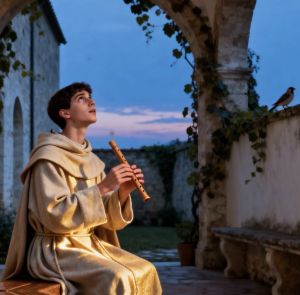
The Gospel considered today is a hymn of praise to God the Father by Jesus, in the dimension of the weakness and vulnerability of the little ones.
He had experienced the disappointment of the "great ones", suspicious of his wonders.
Instead of asking the Father for help, as Son he praises him in his dark moments.
Looking at our Poor Man, all this is evident.
Short in stature, humble in spirit and a minor by profession, Francis of Assisi made littleness his existential and spiritual mark - and he taught his brothers the same.
To be humble and minimal in the following of the Lord was the essential trait of the friar - precisely minor - who wanted to live in communion at the Portiuncula.
Addressing the great and wise of this world, the Saint found resistance in making his proposal of poverty and essentiality of life understood.
They often replied to him:
"The poverty you seek, remain for ever with you, and your children, and your descendants after you" (cf. FF 1964).
In the Sources we find again that "Blessed Francis, hearing these words, marvelled in his heart and gave thanks to God, saying:
«Be blessed, O Lord God, who has kept these things hidden from the wise and prudent and revealed them to the little ones!
Yea, O Father, for thus it pleased thee!
O Lord, Father and master of my life, do not abandon me in their gathering, nor let me fall into that shame, but by your grace grant me to find what I seek, for I am your servant and the Son of your handmaid»" (FF 1965).
Furthermore, it must be remembered that "The servant of God, Francis, small in stature, humble of spirit and a minor by profession, while he lived here on earth, chose for himself and his brothers a small portion of the world [...] and they were certainly inspired by God who, in ancient times, called the place Porziuncola, the place that fell to those who did not want to possess anything on this earth [...].
There stood in this place a church dedicated to the Virgin Mother who, by her particular humility, deserved, after her Son, to be Sovereign of all Saints.
It was here that the Order of the Minors began, and their noble edifice rose wide and harmonious, as if resting on a solid foundation.
The Saint loved this place more than any other, and commanded the friars to venerate it with special devotion.
He wanted it always to be kept as a mirror of the Order in humility and highest poverty, reserving its ownership to others and keeping its use for himself and his own only" (FF 604).
So littleness was an eloquent sign of his being a child of God.
Precisely from such a position of hiddenness, in the difficult and obscure periods of his journey of faith, Francis raised to God the Father the praise for what he was doing:
«Most High, Almighty, good Lord,
To Thee be praise, glory and honour, and every blessing [...]
Praised be You, my Lord, with all Your creatures [...]» (FF 263).
Francis composed such a masterpiece in the cruellest and most suffering moment of his life, ill and in darkness.
Yet, he raised to God an authentic hymn of praise.
Like Jesus, who at the moment of loneliness and apparent defeat, of failure, raised his voice to the Father - to bless and praise him.
The blind alley and the darkness became a source of inspiration, and of a deeper relationship with the Lord; combined with that vulnerable littleness, entrusted to the Father for his Kingdom.
Saturday 26th wk. in O.T. (Lk 10:17-24)
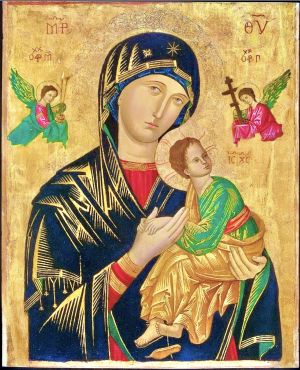
Before the disciples arguing about who was the greatest among them, Jesus educates them by placing a child before their eyes. This is the measure of their greatness.
So: acceptance and littleness are the credentials for the Kingdom.
Small in stature, but truly endowed with that littleness that makes one a child at heart.
Francis was always concerned not to scandalise the little ones that Jesus speaks of in the Gospel.
The authority of the Sources informs us:
"Often thinking of the scandal given to the little ones, he felt an immense sadness, to the point of believing that he would have died of grief, if the divine goodness had not sustained him with its comfort" (FF 1139).
Francis himself described himself as «I, small and simple, inexperienced in speaking, have received the grace of prayer more than that of preaching [...].
In prayer we speak to God, we listen to him, and we remain in the midst of the angels» (FF 1204).
Again: "Nothing else did he possess, the Poor Man of Christ, but two pennies that he could bestow with liberal charity: his body and soul" (FF 1167).
And to his brothers he taught and recommended littleness in every happy or sad affair:
"Scarcity itself was for them abundance and superabundance, while, according to the advice of the Wise One, they took pleasure not in greatness, but in the smallest things" (FF 1075).
Oh what great love he had for the Angels!
The Franciscan Sources tell us that "to the angelic spirits, who burn with a marvellous fire, which inflames the souls of the elect and makes them penetrate into God, he was united by an unbreakable bond of love [...].
For blessed Michael the Archangel, since he has the task of presenting souls to God, he nurtured special devotion and love, dictated by his fervent zeal for the salvation of souls" (FF 1166).
«Beware of despising a single one of these little ones, for I say to you that their angels in heaven ceaselessly see the face of the Father in heaven» (Mt 18:10)
Holy Guardian Angels, October 2
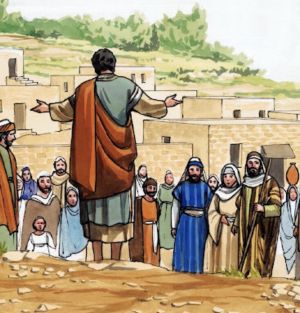
Luke emphasises Jesus' mandate to his own, highlighting how they were to be itinerants of the Gospel.
«Go! Behold, I send you as lambs among wolves. Do not carry a bag, nor a saddlebag, nor sandals, nor greet anyone on the way» (Lk 10:3-4).
After meeting the Lord, Francis considered the proclamation of the Kingdom of God as fundamental.
To all those he met he gave the greeting received by divine revelation: «May the Lord give you Peace!».
Based on Jesus' mandate to his disciples, he also sent the brothers to preach the Good News, two by two, recommending to live in strict poverty, as Jesus taught in the Gospel.
In the Sources we read:
"Francis, having completed the restoration of the church of San Damiano, continued to wear the habit of a hermit, walking with a stick in his hand, shoes on his feet, a leather belt at his hips.
But one day, as he was listening to Mass, he heard the instructions given by Christ when he sent his disciples out to preach: that they were not to carry gold, silver, bread, staff, footwear, or clothing on the road. He understood these instructions better later, having the passage explained to him by the priest.
Then, beaming with joy, he exclaimed:
«That is precisely what I long to accomplish with all my strength!».
And fixing those directives in his memory, he undertook to execute them gladly [...] He put all his enthusiasm into understanding and realising the suggestions of the new grace. Inspired by God, he began to proclaim the perfection of the Gospel, preaching penance to all, with simplicity" (FF 1427).
And he recommended the brothers not to provoke anyone to anger, but to proclaim the Kingdom with meekness:
«The Peace that you announce with your mouth, have it even more abundantly in your hearts.
Do not provoke anyone to anger or scandal, but let all be drawn to peace, goodness and concord by your gentleness [...].
This is our vocation: to heal wounds, bind up brokenness, call the lost back [...]» (FF 1469).
Francis urged his followers to live the Gospel of Christ to the letter as meek lambs among wolves.
Thursday, 26th wk. in O.T. (Lk 10,1-12)
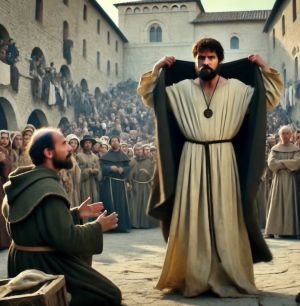
In these verses from chapter nine, the Gospel of Luke highlights the conditions necessary to follow Jesus and His bare, poor and wandering life.
«Foxes have dens and birds of the air have nests, but the Son of Man has nowhere to lay his head» (Lk 9:58).
Francis, a true lover and imitator of Him, followed in His footsteps, living his life of faith in poverty and precariousness, because he understood clearly that following Him in His call meant abandoning everything else.
The Sources recount that the Minims, in their Letter to the whole Order, expressed themselves thus:
«Brother Francis, a man of little account and frailty, your little servant, wishes you health in Him who redeemed us and washed us in His most precious blood.
Hearing his name, adore him with fear and reverence, prostrate on the ground: Lord Jesus Christ, Son of the Most High is his name, blessed for ever and ever» (FF 215).
The Poverello always presented Jesus as the One who had nowhere to settle; in fact, the Son of God showed the precarious nature of his life in every circumstance.
Enamoured with poverty, Francis addressed his friars with the words of Luke 9:58:
"[Thus] he taught the friars to build poor little houses [...] to live in them not as their own homes, but as in the homes of others, as pilgrims and strangers.
He said that the code of pilgrims is this:
«Gather under the roof of others, feel thirst for your homeland, pass away in peace»" (FF1120).
And since he repeated that those who do his works are children of God, the Poor Man of Assisi distinguished himself as a child, and in the Spirit he performed many healings.
"People of all ages and both sexes ran to see and listen to this new man, given by heaven to the world.
He travelled through various regions, fervently proclaiming the Gospel, and the Lord cooperated, confirming the Word with the miracles that accompanied him.
In fact, in the name of the Lord, Francis, preacher of the truth, cast out demons, healed the sick, and, even more amazingly, with the power of his words, he softened and moved the stubborn to repentance and, at the same time, restored health to bodies and hearts" (FF 1212).
Clare herself, in her Letters to Blessed Agnes of Prague, takes up the theme of the precarious dimension of Christ and therefore of discipleship.
«O blessed poverty! To those who love and embrace you, you procure eternal riches...
O pious poverty! The Lord Jesus Christ, in whose power were and are heaven and earth, since a mere nod of his word was enough and all things were created, deigned to embrace you in preference to all other things. For he said:
Foxes have their dens, birds of the sky have their nests, but the Son of Man, that is, Christ, has nowhere to lay his head, and when he laid it on his chest, it was to breathe his last» (FF 2864 - First Letter).
In their radical following of Christ, the two champions of poverty had acquired the freedom to be influenced by nothing but Christ.
Wednesday, 26th wk. in Ordinary Time (Lk 9:57-62)
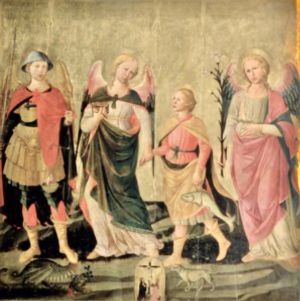
The passage from the Gospel of John introduces us to the feast of Saints Michael, Gabriel and Raphael, archangels entrusted with special missions among men.
Jesus refers to them in his conversation with Nathanael about his divinity:
«You will see heaven open and the angels of God ascending and descending on the Son of Man» (Jn 1:51b).
Francis of Assisi had a special devotion to the Angels, so much so that he chose the Church of St. Mary of the Angels, a place of singular graces, as his small portion to live in.
The Sources, testimony to the life of the Poverello and all the friars, inform us.
"He venerated the Angels with the greatest affection, who are with us on the battlefield and walk with us in the shadow of death.
«We must venerate - he said - these companions who follow us everywhere and likewise invoke them as guardians».
He taught that we must not offend their gaze, nor dare to do in their presence what we would not do in front of men.
And precisely because psalms are sung in choir before the Angels, he wanted everyone who could to gather in the oratory* and sing psalms there with devotion.
He often repeated that Blessed Michael should be honoured in a more solemn manner because he has the task of presenting souls to God.
Therefore, in honour of St. Michael, between the feast of the Assumption and his own feast day, he fasted with the utmost devotion for forty days. And he said:
«Everyone should offer God a tribute of praise or some other special gift in honour of such a glorious prince»" (FF 785).
And, regarding the Porziuncola:
"There he often enjoyed the visit of Angels, as the name of the church itself seemed to indicate, called since ancient times Santa Maria degli Angeli.
Therefore, he chose it as his residence because of his veneration for the Angels and his special love for the Mother of Christ.
The Saint loved this place more than any other place in the world. Here, in fact, he experienced the humility of his beginnings; here he progressed in virtue; here he happily reached his goal.
At the time of his death, he recommended this place to the friars as the place most dear to the Virgin" (FF 1048).
We can believe him, because Francis was an «Israelite in whom there is no deceit».
• Oratory = a place reserved for the prayer of religious or the choir of the church.
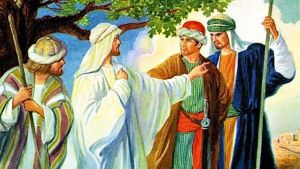
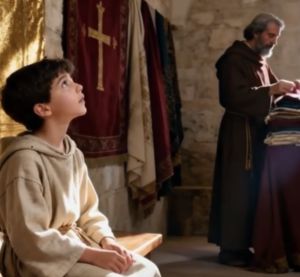
Before the disciples arguing about who was the greatest among them, Jesus educates them by placing before their eyes a child. This is the measure of their greatness.
So: acceptance and littleness are the credentials for the Kingdom set out in this Gospel passage. Let us look at these themes in the Sources.
Of a refined mind, who described himself as simple and idiotic, Francis understood very well the logic of the Gospel: let the one who wants to be great be the smallest, in the same way as a child, considered in times past to be of no value; minimal.
He endeavoured to make his brothers understand all this, more with deeds than words.
Nevertheless, in his "Letter to the Rulers of the Peoples" he writes:
«To all the podestas and consuls, magistrates and rulers of every part of the world [...] to whom this letter will reach, Brother Francis, your servant in the Lord God, small and contemptible, wishes you all health and peace» (FF 210).
Furthermore, we read in the Sources:
"The servant of God, Francis, small in stature, humble of spirit and a minor by profession, while living here on earth, chose for himself and his brothers a small portion of the world: otherwise, without using anything of this world, he would not have been able to serve Christ.
And they were certainly inspired by God who, in ancient times, called Porziuncola the place that fell to the lot of those who wanted absolutely nothing on this earth.
There stood in this place a church dedicated to the Virgin Mother, who, by her particular humility, deserved, after her Son, to be Sovereign of all Saints.
It was here that the Order of the Minors began, and their noble building rose up spacious and harmonious, as if resting on a solid foundation.
The Saint loved this place more than any other and commanded his friars to venerate it with special devotion.
He wanted it always to be kept as a mirror of the Order in humility and the highest poverty, reserving its ownership to others and keeping its use for himself and his own only" (FF 604).
And to his beloved brothers he repeated:
«We have promised great things, greater things are promised to us; let us observe those and aspire to them.
Pleasure is brief, punishment eternal; suffering small, glory infinite» (FF 778).
«The smallest among you is great [...] he who is not against you is for you» (Lk 9:48b.50b)
Monday of the 26th wk. in O.T. (Lk 9,46-50)
Jesus calls us to do the Father’s will through the parable of the two sons called to work in his vineyard.
The risk is that tax collectors and sinners will take precedence in the Kingdom of God, because, having repented, they are in fact doing his will, unlike those who say but do not do.
Thus Francis, a true lover and imitator of Him, sees in his own life and in that of his friars the first fruits of the Kingdom of God drawing near, in the face of events that speak the language of the Creator Himself.
In the Sources we find passages that point to the signs of the believer’s maturation:
«We are spouses when the faithful soul is united to our Lord Jesus Christ by the power of the Holy Spirit.
We are his brothers when we do the will of the Father who is in heaven.
We are mothers when we carry him in our hearts and bodies through divine love and a pure and sincere conscience; we bring him forth through holy works, which must shine forth to others as an example» (FF 168/2. Letter to the Faithful).
Likewise, Francis saw in his illness and death the coming Kingdom of God and his journey in accordance with God’s will.
As he neared death, he raised his head and addressed his brothers thus:
“Then the Saint raised his hands to Heaven, glorifying his Christ, for he could go to Him without hindrance of any kind.
But to show that in everything he was a perfect imitator of Christ his God, he loved his friars and sons—whom he had loved from the very beginning—right to the end […]
Then, whilst all the friars were gathered round him, he stretched out his right hand over them and placed it on the head of each one, beginning with his vicar:
«Farewell - he said - all you, my sons; live in the fear of the Lord and remain in it always!
And since the hour of trial and tribulation is drawing near, blessed are those who persevere in what they have undertaken!
For I am hastening towards God and entrust you all to His grace».
And he blessed not only those present but also all the friars, wherever they might be in the world, and all those who would come after them until the end of time” (FF 806).
26th Sunday in Ordinary Time, year A (Mt 21:28–32)
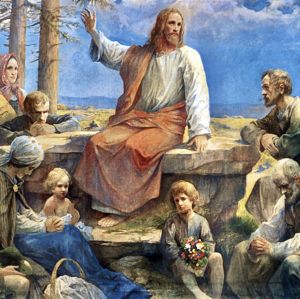
The Gospel of Luke speaks today of the second announcement of the Passion of Jesus.
He sought to prepare the disciples for the consummation of his Paschal Mystery, but they struggled to understand, they did not grasp the meaning of what the Lord was expressing.
Just as Jesus is faced with the disciples' incomprehension before the mystery of his death, so Francis has before him, at the end of his life, the bewilderment of his brothers.
In the Sources:
"He summoned all the brothers present in the house, and seeking to soothe the grief they showed at his death, he exhorted them with fatherly affection to the love of God [...].
«Farewell - he said - all you my sons, live in the fear of the Lord and keep yourselves in it always!
And since the hour of trial and tribulation draws near, blessed are those who persevere in what they have undertaken!
For I hasten to God and commend you all to his grace».
And he also blessed all the brothers, wherever they were in the world, and those who would come after them until the end of the ages" (FF 806).
"While the brethren shed bitter tears and lamented in despair [...] He also wanted the books of the Gospels and asked that they read to him the Gospel according to John [...]" (FF 808).
And again:
"He then turned to the doctor:
«Courage, Brother Doctor, tell me that death is imminent: for me it will be the door of life!».
And to the friars:
«When you see me reduced to the extreme, expose me naked on the earth as you saw me the day before yesterday, and after I am dead, let me lie like this for the time necessary to comfortably cover a mile».
At last his hour came, and all the mysteries of Christ having been fulfilled in him, he departed happily to God" (FF 810).
«Put these words in your ears, for the Son of Man is about to be delivered into the hands of men» (Lk 9:44)
Saturday of the 25th wk. in O.T. (Lk 9,43b-45)
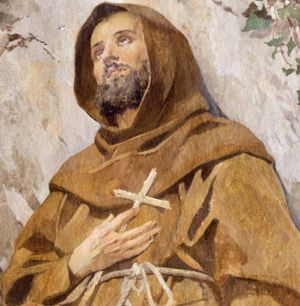
Before the people who mistake him for the Baptist or Elijah or one of the prophets,
Jesus asks his own:
«But who do you say that I am?» (Lk 9:20).
And then he reminds his disciples that the Son of Man will have to suffer much.
Francis of Assisi often spoke to his brothers of the sufferings endured by Christ, of his Passion, for which he wept much.
He testified to his faith in Jesus, the Son of God, with great fervour.
Indeed, "he taught them [...] to confess frankly the truth of the faith, as the Holy Roman Church holds and teaches it.
They observed the teachings of their holy father in all things and, as soon as they saw some church from afar, or some cross, they turned towards it, prostrating themselves humbly on the ground and praying according to the form indicated to them" (FF 1069).
The Sources teach us in this regard:
"He meditated continually on the Lord's words and never lost sight of his works.
But above all, the humility of the Incarnation and the charity of the Passion were so deeply imprinted in his memory that he could hardly think of anything else' (FF 467).
And in his writings:
"To him who suffered so much for us, who has bestowed and will bestow so much good on us in the future [...] He who alone is good, alone most high, alone omnipotent, admirable [...] worthy of praise and blessed for ever and ever. Amen" (FF 202).
Again: "The compassion of the Crucified One became fixed in his holy soul and [...] the venerable stigmata of the Passion, although not yet in the flesh, became deeply impressed in his heart [...] and he can no longer hold back his tears and weeps even aloud the passion of Christ, which is always before his eyes.
He fills the streets with groans, refusing to be consoled by the memory of Christ's wounds.
He met, one day, a close friend of his, and having manifested to him the cause of his grief, immediately he too burst into bitter tears" (FF 594).
The thought that Jesus in us had yet to suffer much tormented him, making him aware of this Mystery day and night.
Friday of the 25th wk. in O.T. (Lk 9,18-22)
There are also serious, dangerous omissions and we have to recognize with healthy realism that in this way things are not all right, it is not all right when errors are made. However, we must also be certain at the same time that if, here and there, the Church is dying because of the sins of men and women, because of their non-belief, at the same time she is reborn (Pope Benedict)
Ci sono anche cadute gravi, pericolose, e dobbiamo riconoscere con sano realismo che così non va, non va dove si fanno cose sbagliate. Ma anche essere sicuri, allo stesso tempo, che se qua e là la Chiesa muore a causa dei peccati degli uomini, a causa della loro non credenza, nello stesso tempo, nasce di nuovo (Papa Benedetto)
The question makes apparent the concern, present in ancient Jewish tradition, over finding a unifying principle in the various formulations of God's will […] Emphasis is placed on the totality of this dedication to God, listing the three faculties that define man in his deep psychological structures: heart, soul and mind. The word mind, diánoia, contains the rational element (Pope Benedict)
La domanda lascia trasparire la preoccupazione, presente nell’antica tradizione giudaica, di trovare un principio unificatore delle varie formulazioni della volontà di Dio […] L’accento è posto sulla totalità di questa dedizione a Dio, elencando le tre facoltà che definiscono l’uomo nelle sue strutture psicologiche profonde: cuore, anima e mente. Il termine mente, diánoia, contiene l’elemento razionale (Papa Benedetto)
A “year” of grace: the period of Christ’s ministry, the time of the Church before his glorious return, an interval of our life (Pope Francis)
Un “anno” di grazia: il tempo del ministero di Cristo, il tempo della Chiesa prima del suo ritorno glorioso, il tempo della nostra vita (Papa Francesco)
The Church, having before her eyes the picture of the generation to which we belong, shares the uneasiness of so many of the people of our time (Dives in Misericordia n.12)
Avendo davanti agli occhi l'immagine della generazione a cui apparteniamo, la Chiesa condivide l'inquietudine di tanti uomini contemporanei (Dives in Misericordia n.12)
Addressing this state of mind, the Church testifies to her hope, based on the conviction that evil, the mysterium iniquitatis, does not have the final word in human affairs (Pope John Paul II)
Di fronte a questi stati d'animo la Chiesa desidera testimoniare la sua speranza, basata sulla convinzione che il male, il mysterium iniquitatis, non ha l'ultima parola nelle vicende umane (Papa Giovanni Paolo II)
Jesus reminds us today that the expectation of the eternal beatitude does not relieve us of the duty to render the world more just and more liveable (Pope Francis)
Let us look at them together, not only because they are always placed next to each other in the lists of the Twelve (cf. Mt 10: 3, 4; Mk 3: 18; Lk 6: 15; Acts 1: 13), but also because there is very little information about them, apart from the fact that the New Testament Canon preserves one Letter attributed to Jude Thaddaeus [Pope Benedict]
Li consideriamo insieme, non solo perché nelle liste dei Dodici sono sempre riportati l'uno accanto all'altro (cfr Mt 10,4; Mc 3,18; Lc 6,15; At 1,13), ma anche perché le notizie che li riguardano non sono molte, a parte il fatto che il Canone neotestamentario conserva una lettera attribuita a Giuda Taddeo [Papa Benedetto]








duevie.art
don Giuseppe Nespeca
Tel. 333-1329741
Disclaimer
Questo blog non rappresenta una testata giornalistica in quanto viene aggiornato senza alcuna periodicità. Non può pertanto considerarsi un prodotto editoriale ai sensi della legge N°62 del 07/03/2001.
Le immagini sono tratte da internet, ma se il loro uso violasse diritti d'autore, lo si comunichi all'autore del blog che provvederà alla loro pronta rimozione.
L'autore dichiara di non essere responsabile dei commenti lasciati nei post. Eventuali commenti dei lettori, lesivi dell'immagine o dell'onorabilità di persone terze, il cui contenuto fosse ritenuto non idoneo alla pubblicazione verranno insindacabilmente rimossi.