Jan 30, 2026 Written by 

For his intimates and for the crowds

In today's Gospel Jesus invites his own to a deserted place, in the background. The throng of the crowd did not even allow them to eat.

But the Lord first of all feels compassion for the people who followed him, because they were like sheep without a shepherd.


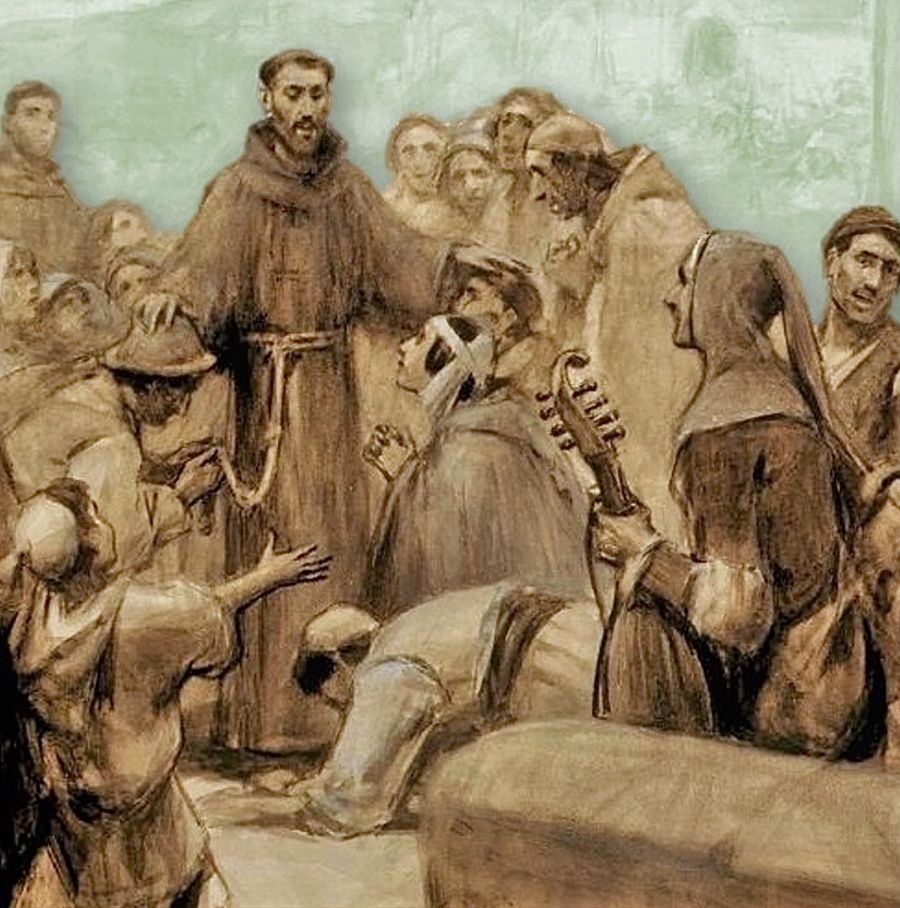
Assiduous contemplation and purity of life had made Francis powerful, by grace, even over the forces of evil, making him a credible witness to the Lord through numerous healings.

The Sources eloquently illuminate in this regard:

"People of all ages [...] ran to see and hear that new man.

He pilgrimaged through the various regions, fervently proclaiming the Gospel; and the Lord cooperated, confirming the Word with the miracles that accompanied it.

Indeed, in the name of the Lord, Francis, preacher of the truth, cast out demons, healed the sick" (FF 1212).

Once "I do not know how to qualify the horrible illness from which a brother suffered, some attributed it to the presence of an evil devil.

The poor man would often throw himself to the ground and, squinting his eyes in a horrible way, he would foam at the mouth; his limbs would now contract, now stretch, now stiff, now bent and twisted [...].

The saint Francis had immense compassion for him, went to him, blessed him, humbly praying to God, and the sick man obtained prompt and complete health and never suffered such an evil again" (FF 440).

"In Città di Castello a woman was possessed by an evil and furious spirit: as soon as the Saint [...] had obediently ordered [him to come out of her], the demon fled full of indignation, leaving the poor obsessed woman free in body and soul" (FF 1219)

Francis had married the Light, obscuring the power of evil.

The Minim had compassion on the tired and exhausted crowds that followed him and, in prayer, his constant refuge, he asked God for labourers for the abundant harvest.

He also asked his brothers to pray much for this cause.

Like Jesus, the Saint travelled through all the towns and villages, preaching the Gospel of the Kingdom and healing every sickness and every infirmity.


«And as he went out he saw many crowds and had compassion on them, for they were like sheep that have no shepherd, and he began to teach them many things» (Mk 6:34)


Saturday, 4th wk. in O.T.  (Mk 6:30-34)

53 Last modified on Friday, 30 January 2026 05:53
Teresa Girolami

Teresa Girolami è laureata in Materie letterarie e Teologia. Ha pubblicato vari testi, fra cui: "Pellegrinaggio del cuore" (Ed. Piemme); "I Fiammiferi di Maria - La Madre di Dio in prosa e poesia"; "Tenerezza Scalza - Natura di donna"; co-autrice di "Dialogo e Solstizio".

Email This email address is being protected from spambots. You need JavaScript enabled to view it.
Even after his failure even in Nazareth (vv.1-6) - his heralds gladly confused the Servant [who was educating them] with the victorious, sighed, respected and glorious Messiah…
Ancora dopo il suo fallimento persino a Nazareth (vv.1-6) - i suoi banditori hanno ben volentieri confuso il Servo [che li stava educando] col Messia vincitore, sospirato, rispettato e glorioso…
During more than 40 years of his reign, Herod Antipas had created a class of functionaries and a system of privileged people who had in their hands the government, the tax authorities, the economy, the justice, every aspect of civil and police life, and his command covered the territory extensively…
Durante più di 40 anni di regno, Erode Antipa aveva creato una classe di funzionari e un sistema di privilegiati che avevano in pugno il governo, il fisco, l’economia, la giustizia, ogni aspetto della vita civile e di polizia, e il suo comando copriva capillarmente il territorio…
Familiarity at the human level makes it difficult to go beyond this in order to be open to the divine dimension. That this son of a carpenter was the Son of God was hard for them to believe. Jesus actually takes as an example the experience of the prophets of Israel, who in their own homeland were an object of contempt, and identifies himself with them (Pope Benedict)
La familiarità sul piano umano rende difficile andare al di là e aprirsi alla dimensione divina. Che questo Figlio di un falegname sia Figlio di Dio è difficile crederlo per loro. Gesù stesso porta come esempio l’esperienza dei profeti d’Israele, che proprio nella loro patria erano stati oggetto di disprezzo, e si identifica con essi (Papa Benedetto)
These two episodes — a healing and a resurrection — share one core: faith. The message is clear, and it can be summed up in one question: do we believe that Jesus can heal us and can raise us from the dead? The entire Gospel is written in the light of this faith: Jesus is risen, He has conquered death, and by his victory we too will rise again. This faith, which for the first Christians was sure, can tarnish and become uncertain… (Pope Francis)
The ability to be amazed at things around us promotes religious experience and makes the encounter with the Lord more fruitful. On the contrary, the inability to marvel makes us indifferent and widens the gap between the journey of faith and daily life (Pope Francis)
La capacità di stupirsi delle cose che ci circondano favorisce l’esperienza religiosa e rende fecondo l’incontro con il Signore. Al contrario, l’incapacità di stupirci rende indifferenti e allarga le distanze tra il cammino di fede e la vita di ogni giorno (Papa Francesco)
An ancient hermit says: “The Beatitudes are gifts of God and we must say a great ‘thank you’ to him for them and for the rewards that derive from them, namely the Kingdom of God in the century to come and consolation here; the fullness of every good and mercy on God’s part … once we have become images of Christ on earth” (Peter of Damascus) [Pope Benedict]
Afferma un antico eremita: «Le Beatitudini sono doni di Dio, e dobbiamo rendergli grandi grazie per esse e per le ricompense che ne derivano (Pietro di Damasco) [Papa Benedetto]

Due Fuochi due Vie - Vol. 1 Due Fuochi due Vie - Vol. 2 Due Fuochi due Vie - Vol. 3 Due Fuochi due Vie - Vol. 4 Due Fuochi due Vie - Vol. 5 Dialogo e Solstizio I fiammiferi di Maria

duevie.art

don Giuseppe Nespeca

Tel. 333-1329741


Disclaimer

Questo blog non rappresenta una testata giornalistica in quanto viene aggiornato senza alcuna periodicità. Non può pertanto considerarsi un prodotto editoriale ai sensi della legge N°62 del 07/03/2001.
Le immagini sono tratte da internet, ma se il loro uso violasse diritti d'autore, lo si comunichi all'autore del blog che provvederà alla loro pronta rimozione.
L'autore dichiara di non essere responsabile dei commenti lasciati nei post. Eventuali commenti dei lettori, lesivi dell'immagine o dell'onorabilità di persone terze, il cui contenuto fosse ritenuto non idoneo alla pubblicazione verranno insindacabilmente rimossi.






