Dec 15, 2025 Written by 

Magnificat: response to the Annunciation, albeit without influence in history

1. Inspired by the Old Testament tradition, with the canticle of the Magnificat Mary celebrates the wonders wrought in her by God. The canticle is the Virgin's response to the mystery of the Annunciation: the angel had invited her to rejoice, now Mary expresses the exultation of her spirit in God the Saviour. Her joy stems from her personal experience of God's benevolent gaze upon her, a poor and uninfluenced creature in history.

With the expression Magnificat, a Latin version of a Greek word of the same meaning, the greatness of God is celebrated, who with the angel's announcement reveals his omnipotence, exceeding the expectations and hopes of the people of the Covenant and even the noblest desires of the human soul.

Before the Lord, powerful and merciful, Mary expresses the feeling of her own littleness: "My soul magnifies the Lord, and my spirit exults in God, my Saviour, because he has looked upon the humility of his handmaid" (Lk 1:47-48). The Greek term 'tapéinosis' is probably borrowed from the canticle of Anna, mother of Samuel. It indicates the "humiliation" and "misery" of a barren woman (cf. 1 Sam 1:11), who entrusts her sorrow to the Lord. With such an expression, Mary makes known her situation of poverty and her awareness of being small before God who, with a gratuitous decision, laid his gaze on her, a humble girl from Nazareth, calling her to become the Mother of the Messiah.

2. The words "henceforth all generations shall call me blessed" (Lk 1:48) start from the fact that Elizabeth first proclaimed Mary "blessed" (Lk 1:45). Not without audacity, the canticle predicts that the same proclamation will extend and expand with unstoppable dynamism. At the same time, it testifies to the special veneration for the Mother of Jesus, present in the Christian community since the first century. The Magnificat constitutes the first fruits of the various expressions of worship, transmitted from one generation to the next, with which the Church manifests its love for the Virgin of Nazareth.

3. "Great things have the Almighty done in me, and holy is his name: from generation to generation his mercy is poured out on those who fear him" (Lk 1:49-50).

What are the "great things" wrought in Mary by the Almighty? The expression recurs in the Old Testament to indicate the deliverance of the people of Israel from Egypt or Babylon. In the Magnificat, it refers to the mysterious event of Jesus' virginal conception, which took place in Nazareth after the angel's announcement.

In the Magnificat, a truly theological canticle because it reveals Mary's experience of God's face, God is not only the Almighty to whom nothing is impossible, as Gabriel had declared (cf. Lk 1:37), but also the Merciful One, capable of tenderness and faithfulness towards every human being.

4. "He has unfolded the power of his arm, he has scattered the proud in the thoughts of their hearts; he has overthrown the mighty from their thrones, he has lifted up the lowly; he has filled the hungry with good things, he has sent the rich empty-handed" (Lk 1:51-53).

With her sapiential reading of history, Mary introduces us to discover the criteria of God's mysterious action. He, reversing the world's judgements, comes to the rescue of the poor and the little ones, to the detriment of the rich and the powerful and, in a surprising way, fills the humble with goods, who entrust their existence to him (cf. John Paul II, Redemptoris Mater, 37).

These words of the canticle, while showing us in Mary a concrete and sublime model, make us realise that it is above all humility of heart that attracts God's benevolence.

5. Finally, the canticle extols the fulfilment of the promises and God's faithfulness to the chosen people: 'He has come to the rescue of Israel, his servant, remembering his mercy, as he promised our fathers, for Abraham and his descendants, for ever' (Lk 1:54-55).

Filled with divine gifts, Mary does not stop her gaze at her personal case, but understands how these gifts are a manifestation of God's mercy for all his people. In her, God fulfils his promises with superabundant faithfulness and generosity.

Inspired by the Old Testament and the spirituality of the daughter of Zion, the Magnificat surpasses the prophetic texts at its origin, revealing in the 'full of grace' the beginning of a divine intervention that goes far beyond Israel's messianic hopes: the holy mystery of the Incarnation of the Word.

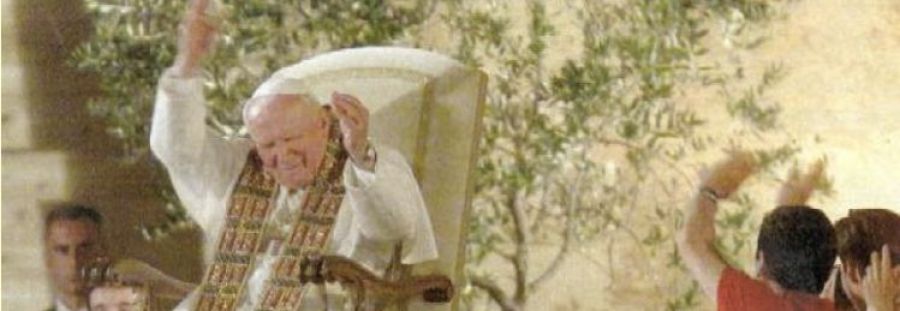
[Pope John Paul II, General Audience 6 November 1996]

54 Last modified on Monday, 15 December 2025 04:55
don Giuseppe Nespeca

Giuseppe Nespeca è architetto e sacerdote. Cultore della Sacra scrittura è autore della raccolta "Due Fuochi due Vie - Religione e Fede, Vangeli e Tao"; coautore del libro "Dialogo e Solstizio".

Email This email address is being protected from spambots. You need JavaScript enabled to view it.
The fire of God's creative and redeeming love burns sin and destroys it and takes possession of the soul, which becomes the home of the Most High! (Pope John Paul II)
Il fuoco dell’amore creatore e redentore di Dio brucia il peccato e lo distrugge e prende possesso dell’anima, che diventa abitazione dell’Altissimo! (Papa Giovanni Paolo II)
«The Spirit of the Lord is upon me, because he has anointed me to preach good news to the poor» (Lk 4:18). Every minister of God has to make his own these words spoken by Jesus in Nazareth [John Paul II]
«Lo Spirito del Signore è sopra di me; per questo mi ha consacrato con l'unzione e mi ha mandato per annunziare un lieto messaggio» (Lc 4, 18). Ogni ministro di Dio deve far sue nella propria vita queste parole pronunciate da Gesù di Nazareth [Giovanni Paolo II]
It is He himself who comes to meet us, who lowers Heaven to stretch out his hand to us and raise us to his heights [Pope Benedict]
È Lui stesso che ci viene incontro, abbassa il cielo per tenderci la mano e portarci alla sua altezza [Papa Benedetto]
As said st. Augustine: «The Word of God which is explained to you every day and in a certain sense "broken" is also daily Bread». Complete food: basic and “compote” food - historical and ideal, in actuality
Come diceva s. Agostino: «La Parola di Dio che ogni giorno viene a voi spiegata e in un certo senso “spezzata” è anch’essa Pane quotidiano». Alimento completo: cibo base e “companatico” - storico e ideale, in atto
What begins as a discovery of Jesus moves to a greater understanding and commitment through a prayerful process of questions and discernment (John Paul II)
Quel che inizia come una scoperta di Gesù conduce a una maggiore comprensione e dedizione attraverso un devoto processo di domande e discernimento (Giovanni Paolo II)
John's Prologue is certainly the key text, in which the truth about Christ's divine sonship finds its full expression (John Paul II)
Il Prologo di Giovanni è certamente il testo chiave, nel quale la verità sulla divina figliolanza di Cristo trova la sua piena espressione (Giovanni Paolo II)
Innocence prepares, invokes, hastens Peace. But are these things of so much value and so precious? The answer is immediate, explicit: they are very precious gifts (Pope Paul VI)
L’innocenza prepara, invoca, affretta la Pace. Ma si tratta di cose di tanto valore e così preziose? La risposta è immediata, esplicita: sono doni preziosissimi (Papa Paolo VI)
We will not find a wall, no. We will find a way out […] Let us not fear the Lord (Pope Francis)
Non troveremo un muro, no, troveremo un’uscita […] Non abbiamo paura del Signore (Papa Francesco)
Raw life is full of powers: «Be grateful for everything that comes, because everything was sent as a guide to the afterlife» [Gialal al-Din Rumi]
La vita grezza è colma di potenze: «Sii grato per tutto quel che arriva, perché ogni cosa è stata mandata come guida dell’aldilà» [Gialal al-Din Rumi]
It is not enough to be a pious and devoted person to become aware of the presence of Christ - to see God himself, brothers and things with the eyes of the Spirit. An uncomfortable vision, which produces conflict with those who do not want to know
Non basta essere persone pie e devote per rendersi conto della presenza di Cristo - per vedere Dio stesso, i fratelli e le cose con gli occhi dello Spirito. Visione scomoda, che produce conflitto con chi non ne vuol sapere

Due Fuochi due Vie - Vol. 1 Due Fuochi due Vie - Vol. 2 Due Fuochi due Vie - Vol. 3 Due Fuochi due Vie - Vol. 4 Due Fuochi due Vie - Vol. 5 Dialogo e Solstizio I fiammiferi di Maria

duevie.art

don Giuseppe Nespeca

Tel. 333-1329741


Disclaimer

Questo blog non rappresenta una testata giornalistica in quanto viene aggiornato senza alcuna periodicità. Non può pertanto considerarsi un prodotto editoriale ai sensi della legge N°62 del 07/03/2001.
Le immagini sono tratte da internet, ma se il loro uso violasse diritti d'autore, lo si comunichi all'autore del blog che provvederà alla loro pronta rimozione.
L'autore dichiara di non essere responsabile dei commenti lasciati nei post. Eventuali commenti dei lettori, lesivi dell'immagine o dell'onorabilità di persone terze, il cui contenuto fosse ritenuto non idoneo alla pubblicazione verranno insindacabilmente rimossi.






