


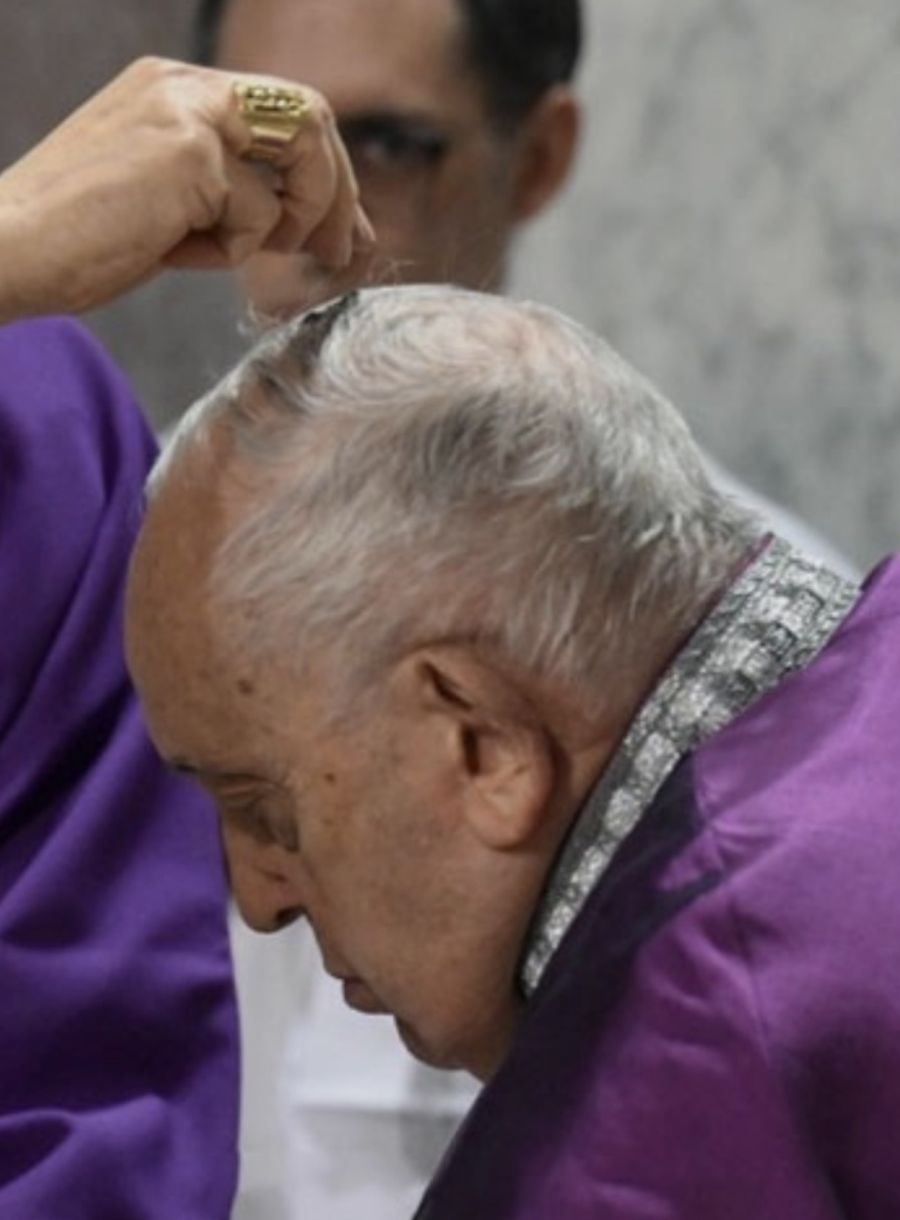
Ash Wednesday [18 February 2026]
May God bless us and the Virgin protect us! I am now sending the texts for Ash Wednesday and Wednesday those for Sunday.
*First Reading from the Book of the Prophet Joel (2:12-18)
'Return to the Lord with all your heart'. The book of the prophet Joel is one of the shortest in the Old Testament: it has only seventy-three verses, divided into four chapters, and is generally dated around 600 BC, shortly before the Exile to Babylon. Three major themes are constantly interwoven in this writing: the announcement of terrible scourges, real or symbolic; the urgent call to fasting and conversion; and finally, the proclamation of the salvation that God grants to his people. It is above all the second theme, that of conversion, which the liturgy proposes at the beginning of the Lenten journey. The invitation to conversion opens solemnly with the typical formula of the prophets: "The word of the Lord." It draws attention and asks us to take seriously what follows. And what follows is a decisive word: "Return". It is the fundamental verb of biblical penitential language. God invites his people to return to him, while the people, in turn, implore God to "return", that is, to grant forgiveness and mercy. This return to God must be expressed through fasting, tears and mourning: traditional signs of penance. However, the prophets, and Joel in particular, warn against the risk of stopping at outward appearances. For this reason, the prophet strongly affirms: "Rend your hearts and not your garments". Authentic conversion is not a matter of visible rituals, but a profound change of heart. Joel thus follows in the great prophetic tradition inaugurated by Isaiah, who denounced empty and formal worship, incapable of transforming life: God rejects solemn feasts and multiplied prayers when hands remain stained with injustice. What He asks for is a true purification of the heart and actions, the abandonment of evil and a concrete commitment to good and justice. The same message is expressed in a particularly intense way in Psalm 50/51, which defines true conversion as a "broken and humbled heart". In the light of Ezekiel, this image takes on an even deeper meaning: it is necessary for the heart of stone to be broken so that a heart of flesh may finally be born, capable of listening to God and living according to his will. When Joel calls for hearts to be torn, he means precisely this radical transformation of the human being. Conversion, in Joel's view, aims to obtain God's forgiveness and avert deserved punishment. The prophet reminds us that the Lord is 'tender and merciful, slow to anger and rich in love' and leaves open a hope: perhaps God will retrace his steps, renounce punishment and save his people from humiliation before the nations. But the final announcement exceeds all expectations: forgiveness is not only possible, it has already been granted. The liturgical translation speaks of a God who is 'moved' by his people, but the Hebrew text is even stronger: 'The Lord burns with zeal for his land and has compassion on his people'. This is not a cold or distant pity, but a passionate and faithful love. It remains to be discovered in biblical revelation that this mercy is not reserved for Israel alone. The book of Jonah shows this in a surprising way, recounting the conversion of Nineveh, the pagan city: faced with the fasting and change of life of its inhabitants, God renounces the punishment he had announced. The message is clear: the Lord "burns with zeal" for all people, even those who seem distant or unworthy.
This truth will find its definitive expression in the New Testament, when St Paul affirms that God has manifested his love in a radical way: Christ died for us while we were still sinners (Rom 5:8).
*Responsorial Psalm (50/51)
"Have mercy on me, O God, in your love; in your great mercy blot out my guilt. Wash me clean of my guilt, purify me from my sin." The people of Israel are gathered in the Temple in Jerusalem for a great penitential celebration. They recognise themselves as sinners, but they also know God's inexhaustible mercy. And, after all, if they gather to ask for forgiveness, it is precisely because they know in advance that forgiveness has already been granted. This was the great discovery of King David, who had brought his beautiful neighbour Bathsheba (the wife of an officer, Uriah, who was at war at the time) to his palace and slept with her, and she became pregnant. Some time later, Bathsheba let David know that she was expecting his child. At that point, David arranged for the death of her betrayed husband on the battlefield, so that he could definitively take possession of the woman and the child she was carrying. Now, and this is where God's unexpectedness comes in, when the prophet Nathan went to David, he did not first try to extract a confession of repentance from him; instead, he began by reminding him of all the gifts he had received from God and announcing his forgiveness, even before David had had time to make the slightest admission of guilt (cf. 2 Sam 12). In essence, he said to him, 'Look at all that God has given you... and know that he is ready to give you anything else you want!'. Israel has always been able to verify that God is truly a merciful and compassionate Lord, slow to anger, rich in faithful love, according to the revelation made to Moses in the desert (Ex 34:6). The prophets also reiterated this message, and the verses of the psalm we have heard are imbued with the discoveries of Isaiah and Ezekiel. Isaiah, for example, has God say: "I, even I, am he who blots out your transgressions for my own sake, and I will not remember your sins" (Isaiah 43:25). The proclamation of God's gratuitous forgiveness sometimes surprises us: it seems too good to be true; to some it even seems unfair. If everything is forgivable, what is the point of making an effort? It is to forget too quickly that all of us, without exception, need God's mercy: so let us not complain about it! And let us not be surprised if God surprises us, because, as Isaiah says, "God's thoughts are not our thoughts". And in forgiving, Isaiah points out, God surprises us more than anything else. Faced with the ever-renewed proclamation of God's mercy, the people of Israel recognise themselves as sinners. The confession is not detailed, as it never is in the penitential psalms, but the essential is said in this supplication: Have mercy on me, O God, in your love, in your great mercy, blot out my sin... And God, who is all mercy, expects nothing more than this simple recognition of our poverty. After all, the word 'mercy' has the same root as the word 'alms': literally, we are beggars before God. At this point, we have two things left to do.
Simply give thanks for this forgiveness that is continually given. When Israel turns to God, it always acknowledges the goodness with which He has filled it since the beginning of its history, and this shows that the most important prayer in a penitential celebration is the acknowledgement of God's gifts and forgiveness: we must begin by contemplating Him; only then, this contemplation, revealing the gap between Him and us, allows us to recognise ourselves as sinners: we confess God's love together with our sin. Then the song of gratitude will flow spontaneously from our lips when God opens our hearts. "Lord, open my lips, and my mouth shall proclaim your praise" (Psalm 50/51). Praise and thanksgiving can only arise in us if God opens our hearts and our lips. The second thing God expects of us is to forgive in turn, without delay or conditions... and that is quite a programme.
*Second reading from the second letter of St Paul to the Corinthians (5:20-6:2)
"Be reconciled to God," says Paul; but reconciliation implies that there is a quarrel: what quarrel is it? The men of the Old Testament discovered that God is not at odds with man. Psalm 102/103, for example, states: The Lord does not always contend, nor does he keep his anger forever; he does not treat us according to our sins, nor repay us according to our iniquities... Isaiah also invites the wicked to abandon their ways, the unrighteous to abandon their thoughts; return to the Lord, who will have compassion on you, to our God, who forgives abundantly (Is 55:7). And the book of Wisdom adds: 'You have mercy on all because you can do all things, and you turn away your gaze from the sins of men to lead them to repentance... You spare them all, because they are yours, Lord, who loves life... Your dominion over all makes you use clemency towards all' (Wisdom 11:23; 12:16). The men of the Bible experienced this, beginning with David. God knew that he had blood on his hands (after the killing of Uriah, Bathsheba's husband, 2 Sam 12), yet he sent the prophet Nathan to tell him in essence: "Everything you have, I have given you, and if that is not enough, I am ready to give you everything else you desire." God also knew that Solomon owed his throne to the elimination of his rivals, yet he listened to his prayer at Gibeon and granted it far beyond what the young king had dared to ask (1 Kings 3). Furthermore, God's very name — the Merciful One — means that he loves us even more when we are miserable. God, therefore, is not at odds with man; yet Paul speaks of reconciliation, because man has always been at odds with God. The text of Genesis (Genesis 2-3) attributes the accusatory phrase to the serpent: "God knows that on the day you eat of it, your eyes will be opened and you will be like gods, knowing good and evil" (Gen 3:4). In other words, man suspects that God is jealous and does not want his good. But since that voice is not natural to man (it is the serpent's), he can be healed of this suspicion. This is what Paul says: "It is God himself who calls you; we urge you in the name of Christ: be reconciled to God." And what did God do to remove this quarrel, this suspicion, from our hearts? He who knew no sin, God made him sin for us: Jesus knew no sin even for a moment, he was never at odds with the Father. Paul adds: 'He became obedient' (Phil 2:8), that is, trusting even through suffering and death. He sought to communicate to men this trust and the revelation of a God who is only love, forgiveness, and help for the little ones. Paradoxically, it was precisely for this reason that he was considered blasphemous, placed among sinners and executed as a cursed man (Deut 21:23). The darkness of men fell upon him, and God allowed it because it was the only way to make us realise how far his "zeal for his people" can go, as the prophet Joel says. Jesus suffered in the flesh the sin of men, their violence, their hatred, their rejection of a God of love. On the face of the crucified Christ, we contemplate the horror of human sin, but also God's gentleness and forgiveness. From this contemplation can come our conversion, our 'justification', as Paul says. They will look upon him whom they have pierced (cf. Zechariah 12:10; John 19:37). To discover in Jesus, who forgives his executioners, the very image of God means to enter into the reconciliation offered by God. We are left with the task of proclaiming this to the world: 'We are ambassadors for Christ', says Paul, considering himself sent on mission to his brothers and sisters. It is up to us to continue this mission, and this is probably the meaning of Paul's final quotation: "For it is written in Scripture: 'At the favourable time I answered you, on the day of salvation I helped you.'" Paul here takes up a phrase from Isaiah, who exhorted the Babylonian exiles to proclaim that the hour of God's salvation had come. In turn, Christ entrusted to the Church the task of proclaiming the forgiveness of sins to the world.
*From the Gospel according to Matthew (6:1-6, 16-18)
Here we have two short excerpts from the Sermon on the Mount, which occupies chapters 5-7 of St Matthew; the entire sermon is built around its central core, the Lord's Prayer (6:9-13), which gives meaning to everything else. The recommendations we read today are not just moral advice: they concern the very meaning of faith. All our actions are rooted in the discovery that God is Father. Thus, prayer, almsgiving and fasting become paths to bring us closer to God the Father: fasting means learning to go out of ourselves, praying means centring ourselves on God, giving alms means centring ourselves on our brothers and sisters. Three times Jesus repeats similar, almost polemical formulations: Do not be like those who flaunt their piety.... It is important to remember how significant religious manifestations were in Jewish society at the time, with the inevitable risk of attributing too much value to outward gestures; and probably even prominent figures did not escape this! Matthew sometimes reports Jesus' rebukes to those who focused more on the length of their fringes than on mercy and faithfulness (Mt 23:5f). Here, however, Jesus invites his disciples to a truth operation: If you want to live as righteous people, avoid acting in front of others to be admired. Righteousness was the great concern of believers: and if Jesus mentions the pursuit of righteousness twice in the Beatitudes, it is because that term, that thirst, was familiar to his listeners: "Blessed are those who hunger and thirst for righteousness, for they shall be satisfied" (5:6); "Blessed are those who are persecuted for righteousness' sake, for theirs is the kingdom of heaven" (5:10). True biblical justice consists in harmony with God's plan, not in the accumulation of practices, however noble they may seem. The famous phrase from Genesis — Abraham believed in the Lord, and it was credited to him as righteousness (Gen 15:6) — teaches us that justice is first and foremost righteousness, as in a musical instrument, a deep harmony with God's will.
The three practices — prayer, fasting, almsgiving — are paths to righteousness.
Prayer: let God guide us according to his plan: "Hallowed be thy name, thy kingdom come, thy will be done on earth as it is in heaven." We wait for Him to teach us the true needs of the Kingdom. Jesus precedes the teaching of the Our Father with this recommendation: "When you pray, do not do as the pagans do... your Father knows what you need before you ask him (6:7-8).
Fasting: by ceasing to pursue what we believe is necessary for our happiness, which risks absorbing us more and more, we learn freedom and recognise true priorities; Man does not live by bread alone, but by every word that comes from the mouth of God (Mt 4:4).
Almsgiving: The word almsgiving comes from the same family as eleison: to give alms means to open one's heart to mercy. God wants the good of all his children; justice, understood as harmony with Him, inevitably includes a dimension of social justice. The parable of the Last Judgement (Mt 25:31-46) confirms this: "Come, blessed of my Father... for I was hungry and you gave me food... and the righteous will enter into eternal life." The behaviours that Jesus condemns — do not be like those who show off — are the opposite: they keep man centred on himself, closing his heart to the transforming action of the Spirit.
+Giovanni D'Ercole








