


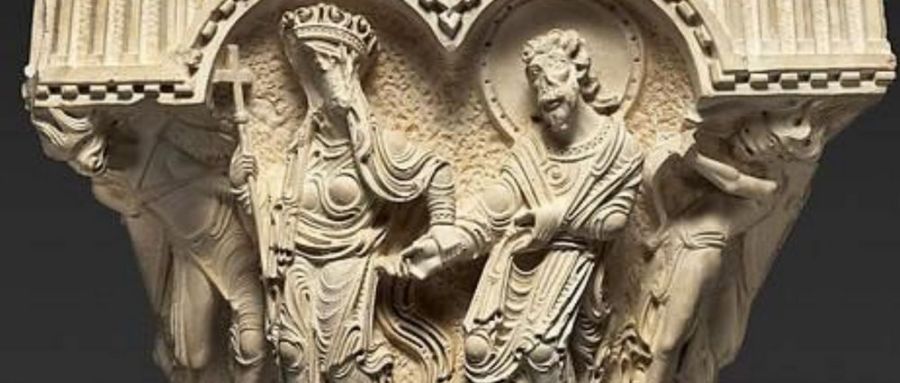
But can he participate in the rite?
(Lk 5:27-32)
"Jesus does not exclude anyone from his friendship. The good proclamation of the Gospel consists precisely in this: in the offer of God's grace to the sinner! In the figure of Matthew, therefore, the Gospels propose to us a real paradox: the one who is apparently furthest from holiness can even become a model of welcoming God's mercy and allowing us to glimpse its wonderful effects in his own existence".
[Pope Benedict, General Audience 30 August 2006].
At the time when Lk writes his Gospel (just after the mid-1980s) the community of pagan converts to Christ in Ephesus was pervaded by living temptations and marked by defections.
In addition, a question arose in the internal church debate about the kind of permissible participation in meetings, and the Breaking of Bread.
The evangelist recounts the episode of 'Levi', avoiding simply calling him Matthew - as if to accentuate his Semitic and paradoxically cultic derivation.
Thus Lk wants to describe how Jesus himself had faced the same conflict: without any ritual or sacral attention, if not to man.
In short, according to the Master, in the journey of Faith, the relationship with the distant and different, and our own hardships or hidden abysses, have something to tell us.
The Father is a friendly Presence. His initiative of saved life is for all, even for those who can do no more than look after his records.
This diminishes and overcomes the obsession with sin that religions considered an insuperable barrier to communion with God - marking life.
The Glad Tidings of that pericope is that Communion is not gratification or recognition.
The Eucharist (v.29) is not a reward for merit (v.30), nor is it a discrimination in favour of sacred or adult marginalisation.
Eating together was a sign of valuable sharing, even on a religious level. Thus, at feasts the observant avoided contact with members deemed sinful.
Instead, everyone is called and everyone can be reborn, even surpassing the pure.
So to place oneself among sinners is not a defeat, but truth. And sin itself is no longer just a deviation to be corrected.
That is why the figure of the new Master touched people's hearts: he bore the sign of Grace; communion with the lost and guilty.
But with such gestures the Son seemed to put himself in God's place (v.30).
In short, the Father catches us without fences, where we are: he does not care about social status or origin.
Among the disciples it is likely that there were quite a few members of the Palestinian resistance, who opposed the Roman occupiers.
On the other hand, here Jesus calls a collaborator, and one who allowed himself to be led by advantage.
As if to say: the New Community of sons and brothers does not cultivate privileges, separation, oppression, hatred.
The Master always kept himself above the political shocks, ideological distinctions and corrupt disputes of his time.
In his Church there is a strong sign of discontinuity with religions: prohibition must be replaced by friendship.
The apostles themselves were not called to the same strict practice of segregation and division typical of ethno-purist beliefs, which prevailed around them [and was believed to reflect God's established order on earth].
Even today, the Lord does not invite the best or the worst to follow, but the opposites. A principle that also applies to the intimate life.
The recovery of opposing sides also of our personality, disposes us "to conversion" (v.32): not to rearrange the world of the Temple, but to make us change our point of view, mentality, principles, way of being.
It is not religious perfection that makes one love the exodus.
In short, prohibition must be replaced by friendship. Intransigence must be supplanted by indulgence; harshness by condescension.
In such an adventure we are not called to forms of disassociation: we start with ourselves.
Thus we arrive without hysteria at micro-relationships - and without ideological charges, at the current even devout mentality.
No more bogus goals, superficial objectives, obsessions and useless reasoning, nor mechanical habits, ancient or others', never reworked in themselves.
With such an experience of inner excavation and identification, women and men of Faith must share life with anyone - even notorious transgressors like the publican, seeing themselves in them.
And laying down the artifices: without first demanding any license, nor long disciplines of the arcane or pious practices that celebrate detachment [such as the ablutions that preceded the meal].
In the parallel text of Matthew 9:9-13, the tax collector is explicitly called by name: Matathiah, underlining the same content and identical appeal to the assemblies of believers.
Matathiah means "man of God", "given by God"; precisely "Gift of God" (Matath-Yah) [despite the anger of the official authorities].
According to the direct teaching of Jesus himself - even to one of the apostles - the only impurity is that of not giving space to those who ask for it because they have none.
The Lord wants full communion with sinners, and for them to be treated as brothers - full members of the same Family of God - not for the sake of some feel-good platitude: it is an invitation to recognise oneself.
Not to submit ourselves to some humiliating paternalism, but because allowing ourselves to be transformed from poor or rich into lords is a resource.
"And Levi made a great banquet for him in his house; and there was a great crowd of publicans and others who were reclining [at table] with them" (Lk 5:29 Greek text).
"They were reclining": according to the manner of celebrating solemn banquets, by free men - now all free.
How marvellous, such a monstrance! A living Body of Christ that smells of concrete Union, conviviality of differences - not of artificial rejections, by transgression!
It is this all empathic and royal awareness that smoothes out and makes credible the content of the Announcement (v.31) - even though it shocks the susceptibility of the official teachers.
From now on, the division between believers and non-believers will be far more humanising than between "born again" and not, or pure and impure.
A whole other carat - the principle of a saved life that unfolds and overflows beyond the various clubs [old-fashioned or glossy as they may be].
Christ also calls, welcomes and redeems the Levi in us, that is, the more rubric - or worn-out - side of our personality.
Even our unbearable or rightly hated character: the rigid one and the - equally our - rubricist one.
By reintegrating the opposite sides, it will even make them flourish: they will become inclusive, indispensable, allied and intimately winning aspects of the future testimony, empowered with genuine love.
Being considered strong, capable of leading, observant, excellent, pristine, magnificent, performing, extraordinary, glorious, unfailing... damages people.
It puts a mask on us, makes us one-sided; it takes away understanding.
It floats the character we are sitting in, above reality.
For one's growth and blossoming, more important than always winning is to learn to accept, to surrender to the point of capitulation; to make oneself considered deficient, inadequate.
Says the Tao Tê Ching [XLV]: 'Great uprightness is like sinuousness, great skill is like ineptitude, great eloquence is like stammering'.
The contrived norm (unfortunately, sometimes even unwise leadership) makes us live according to success and external glory, obtained through compartmentalisation.
Jesus inaugurates a new kind of relationship, and 'covenants' of fruitful divergence - a New Covenant, even within ourselves.
Here, the Word alone 'Follow Me' (v.14) [not 'others'] creates everything.
Therefore, in this Lent we can put the taken-for-granted idea of purity, and memberships, in brackets.
All this in order to rely on God alone, to break down barriers, to put ourselves at the banquet of the marginalised (from the 'proper' order established on earth).
And to party.
The Master's Wisdom and the multifaceted art of Nature [just exemplified in the crystalline wisdom of the Tao] lead all to be incisive and human.
It is not perfection that makes us love exodus.
To internalise and live the message:
What is your spiritual and human strength? How was it generated?








