


don Giuseppe Nespeca
Giuseppe Nespeca è architetto e sacerdote. Cultore della Sacra scrittura è autore della raccolta "Due Fuochi due Vie - Religione e Fede, Vangeli e Tao"; coautore del libro "Dialogo e Solstizio".
End of strategic positions
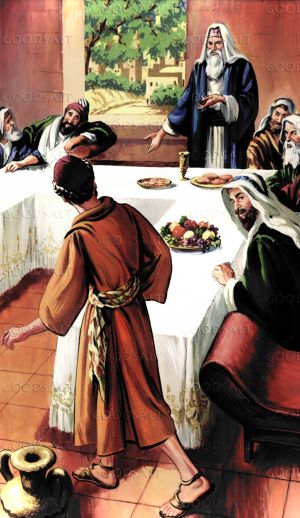
(Lk 14:1.7-14)
The Bible often presents Salvation under the image of a banquet in which God himself participates alongside man.
At the table of a "righteous" one did not sit immediately arriving: you had to stick to a strict label - because of class hierarchies absolutely to be respected.
At the center the persons of regard, then the owner; then all the others, but in order: according to social position, religious function, possessed wealth.
Clumsiness and complacency of vanity, the Lord evaluates them. Smoke volutes, strident especially in the case of the Eucharistic Banquet [v.1: «eating bread»; v.8: «wedding feast»].
And the way in which Jesus speaks at the Table is surprising: He imposes himself, reproaches, suggests.
Finally He begins to blame the one who "invited" him [vv.12-14: «this is not how you have to choose the guests...»]. The effect is lashing.
Yet his is not a lesson in etiquette, nor an exhortation to common sense; much less of opportunism.
During the breaking of the Bread, Christ is not an occasional guest, but the amphitryon, the master of the House [here already worried about the possible failure of his proposal].
The banquet of Lk 14 is precisely setting for the sacred Banquet in which everyone is simple summoned - by vocation (not by merit).
In fact, the recurring term is what some texts palely translate with "invited" while the Greek ‘kalèo’ means ‘[I] call': the «called».
Here it is necessary that notables and bystanders who willingly participate to show off immediately repent.
Not only must they stay away from grabbing, but they must also keep away from pathetic rush to occupy strategic positions.
With the image of the Eucharistic Banquet, Lk presents the world of relationships as God imagined it - reign where the Creator has «called» all his sons.
"Norm" between family members is not appropriation, nor some catwalk that inflates (only some) of self-respect.
Broken Bread regulates behavior in the sense of Gratuitousness.
It is Food of life not degrading, but humanizing: mutual recognition, dialogue, love, shared knowledge...
Food for a non-fierce life - despite the criteria of the ancient world may tend to infiltrate again.
Desire to accumulate and get noticed leads out of the logic of the unconditional invitation.
Arrogant pace of the primactors who sit on the throne to overcome and stand out - to be served first, better and with more abundance than the others - will soon be unmasked and overturned (vv.9-11).
With the drafting of the Gospel of Lk [mid-80’s] we are already in a time where disagreements explode over issues of precedence!
Problem perhaps unchanged, that in fact it is not resolved by moving back two or three places (vv.8-9) but reversing the scale of nomenklature (vv.10-11).
Indeed, that of love is «a continuing adventure [never finished] that makes every periphery converge in a greater sense of mutual belonging».
«As Jesus told us: You are all brothers (Mt 23:8)» [Fratelli Tutti, n.95].
In short, the assembly of sons helps everyone to converge; it cannot be accomplice of those who transform the world into exteriority, position and business.
[Saturday 30th wk. in O.T. October 31, 2026]
The humble person, though perceived as a failure, in fact walks the path of courage

But what is it that makes people "young" in the Gospel sense? Our Meeting, which is taking place in the shadow of a Marian Shrine, invites us to look to Our Lady. Let us therefore ask ourselves: How did Mary spend her youth? Why was it that in her the impossible became possible? She herself reveals it to us in the Canticle of the Magnificat. God "regarded the low estate of his handmaiden" (Lk 1: 48a). It was Mary's humility that God appreciated more than anything else in her. And it is precisely of humility that the other two Readings of today's liturgy speak to us. Is it not a happy coincidence that this message is addressed to us exactly here in Loreto? Here, we think spontaneously of the Holy House of Nazareth, which is the Shrine of humility: the humility of God who took flesh, who made himself small, and the humility of Mary who welcomed him into her womb; the humility of the Creator and the humility of the creature. Jesus, Son of God and Son of man, was born from this encounter of humility. "The greater you are, the more you humble yourself, so you will find favour in the sight of the Lord. For great is the might of the Lord" (3: 18-20) says the passage in Sirach; and in the Gospel, after the Parable of the Wedding Feast, Jesus concludes: "Every one who exalts himself will be humbled, and he who humbles himself will be exalted" (Lk 14: 11). Today, this perspective mentioned in the Scriptures appears especially provocative to the culture and sensitivity of contemporary man. The humble person is perceived as someone who gives up, someone defeated, someone who has nothing to say to the world. Instead, this is the principal way, and not only because humility is a great human virtue but because, in the first place, it represents God's own way of acting. It was the way chosen by Christ, the Mediator of the New Covenant, who "being found in human form he humbled himself and became obedient unto death, even death on a cross" (Phil 2: 8).
Dear young people, I seem to perceive in these words of God about humility an important message which is especially current for you who want to follow Christ and belong to his Church. This is the message: do not follow the way of pride but rather that of humility. Go against the tide: do not listen to the interested and persuasive voices that today are peddling on many sides models of life marked by arrogance and violence, by oppression and success at any cost, by appearances and by having at the expense of being. How many messages, which reach you especially through the mass media, are targeting you! Be alert! Be critical! Do not follow the wave produced by this powerful, persuasive action. Do not be afraid, dear friends, to prefer the "alternative" routes pointed out by true love: a modest and sound lifestyle; sincere and pure emotional relationships; honest commitment in studies and work; deep concern for the common good. Do not be afraid of seeming different and being criticized for what might seem to be losing or out of fashion; your peers but adults too, especially those who seem more distant from the mindset and values of the Gospel, are crying out to see someone who dares to live according to the fullness of humanity revealed by Jesus Christ.
Therefore, dear friends, the way of humility is not the way of renunciation but that of courage. It is not the result of a defeat but the result of a victory of love over selfishness and of grace over sin.
In following Christ and imitating Mary, we must have the courage of humility; we must entrust ourselves humbly to the Lord, because only in this way will we be able to become docile instruments in his hands and allow him to do great things in us
[Pope Benedict, Youth Agora, Loreto, 2 September 2007]
At Home: the reversal that leads the way forward
5. It becomes more evident that love is transformed into mercy when it is necessary to go beyond the precise norm of justice-precise and often too narrow. The prodigal son, having wasted the property he received from his father, deserves - after his return - to earn his living by working in his father's house as a hired servant and possibly, little by little, to build up a certain provision of material goods, though perhaps never as much as the amount he had squandered. This would be demanded by the order of justice, especially as the son had not only squandered the part of the inheritance belonging to him but had also hurt and offended his father by his whole conduct. Since this conduct had in his own eyes deprived him of his dignity as a son, it could not be a matter of indifference to his father. It was bound to make him suffer. It was also bound to implicate him in some way. And yet, after all, it was his own son who was involved, and such a relationship could never be altered or destroyed by any sort of behavior. The prodigal son is aware of this and it is precisely this awareness that shows him clearly the dignity which he has lost and which makes him honestly evaluate the position that he could still expect in his father's house.
6. Particular Concentration on Human Dignity
This exact picture of the prodigal son's state of mind enables us to understand exactly what the mercy of God consists in. There is no doubt that in this simple but penetrating analogy the figure of the father reveals to us God as Father. The conduct of the father in the parable and his whole behavior, which manifests his internal attitude, enables us to rediscover the individual threads of the Old Testament vision of mercy in a synthesis which is totally new, full of simplicity and depth. The father of the prodigal son is faithful to his fatherhood, faithful to the love that he had always lavished on his son. This fidelity is expressed in the parable not only by his immediate readiness to welcome him home when he returns after having squandered his inheritance; it is expressed even more fully by that joy, that merrymaking for the squanderer after his return, merrymaking which is so generous that it provokes the opposition and hatred of the elder brother, who had never gone far away from his father and had never abandoned the home.
The father's fidelity to himself - a trait already known by the Old Testament term hesed - is at the same time expressed in a manner particularly charged with affection. We read, in fact, that when the father saw the prodigal son returning home "he had compassion, ran to meet him, threw his arms around his neck and kissed him."64 He certainly does this under the influence of a deep affection, and this also explains his generosity towards his son, that generosity which so angers the elder son. Nevertheless, the causes of this emotion are to be sought at a deeper level. Notice, the father is aware that a fundamental good has been saved: the good of his son's humanity. Although the son has squandered the inheritance, nevertheless his humanity is saved. Indeed, it has been, in a way, found again. The father's words to the elder son reveal this: "It was fitting to make merry and be glad, for this your brother was dead and is alive; he was lost and is found."65 In the same chapter fifteen of Luke's Gospel, we read the parable of the sheep that was found66 and then the parable of the coin that was found.67 Each time there is an emphasis on the same joy that is present in the case of the prodigal son. The father's fidelity to himself is totally concentrated upon the humanity of the lost son, upon his dignity. This explains above all his joyous emotion at the moment of the son's return home.
Going on, one can therefore say that the love for the son the love that springs from the very essence of fatherhood, in a way obliges the father to be concerned about his son's dignity. This concern is the measure of his love, the love of which Saint Paul was to write: "Love is patient and kind.. .love does not insist on its own way; it is not irritable or resentful...but rejoices in the right...hopes all things, endures all things" and "love never ends."68 Mercy - as Christ has presented it in the parable of the prodigal son - has the interior form of the love that in the New Testament is called agape. This love is able to reach down to every prodigal son, to every human misery, and above all to every form of moral misery, to sin. When this happens, the person who is the object of mercy does not feel humiliated, but rather found again and "restored to value." The father first and foremost expresses to him his joy that he has been "found again" and that he has "returned to life. This joy indicates a good that has remained intact: even if he is a prodigal, a son does not cease to be truly his father's son; it also indicates a good that has been found again, which in the case of the prodigal son was his return to the truth about himself.
[Pope John Paul II, Dives in Misericordia]
Using their elbows to make themselves seem more important
In the scene from today’s Gospel passage, Jesus, in the home of one of the chief Pharisees, observes that the guests at lunch rush to choose the first place. It is a scene that we have seen so often: seeking the best place even “with our elbows”. Observing this scene, Jesus shares two short parables, and with them two instructions: one concerning the place, and the other concerning the reward.
The first analogy is set at a wedding banquet. Jesus says: “When you are invited by any one to a marriage feast, do not sit down in a place of honor, lest a more eminent man than you be invited by him; and he who invited you both will come and say to you, ‘Give place to this man’, and then you will begin with shame to take the lowest place” (Lk 14:8-9). With this recommendation, Jesus does not intend to give rules of social behaviour, but rather a lesson on the value of humility. History teaches that pride, careerism, vanity and ostentation are the causes of many evils. And Jesus helps us to understand the necessity of choosing the last place, that is, of seeking to be small and hidden: humility. When we place ourselves before God in this dimension of humility, God exalts us, he stoops down to us so as to lift us up to himself; “For every one who exalts himself will be humbled, and he who humbles himself will be exalted” (v. 11).
Jesus’ words emphasize completely different and opposing attitudes: the attitude of those who choose their own place and the attitude of those who allow God to assign it and await a reward from Him. Let us not forget this: God pays much more than men do! He gives us a much greater place than that which men give us! The place that God gives us is close to his heart and his reward is eternal life. “You will be blessed”, Jesus says, “you will be repaid at the resurrection of the just” (v. 14).
[…]
[Pope Francis, Angelus, 28 August 2016]
Being oneself and being different. Road of proximity
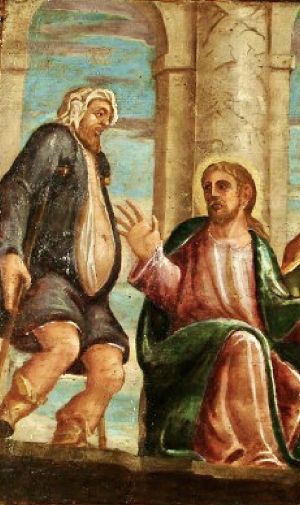
No more frills: humanity cluttered with - or free
(Lk 14:1-6)
The Bible often presents Salvation under the image of a banquet in which God himself participates alongside man.
Here specific reference is made to the assembly of those summoned to break the Bread [«to eat bread»: v.1] - a scene still dominated by Judaizers.
In appearance, the surface is calm. All the more reason for the (mischievous) Lord to throw in the pebble, to reshape its soporific sides.
His directness still astounds, and baffles any quietism.
Strange that a hydropic could have entered the House of a Pharisee - but significant, in the sense of the Gospel call.
In the leader's abode [old-fashioned, or 'approved' fashion] the housed humanity is cluttered with vaguely spiritual shredding - not of the luminous, living Faith.
There one moves with difficulty.
In the assembly, someone does not stand up; he is crammed inside... of things that have to be eliminated as soon as possible - or he won’t make it.
But it is only Jesus' question that immediately cleanses useless excesses.
Inside the well of v.5 it is as if not a donkey or an ox had fallen in, but a brother or a son, and ourselves.
In short: the excuses of legalism or conformist manners do not even touch the Father, while the leaders present do not know what word to utter.
Nor do they even vaguely conceive of the Will of God as Love that readily intervenes, that gets involved in vulnerabilities or eccentricities.
Instead, the Son - and whoever makes him present - grasps the hand of shaky humanity in its Oneness. And heals its limitation.
But He activates Himself not to stick it behind [as the directors of the time would have done] but to make it lighter, able to breathe and not just compress.
A merciless brushstroke this of Lk, emphasizing the difference between empty “teaching” - albeit in religious form - and 'action of Faith' linked to concrete life (v.3).
Yes: it was precisely the “expert ones” who lacked «the pleasure of recognizing the other [...] of being himself and of being different» (FT, 217-218).
In short, even originality or pain comes to us to generate right eyes; to teach us how to live. To remind us that we are called to be born again, far beyond the idea of 'perfection'.
We cannot rely solely on context, on external approval; realities often lacking in humanizing passion.
There is a 'fire' that lives within us, a Calling by Name that knows how to dispose of useless, other people's ballasts. They trample and pollute us; therefore they must be placed in the background and flown over.
Our journey in the Spirit - even in the official place of worship - is an unprecedented route towards personal fulfilment.
We cannot turn away from the Goal that belongs to us.
In doing so, any pain will be short-lived, and it will be a lesson: there we are simply giving birth to the essentiality that inhabits us.
Easter leap of Freedom.
[Friday 30th wk. in O.T. October 30, 2026]
Be yourself and be different. Path of closeness
The end of a sacred order: stuffed - or free
(Lk 14:1-6)
The Bible often presents salvation as a banquet in which God himself participates alongside man.
Here, specific reference is made to the assembly of those summoned to break bread [‘to eat bread’: v. 1 Greek text] – a scene still dominated by traditionalists or conformist Judaizers.
On the surface, all appears calm. All the more reason for the Lord (very mischievously) to throw a spanner in the works, to reshape its soporific aspects.
Where He makes His presence felt in earnest - even in places dedicated to the peaceful celebration of the Sacraments - nothing remains as it was before.
His frankness still astounds and confounds all quietism.
It is strange that a hydropic man could have entered the house of a Pharisee - but significant, in the sense of the Gospel message.
In the home of the leader [whether old-fashioned or 'approved' fashionable], the human guests are stuffed with vaguely spiritual platitudes - not with the luminous and living Faith.
There, one moves with difficulty.
In the assembly (coincidentally), someone cannot stand; he is full of... with things to be eliminated as soon as possible - or they will not make it.
But it is only Jesus' question that immediately cleanses the useless excesses inoculated drop by drop by false guides into the unfortunate.
Inside the well in verse 5, it is as if not a donkey or an ox had fallen, but a brother or a son, and ourselves.
In short: the excuses of religious legalism [ancient or à la page] and good manners do not even touch the Father.
The leaders present do not know what to say: in reality, they have nothing to say (to anyone).
They do not even vaguely conceive of God's Will as Love that intervenes promptly, that gets involved in our vulnerabilities or eccentricities.
Pope Francis would say of them, in his third encyclical: 'accustomed to looking away, passing by, ignoring situations' (Fratelli Tutti, n.64).
Instead, the Son - and anyone who makes him Present - takes humanity by the hand, in its Uniqueness. And heals its limitations.
But He acts not to stick to it [as the directors of the time would have done] but to make it lighter, able to breathe and not just compress.
Humanity liberated, finally autonomous - capable of tracing a path on its own legs; even if it turns out to be 'distant'.
This is a ruthless brushstroke by Luke, which highlights the difference between empty 'teaching' - albeit in religious form - and 'action of Faith' linked to concrete life (v.3).
In choosing between the real good of the person and the reputation of the group [the ruling clique], Jesus has no doubt.
On the other hand, for the great devotees and leaders, giving credence, or the prestige of the institution, and the 'custom' of doctrine, as well as great sophisticated ideas... are their whole life.
The Master still does not remain silent today, and ridicules the personal inconsistency of some masters of theology who, while maintaining appearances, feel exempt from everything in their private lives.
In fact, it is precisely the 'experts' who sometimes lack 'the taste for recognising the other [...] for being themselves and for being different' (FT, 217-218).
Theology yes, but of the Incarnation. The spice of life is not permanence: it is better to eliminate unnecessary burdens.
In our assemblies there are naive and practising believers, but they are not very aware, rather unprepared and misguided.
We could say: faithful considered as glasses to be filled, devotees destined to say 'yes sir' and not express themselves: evaluated without any significant spiritual personality.
They are not welcomed as a gift, but rather neglected; cloaked in the thoughts, practices and objectives of others.
For some community leaders... they are just numbers.
Let us try to paraphrase John Paul II (Dives in Misericordia nos. 12-13) but with reference to the figure of the hydropic.
There are souls - of every Christian denomination - who fear becoming victims of oppression and hide themselves.
They lack inner freedom, the possibility of expressing their vocational character, of expressing what they believe in.
They do not feel able to be guided by the voice of conscience, which intimately indicates the right path to follow.
For fear of retaliation or ridicule, or rather lack of awareness, they prefer a peaceful existence in all areas of life.
Expressing themselves in a spontaneous, natural and healthy way could be uncomfortable - not in tune with the local domestication programme.
Thus, while manipulators tend to use them without scruples, simple people continue to place themselves in a subordinate position.
They do not even remotely imagine or are educated to consider themselves custodians of a precious, unique Pearl for the work of Salvation.
They undergo a kind of daily torture that clogs them with external ideas, observances that do not correspond to their soul and their right to truth and freedom.
In short, as the Gospel passage illustrates, the Church takes the educational risk and reveals the meaning of 'Christ in action' only when it brings unstable people closer to the sources of conscience and personal 'flesh'.
In short, even originality or pain come to us to generate the right eyes; to teach us how to live. To remind us that we are called to be born again, far beyond the idea of 'perfection'.
In this way, we cannot rely solely on context, on external approval; realities often devoid of humanising passion.
There is a 'fire' that lives within us, a Call by Name that knows how to dispose of useless, other people's ballast. They trample on us and pollute us; therefore, they must be placed in the background and overlooked.
Our journey in the Spirit - even in the official place of worship - is an unprecedented itinerary towards personal fulfilment.
We cannot stray from the Goal that belongs to us.
In this way, every pain will be short-lived and will teach us something: there we are simply giving birth to the essentiality that dwells within us.
The transition from religious meaning to a life of Faith brings with it the Easter leap of Freedom.
To internalise and live the message:
How would you describe your transition from religiosity to Faith?
Have you purified yourself of the inculcated trappings that weighed down your essential personality?
Have you freed yourself from the sophisticated thoughts that overlook the 'flesh'?
Have you made the Easter leap of freedom?
Consistent adherence

Reading, study and meditation of the Word should then flow into a life of consistent fidelity to Christ and his teachings.
Saint James tells us: "Be doers of the word, and not merely hearers who deceive themselves. For if any are hearers of the word and not doers, they are like those who look at themselves in a mirror; for they look at themselves and, on going away, immediately forget what they were like. But those who look into the perfect law, the law of liberty, and persevere, being not hearers who forget but doers who act - they will be blessed in their doing" (1:22-25). Those who listen to the word of God and refer to it always, are constructing their existence on solid foundations. "Everyone then who hears these words of mine and acts on them", Jesus said, "will be like a wise man who built his house on rock" (Mt 7:24). It will not collapse when bad weather comes.
To build your life on Christ, to accept the word with joy and put its teachings into practice: this, young people of the third millennium, should be your programme!
[Pope Benedict, Message for the 21st World Youth Day, 9 April 2006]
Peaceful subjugation
11. Man rightly fears falling victim to an oppression that will deprive him of his interior freedom, of the possibility of expressing the truth of which he is convinced, of the faith that he professes, of the ability to obey the voice of conscience that tells him the right path to follow. The technical means at the disposal of modern society conceal within themselves not only the possibility of self-destruction through military conflict, but also the possibility of a "peaceful" subjugation of individuals, of environments, of entire societies and of nations, that for one reason or another might prove inconvenient for those who possess the necessary means and are ready to use them without scruple. An instance is the continued existence of torture, systematically used by authority as a means of domination and political oppression and practiced by subordinates with impunity.
Together with awareness of the biological threat, therefore, there is a growing awareness of yet another threat, even more destructive of what is essentially human, what is intimately bound up with the dignity of the person and his or her right to truth and freedom.
13. The Church lives an authentic life when she professes and proclaims mercy-the most stupendous attribute of the Creator and of the Redeemer-and when she brings people close to the sources of the Savior's mercy, of which she is the trustee and dispenser.
[Pope John Paul II, Dives in Misericordia]
Letter and Law
"The passage from the Gospel we have heard is taken from chapter XIV of Luke," explained the Pope, pointing out that "almost the entire chapter, except for a small part at the end, revolves around a meal, around the table, and everything that happens there happens at the table." Hence "the idea of the banquet at the end of the chapter," in the parable told by Jesus, particularly in verses 15-24 proposed by the liturgy of the day.
Referring to the beginning of the chapter, the Pontiff emphasised that "Jesus went to lunch at the house of a Pharisee who had invited him: Jesus always accepted." But "as soon as he entered, he saw a man suffering from dropsy and immediately went to heal him: Jesus always wants to heal us, all of us." However, the Pope recalled, "it was Saturday, all the doctors of the law were there, and he asked permission: 'Is it lawful to heal on the Sabbath? And "these people, who never said what they thought - they were hypocrites - remained silent".
Jesus healed that sick man.
[Pope Francis, Santa Marta, in L'Osservatore Romano 07/11/2018]
The foxes, the little hen, and the Prophet
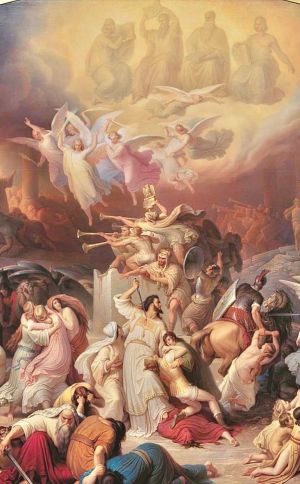
End of a "sacred" order
(Lk 13:31-35)
The context in which Jesus lived was threatening: even in the outlying provinces of the Empire, power was absolute and those in authority were accountable to no one for the small-scale running of affairs.
But the building up of the Kingdom of God does not depend on any authorization of rapacious rulers on the territory of the provinces.
Those who want to fulfil their mission cannot satisfy the «foxes» who usurp power.
They are small and harmful situation’s parasites, but quick - even if they are not big roaring fairs as in the roman and senatorial court.
With his cunning attitude, king Herod (astute collaborationist) had managed to secure dominance for several decades, and a life without big jolts.
Each village in Palestine was manned by officials and delators of the sovereign, as well as practitioners and subordinates of the official popular religion [including the Pharisees, which Jesus sends back to the sender: v.32].
Antipas – like a puppet [fox] – always managed to stay afloat in any situation and keep to himself.
But after having deluded himself of having settled the Baptist and his school with him, here the king is again alarmed by the rise of a greater danger.
The young Rabbi spread deep confidence not in the strong, but in the weak. In this way, he was working deeply in consciences, and seemed to be able to outclass even the Prophets.
If the inspectors had rushed from the centre of power over the territory (v.31), Jesus must have made it really big. Thus demonstrating total freedom from conditioning.
Therefore, the success of his thought could have provoked disorder in the structure of the system.
But God’s messengers do not flee from risk.
They do this not out of duty, but out of fidelity to themselves, and because they are attracted by a Vision that belongs to everyone: they manage to grasp and sense that the pains of childbirth will generate new Births.
In short, Jesus and his close friends live an existence marked by a kind of attraction of the Cross - out of Love that goes to the end, all the way, and does not disdain comparisons.
Jerusalem was the center of the people of God’ sons, "chosen" [only] to unfold the face of the Father.
Vocation of the holy city was not to surrender to a fox (v.32) but to become a brooding hen [v.34: properly, «hen»] that does not close but spreads wings for its little ones, gathering all the innocent.
Of course, their feeling for the fate of a homeland that lets itself go to vanities, to the ideology of power and its "advantage", embarking on the path of self-destruction, makes us weep with pain.
However - although defenestrated from his House in the ‘holy city’, as well as from the heart of those who demand only quietism - in Christ the authentic People of friends will propose themselves again (v.35) also on the path of failure.
Not colonizing the features, but in a simple way (not unilateral): inclusive; expanding the horizon and detaching from the tinsel and trappings.
My turning away from Herod’s cunning and the conformist subservience of all «foxes» (v. 32).
[Thursday 30th wk. in O.T. October 29, 2026]
Today, as yesterday, the Church needs you and turns to you. The Church tells you with our voice: don’t let such a fruitful alliance break! Do not refuse to put your talents at the service of divine truth! Do not close your spirit to the breath of the Holy Spirit! (Pope Paul VI)
Oggi come ieri la Chiesa ha bisogno di voi e si rivolge a voi. Essa vi dice con la nostra voce: non lasciate che si rompa un’alleanza tanto feconda! Non rifiutate di mettere il vostro talento al servizio della verità divina! Non chiudete il vostro spirito al soffio dello Spirito Santo! (Papa Paolo VI)
Sometimes we try to correct or convert a sinner by scolding him, by pointing out his mistakes and wrongful behaviour. Jesus’ attitude toward Zacchaeus shows us another way: that of showing those who err their value, the value that God continues to see in spite of everything (Pope Francis)
A volte noi cerchiamo di correggere o convertire un peccatore rimproverandolo, rinfacciandogli i suoi sbagli e il suo comportamento ingiusto. L’atteggiamento di Gesù con Zaccheo ci indica un’altra strada: quella di mostrare a chi sbaglia il suo valore, quel valore che Dio continua a vedere malgrado tutto (Papa Francesco)
Deus dilexit mundum! God observes the depths of the human heart, which, even under the surface of sin and disorder, still possesses a wonderful richness of love; Jesus with his gaze draws it out, makes it overflow from the oppressed soul. To Jesus, therefore, nothing escapes of what is in men, of their total reality, in which good and evil are (Pope Paul VI)
Deus dilexit mundum! Iddio osserva le profondità del cuore umano, che, anche sotto la superficie del peccato e del disordine, possiede ancora una ricchezza meravigliosa di amore; Gesù col suo sguardo la trae fuori, la fa straripare dall’anima oppressa. A Gesù, dunque, nulla sfugge di quanto è negli uomini, della loro totale realtà, in cui sono il bene e il male (Papa Paolo VI)
The "talent" was an ancient Roman coin, of great value, and precisely because of this parable's popularity it became synonymous with personal gifts, which everyone is called to develop. In fact […] (Pope Benedict)
Il "talento" era un’antica moneta romana, di grande valore, e proprio a causa della popolarità di questa parabola è diventata sinonimo di dote personale, che ciascuno è chiamato a far fruttificare. In realtà […] (Papa Benedetto)
O Lord, let my faith be full, without reservations, and let penetrate into my thought, in my way of judging divine things and human things (Pope Paul VI)
O Signore, fa’ che la mia fede sia piena, senza riserve, e che essa penetri nel mio pensiero, nel mio modo di giudicare le cose divine e le cose umane (Papa Paolo VI)
The Judgment surprises and makes friends with the journey of each one who notices
Il Giudizio sorprende e fa amicizia con il viaggio di ciascuno che si accorge
This is where the challenge for your life lies! It is here that you can manifest your faith, your hope and your love! [John Paul II at the Tala Leprosarium, Manila]
È qui la sfida per la vostra vita! È qui che potete manifestare la vostra fede, la vostra speranza e il vostro amore! [Giovanni Paolo II al Lebbrosario di Tala, Manila]
Jesus makes memory and remembers the whole history of the people, of his people. And he recalls the rejection of his people to the love of the Father (Pope Francis)
Gesù fa memoria e ricorda tutta la storia del popolo, del suo popolo. E ricorda il rifiuto del suo popolo all’amore del Padre (Papa Francesco)





duevie.art
don Giuseppe Nespeca
Tel. 333-1329741
Disclaimer
Questo blog non rappresenta una testata giornalistica in quanto viene aggiornato senza alcuna periodicità. Non può pertanto considerarsi un prodotto editoriale ai sensi della legge N°62 del 07/03/2001.
Le immagini sono tratte da internet, ma se il loro uso violasse diritti d'autore, lo si comunichi all'autore del blog che provvederà alla loro pronta rimozione.
L'autore dichiara di non essere responsabile dei commenti lasciati nei post. Eventuali commenti dei lettori, lesivi dell'immagine o dell'onorabilità di persone terze, il cui contenuto fosse ritenuto non idoneo alla pubblicazione verranno insindacabilmente rimossi.