Oct 22, 2026 Written by 

Being oneself and being different. Road of proximity

No more frills: humanity cluttered with - or free

(Lk 14:1-6)


The Bible often presents Salvation under the image of a banquet in which God himself participates alongside man.

Here specific reference is made to the assembly of those summoned to break the Bread [«to eat bread»: v.1] - a scene still dominated by Judaizers.

In appearance, the surface is calm. All the more reason for the (mischievous) Lord to throw in the pebble, to reshape its soporific sides.

His directness still astounds, and baffles any quietism.

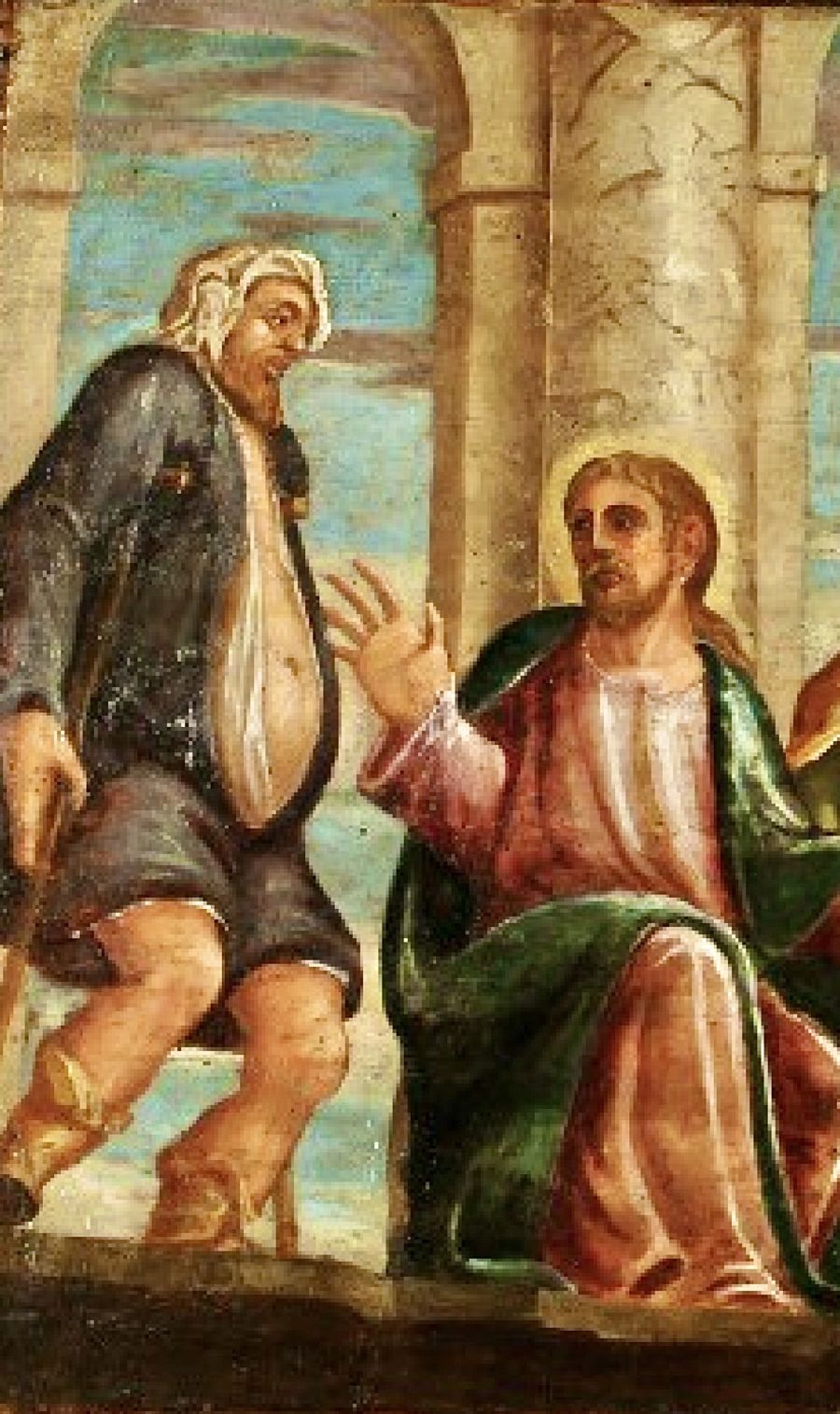
Strange that a hydropic could have entered the House of a Pharisee - but significant, in the sense of the Gospel call.

In the leader's abode [old-fashioned, or 'approved' fashion] the housed humanity is cluttered with vaguely spiritual shredding - not of the luminous, living Faith.

There one moves with difficulty.

In the assembly, someone does not stand up; he is crammed inside... of things that have to be eliminated as soon as possible - or he won’t make it.

But it is only Jesus' question that immediately cleanses useless excesses.

Inside the well of v.5 it is as if not a donkey or an ox had fallen in, but a brother or a son, and ourselves.

In short: the excuses of legalism or conformist manners do not even touch the Father, while the leaders present do not know what word to utter.

Nor do they even vaguely conceive of the Will of God as Love that readily intervenes, that gets involved in vulnerabilities or eccentricities.

Instead, the Son - and whoever makes him present - grasps the hand of shaky humanity in its Oneness. And heals its limitation.

But He activates Himself not to stick it behind [as the directors of the time would have done] but to make it lighter, able to breathe and not just compress.

A merciless brushstroke this of Lk, emphasizing the difference between empty “teaching” - albeit in religious form - and 'action of Faith' linked to concrete life (v.3).

Yes: it was precisely the “expert ones” who lacked «the pleasure of recognizing the other [...] of being himself and of being different» (FT, 217-218).

In short, even originality or pain comes to us to generate right eyes; to teach us how to live. To remind us that we are called to be born again, far beyond the idea of 'perfection'.

We cannot rely solely on context, on external approval; realities often lacking in humanizing passion.

There is a 'fire' that lives within us, a Calling by Name that knows how to dispose of useless, other people's ballasts. They trample and pollute us; therefore they must be placed in the background and flown over.

Our journey in the Spirit - even in the official place of worship - is an unprecedented route towards personal fulfilment.

We cannot turn away from the Goal that belongs to us.

In doing so, any pain will be short-lived, and it will be a lesson: there we are simply giving birth to the essentiality that inhabits us.

Easter leap of Freedom.


[Friday 30th wk. in O.T.  October 30, 2026]

346 Last modified on Friday, 30 October 2026 11:59
don Giuseppe Nespeca

Giuseppe Nespeca è architetto e sacerdote. Cultore della Sacra scrittura è autore della raccolta "Due Fuochi due Vie - Religione e Fede, Vangeli e Tao"; coautore del libro "Dialogo e Solstizio".

How we treat them will be taken as the way we treat Jesus himself. We do not see here a simple literary device, or a simple metaphor [Pope Benedict]
Il comportamento che noi abbiamo nei loro confronti sarà dunque considerato come il comportamento che abbiamo nei confronti di Gesù stesso. Non vediamo in questo una semplice formula letteraria, una semplice immagine! [Papa Benedetto]
The Sadducees, addressing Jesus for a purely theoretical "case", at the same time attack the Pharisees' primitive conception of life after the resurrection of the bodies; they in fact insinuate that faith in the resurrection of the bodies leads to admitting polyandry, contrary to the law of God (Pope John Paul II)
I Sadducei, rivolgendosi a Gesù per un "caso" puramente teorico, attaccano al tempo stesso la primitiva concezione dei Farisei sulla vita dopo la risurrezione dei corpi; insinuano infatti che la fede nella risurrezione dei corpi conduce ad ammettere la poliandria, contrastante con la legge di Dio (Papa Giovanni Paolo II)
Today, as yesterday, the Church needs you and turns to you. The Church tells you with our voice: don’t let such a fruitful alliance break! Do not refuse to put your talents at the service of divine truth! Do not close your spirit to the breath of the Holy Spirit! (Pope Paul VI)
Oggi come ieri la Chiesa ha bisogno di voi e si rivolge a voi. Essa vi dice con la nostra voce: non lasciate che si rompa un’alleanza tanto feconda! Non rifiutate di mettere il vostro talento al servizio della verità divina! Non chiudete il vostro spirito al soffio dello Spirito Santo! (Papa Paolo VI)
Sometimes we try to correct or convert a sinner by scolding him, by pointing out his mistakes and wrongful behaviour. Jesus’ attitude toward Zacchaeus shows us another way: that of showing those who err their value, the value that God continues to see in spite of everything (Pope Francis)
A volte noi cerchiamo di correggere o convertire un peccatore rimproverandolo, rinfacciandogli i suoi sbagli e il suo comportamento ingiusto. L’atteggiamento di Gesù con Zaccheo ci indica un’altra strada: quella di mostrare a chi sbaglia il suo valore, quel valore che Dio continua a vedere malgrado tutto (Papa Francesco)
Deus dilexit mundum! God observes the depths of the human heart, which, even under the surface of sin and disorder, still possesses a wonderful richness of love; Jesus with his gaze draws it out, makes it overflow from the oppressed soul. To Jesus, therefore, nothing escapes of what is in men, of their total reality, in which good and evil are (Pope Paul VI)
Deus dilexit mundum! Iddio osserva le profondità del cuore umano, che, anche sotto la superficie del peccato e del disordine, possiede ancora una ricchezza meravigliosa di amore; Gesù col suo sguardo la trae fuori, la fa straripare dall’anima oppressa. A Gesù, dunque, nulla sfugge di quanto è negli uomini, della loro totale realtà, in cui sono il bene e il male (Papa Paolo VI)
The "talent" was an ancient Roman coin, of great value, and precisely because of this parable's popularity it became synonymous with personal gifts, which everyone is called to develop. In fact […] (Pope Benedict)
Il "talento" era un’antica moneta romana, di grande valore, e proprio a causa della popolarità di questa parabola è diventata sinonimo di dote personale, che ciascuno è chiamato a far fruttificare. In realtà […] (Papa Benedetto)
O Lord, let my faith be full, without reservations (Pope Paul VI)

Due Fuochi due Vie - Vol. 1 Due Fuochi due Vie - Vol. 2 Due Fuochi due Vie - Vol. 3 Due Fuochi due Vie - Vol. 4 Due Fuochi due Vie - Vol. 5 Dialogo e Solstizio I fiammiferi di Maria

duevie.art

don Giuseppe Nespeca

Tel. 333-1329741


Disclaimer

Questo blog non rappresenta una testata giornalistica in quanto viene aggiornato senza alcuna periodicità. Non può pertanto considerarsi un prodotto editoriale ai sensi della legge N°62 del 07/03/2001.
Le immagini sono tratte da internet, ma se il loro uso violasse diritti d'autore, lo si comunichi all'autore del blog che provvederà alla loro pronta rimozione.
L'autore dichiara di non essere responsabile dei commenti lasciati nei post. Eventuali commenti dei lettori, lesivi dell'immagine o dell'onorabilità di persone terze, il cui contenuto fosse ritenuto non idoneo alla pubblicazione verranno insindacabilmente rimossi.