Jan 17, 2026 Written by 

Arduous Crossing, not poor Happiness

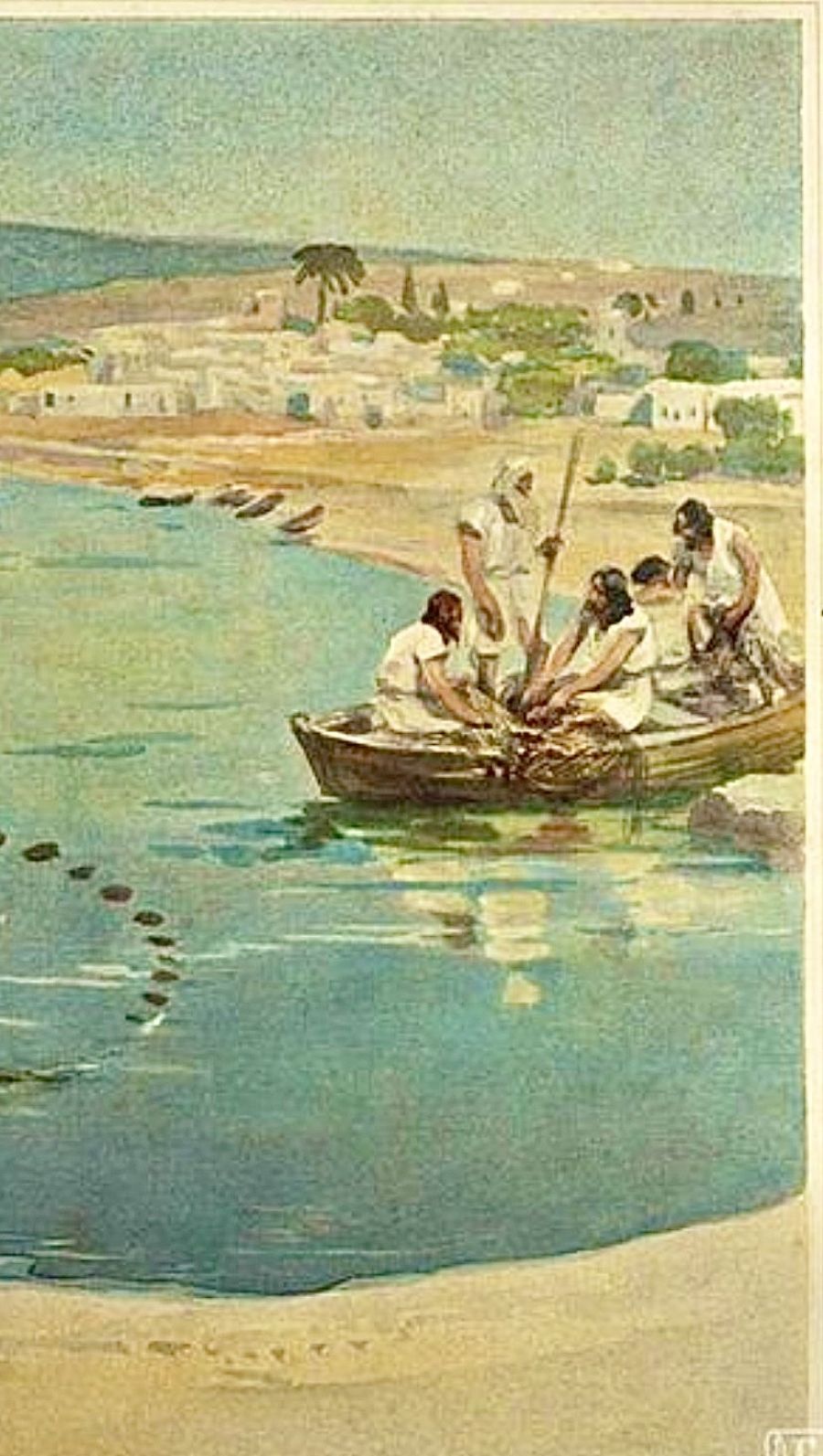
The Call of the fishermen

(Mt 4:12-23)


It is not the call of the boss, but the invitation of the Friend, who lives firsthand what he preaches, exposing himself.

To Abraham God says «Go to the land that I will point you to». Jesus does not say «Go», but «Come»: it’s He who risks and goes ahead, offering Himself as Lamb.

Abraham is only an envoy; the disciple of Christ on the way reproposes a Person in relationship and his whole story.

«Fishermen of men»: the meaning of the expression is clearer in Lk 5:10 [Greek text]: our mission is to raise to life those who no longer breathe, suffocate, enveloped by impetuous waves, by forces of negativity.

Pull them out of polluted eddies where one live dehumanizing. To place everyone in transparent water, with values that are no longer those of the folded up and corrupt society of the cunnings.

The Son of God calls us to cut off what degrades the experience of personal fullness. He promotes in each one the dna of God who doesn’t create competition, but communion.

It’s essential to abandon the «nets»: what envelops and prevents, blocks. Even the «boat», that is, the way of managing work.

And the «father», who in the family passed on the tradition, customs which risked blurring the new Light.

All jerseys to be broken. It means: a new approach, even if you continue to carry out the previous life.

Values are no longer static and banal [seeking consensus, settling down...]: fatuous glitters, that inculcate external idols, regulating and uniformizing.


To give these new impulses, Jesus flies over the court palaces, from which nothing would have been born.

Nor does he designate anyone with the title that belongs to Him alone: «Pastor».

We need attention, not directors and leaders who judge, or binaries that do not concern us; nor unnecessary mental patterns.

The woman and the man of all times need only wise support; traveling companions who help discover their hidden sides, unknowns, secrets, that can flourish.

The Person dimension is essential.

Of course, we must distract the mind from the known, and take the Way of the "farther": no shortcut free of unknowns.

Road traveled on foot, which changes one’s own and other people’s mental atmosphere; wich flies over the custom, used, whatever, external way of seeing things.

Here, standing in our Call and naturalness, we’ll be all-round ourselves. And we will be surprised.

This in the gamble of unpredictable Love: only in this way can one contact one’s own deep states, to know each other; thus realizing unexpected dreams of open and complete life, by activating dormant energies.

And like Jesus, able to put into action anyone who we meet - recovering the opposite sides and eccentricities, for a total ideal.


Special trait: to turn to all the earth, even the enemies. Without presumption, without any foreclosure.

In Christ, there is no more imperfection, mistake or unfirm condition that can keep us distant.

Each is indispensable and precious. Everyone is legitimized. No one should atone.


Openness, not effort.


[3rd Sunday in O.T. (year A)  January 25, 2026]

264 Last modified on Sunday, 25 January 2026 12:02
don Giuseppe Nespeca

Giuseppe Nespeca è architetto e sacerdote. Cultore della Sacra scrittura è autore della raccolta "Due Fuochi due Vie - Religione e Fede, Vangeli e Tao"; coautore del libro "Dialogo e Solstizio".

“Give me a drink” (v. 7). Breaking every barrier, he begins a dialogue in which he reveals to the woman the mystery of living water, that is, of the Holy Spirit, God’s gift [Pope Francis]
«Dammi da bere» (v. 7). Così, rompendo ogni barriera, comincia un dialogo in cui svela a quella donna il mistero dell’acqua viva, cioè dello Spirito Santo, dono di Dio [Papa Francesco]
The mystery of ‘home-coming’ wonderfully expresses the encounter between the Father and humanity, between mercy and misery, in a circle of love that touches not only the son who was lost, but is extended to all (Pope John Paul II)
Il mistero del ‘ritorno-a-casa’ esprime mirabilmente l’incontro tra il Padre e l’umanità, tra la misericordia e la miseria, in un circolo d’amore che non riguarda solo il figlio perduto, ma si estende a tutti (Papa Giovanni Paolo II)
The image of the vineyard is clear: it represents the people whom the Lord has chosen and formed with such care; the servants sent by the landowner are the prophets, sent by God, while the son represents Jesus. And just as the prophets were rejected, so too Christ was rejected and killed (Pope Francis)
L’immagine della vigna è chiara: rappresenta il popolo che il Signore si è scelto e ha formato con tanta cura; i servi mandati dal padrone sono i profeti, inviati da Dio, mentre il figlio è figura di Gesù. E come furono rifiutati i profeti, così anche il Cristo è stato respinto e ucciso (Papa Francesco)
‘Lazarus’ means ‘God helps’. Lazarus, who is lying at the gate, is a living reminder to the rich man to remember God, but the rich man does not receive that reminder. Hence, he will be condemned not because of his wealth, but for being incapable of feeling compassion for Lazarus and for not coming to his aid. In the second part of the parable, we again meet Lazarus and the rich man after their death (vv. 22-31). In the hereafter the situation is reversed [Pope Francis]
“Lazzaro” significa “Dio aiuta”. Lazzaro, che giace davanti alla porta, è un richiamo vivente al ricco per ricordarsi di Dio, ma il ricco non accoglie tale richiamo. Sarà condannato pertanto non per le sue ricchezze, ma per essere stato incapace di sentire compassione per Lazzaro e di soccorrerlo. Nella seconda parte della parabola, ritroviamo Lazzaro e il ricco dopo la loro morte (vv. 22-31). Nell’al di là la situazione si è rovesciata [Papa Francesco]
Brothers and sisters, a frequent flaw of those in authority, whether civil or ecclesiastic authority, is that of demanding of others things — even righteous things — that they do not, however, put into practise in the first person. They live a double life. Jesus says: “They bind heavy burdens, hard to bear, and lay them on men’s shoulders; but they themselves will not move them with their finger (v.4). This attitude sets a bad example of authority, which should instead derive its primary strength precisely from setting a good example. Authority arises from a good example, so as to help others to practise what is right and proper, sustaining them in the trials that they meet on the right path. Authority is a help, but if it is wrongly exercised, it becomes oppressive; it does not allow people to grow, and creates a climate of distrust and hostility, and also leads to corruption (Pope Francis)
Fratelli e sorelle, un difetto frequente in quanti hanno un’autorità, sia autorità civile sia ecclesiastica, è quello di esigere dagli altri cose, anche giuste, che però loro non mettono in pratica in prima persona. Fanno la doppia vita. Dice Gesù: «Legano infatti fardelli pesanti e difficili da portare e li pongono sulle spalle della gente, ma essi non vogliono muoverli neppure con un dito» (v.4). Questo atteggiamento è un cattivo esercizio dell’autorità (Papa Francesco)

Due Fuochi due Vie - Vol. 1 Due Fuochi due Vie - Vol. 2 Due Fuochi due Vie - Vol. 3 Due Fuochi due Vie - Vol. 4 Due Fuochi due Vie - Vol. 5 Dialogo e Solstizio I fiammiferi di Maria

duevie.art

don Giuseppe Nespeca

Tel. 333-1329741


Disclaimer

Questo blog non rappresenta una testata giornalistica in quanto viene aggiornato senza alcuna periodicità. Non può pertanto considerarsi un prodotto editoriale ai sensi della legge N°62 del 07/03/2001.
Le immagini sono tratte da internet, ma se il loro uso violasse diritti d'autore, lo si comunichi all'autore del blog che provvederà alla loro pronta rimozione.
L'autore dichiara di non essere responsabile dei commenti lasciati nei post. Eventuali commenti dei lettori, lesivi dell'immagine o dell'onorabilità di persone terze, il cui contenuto fosse ritenuto non idoneo alla pubblicazione verranno insindacabilmente rimossi.






