Nov 15, 2025 Written by 

Today with Me: the Wine that gets us out of the nest

(Lk 23:35-43)


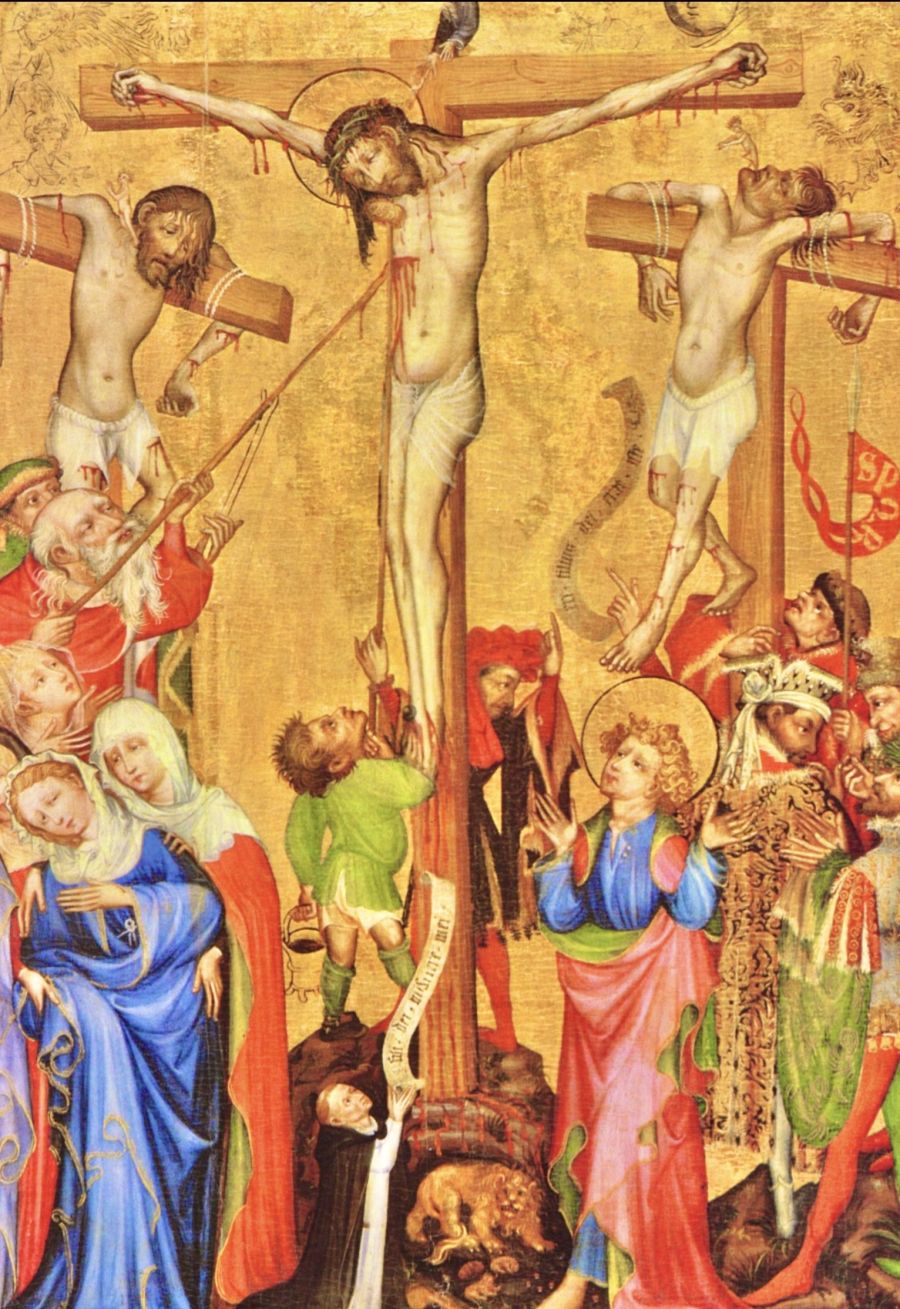
The Son is crucified among criminals. For political and religious power, he was a much worse danger.

According to Lk, only one outraged him; the other called Jesus by name and relied on him (v.42).

At the beginning of the Gospel the coming of the Lord is placed among the least of the earth.

He manifests himself to the world among impure and despised people [even certain that they must be incinerated of the Judge Messiah, and who therefore were afraid of him] not among the righteous and saints of the Temple.

Then his whole life takes place in the midst of tax collectors and sinners, because he came for them.

In fact: who brings back to the Father’s house? A guy any, representing all of us - a criminal who had committed murders - because all sins consist in taking away someone’s life and joy of living.

So that killer represents us. And Christ begins to build Family precisely with the criminal next door, who are we: sinners recovered from his unconditional Love.


In Lk the crowd is in disarray.

People do not insult the Faithful Son accused by religious authorities, but remain perplexed, they do not understand.

The people did not have healthy spiritual guides, capable of making the authentic features of God’s world be recognized - and vice versa, what made it caricature.

That of “universal King” is a title that today carries with it many misunderstandings - when attributed to the authentic Christ, reduced to zero.

This is because it’s confused with artificial magnitudes, magnificences of exteriority.

The regality of believers in Him is inapparent, all substance. Power that opens up new possibilities, even in dark dimension.

Nothing to do with the temptations to realize oneself by thinking in a trivial, hasty, outwardly, comfortable way, and promoting only oneself  (vv.37.39).

In the Gospels - in fact - evil is presented not as a bad opponent and antagonist, but affable and complacent counselor, who seems to convey security from the unexpected, and make us win positions.

Friend who loves and protects us, so he gives the tips to stand up, impose, succeed.

But focussing on appearances ends up making us ignore and not understand the deep paths of the soul.


At the word «kingdom», Pilate immediately thought that of Tiberius (vv.2-4)

Here the size of the Kingdom is upside down: it doesn’t show the muscles.

His King stands us by, he is a Person able to create harmony of beauty within; a quieter road.

Salvation comes from what in our life is considered as bland and nothingness, yet it opens wide the infinite that dwells inside - the boundless of the primordial, present and final Friend.

He reverberates in the heart, and directs - Eternal who intimately resonates, even in tragic situations.

This comes even from those who - Jesus, benevolent oppressed - was valued a cursed by God and considered scum of society à la page.

Conversely, friendly Presence; wich makes us "see" and unlocks.

The radical difference between religiosity and Faith? The sense of an intimate and surprising Mystery that awakens us.

Wine, not «vinegar» [sour wine (v.36)]: corruption of love and of the celebration.


The God of religions drives out the contradictory and inadequate woman and man from Paradise. The Father welcomes them.


[34th Sunday in O.T.  (year C), November 23, 2025, Christ the King]

163 Last modified on Sunday, 23 November 2025 12:17
don Giuseppe Nespeca

Giuseppe Nespeca è architetto e sacerdote. Cultore della Sacra scrittura è autore della raccolta "Due Fuochi due Vie - Religione e Fede, Vangeli e Tao"; coautore del libro "Dialogo e Solstizio".

And thus we must see Christ again and ask Christ: “Is it you?” The Lord, in his own silent way, answers: “You see what I did, I did not start a bloody revolution, I did not change the world with force; but lit many I, which in the meantime form a pathway of light through the millenniums” (Pope Benedict)
E così dobbiamo di nuovo vedere Cristo e chiedere a Cristo: “Sei tu?”. Il Signore, nel modo silenzioso che gli è proprio, risponde: “Vedete cosa ho fatto io. Non ho fatto una rivoluzione cruenta, non ho cambiato con forza il mondo, ma ho acceso tante luci che formano, nel frattempo, una grande strada di luce nei millenni” (Papa Benedetto)
Experts in the Holy Scriptures believed that Elijah's return should anticipate and prepare for the advent of the Kingdom of God. Since the Lord was present, the first disciples wondered what the value of that teaching was. Among the people coming from Judaism the question arose about the value of ancient doctrines…
Gli esperti delle sacre Scritture ritenevano che il ritorno di Elia dovesse anticipare e preparare l’avvento del Regno di Dio. Poiché il Signore era presente, i primi discepoli si chiedevano quale fosse il valore di quell’insegnamento. Tra i provenienti dal giudaismo sorgeva il quesito circa il peso delle dottrine antiche...
Gospels make their way, advance and free, making us understand the enormous difference between any creed and the proposal of Jesus. Even within us, the life of Faith embraces all our sides and admits many things. Thus we become more complete and emancipate ourselves, reversing positions.
I Vangeli si fanno largo, avanzano e liberano, facendo comprendere l’enorme differenza tra credo qualsiasi e proposta di Gesù. Anche dentro di noi, la vita di Fede abbraccia tutti i nostri lati e ammette tante cose. Così diventiamo più completi e ci emancipiamo, ribaltando posizioni
We cannot draw energy from a severe setting, contrary to the flowering of our precious uniqueness. New eyes are transmitted only by the one who is Friend. And Christ does it not when we are well placed or when we equip ourselves strongly - remaining in a managerial attitude - but in total listening
Non possiamo trarre energia da un’impostazione severa, contraria alla fioritura della nostra preziosa unicità. Gli occhi nuovi sono trasmessi solo da colui che è Amico. E Cristo lo fa non quando ci collochiamo bene o attrezziamo forte - permanendo in atteggiamento dirigista - bensì nell’ascolto totale
The Evangelists Matthew and Luke (cf. Mt 11:25-30 and Lk 10:21-22) have handed down to us a “jewel” of Jesus’ prayer that is often called the Cry of Exultation or the Cry of Messianic Exultation. It is a prayer of thanksgiving and praise [Pope Benedict]
Gli evangelisti Matteo e Luca (cfr Mt 11,25-30 e Lc 10,21-22) ci hanno tramandato un «gioiello» della preghiera di Gesù, che spesso viene chiamato Inno di giubilo o Inno di giubilo messianico. Si tratta di una preghiera di riconoscenza e di lode [Papa Benedetto]
The human race – every one of us – is the sheep lost in the desert which no longer knows the way. The Son of God will not let this happen; he cannot abandon humanity in so wretched a condition. He leaps to his feet and abandons the glory of heaven, in order to go in search of the sheep and pursue it, all the way to the Cross. He takes it upon his shoulders and carries our humanity (Pope Benedict)
L’umanità – noi tutti - è la pecora smarrita che, nel deserto, non trova più la strada. Il Figlio di Dio non tollera questo; Egli non può abbandonare l’umanità in una simile miserevole condizione. Balza in piedi, abbandona la gloria del cielo, per ritrovare la pecorella e inseguirla, fin sulla croce. La carica sulle sue spalle, porta la nostra umanità (Papa Benedetto)

Due Fuochi due Vie - Vol. 1 Due Fuochi due Vie - Vol. 2 Due Fuochi due Vie - Vol. 3 Due Fuochi due Vie - Vol. 4 Due Fuochi due Vie - Vol. 5 Dialogo e Solstizio I fiammiferi di Maria

duevie.art

don Giuseppe Nespeca

Tel. 333-1329741


Disclaimer

Questo blog non rappresenta una testata giornalistica in quanto viene aggiornato senza alcuna periodicità. Non può pertanto considerarsi un prodotto editoriale ai sensi della legge N°62 del 07/03/2001.
Le immagini sono tratte da internet, ma se il loro uso violasse diritti d'autore, lo si comunichi all'autore del blog che provvederà alla loro pronta rimozione.
L'autore dichiara di non essere responsabile dei commenti lasciati nei post. Eventuali commenti dei lettori, lesivi dell'immagine o dell'onorabilità di persone terze, il cui contenuto fosse ritenuto non idoneo alla pubblicazione verranno insindacabilmente rimossi.






