Nov 16, 2025 Written by 

Without canceling the person, already bare of two cents

Small coins and festival of the voracious God, in solemn appearances

(Lk 21:1-4)


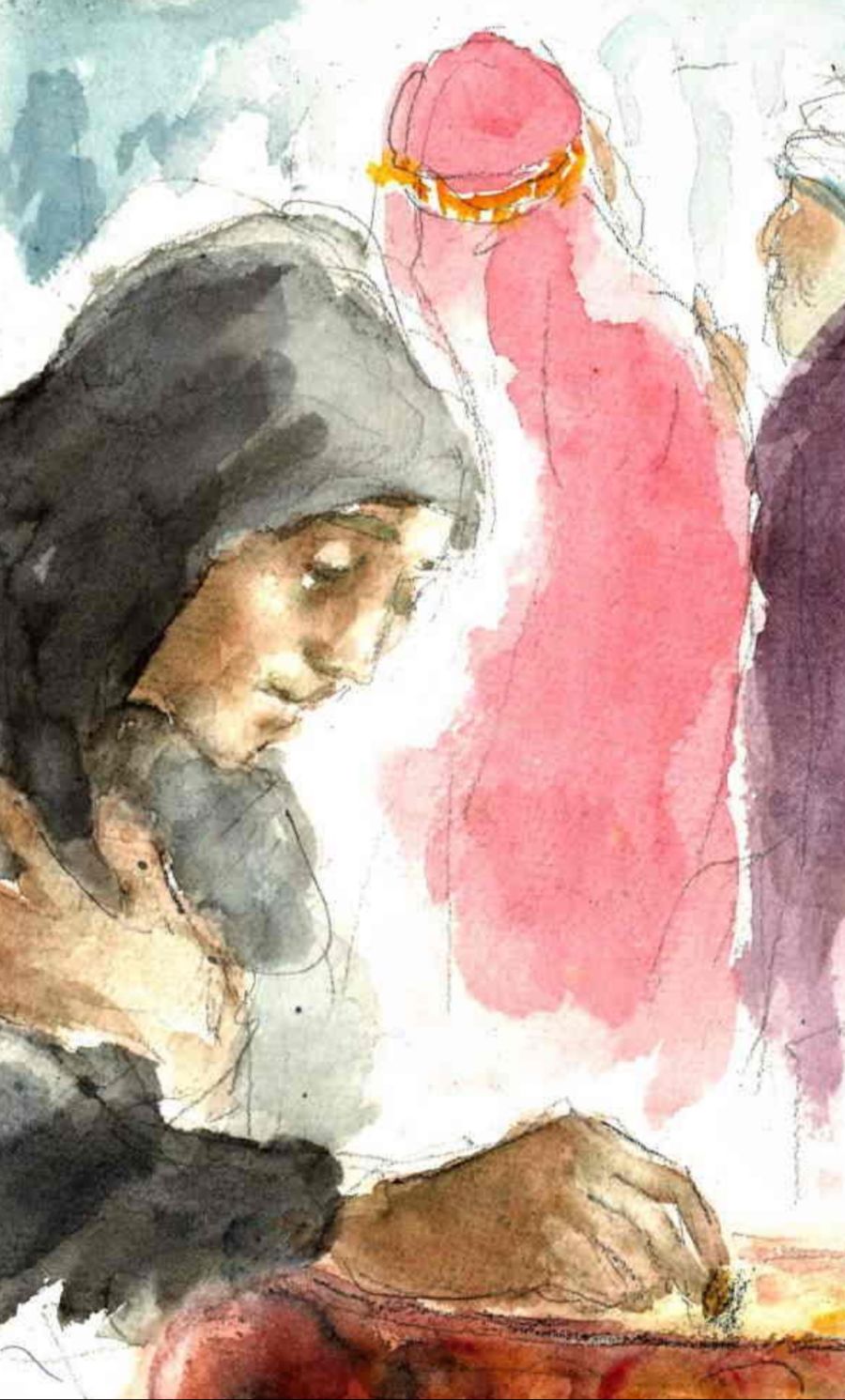
Jesus faces the treasure of the Temple, the true "god" of the whole sanctuary. The comparison is ruthless: one as opposed to the other (v.1; cf. Mk 12:41).

Enigma that could not be solved with a simple "purification" of the sacred place, or a replenishment of devotion.

It will be surprising, but the Gospel passage does not sing praises of individual humility which by faith deprives itself of everything: it’s rather a radical appeal to church leaders and to the sense of institution.

The Lord is saddened by every expropriation conditioned by awe. Indeed, fear takes life from those who do not enjoy fullness.

Christ weeps the subordinate condition of the poor and neglected: He does not make her take the chair. He does not credit the situation. He doesn’t want the woman already naked by two cents to undress all.

He seems distraught for that one silent figure; to underline the difference between the voracious demands of the ancient religions’ God and those of a completely different sign - in our favor - of the Father in the Faith.


While Jesus noticed and was mourning on the minuteous gesture of the little woman, the Apostles did not even notice the irrelevant poor creature, continuing to gape at the magnificence of the Temple.

Who knows what they were dreaming about... seduced by honor.

To divert them from the fever of reputation and considerations they desired to boast of, there was a need for an awareness; but to move them out of their place and yardstick the miracles would not have been enough.

Thus Jesus seeks to convey in conscience the Good News that the Father is the exact opposite of how he had been painted to them by the spiritual guides of the time.

The Eternal disconcerts: He does not take, does not appropriate, does not plunder, nor does absorb or debilitate us - but He is the One who gives.

He does not punish if you do not placate Him with both the little coins you have, without withholding a single one - even if only by doing in half (v.2).

The honour to God is not exclusive, but inclusive.

Paraphrasing the encyclical Fratelli Tutti, we could say that in authentic communities [as in families] «everyone contributes to the common purpose; everyone works for the common good, not denying each person’s individuality but encouraging and supporting it» (n.230).


The Son notes with bitterness that the beautiful protagonists themselves «devour the houses of widows» (Lk 20:47) as vampires. So convincing as to make the souls of the simple even their supporters and victims.

Christ is saddened by such unconscious complicity, induced by the lack of knowledge of the Father’s Face - preached as a leech God.

In fact, in the path of personal Faith true believers are not repeaters of external roles (Lk 20:45-47).

We collaborate with the creative and deifying work of the Eternal in offering ourselves as a vital food for the humanity to which the Bridegroom has been taken away - here in the figure of the poor «widow» who bleed out.

In short, we must no longer macerate and wear ourselves out, because of the glory of the Almighty, but enrich ourselves with Him and pronounce fully!

A God all substance, of little epidermal appearance.

Yet the antithesis of the rich and poor was resurfacing in the early communities... to the detriment of the isolated.

Here, precisely the reversal of the fortunes had to become characteristic of the adoring Church, which is immersed in the same rhythm of the supreme vital Source.


It will therefore be the amiable institution that will remain naked and pilgrim, even in the space of the small and unsteady.

And the action of the assemblies of believers will be able to activate a new, convivial world, humanizing disharmonies.

A reality that beats ‘time’. For a ‘Kingdom’ really not neutral. But where does the soul counts, not the curriculum.


[Monday 34th wk. in O.T.  November 24, 2025]

156 Last modified on Monday, 24 November 2025 11:59
don Giuseppe Nespeca

Giuseppe Nespeca è architetto e sacerdote. Cultore della Sacra scrittura è autore della raccolta "Due Fuochi due Vie - Religione e Fede, Vangeli e Tao"; coautore del libro "Dialogo e Solstizio".

And thus we must see Christ again and ask Christ: “Is it you?” The Lord, in his own silent way, answers: “You see what I did, I did not start a bloody revolution, I did not change the world with force; but lit many I, which in the meantime form a pathway of light through the millenniums” (Pope Benedict)
E così dobbiamo di nuovo vedere Cristo e chiedere a Cristo: “Sei tu?”. Il Signore, nel modo silenzioso che gli è proprio, risponde: “Vedete cosa ho fatto io. Non ho fatto una rivoluzione cruenta, non ho cambiato con forza il mondo, ma ho acceso tante luci che formano, nel frattempo, una grande strada di luce nei millenni” (Papa Benedetto)
Experts in the Holy Scriptures believed that Elijah's return should anticipate and prepare for the advent of the Kingdom of God. Since the Lord was present, the first disciples wondered what the value of that teaching was. Among the people coming from Judaism the question arose about the value of ancient doctrines…
Gli esperti delle sacre Scritture ritenevano che il ritorno di Elia dovesse anticipare e preparare l’avvento del Regno di Dio. Poiché il Signore era presente, i primi discepoli si chiedevano quale fosse il valore di quell’insegnamento. Tra i provenienti dal giudaismo sorgeva il quesito circa il peso delle dottrine antiche...
Gospels make their way, advance and free, making us understand the enormous difference between any creed and the proposal of Jesus. Even within us, the life of Faith embraces all our sides and admits many things. Thus we become more complete and emancipate ourselves, reversing positions.
I Vangeli si fanno largo, avanzano e liberano, facendo comprendere l’enorme differenza tra credo qualsiasi e proposta di Gesù. Anche dentro di noi, la vita di Fede abbraccia tutti i nostri lati e ammette tante cose. Così diventiamo più completi e ci emancipiamo, ribaltando posizioni
We cannot draw energy from a severe setting, contrary to the flowering of our precious uniqueness. New eyes are transmitted only by the one who is Friend. And Christ does it not when we are well placed or when we equip ourselves strongly - remaining in a managerial attitude - but in total listening
Non possiamo trarre energia da un’impostazione severa, contraria alla fioritura della nostra preziosa unicità. Gli occhi nuovi sono trasmessi solo da colui che è Amico. E Cristo lo fa non quando ci collochiamo bene o attrezziamo forte - permanendo in atteggiamento dirigista - bensì nell’ascolto totale
The Evangelists Matthew and Luke (cf. Mt 11:25-30 and Lk 10:21-22) have handed down to us a “jewel” of Jesus’ prayer that is often called the Cry of Exultation or the Cry of Messianic Exultation. It is a prayer of thanksgiving and praise [Pope Benedict]
Gli evangelisti Matteo e Luca (cfr Mt 11,25-30 e Lc 10,21-22) ci hanno tramandato un «gioiello» della preghiera di Gesù, che spesso viene chiamato Inno di giubilo o Inno di giubilo messianico. Si tratta di una preghiera di riconoscenza e di lode [Papa Benedetto]
The human race – every one of us – is the sheep lost in the desert which no longer knows the way. The Son of God will not let this happen; he cannot abandon humanity in so wretched a condition [Papa Benedetto]
The seed brought by the wind of the Spirit makes its own plant, which does not necessarily resemble the surrounding ones: it is not bound in its particular expressiveness, and silently flies even ‘out of fences’
Il seme portato dal vento dello Spirito fa la sua pianta, che non necessariamente somiglia a quelle circostanti: non si vincola nella sua espressività particolare, e silenziosamente vola anche ‘fuori confine’

Due Fuochi due Vie - Vol. 1 Due Fuochi due Vie - Vol. 2 Due Fuochi due Vie - Vol. 3 Due Fuochi due Vie - Vol. 4 Due Fuochi due Vie - Vol. 5 Dialogo e Solstizio I fiammiferi di Maria

duevie.art

don Giuseppe Nespeca

Tel. 333-1329741


Disclaimer

Questo blog non rappresenta una testata giornalistica in quanto viene aggiornato senza alcuna periodicità. Non può pertanto considerarsi un prodotto editoriale ai sensi della legge N°62 del 07/03/2001.
Le immagini sono tratte da internet, ma se il loro uso violasse diritti d'autore, lo si comunichi all'autore del blog che provvederà alla loro pronta rimozione.
L'autore dichiara di non essere responsabile dei commenti lasciati nei post. Eventuali commenti dei lettori, lesivi dell'immagine o dell'onorabilità di persone terze, il cui contenuto fosse ritenuto non idoneo alla pubblicazione verranno insindacabilmente rimossi.






