


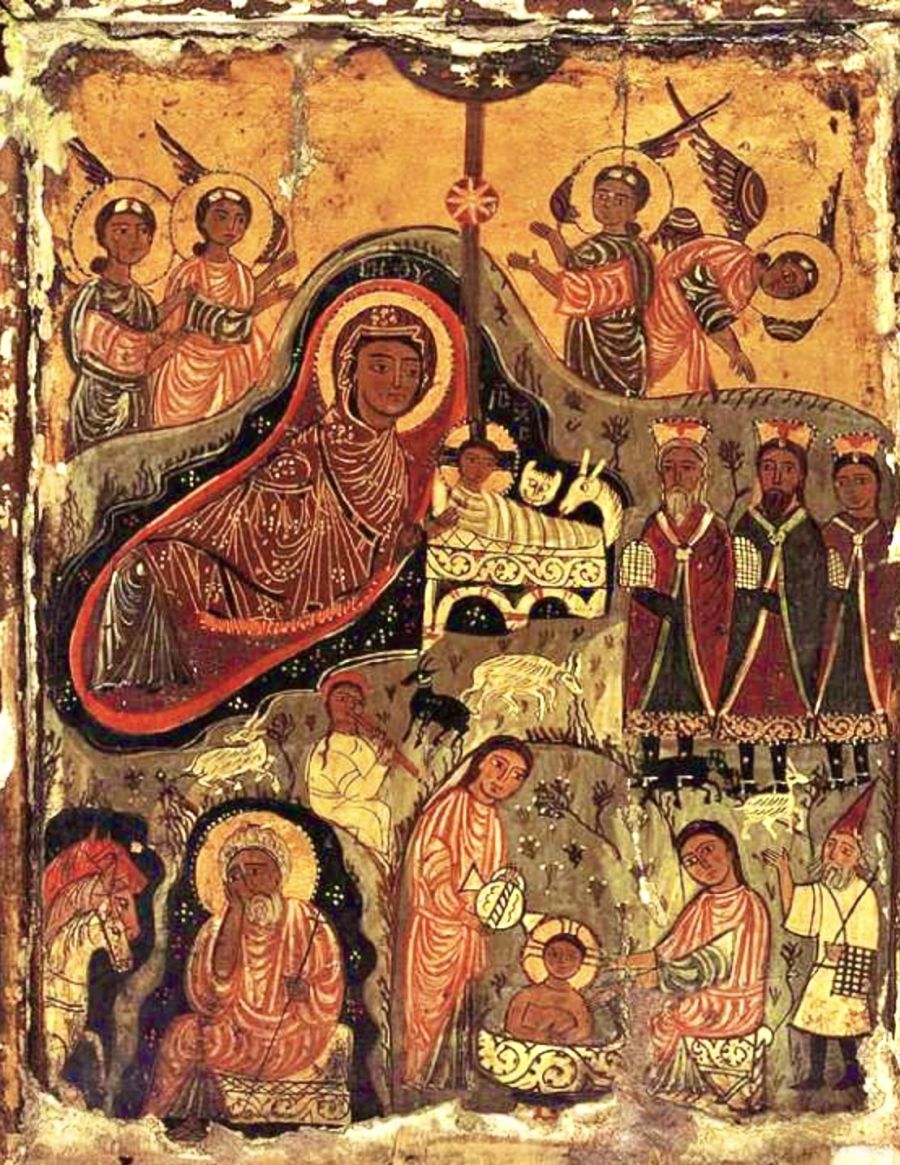
Epiphany of the Lord (year A) [6 January 2026]
May God bless us and may the Virgin protect us! Happy Epiphany!
*First Reading from the Book of the Prophet Isaiah (60:1-6)
In these dark days, here is an announcement of light! This text from Isaiah is filled with insistent images of light: "Arise, shine, for your light has come, and the glory of the Lord has risen upon you... The Lord shines upon you... His glory appears upon you... Then you will see and be radiant." It is precisely this abundance of light that makes us understand that the real climate is anything but bright. The prophets do not cultivate paradox, but the art of hope: they speak of light because the people are immersed in the darkest night. The historical context is that of the post-exile period (525-520 BC). The return from Babylon did not bring the expected prosperity. Tensions are high: between those who remained in the country and those returning from exile; between different generations; between Jews and foreign populations settled in Jerusalem during the occupation. The most painful issue concerns the reconstruction of the Temple: the returnees refuse the help of groups considered religiously unfaithful; this gives rise to a conflict that blocks the work and dampens enthusiasm. As the years passed, discouragement set in. It was here that Isaiah, together with the prophet Haggai (cf. 1:2-8, 12-15; 2:3-9), provoked a spiritual awakening. Sadness is not worthy of the people of the promises. The prophet's one great argument is this: Jerusalem is the city chosen by God, the place where He has placed His Name. For this reason, Isaiah can dare to say: 'Arise, Jerusalem! Shine forth'. Even when everything seems dark, God's faithfulness remains the foundation of hope. The almost triumphal language does not describe a situation that has already been resolved, but anticipates the day that is coming. In the night, we look for the dawn: the prophet's task is to restore courage, to remember the promise. The message is clear: do not be discouraged; get to work, rebuild the Temple, because the light of the Lord will come. Three final points: Faith combines lucidity and hope: seeing reality does not extinguish trust. The promise is not a political triumph, but God's victory, his glory that illuminates humanity. Jerusalem already points to the people and, beyond the people, to all humanity called to communion: God's plan transcends every city and every border.
*Important elements: +Post-exilic context (525-520 BC) and climate of discouragement. +Internal conflicts and blockage of the reconstruction of the Temple. +Language of light as an announcement of hope in the night. +Vocation of Jerusalem: chosen city, place of Presence. +Prophetic call to action: rise up and rebuild. +Hope based on God's faithfulness, not on political successes. +Universal openness: the promise concerns all humanity
*Responsorial Psalm (71/72)
Men dream and God carries out his plan. Psalm 71 ideally brings us into the celebration of a king's coronation. The accompanying prayers express the deepest desires of the people: justice, peace, prosperity for all, to the ends of the earth. It is the great dream of humanity throughout the ages. Israel, however, has a unique certainty: this dream coincides with God's own plan. The last verse of the psalm, which blesses only the Lord and not the king, offers us the key to understanding. The psalm was composed after the exile, at a time when there was no longer a king in Israel. This means that the prayer is not addressed to an earthly sovereign, but to the king promised by God, the Messiah. And since it is a divine promise, it is certain. The whole Bible is permeated with this unshakeable hope: history has meaning and direction. The prophets call it 'the Day of the Lord', Matthew 'the Kingdom of Heaven', Paul 'the merciful plan'. It is always the same plan of love that God tirelessly proposes to humanity. The Messiah will be its fulfilment, and it is He whom Israel invokes in praying the psalms. This Psalm describes the ideal king, awaited for centuries, in continuity with the promise made to David through the prophet Nathan: a kingdom stable forever, a king called the son of God. Over the centuries, this promise has been deepened: if the king is the son of God, then his kingdom will be founded on justice and peace. Each new coronation rekindled this expectation. Yet the ideal kingdom has not yet been fully realised. It may seem like a utopia. But for the believer it is not: it is a promise from God, and therefore a certainty. Faith is the anchor of the soul: in the face of the failures of history, the believer does not give up hope, but waits patiently, certain of God's faithfulness. The psalm announces a decisive reversal: power and justice will finally coincide. In God, power is only love. For this reason, the messianic king will free the poor, defend the weak and bring endless peace. His kingdom will have no boundaries: it will extend to the whole earth and last forever. For Israel, this psalm remains a prayer of expectation for the Messiah. For Christians, it is fulfilled in Jesus Christ, and the episode of the Wise Men is already a sign of the universality of his kingdom: the nations come to him, bringing gifts and adoration.
*Important elements: +Psalm 71 as a prayer for the universal desires for justice and peace. +Coincidence between man's dream and God's plan. +Post-exilic composition: waiting for the king-Messiah. +Promise made to David (2 Sam 7) as the foundation of expectation. +History has meaning and direction in God's plan. +The ideal king: justice, peace, defence of the poor. +God's power as love and service. +Universal and endless kingdom. +Messianic Jewish reading and Christian fulfilment in Jesus Christ. + The Wise Men as the first sign of the fulfilment of the universal promise
*Second Reading from St Paul's Letter to the Ephesians (3:2...6)
This passage is taken from the Letter to the Ephesians (chapter 3) and takes up a central theme already announced in chapter 1: the 'merciful plan/mystery of God'. Paul recalls that God has made known the mystery of his will: to bring history to its fulfilment, recapitulating in Christ all that is in heaven and on earth (Eph 1:9-10). For St Paul, the mystery is not a closely guarded secret, but God's intimacy offered to man. It is a plan that God reveals progressively, with patient pedagogy, just as a parent accompanies a child in the discovery of life. Thus God has guided his people throughout history, step by step, until the decisive revelation in Jesus Christ. With Christ, a new era begins: before and after him. The heart of the mystery is this: Christ is the centre of the world and of history. The whole universe is called to be reunited in Him, like a body around its head. Paul emphasises that this unity concerns all nations: all are associated in sharing the same inheritance, in forming the same body, in participating in the same promise through the Gospel. In other words: the inheritance is Christ, the promise is Christ, the body is Christ. When we say "Thy will be done" in the Lord's Prayer, we are asking for the fulfilment of this plan. God's plan is therefore universal: it concerns not only Israel, but all humanity. This openness was already present in the promise made to Abraham: "All the families of the earth shall be blessed in you" (Gen 12:3), and proclaimed by prophets such as Isaiah. However, this truth was slowly understood and often forgotten. At the time of Paul, it was not at all obvious to accept that pagans were fully participants in salvation. The early Christians of Jewish origin struggled to recognise them as full members. Paul intervenes decisively: pagans too are called to be witnesses and apostles of the Gospel. It is the same message that Matthew expresses in the story of the Wise Men: the nations come to the light of Christ. The text ends with an appeal: God's plan requires the cooperation of man. If there was a star for the Wise Men, for many today the star will be the witnesses of the Gospel. God continues to fulfil his benevolent plan through the proclamation and life of believers.
*Important elements: +The 'mystery' as a revelation of God's benevolent plan and progressive revelation culminating in Christ. +Christ as the centre of history and the universe and all humanity united in Christ: heritage, body and promise. Universality of salvation: Jews and pagans together in continuity with the promise to Abraham and the prophets. +Historical difficulties in accepting pagans. +Epiphany and Wise Men as a sign of universalism and Call to witness: collaborating in the proclamation of the Gospel
*From the Gospel according to Matthew (2:1-12)
At the time of Jesus, the expectation of the Messiah was very intense. People spoke of him everywhere and prayed to God to hasten his coming. Most Jews imagined the Messiah as a king descended from David: he would reign from Jerusalem, drive out the Romans and finally establish peace, justice and brotherhood in Israel; some even hoped that this renewal would extend to the whole world. This expectation was based on various prophecies in the Old Testament. First of all, that of Balaam in the Book of Numbers: called to curse Israel, he instead announced a promise of glory, speaking of a star rising from Jacob and a sceptre rising from Israel (Num 24:17). Over the centuries, this prophecy was interpreted in a messianic sense, to the point of suggesting that the coming of the Messiah would be marked by a star. This is why Herod takes the news brought by the Wise Men very seriously. Another decisive prophecy is that of Micah, who announces the birth of the Messiah in Bethlehem, the small village from which the ruler of Israel will come (Micah 5:1), in continuity with the promise made to David of a dynasty destined to last. The Wise Men, probably pagan astrologers, do not have a deep knowledge of the Scriptures: they set out simply because they have seen a new star. When they arrive in Jerusalem, they inquire with the authorities. Here a first great contrast emerges: on the one hand, the Wise Men, who seek without prejudice and ultimately find the Messiah; on the other, those who know the Scriptures perfectly but do not move, do not even make the short journey from Jerusalem to Bethlehem, and therefore do not encounter the Child. Herod's reaction is yet different. Jealous of his power and known for his violence, he sees the Messiah as a dangerous rival. Behind an apparent calm, he seeks precise information: the place of birth and the age of the child. His anguish and fear lead him to the cruel decision to kill all children under the age of two. In the story of the Wise Men, Matthew already offers us a summary of the entire life of Jesus: from the beginning, He encounters hostility and rejection from political and religious authorities. He will not be recognised as the Messiah, He will be accused and finally eliminated. Yet He is truly the promised Messiah: anyone who seeks Him with a sincere heart, like the Wise Men, can enter into God's salvation.
*St John Chrysostom on the episode of the Wise Men: "The Wise Men, though foreigners, rose, departed and came to the Child; so too must those who wish to encounter Christ move with a fervent heart, without waiting for comfort or security." (Homily VII on Matthew 2)
*Most important elements: +Strong messianic expectation at the time of Jesus and expectation of a Messiah-king, descendant of David. +Prophecy of the star (Balaam) and birth in Bethlehem (Micah). +The Wise Men: sincere seekers guided by the star. +Contrast between those who seek and those who know but do not move. +Herod's hostility, jealousy of power and violence. +Jesus rejected from the beginning of his life. + Universality of salvation: those who seek, find. + The Wise Men as a model of faith on the journey.
+ Giovanni D'Ercole








