Mar 30, 2026 Written by 

From outside to inside

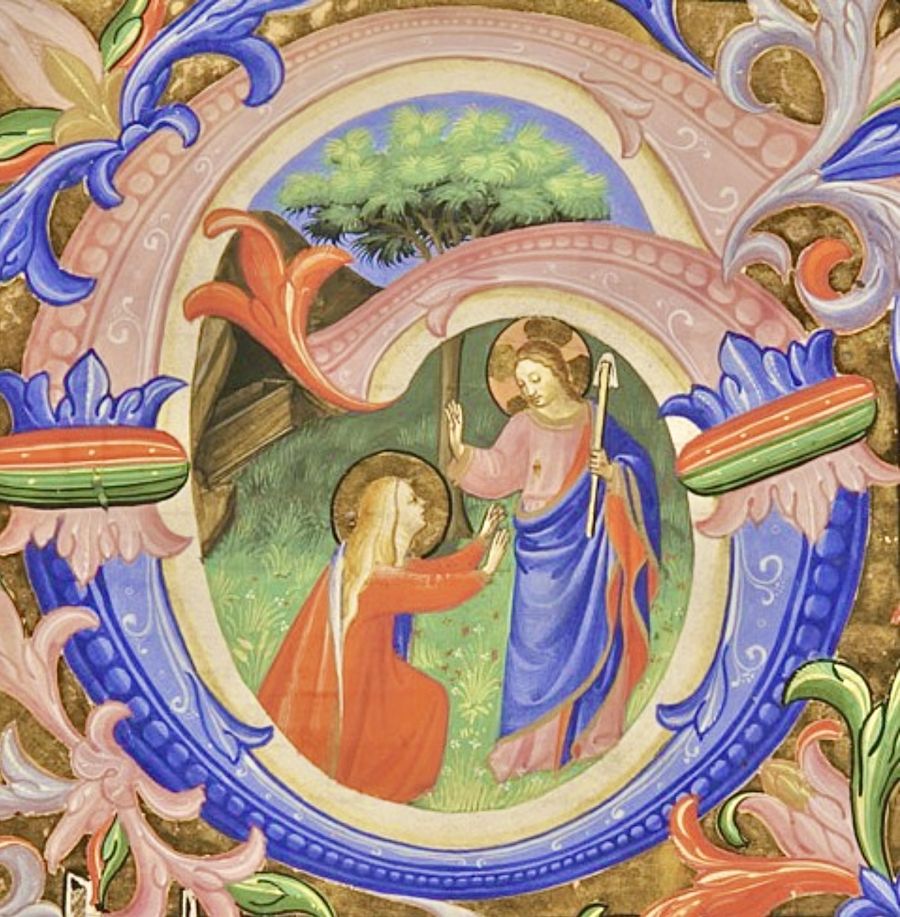
«Woman, why are you weeping? Whom do you seek?» (Jn 20:15)


Mary of Magdala wept for her Lord near the tomb. Lost and grieving, she grieved not knowing where he was, until Jesus made himself present.

Clare too, in the enclosure of San Damiano, wept while praying for her Christ, uniting herself to his Passion, while awaiting the Resurrection.

In the Legend we read:

"She had now fixed in the Light the burning gaze of inner desire and, having transcended the sphere of human vicissitudes, she opened wide the field of her spirit to the rain of Grace.

[...] Very often, prostrate in prayer with her face to the ground, she bathed the ground with tears and brushed it with kisses: so that she seemed always to have her Jesus in her arms, whose feet she bathed with tears, on whom she pressed kisses" (FF 3197).

Clare inwardly sought the Lord, even for those who did not desire Him.

She was careful not to hold back Christ who was ascending to the Father, living the announcement of the Resurrection with a face of light, testifying to the present vision of Him to the brothers and sisters who approached her.

He lived the perennial earthly Exodus in view of the Promised Land, which he already savoured in small doses.

Francis, for his part, jester of the Resurrection, mourned the Passion of Love, corroborated by existential rebirth.

Again, in St Bonaventure's Major Legend:

"To those who saw him, he seemed a man from another world: one who, his mind and face always turned to heaven, strove to draw all upwards" (FF 1072).

Just as Mary of Magdala made the transition from outside (near the tomb) to inside her own soul - to recognise the Risen Jesus.

So Francis, after living on the outside, among cheerful Assisian brigades, had encountered the «Rabbuni» within his heart.  Recognising and deciphering the Master of his life, in prayer before the Crucifix of San Damiano.

There finding God, he found himself again; in the midst of weeping and perfect joy.

Jesus also asked him the question: «Why are you weeping? Whom do you seek?» (Jn 20:15).

The Damianite Crucifix became the place of his resurrection, where the tears of a missed life, spent in solace, gave way to the Calling by name, in view of a personal and communitarian regeneration.

At Saint Damian, when a divine Voice came to him from the Crucifix inviting him to change his life, the Poor Man uttered this prayer

«Rapture, I pray thee, O Lord,

the burning and sweet power of your love

my mind from all things that are under heaven,

that I might die for love of thy love,

As thou hast deigned to die

for love of my love» (FF 277).


Octave of Easter Tuesday  (Jn 20:11-18)

184 Last modified on Monday, 30 March 2026 05:24
Teresa Girolami

Teresa Girolami è laureata in Materie letterarie e Teologia. Ha pubblicato vari testi, fra cui: "Pellegrinaggio del cuore" (Ed. Piemme); "I Fiammiferi di Maria - La Madre di Dio in prosa e poesia"; "Tenerezza Scalza - Natura di donna"; co-autrice di "Dialogo e Solstizio".

Email This email address is being protected from spambots. You need JavaScript enabled to view it.
In this passage, the Lord tells us three things about the true shepherd:  he gives his own life for his sheep; he knows them and they know him; he is at the service of unity [Pope Benedict]
In questo brano il Signore ci dice tre cose sul vero pastore: egli dà la propria vita per le pecore; le conosce ed esse lo conoscono; sta a servizio dell'unità [Papa Benedetto]
Let us permit St Augustine to speak once more: "If only good shepherds be not lacking! Far be it from us that they should be lacking, and far be it from divine mercy not to call them forth and establish them. It is certain that if there are good sheep, there are also good shepherds: in fact it is from good sheep that good shepherds are derived." (Sermones ad populum, Sermo XLIV, XIII, 30) [John Paul II]
Lasciamo ancora una volta parlare Sant’Agostino: “Purché non vengano a mancare buoni pastori! Lungi da noi che manchino, e lungi dalla misericordia divina il non farli sorgere e stabilirli. Certo è che se ci sono buone pecore, ci sono anche buoni pastori: infatti è dalle buone pecore che derivano i buoni pastori” (S. Agostino, Sermones ad populum, I, Sermo XLIV, XIII, 30) [Giovanni Paolo II]
Jesus, Good Shepherd and door of the sheep, is a leader whose authority is expressed in service, a leader who, in order to command, gives his life and does not ask others to sacrifice theirs. One can trust in a leader like this (Pope Francis)
Gesù, pastore buono e porta delle pecore, è un capo la cui autorità si esprime nel servizio, un capo che per comandare dona la vita e non chiede ad altri di sacrificarla. Di un capo così ci si può fidare (Papa Francesco)
To be Christians means to be missionaries, to be apostles (cfr. Decree Apostolicam Actuositatem, n.2). It is not enough to discover Christ - you must bring Him to others! [John Paul II]
Essere cristiani significa essere missionari-apostoli (cfr. «Apostolicam Actuositatem», 2). Non basta scoprire Cristo - bisogna portarlo agli altri! [Giovanni Paolo II]
What is meant by “eat the flesh and drink the blood” of Jesus? Is it just an image, a figure of speech, a symbol, or does it indicate something real? (Pope Francis)
Che significa “mangiare la carne e bere il sangue” di Gesù?, è solo un’immagine, un modo di dire, un simbolo, o indica qualcosa di reale? (Papa Francesco)
What does bread of life mean? We need bread to live. Those who are hungry do not ask for refined and expensive food, they ask for bread. Those who are unemployed do not ask for enormous wages, but the “bread” of employment. Jesus reveals himself as bread, that is, the essential, what is necessary for everyday life; without Him it does not work (Pope Francis)
Che cosa significa pane della vita? Per vivere c’è bisogno di pane. Chi ha fame non chiede cibi raffinati e costosi, chiede pane. Chi è senza lavoro non chiede stipendi enormi, ma il “pane” di un impiego. Gesù si rivela come il pane, cioè l’essenziale, il necessario per la vita di ogni giorno, senza di Lui la cosa non funziona (Papa Francesco)
In addition to physical hunger man carries within him another hunger — all of us have this hunger — a more important hunger, which cannot be satisfied with ordinary food. It is a hunger for life, a hunger for eternity which He alone can satisfy, as he is «the bread of life» (Pope Francis)
Oltre alla fame fisica l’uomo porta in sé un’altra fame – tutti noi abbiamo questa fame – una fame più importante, che non può essere saziata con un cibo ordinario. Si tratta di fame di vita, di fame di eternità che Lui solo può appagare, in quanto è «il pane della vita» (Papa Francesco)

Due Fuochi due Vie - Vol. 1 Due Fuochi due Vie - Vol. 2 Due Fuochi due Vie - Vol. 3 Due Fuochi due Vie - Vol. 4 Due Fuochi due Vie - Vol. 5 Dialogo e Solstizio I fiammiferi di Maria

duevie.art

don Giuseppe Nespeca

Tel. 333-1329741


Disclaimer

Questo blog non rappresenta una testata giornalistica in quanto viene aggiornato senza alcuna periodicità. Non può pertanto considerarsi un prodotto editoriale ai sensi della legge N°62 del 07/03/2001.
Le immagini sono tratte da internet, ma se il loro uso violasse diritti d'autore, lo si comunichi all'autore del blog che provvederà alla loro pronta rimozione.
L'autore dichiara di non essere responsabile dei commenti lasciati nei post. Eventuali commenti dei lettori, lesivi dell'immagine o dell'onorabilità di persone terze, il cui contenuto fosse ritenuto non idoneo alla pubblicazione verranno insindacabilmente rimossi.






