


don Giuseppe Nespeca
Giuseppe Nespeca è architetto e sacerdote. Cultore della Sacra scrittura è autore della raccolta "Due Fuochi due Vie - Religione e Fede, Vangeli e Tao"; coautore del libro "Dialogo e Solstizio".
Disarming power of truth breaks down the wall of hypocrisy
The hypocritical accusers pretend to entrust the judgement to him whereas it is actually he himself whom they wish to accuse and judge. Jesus, on the other hand, is "full of grace and truth" (Jn 1: 14): he can read every human heart, he wants to condemn the sin but save the sinner, and unmask hypocrisy. St John the Evangelist highlights one detail: while his accusers are insistently interrogating him, Jesus bends down and starts writing with his finger on the ground. St Augustine notes that this gesture portrays Christ as the divine legislator: in fact, God wrote the law with his finger on tablets of stone (cf. Commentary on John's Gospel, 33,5). Thus Jesus is the Legislator, he is Justice in person. And what is his sentence? "Let him who is without sin among you be the first to throw a stone at her". These words are full of the disarming power of truth that pulls down the wall of hypocrisy.
[Pope Benedict, Angelus 21 March 2010]
2. The present-day mentality, more perhaps than that of people in the past, seems opposed to a God of mercy, and in fact tends to exclude from life and to remove from the human heart the very idea of mercy. The word and the concept of "mercy" seem to cause uneasiness in man, who, thanks to the enormous development of science and technology, never before known in history, has become the master of the earth and has subdued and dominated.
15. Let us offer up our petitions, directed by the faith, by the hope, and by the charity which Christ has planted in our hearts. This attitude is likewise love of God, whom modern man has sometimes separated far from himself, made extraneous to himself, proclaiming in various ways that God is "superfluous." This is, therefore, love of God, the insulting rejection of whom by modern man we feel profoundly, and we are ready to cry out with Christ on the cross: "Father, forgive them; for they know not what they do."137 At the same time it is love of people, of all men and women without any exception or division: without difference of race, culture, language, or world outlook, without distinction between friends and enemies. This is love for people-it desires every true good for each individual and for every human community, every family, every nation, every social group, for young people, adults, parents, the elderly-a love for everyone, without exception. This is love, or rather an anxious solicitude to ensure for each individual every true good and to remove and drive away every sort of evil.
[Pope John Paul II, Dives in Misericordia]
When it is said of someone that they are a person with a double life, it is not to pay them a compliment. On the contrary. It is those people who irritate, cause indignation, or often even disgust with behaviour that contradicts the things that they are paying lip service to. Whether it is a politician or a neighbour makes little difference: discovering, so to speak, a 'double life', is something that always hurts. And let us not mention the disillusionment it can generate, especially in young people.
But if preaching well and braying badly is always an irritating thing, when it is a priest doing it, it is even more intolerable. Because there is something more at stake. Pope Francis said it very clearly, and as always in a very direct and effective style, a few days ago. When, in the homily of the morning Mass at Santa Marta, he stressed how "it is ugly to see pastors of double life", indeed it is a real "wound in the Church". For the Pope, they are "sick pastors, who have lost their authority and go on in this double life"; and, he added, "there are many ways of carrying on the double life: but it is double ... And Jesus is very strong with them. Not only does he tell people not to listen to them but not to do what they do, but what does he say to them? "You are whited sepulchres": beautiful in doctrine, from the outside. But inside, rottenness. This is the end of the pastor who has no closeness with God in prayer and with people in compassion'.
For it is this that makes the difference. Francis reiterates it firmly: 'What gives a pastor authority or awakens the authority that is given by the Father, is closeness: closeness to God in prayer and closeness to people. The pastor detached from the people does not reach the people with the message. Closeness, this double closeness. This is the anointing of the pastor who is moved by God's gift in prayer, and can be moved by people's sins, problems, illnesses: let the pastor be moved. The scribes ... had lost the 'ability' to be moved precisely because 'they were not close either to the people or to God'". And without this closeness, or when for whatever reason it is lost, 'the shepherd ends up in inconsistency of life'.
It seems like re-reading the words that John Paul II, in his Holy Thursday letter addressed to priests around the world in 1986, dedicated to the Holy Curate of Ars, pointing to him, on the second centenary of his birth, as an example for all priests. 'It is certainly not a matter of forgetting,' wrote Benedict XVI, again on St John Mary Vianney, in his letter of indiction for the 2009 Year for Priests, 'that the substantial effectiveness of the ministry remains independent of the holiness of the minister; but neither can we overlook the extraordinary fruitfulness generated by the encounter between the objective holiness of the ministry and the subjective holiness of the minister. The Curé d'Ars immediately began this humble and patient work of harmonisation between his life as a minister and the holiness of the ministry entrusted to him, deciding to 'live' even materially in his parish church: 'As soon as he arrived, he chose the church as his dwelling... He would enter the church before dawn and only leave it after the evening Angelus. There one had to look for him when one needed him,' reads the first biography'. Consistency, then. Not duplicity. Because God's people need everything except whitewashed sepulchres.
[Pope Francis, St. Martha; Salvatore Mazza in Avvenire 13 January 2018]

Filtering and swallowing. Duality or integral practice: branches and Roots
(Mt 23:23-26)
When leaders of an equivocal religiosity want to be accredited, they insist on abstract ideas or details, and pretend not to see the abnormal.
In ancient times, the duplicity between what they showed and what they cultivated was proverbial.
To cover up their despicable spirit of robbery (v.25), here they are to make sprout all sorts of legalistic subtleties, overshadowing the substantial demands.
Even in Israel, they were never on the line of the Prophets: they calculated to make Jesus suffer who exposed them, to discourage him with mocking insults and accusations - in order to undermine his boldness.
Yet the new Rabbi continued in the lashing condemnation of religious formalism, which created barriers to any profound motivations’ search for action.
However, his story makes us understand that even the harsh conditions and ambiguous attitudes of the authorities themselves can be an opportunity and a starting point.
Perhaps a gift, to act.
The inner person also enlivens by breaking a mask, a role, a formal task, a character; a consolidated icon of wanting to appear and not to be.
However, today it is also up to us to take the greatest risk with Christ, in favour of a long adventure of the soul.
Here we touch those spaces where the Call by Name does not resemble anyone else.
Where we meet ourselves, our profound vocational identity, the unexpressed talents, and the divine Author’s signature, in Uniqueness.
If we do not keep it quiet, then the vocational Seed that does not lie and guides us emerges; the present Risen Christ who reveals himself to be understanding, delicate, attentive, absolutely personal but clear.
Attention to details and minutiae is good and propulsive (v.23) only if it joins this intimate discovery of one’s singular Mission.
Here the reference to substantial values does not imply carelessness or contempt for what seems secondary: this appeal can conceal an unrepeatable character.
Devoid of extreme solicitations, the motive of our actions would perhaps remain the benefit and concern of our own fame; so on.
This would pervade the soul from not doing or not saying anything, making arid and discredited the experience of Faith.
In this way, even an internal or external contradiction can contribute to giving birth to our deepest side.
Even anger at a disorder can activate development, so that we correspond to our Name.
And so we sink our roots, strengthen the trunk, to stimulate inner youthfulness. With our sights set on the hidden Seed, before raising “branches”.
The Master proposes an ascent to essentiality - also so that we can follow the «one specific path that the Lord has in mind for us» [Gaudete et Exsultate n.11].
All in a great desire to be born again, in the small and the big, to give birth to our deepest side.
[Tuesday 21th wk. in O.T. August 25, 2026]
In the Liturgy of the Word [...] the theme of God’s Law, of his commandments, makes its entrance in the Liturgy of the Word this Sunday. It is an essential element of the Jewish and Christian religions, where the complete fulfilment of the law is love (cf. Rom 13:10). God’s Law is his word which guides men and women on the journey through life, brings them out of the slavery of selfishness and leads them into the “land” of true freedom and life. This is why the Law is not perceived as a burden or an oppressive restriction in the Bible. Rather, it is seen as the Lord’s most precious gift, the testimony of his fatherly love, of his desire to be close to his People, to be its Ally and with it write a love story.
This is what the devout Israelite prays: “I will delight in your statutes, / I will not forget your word.... Lead me in the path of your commandments, / for I delight in it” (Ps 119[118]:16, 35). In the Old Testament the person who passes on the Law to the People on God’s behalf is Moses. After the long journey in the wilderness, on the threshold of the promised land, he proclaims: “Now, O Israel, give heed to the statutes and the ordinances which I teach you, and do them; that you may live, and go in and take possession of the land which the Lord, the God of your fathers, gives you” (Deut 4:1). And this is the problem: when the People put down roots in the land and are the depository of the Law, they are tempted to place their security and joy in something that is no longer the Word of God: in possessions, in power, in other ‘gods’ that in reality are useless, they are idols. Of course, the Law of God remains but it is no longer the most important thing, the rule of life; rather, it becomes a camouflage, a cover-up, while life follows other paths, other rules, interests that are often forms of egoism, both individual and collective.
Thus religion loses its authentic meaning, which is to live listening to God in order to do his will — that is the truth of our being — and thus we live well, in true freedom, and it is reduced to practising secondary customs which instead satisfy the human need to feel in God’s place. This is a serious threat to every religion which Jesus encountered in his time and which, unfortunately, is also to be found in Christianity. Jesus’ words against the scribes and Pharisees in today’s Gospel should therefore be food for thought for us as well.
Jesus makes his own the very words of the Prophet Isaiah: “This People honours me with their lips, but their heart is far from me; in vain do they worship me, teaching as doctrines the precepts of men” (Mk 7:6-7; cf. Is 29,13). And he then concludes: “You leave the commandment of God, and hold fast the tradition of men” (Mk 7:8).
The Apostle James too alerts us in his Letter to the danger of false piety. He writes to the Christians: “Be doers of the word, and not hearers only, deceiving yourselves” (Jas 1:22). May the Virgin Mary, to whom we now turn in prayer, help us to listen with an open and sincere heart to the word of God so that every day it may guide our thoughts, our decisions and our actions.
[Pope Benedict, Angelus 2 September 2012]
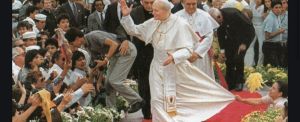
1. "Lord, show us the Father" (Jn 14:8). In the culminating and concluding hour of the messianic activity of Jesus of Nazareth, on the eve of his passion and death on the cross, the Apostles gathered in the cenacle, and in particular Philip, ask the Master: "Lord, show us the Father". Jesus answers them: 'He who has seen me has seen the Father.... I am in the Father and the Father is in me" (Jn 14:9. 11). The disciples' last conversation with their Master is dense with profound content; in it the most profound elements of the Good News converge and are somehow encapsulated. During his earthly mission Jesus had continually spoken of the Father, he had always lived united with Him, in everything he had referred to Him. He, who is totally from Him and for Him, had commanded the disciples to pray to Him by calling Him: 'Our Father'. At the Last Supper, answering Philip's question, he says: "Do you not believe that I am in the Father and the Father is in me? The words that I say to you, I do not speak them of myself; but the Father who is with me does his works... believe this by the works themselves" (John 14: 10-11).
2. Who is God? The answer to this question is undoubtedly paramount and fundamental to human life. The answers to the questions "Does God exist?" and "Who is God?" can be found in superabundance in the Good News enunciated by Christ. "The only-begotten Son, who is in the bosom of the Father, he has revealed him" (Jn 1:18). He has revealed God to us in his infinite glory. Although he always remains a mystery to us human beings, this God - Father, Son and Holy Spirit - allows us to call him by name. Already in the Old Covenant his Name was revealed to men: Yahweh, "He who is". In the Gospel revelation this Name of God, without losing its primordial identity, has in a certain sense been further opened to human intelligence: "He who is" is Father, Son and Holy Spirit. Believers have thus been given to know through faith the inscrutable unity of the Trinity.
3. At the same time, this infinite and mysterious God in His only-begotten Son has drawn near to man in an ineffable way: in Him, the Word made flesh, God has become man. This is why man can now see God: "He who has seen me has seen the Father" (Jn 14:9). But God has done even more: Christ, the Son of God, has come among men as the Way to the Father. He himself, who comes from the Father and returns to the Father through his cross and resurrection, becomes the Way for us all. Through Him, we too "go" to the Father: through Christ in the Holy Spirit. Through Him we can participate in the fullness of God's own Truth and Life: Yahweh, that is, "He who is" is precisely this absolute divine Fullness, which in Christ is shared with us. "No one comes to the Father except through me" (Jn 14:6), says Jesus. In Him, human life finds its ultimate end in God, who manifests Himself as the eternal "dwelling place" for man, whose existence on earth is like a pilgrimage in search of the Absolute. "In my Father's house there are many places" (Jn 14:2): therefore there are many who will dwell there. To the questions and difficulties of human intelligence, which before this statement wonders how this will be possible, Jesus replies: "If not, I would have told you. I am going to prepare a place for you...". (Jn 14:2). We are thus led to the summit of our faith and hope: Christ's messianic activity, which proclaims the Gospel of the Kingdom and fulfils the paschal mystery, constitutes a unique preparation for definitive communion with God. Through this salvific mission, the Son prepares a place for us in the Father's house. We are therefore all "called", that is, we are invited to dwell in the eternal dwellings, to participate in and enjoy that fullness of Truth and Life that is God himself.
4. The invitation to dwell in the eternal dwellings is addressed to all of us, dear Brothers and Sisters, gathered in this enchanting Valley, witness to the ancient and glorious Church of St Libertine. We stand before the largest complex of ancient temples still standing today. It speaks to us of the deep need for God present in the heart of humanity in every age and culture. And I am glad to be able to read and interpret with you this Johannine Gospel of today Sunday. I am glad that these ancient columns of Greek temples can hear the living voice of the Gospel, of Christian Revelation, after so many millennia. We are living, this evening, at the close of my visit to your Diocese, a special experience of faith and communion. Coming from the various regions of the Island, dear faithful, you have gathered together with the Successor of Peter to renew your adherence to Christ, the "cornerstone" that structures the whole edifice of God. You are the witnesses of Jesus, Way, Truth and Life of man in this Sicilian land. Your existence is called to become more and more an evangelical sign of reconciliation and resurrection.
5. When man opens himself to faith, he experiences that selfishness is replaced by altruism, hatred by love, revenge by forgiveness, greed by loving service, selfishness and individualism by solidarity, division by concord - as this ancient temple near Agrigento is called -, violence by mercy. This happens when man opens himself to faith. When, on the other hand, one rejects the Gospel and its message of salvation, a process of attrition of moral values is set in motion, which easily has negative repercussions on social life itself. Is this not perhaps the ultimate reason for the failure of a culture based on personal gain, which does not consider the real needs of people, especially the poorest, condemned to remain victims of the injustices of an increasingly competitive society with less and less solidarity? The real force capable of overcoming these destructive tendencies springs from faith. This, however, demands not only an intimate personal adherence, but also a courageous outward witness, expressed in a convinced condemnation of evil. It demands here, in your land, a clear reprobation of the culture of the Mafia, which is a culture of death, profoundly inhuman, anti-evangelical, an enemy of the dignity of persons and of civil coexistence.
6. The serious situations of poverty, which have caused so much suffering among your people, forcing a large number of men and women to separate from their dearest affections to emigrate to distant countries, have favoured the emergence and spread of real diseases in the social fabric, such as latifundialism and mafia phenomena. At the same time, however, many people, precisely in such difficult conditions, have learnt to suffer with dignity, to work with tenacity, and to never lose hope in God and man. Just as in past years the Sicilian people were able to overcome long and painful trials, so too today they have the necessary resources, together with the solidarity support of the Italian nation, to heal the current wounds, many of which are the fruit of atavistic social conditions. The Sicilian Church is called, today as in the past, to share the commitment, fatigue and risks of those who struggle, even at personal cost, to lay the foundations for a future of progress, justice and peace for the entire Island.
7. May divine grace sustain you, dear friends, in this fraternal and concerted effort. "Turn to us, O Lord; in you we hope" (Responsorial Psalm): the liturgy has had us repeat this confident invocation just now. We hope in the Lord: this is the firm certainty that sustains the steps of those who work for justice and peace. May this also be the comfort of all of you, living stones of the ancient edifice of the pilgrim Church of God in Sicily. With these sentiments I am happy to embrace in the Lord the dear Bishops of the Region, present here together with Cardinal Salvatore Pappalardo, Archbishop of Palermo. I greet in particular Monsignor Carmelo Ferraro, Pastor of the Diocese of Agrigento, which is hosting this solemn celebration. I cordially thank him for the courteous expressions he wished to address to me on your behalf. My thoughts turn then to the secular and regular Clergy, to the priests, to the men and women Religious, to the Members of secular Institutes and Societies of Apostolic Life, as well as to the Laity generously engaged in Christian life in the different fields, in the different vocations, in the different commitments. Finally, I address a special, affectionate thought to the sick, those who are present here and many others whom I wish to unite in my prayers and intentions. Then there are the young people. They have kept vigil all night. They should be tired and fatigued, but you cannot see it. You can see the strength. Where did this strength come from? I think it came from the Spirit that the Lord does not deny to those who pray to Him. And these young people prayed all night long. I wish you, dear friends, this strength, the strength for good, the strength to overcome the hardships, the moral illnesses of your land. The strength for a better future for Sicily. In this context, the words of the Apostle Peter ring true: 'You are a chosen race, a royal priesthood, a holy nation, a people whom God has purchased to proclaim the wonderful works' (1 Pet 2:9) of the Lord. Be all of you apostles of the One who has called you out of darkness into his admirable light. This is the charge I leave you. Especially to you, young people, and to all you members of this splendid Christian community of Agrigento.
8. "I am the way, the truth and the life" (Jn 14:6): as he once spoke to the apostles, so Jesus speaks to us this evening. He adds: "I will take you with me, that you also may be where I am. And of the place where I go, you know the way" (John 14: 3-4), for: "I am going to the Father". We all, following Christ, his prayer, his Gospel, repeat tonight "Our Father". It is the prayer of our life. Not only do we strive to make the invocations of this prayer our own, but we want to love Christ, the only Way to the Father, with all our heart and life.
Lord Jesus, "show us the Father and that is enough for us" (John 14: 8).
Amen!
At the end of the Holy Mass, after the final Blessing, John Paul II pronounced these words in his own words (the transcription that follows is literal, therefore with some grammatical imperfections)
Dearly beloved,
I wish you, as the deacon said, to go in peace: to go in peace to find peace in your land.
Dearly beloved,
one does not easily forget such a celebration, in this Valley, against the backdrop of temples: temples from the Greek period that express this great culture and this great art and also this religiosity, the temples that are witnesses today to our Eucharistic celebration. And one has been named "Concordia": be this name emblematic, be it prophetic. Let there be concord in this land of yours! Concordia without death, without murder, without fear, without threats, without victims! Let there be concord! This concord, this peace to which every people and every family aspires! After so many times of suffering you finally have a right to live in peace. And these who are guilty of disturbing this peace, these who bear so many human victims on their consciences, they must understand, they must understand that innocent people are not allowed to be killed! God once said: 'Thou shalt not kill': no man, any, any human agglomeration, mafia, cannot change and trample on this most holy right of God!
This people, the Sicilian people, so attached to life, a people that loves life, that gives life, cannot always live under the pressure of an opposing civilisation, a civilisation of death. What is needed here is a civilisation of life! In the name of this Christ, crucified and risen, of this Christ who is life, the way, the truth and the life, I say to those responsible: convert! Once will come the judgement of God!
Dearly beloved,
thank you for your participation in this prayer that is so evocative, so profound, so participatory. I leave you with this greeting: Praised be Jesus Christ, the way, the truth and the life! Amen.
[Pope John Paul II, homily in the Valley of the Temples, Agrigento 9 May 1993]
11. “Each in his or her own way” the Council says. We should not grow discouraged before examples of holiness that appear unattainable. There are some testimonies that may prove helpful and inspiring, but that we are not meant to copy, for that could even lead us astray from the one specific path that the Lord has in mind for us. The important thing is that each believer discern his or her own path, that they bring out the very best of themselves, the most personal gifts that God has placed in their hearts (cf. 1 Cor 12:7), rather than hopelessly trying to imitate something not meant for them. We are all called to be witnesses, but there are many actual ways of bearing witness. Indeed, when the great mystic, Saint John of the Cross, wrote his Spiritual Canticle, he preferred to avoid hard and fast rules for all. He explained that his verses were composed so that everyone could benefit from them “in his or her own way”. For God’s life is communicated “to some in one way and to others in another”.
[Gaudete et Exsultate].
Furthermore, pastors and lay people accompanying their brothers and sisters in the faith or on a path of openness to God must always remember what the Catechism of the Catholic Church clearly states: 'Imputability and responsibility for an action can be diminished or even nullified by ignorance, unawareness, coercion, fear, habit, excessive attachment, and other psychological or social factors. Consequently, without departing from the evangelical ideal, they must accompany with patience and mercy through the various stages of personal growth when these occur. I want to remind priests that the confessional should not be a torture chamber, but rather a place of encounter with God's mercy that spurs us on to do our best. A small step, in the midst of our human limitations, can please God more than a life that is apparently perfect, but proceeds without ever encountering great difficulties.
[Pope Francis, in:
https://www.spaziosacro.com/node/186126]
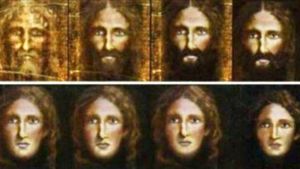
From the ancient dream to the embodied relationship
(Jn 1:45-51)
People are convinced by meeting, seeing and experiencing, not by imposing. However, the Eternal plan baffles us.
Witness and sharing lead persons to Christ, but they are not enough - because his plan is not as people imagine or propose, as they await and desires it to be.
To the enthusiastic announcement, Nathanael responds with a preconceived skepticism that represents us: what good can come out of the most insignificant suburbs (v.46)?
Why does not the solution to our expectations come from predictable places [Judaea]?
Personal encounter with Jesus and listening to his Word go beyond every obstacle, up to an explicit and convinced profession of Faith.
And like Nathanael, whoever consecrates his life to the study of the Scriptures finds in them Christ himself (vv.45.48-49).
At first perhaps we too approached the Son of God imagining that he had the attributes of King of a chosen people (v.49).
Then the custom with the Person and the vital experience [«Come and see»: sense of the basic Semitic expression of v.46] showed us a much broader Relationship with Heaven (vv.50-51).
In walking the Way that the unexpected Messiah proposes, we perceive the convergence of God’s movement towards men and our longing for him.
It is the realization (and overcoming) of Jacob’s ancient dream.
Those who pursue preconceptions remain to take the cool under a fig tree (cf.v.48), ie he remains linked to the ancient religion [the rabbis taught the ancient Scriptures sitting under the trees; the fig tree was symbol of Israel].
«Israelite without deceit» (v.47): each one is so when, after sifting, he knows how to get rid of common opinions and teachings; when he realizes that they do not coincide with the Father’s plan.
Salvation history aims at «greater things» (v.50) than those already wanted; normal, expected, invoked, calculated, longed for.
From religiosity we will move on to Faith: the best of God’s Dream in us must come. «Greater things» than clichés.
Jesus is Jacob’s authentic Dream, which heralded to a vast lineage; further unfolded (Gen 28:10-22) and become reality.
But no one would have expected that the Messiah could identify himself with the «Son of Man» (v.51), the One who creates abundance where it is not there, and that before did not seem licit it could expand.
The new bond between God and human beings is in the Brother who becomes ‘next of kin’: which creates an atmosphere of humanization with wide outlines - not at all discriminating.
‘True, successful Son’ is the one who, having reached the maximum of human fullness, comes to reflect the divine condition and radiates it in a widespread way - not selective as expected.
It is the flowering and humanization of the people: the peaceful, true and full development of the divine plan on humanity.
«Son of Man» is therefore not a stowed, cautious, controlled and reserved title, but an opportunity for all those who adhere to the Lord’s proposal, and reinterpret life in a creative personal way.
They go beyond the firm boundaries, making room for the Gift; welcoming from the Grace fullness of being, in its new unrepeatable tracks.
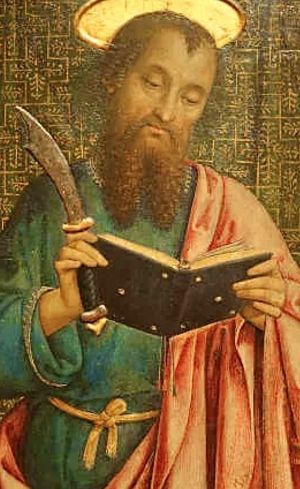
[St. Bartholomew, Apostle. August 24]
From the ancient dream to the incarnate relationship
(Jn 1:45-51)
Today's liturgy presents the first encounter with the Lord of Nathanael, whom some traditions identify as the apostle Bartholomew.
The purpose of the call is to follow Jesus; let us see the concatenation of events. First of all: people are convinced by encountering, seeing and experiencing, not by imposing.
But the plan of the Eternal displaces us. Witnessing and sharing lead to Christ, but they are not enough - because his plan is not what people imagine or propose, what they expect and desire it to be.
To the enthusiastic announcement of Philip [a name of Greek origin], Nathanael [from the Hebrew Netan'El: "God has given"] responds with a preconceived scepticism that represents us: what good can come out of the most insignificant peripheries (v.46)?
How is it that the solution to our expectations does not come from the palaces of power, from the exceptional magnificence of the Holy City, or from the established and selective doctrinal prestige of the observant territory (Judea)?
Nazareth was a negligible village of hotheads and troglodyte Galileans; Jesus a carpenter-carpenter, so he did not even have land.
The expectation of the Messiah was anchored to quite other manifestations of prestige, wealth, pomp and power (substitutes for the authentic experience of relationship and fullness of being).
The personal encounter with Jesus and listening to his Word conquered every obstacle, up to an explicit and convinced profession of Faith.
And like Nathanael, he who consecrates his life to the study of the Scriptures finds Christ in them (vv.45.48-49).
At first perhaps we too approached the Son of God imagining that he had the attributes of King of a chosen people (v.49).
Then the familiarity with the Person and the vital experience ["Come and see": sense of the basic Semitic expression of v.46] showed us a much wider Relationship with Heaven (vv.50-51).
In walking the Way that the unexpected Messiah proposes, we grasp the convergence of God's movement towards mankind and our yearning for Him. It is the realisation (and overcoming) of Jacob's ancient dream.
Those who pursue preconceptions remain to take the cool under the fig tree (cf. v.48), that is, they remain tied to the ancient religion [the rabbis taught the ancient scriptures by sitting under the trees; the fig tree was a symbol of Israel].
By dwelling in expectations of magnificence and allowing ourselves to be carried away by standard intentions of expected glory, we do not enter into the movement that binds our land to Love: we find ourselves growing old, bogged down and barren - unable to generate new creatures and be born again.
"Israelite without deceit" (v.47): each one is when - having sifted - he knows how to discard common opinions and teachings; when he realises that they do not agree with the Father's plan for us.
The history of salvation aims at "greater things" (v.50) than those already desired; normal, foreseen, invoked, calculated and hoped for (transmitted by doctrines and "teachers" such and such).
Even the Design of Providence is not as people imagine or wish it to be. There are situations that no one has ever seen.
"God has given" [meaning of the proper name Nathanael], but each one must be born again.
From Nathanael each believer makes Exodus to transmigrate to the meaning of the name Bartholomew: "Son of the well-ploughed field and of the earth with abundant furrows".
From religiosity we pass to Faith: the best of God's Dream in us is to come. "Greater things" than platitudes.
Jesus is the authentic Dream of Jacob, which foreshadowed a vast descendants; further unfolded (Gen 28:10-22) and become reality.
But no one would have expected that the Messiah could be identified with the "Son of Man" (v.51), the One who creates abundance where there is none - and it did not seem permissible before to expand.
The new bond between God and human beings is in the Brother who becomes the 'next of kin', who creates an atmosphere of humanisation with broad contours - not at all discriminating.
"The 'Son of Man' is the one who, having reached the highest human fullness, comes to reflect the divine condition and radiates it widely - not selectively as expected.
Successful Son: the Person with the definitive step, who in us aspires to the most dilated fullness in events and relationships, to an indestructible carat within each one who approaches [and encounters divine marks].
It is growth and humanisation of the people: the quiet, true and full development of the divine plan on humanity.
"Son of Man" is therefore not a religious, guarded, controlled and reserved title, but an opportunity for all those who adhere to the Lord's proposal, and reinterpret life in a personal creative way.
They overcome their own firm and summary boundaries, making room for the Gift; receiving from Grace fullness of being and character, in its new, unrepeatable tracks.Feeling totally and undeservedly friends, we discover other facets... we change the way we are with ourselves, and the way we read history.
In short, we can grow, realise ourselves, blossom, radiate the completeness we have received - without any more closures.
On this Path, every day we perceive the same impulse that brought Nathanael to Jesus: an unparalleled instinct of Presence [Michael: Who like God?], a liberation of the shrunken consciousness [Raphael: God healed - Rescuer], an awe-inspiring unveiling [Gabriel: Strength of God].
In short, on new adventures to be undertaken, the invisible world has a special relationship with humanity and creation.
In soul and in things, we are as it were guided on the right path (in an unceasing, growing, unexpected way) even through our anxieties, rebellions, crises and doubts.
From Son of David to Son of Man
The Church is Catholic because Christ embraces the whole of humanity in his mission of salvation. While Jesus' mission in his earthly life was limited to the Jewish people, "to the lost sheep of the house of Israel" (Mt 15:24), it was nevertheless oriented from the beginning to bring the light of the Gospel to all peoples and to bring all nations into the Kingdom of God. Confronted with the faith of the Centurion in Capernaum, Jesus exclaims: "Now I tell you that many will come from the east and the west and sit down at table with Abraham, Isaac and Jacob in the kingdom of heaven" (Mt 8:11). This universalistic perspective emerges, among other things, from the presentation Jesus made of himself not only as "Son of David", but as "son of man" (Mk 10:33), as we also heard in the Gospel passage just proclaimed. The title "Son of Man", in the language of the Jewish apocalyptic literature inspired by the vision of history in the Book of the Prophet Daniel (cf. 7:13-14), recalls the person who comes "with the clouds of heaven" (v. 13) and is an image that heralds an entirely new kingdom, a kingdom supported not by human powers, but by the true power that comes from God. Jesus uses this rich and complex expression and refers it to Himself to manifest the true character of His messianism, as a mission destined for the whole man and every man, overcoming all ethnic, national and religious particularism. And it is precisely in following Jesus, in allowing oneself to be drawn into his humanity and thus into communion with God, that one enters into this new kingdom, which the Church announces and anticipates, and which overcomes fragmentation and dispersion".
[Pope Benedict, address to the Consistory 24 November 2012]
We see this great figure, this force in the Passion, in resistance to the powerful. We wonder: what gave birth to this life, to this interiority so strong, so upright, so consistent, spent so totally for God in preparing the way for Jesus? The answer is simple: it was born from the relationship with God (Pope Benedict)
Noi vediamo questa grande figura, questa forza nella passione, nella resistenza contro i potenti. Domandiamo: da dove nasce questa vita, questa interiorità così forte, così retta, così coerente, spesa in modo così totale per Dio e preparare la strada a Gesù? La risposta è semplice: dal rapporto con Dio (Papa Benedetto)
The lamp is a symbol of the faith that illuminates our life, while the oil is a symbol of the charity that nourishes the light of faith, making it fruitful and credible (Pope Francis)
La lampada è il simbolo della fede che illumina la nostra vita, mentre l’olio è il simbolo della carità che alimenta, rende feconda e credibile la luce della fede (Papa Francesco)
Jesus wants our existence to be laborious, that we never lower our guard, so as to welcome with gratitude and wonder each new day given to us by God. Every morning is a blank page on which a Christian begins to write with good works (Pope Francis)
Gesù vuole che la nostra esistenza sia laboriosa, che non abbassiamo mai la guardia, per accogliere con gratitudine e stupore ogni nuovo giorno donatoci da Dio. Ogni mattina è una pagina bianca che il cristiano comincia a scrivere con le opere di bene (Papa Francesco)
And this is the problem: when the People put down roots in the land and are the depository of the Law, they are tempted to place their security and joy in something that is no longer the Word of God (Pope Benedict)
Ed ecco il problema: quando il popolo si stabilisce nella terra, ed è depositario della Legge, è tentato di riporre la sua sicurezza e la sua gioia in qualcosa che non è più la Parola del Signore (Papa Benedetto)
Despite the scarcity of information about him, St Bartholomew stands before us to tell us that attachment to Jesus can also be lived and witnessed to without performing sensational deeds. Jesus himself, to whom each one of us is called to dedicate his or her own life and death, is and remains extraordinary (Pope Benedict)
La figura di san Bartolomeo, pur nella scarsità delle informazioni che lo riguardano, resta comunque davanti a noi per dirci che l'adesione a Gesù può essere vissuta e testimoniata anche senza il compimento di opere sensazionali. Straordinario è e resta Gesù stesso, a cui ciascuno di noi è chiamato a consacrare la propria vita e la propria morte (Papa Benedetto)
Faith is more than just empirical or historical facts; it is an ability to grasp the mystery of Christ’s person in all its depth [Pope Benedict]
La fede va al di là dei semplici dati empirici o storici, ed è capace di cogliere il mistero della persona di Cristo nella sua profondità [Papa Benedetto]
More than 600 precepts are mentioned in the Law of Moses. How should the great commandment be distinguished among these? (Pope Francis)
Nella Legge di Mosè sono menzionati oltre seicento precetti. Come distinguere, tra tutti questi, il grande comandamento? (Papa Francesco)
The invitation has three characteristics: freely offered, breadth and universality. Many people were invited, but something surprising happened: none of the intended guests came to take part in the feast, saying they had other things to do; indeed, some were even indifferent, impertinent, even annoyed (Pope Francis)








duevie.art
don Giuseppe Nespeca
Tel. 333-1329741
Disclaimer
Questo blog non rappresenta una testata giornalistica in quanto viene aggiornato senza alcuna periodicità. Non può pertanto considerarsi un prodotto editoriale ai sensi della legge N°62 del 07/03/2001.
Le immagini sono tratte da internet, ma se il loro uso violasse diritti d'autore, lo si comunichi all'autore del blog che provvederà alla loro pronta rimozione.
L'autore dichiara di non essere responsabile dei commenti lasciati nei post. Eventuali commenti dei lettori, lesivi dell'immagine o dell'onorabilità di persone terze, il cui contenuto fosse ritenuto non idoneo alla pubblicazione verranno insindacabilmente rimossi.