Nov 14, 2026 Written by 

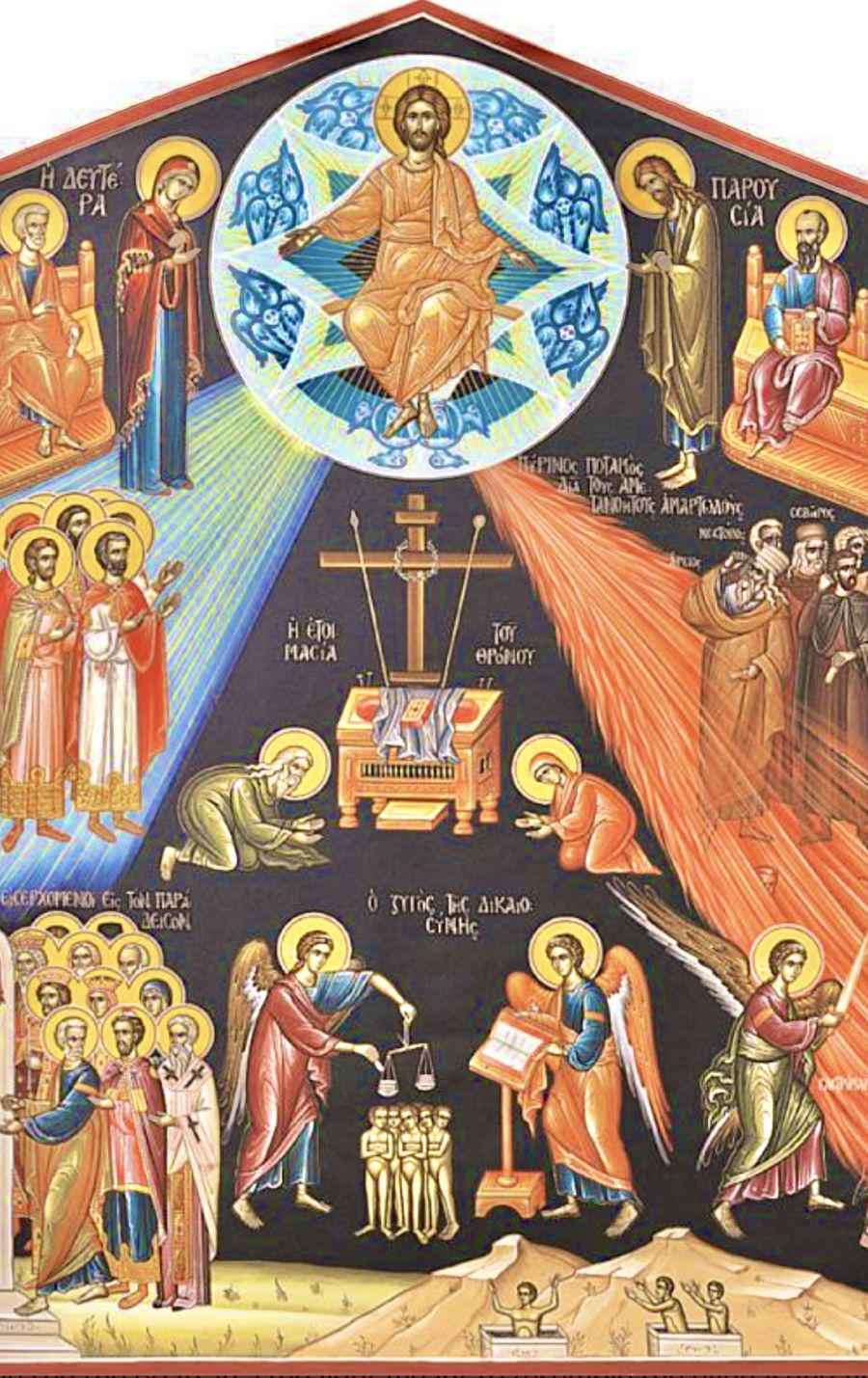
Judgment and sentences

(Mt 25:31-46)


The famous Judgment passage presents the ‘coming’ Risen (v.31) as «Son of man», that is, authentic and complete development of divine plan for humanity: his kind of "verdict" follows.

God embraces the limited condition of his creatures, so the behavior that realizes our life does not concern the religious attitude itself, but what we have had towards our fellow men.


In all ancient beliefs, the soul of the deceased was weighed on a notarial basis and judged according to the positive or negative balance.

In the opinion of the rabbis, Divine Mercy intervened in favor only when the good and bad works were balanced.

Jesus does not speak of a Court that proclaims immutable negative sentences on the whole person, but of his humanizing traits.

«Life of the Eternal» (v.46 Greek text) alludes to a kind of life that is not biological but relational and full of being, which we can already experience.

These are episodes in which our genuine DNA emerged, the Gold that inhabits us: when we knew how to respond to the needs not of God, but of life itself and of our brothers.

These are the moments in which we have been profound listeners to the nature, hope and vocation of all - sensitive to the needs of others. Opportunities that have allowed us to bring the human condition closer to the heavenly one.

Comparing the ‘works’ declared "paradigm" with those of the lists of other religions - even in ancient Egypt - we note the difference in v.36: «I was in prison and you came to me» (vv.39.43).

The difference is remarkable precisely under the criterion of divine Justice: it overlooks forensic considerations, because it creates justice where there is none.

The Father gives life in every case, because He is not “good” [as is believed in all devout persuasions] but exclusively good.

‘Righteous’ - then - did not even realize that they had done who knows what: they spontaneously corresponded to their nature as sons (v.39).

They have had sympathy for our ‘flesh’ in its reality - considering it familiar. They have loved with and like Jesus, in Him.

The others, all taken up by formalisms of no interest to God, are surprised that the Father is not all there where they had imagined Him - locked in the sentences of ordinary justice: «When we saw you [...] in prison and did not we serve you?» (v. 44).

Vocation to meet leads spontaneously to transgress divisions: legalistic, of retribution, or prejudice and kind of cult.

This is the eminent Salvation - which nestles in the direct and genuine aspect, not so much in the organized purposes; nor does it have any consistency on the basis of opinions.

We fulfill ourselves in responding to the instinctive Call that arises from our own essential (altruistic) imprint, even the slightest, ill-considered, or eccentric and shaky - not extraordinary.

Without too external conditions, it recognizes itself disseminated in the soul and in the beneficial divinizing fullness of the «Son of man».

Jesus' ultimate Teaching: eminent, global and all-human Judgement; not verdict by concept and account.

Here the Jesus’ identification with the little ones: his Person has a central meaning, which surpasses the ‘distinction’ between friends and outlaws.

The Person is now a different Subject, far richer - solid in itself, but expanding into the divine and human You, even destitute.


[34th Sunday in O.T.  November 22, 2026]

93 Last modified on Saturday, 14 November 2026 04:57
don Giuseppe Nespeca

Giuseppe Nespeca è architetto e sacerdote. Cultore della Sacra scrittura è autore della raccolta "Due Fuochi due Vie - Religione e Fede, Vangeli e Tao"; coautore del libro "Dialogo e Solstizio".

How we treat them will be taken as the way we treat Jesus himself. We do not see here a simple literary device, or a simple metaphor [Pope Benedict]
Il comportamento che noi abbiamo nei loro confronti sarà dunque considerato come il comportamento che abbiamo nei confronti di Gesù stesso. Non vediamo in questo una semplice formula letteraria, una semplice immagine! [Papa Benedetto]
The Sadducees, addressing Jesus for a purely theoretical "case", at the same time attack the Pharisees' primitive conception of life after the resurrection of the bodies; they in fact insinuate that faith in the resurrection of the bodies leads to admitting polyandry, contrary to the law of God (Pope John Paul II)
I Sadducei, rivolgendosi a Gesù per un "caso" puramente teorico, attaccano al tempo stesso la primitiva concezione dei Farisei sulla vita dopo la risurrezione dei corpi; insinuano infatti che la fede nella risurrezione dei corpi conduce ad ammettere la poliandria, contrastante con la legge di Dio (Papa Giovanni Paolo II)
Today, as yesterday, the Church needs you and turns to you. The Church tells you with our voice: don’t let such a fruitful alliance break! Do not refuse to put your talents at the service of divine truth! Do not close your spirit to the breath of the Holy Spirit! (Pope Paul VI)
Oggi come ieri la Chiesa ha bisogno di voi e si rivolge a voi. Essa vi dice con la nostra voce: non lasciate che si rompa un’alleanza tanto feconda! Non rifiutate di mettere il vostro talento al servizio della verità divina! Non chiudete il vostro spirito al soffio dello Spirito Santo! (Papa Paolo VI)
Sometimes we try to correct or convert a sinner by scolding him, by pointing out his mistakes and wrongful behaviour. Jesus’ attitude toward Zacchaeus shows us another way: that of showing those who err their value, the value that God continues to see in spite of everything (Pope Francis)
A volte noi cerchiamo di correggere o convertire un peccatore rimproverandolo, rinfacciandogli i suoi sbagli e il suo comportamento ingiusto. L’atteggiamento di Gesù con Zaccheo ci indica un’altra strada: quella di mostrare a chi sbaglia il suo valore, quel valore che Dio continua a vedere malgrado tutto (Papa Francesco)
Deus dilexit mundum! God observes the depths of the human heart, which, even under the surface of sin and disorder, still possesses a wonderful richness of love; Jesus with his gaze draws it out, makes it overflow from the oppressed soul. To Jesus, therefore, nothing escapes of what is in men, of their total reality, in which good and evil are (Pope Paul VI)
Deus dilexit mundum! Iddio osserva le profondità del cuore umano, che, anche sotto la superficie del peccato e del disordine, possiede ancora una ricchezza meravigliosa di amore; Gesù col suo sguardo la trae fuori, la fa straripare dall’anima oppressa. A Gesù, dunque, nulla sfugge di quanto è negli uomini, della loro totale realtà, in cui sono il bene e il male (Papa Paolo VI)
The "talent" was an ancient Roman coin, of great value, and precisely because of this parable's popularity it became synonymous with personal gifts, which everyone is called to develop. In fact […] (Pope Benedict)
Il "talento" era un’antica moneta romana, di grande valore, e proprio a causa della popolarità di questa parabola è diventata sinonimo di dote personale, che ciascuno è chiamato a far fruttificare. In realtà […] (Papa Benedetto)
O Lord, let my faith be full, without reservations (Pope Paul VI)

Due Fuochi due Vie - Vol. 1 Due Fuochi due Vie - Vol. 2 Due Fuochi due Vie - Vol. 3 Due Fuochi due Vie - Vol. 4 Due Fuochi due Vie - Vol. 5 Dialogo e Solstizio I fiammiferi di Maria

duevie.art

don Giuseppe Nespeca

Tel. 333-1329741


Disclaimer

Questo blog non rappresenta una testata giornalistica in quanto viene aggiornato senza alcuna periodicità. Non può pertanto considerarsi un prodotto editoriale ai sensi della legge N°62 del 07/03/2001.
Le immagini sono tratte da internet, ma se il loro uso violasse diritti d'autore, lo si comunichi all'autore del blog che provvederà alla loro pronta rimozione.
L'autore dichiara di non essere responsabile dei commenti lasciati nei post. Eventuali commenti dei lettori, lesivi dell'immagine o dell'onorabilità di persone terze, il cui contenuto fosse ritenuto non idoneo alla pubblicazione verranno insindacabilmente rimossi.