


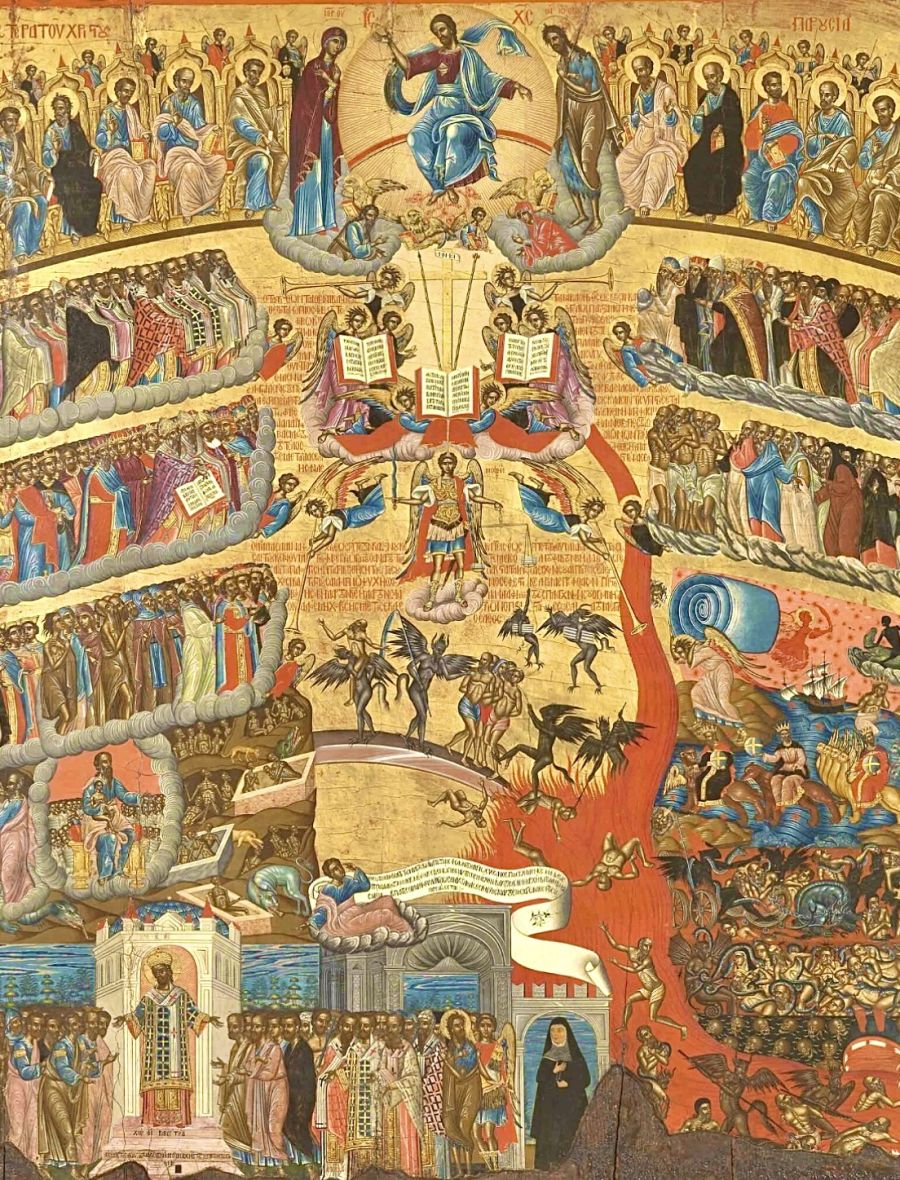
Solemnity of Our Lord Jesus Christ, King of the Universe (year A) [22 November 2026]
This is the last Sunday of the liturgical year
First Reading from the Book of the Prophet Ezekiel (34:11–12, 15–17)
The Book of the Prophet Ezekiel was written in Hebrew in Babylon (593–571 BC), but the Church has always read the Greek version of the Septuagint (LXX), which is the one quoted in the New Testament. The year is 591 BC: Ezekiel is in exile in Tel Aviv, on the River Chebar. Jerusalem has not yet fallen completely, but the ruling class has already been deported, and chapter 34 is an indictment of the kings, priests, leaders and shepherds of Israel. We are at the heart of the great chapter on the ‘shepherd’ in Ezekiel, one of the most important texts in the entire Old Testament for understanding the biblical concept of God as Shepherd and, subsequently, the presentation of Jesus as the Good Shepherd in John 10. The people are in exile and the temple is destroyed; the king is a prisoner and Israel seems finished; the flock is ‘scattered’. Who are the ‘bad shepherds’? In the ancient Near East, ‘shepherd’ was the title of the king, and in Ezekiel the shepherds are the kings of Judah—in particular Zedekiah—but also the leaders, priests and prophets who were supposed to guide the people. The prophet accuses them in the harshest terms in the preceding verses (vv. 2–4): ‘Woe to the shepherds of Israel who feed themselves!’ The kings had thought only of their own power, of political alliances with Egypt or Babylon, and of their own well-being, not of the good of the people. The result was dispersion: exile. The image of the scattered flock ‘in days of clouds and thick darkness’ (v. 12) is a theological description of exile: not merely a military defeat, but a day of darkness, of God’s judgement. In Israel, following the failure of the kings, people were expecting a new David, an ideal king. Ezekiel announces this, but only in v. 23: ‘I will raise up for them a shepherd who will tend them, my servant David.’ Before this, however, there is an even more radical development: it will not be another man who saves Israel, but God himself, who personally takes action. This is the theological structure of the entire chapter: human failure is not the final word, because God no longer delegates his mercy. And ‘he will gather his sheep from all the places where they were scattered’. It is the promise of a return from exile, but also a broader promise: the diaspora of Israel will be restored. For Ezekiel, exile is not God’s abandonment, but the place where God goes to seek out his people. Ezekiel lists six actions of God, in ascending order: I will seek out the lost, bring back the strayed, bind up the wounded, heal the sick, care for the fat and the strong, and feed them with justice. Note the precision: God does not treat all the sheep in the same way, for the lost sheep must be sought out, the strayed sheep must be brought back, the wounded sheep must be bandaged, and the sick sheep must be healed. God’s justice, here, is not the justice that punishes everyone in the same way, but the justice that gives each one what they need. And here is a crucial detail: in some ancient versions of verse 16, the Hebrew text states that God ‘will destroy the fat and the strong’, whilst the CEI translates it as ‘I will care for’. The textual issue is complex, but the meaning is clear in the context of verse 17: God is not indifferent; therefore, he will judge the fat sheep that oppress the others, for his care is always linked to justice. ‘I will judge between sheep and sheep, between rams and goats.’ At this point, the perspective in the text shifts. Up to this point, the judgement was directed against the shepherds; now it is within the flock itself. Even amongst the sheep there are oppressors: the rams and goats that jostle, trample, drink the clear water and muddy the rest with their hooves (as Ezekiel will say in verses 18–19). As well as the leaders, God also judges the relationships within the community. It is not enough to be a victim of bad shepherds to be considered righteous, for everyone is responsible for how they treat their weakest brother or sister. This verse will be taken up again by Jesus in Matthew 25:31–46, in the judgement between the sheep and the goats. This text is an examination of conscience for every authority: political, ecclesiastical, and familial. The true shepherd is recognised by one question: ‘Am I feeding myself, or am I feeding the flock?’ . The criterion is not efficiency, nor consensus, nor the preservation of power. It is the care of the most vulnerable: the lost, straying, wounded or sick sheep. A shepherd, a parish priest, a parent or an administrator who forgets the least among us, according to Ezekiel, has already failed, even if the flock appears numerous. Then there is the central message of the passage, and the most comforting one. If we are going through a time of crisis on a ‘day of clouds and thick mist’—that is, of inner exile and distance from God—the prophet reminds us that it is not up to us to find the way back, but God himself comes to seek us out. Ezekiel’s spirituality is the opposite of a ‘do-it-yourself’ approach. God does not wait for the sheep to return on its own. He goes out to seek it. And when He finds it wounded, He does not reproach it for having been wounded. He binds up its wounds. This is the biblical foundation of the parable of the Good Shepherd and, in the New Testament, of Christ’s mercy: ‘The Son of Man came to seek and to save what was lost’ (Luke 19:10). The Church is not merely a victim of bad shepherds; even within the community there are sheep who oppress other sheep: through judgement, through gossip, through indifference, through the pursuit of the highest positions. God judges ‘between sheep and sheep’. In summary, Ezekiel (34:11–12, 15–17) tells us that human failure is not the end of the story, for God himself becomes the shepherd, and his justice is tailored care, not a one-size-fits-all approach: the community will be judged not only for its leaders, but also for how its members treat one another.
Responsorial Psalm (22/23)
This Psalm is the most beloved in the Bible. Although attributed to David, it does not matter whether it was written by David the young shepherd or David the king in exile. It is both a regal and a personal Psalm, a Psalm of trust, not a supplication, nor a thanksgiving for a specific event, but a comforting affirmation: the Lord is present. It is the Psalm that was prayed in Israel when ascending to the Temple, composed of two intertwined images: God as Shepherd and God as host, as master of the house. The Psalm becomes a journey: from the pasture to the home, from the countryside to the Temple, from life to death and beyond, whilst the historical context is the nomadic experience of Israel: a people who lived for 40 years in the desert guided by God the Shepherd, and then experienced exile in Babylon – the valley of the shadow of death – and the return. The Psalm is the song of those who have been guided.
“The Lord is my shepherd: I shall not want” speaks of my shepherd, “the shepherd of Israel”. The personal possessive “my” indicates the intimacy of biblical faith. “I shall not want” does not mean that I will have everything I want, but that I shall not lack what is necessary to live as a child of God; it is the same promise we find in Matthew 6:33, which invites us to “seek first the kingdom of God and his righteousness” because all the rest will be given in addition. ‘You prepare a table before me in the presence of my enemies. You anoint my head with oil; my cup overflows.’ Here the image shifts: from shepherd to host. In the East, when a guest arrives, the host sets the table even if there are enemies outside. God does not wait for the war to end before feeding you. He nourishes you in the midst of the battle. He anoints your head with fragrant oil, which is a gesture of welcome, honour and joy; it is not, therefore, the anointing of a king, but rather the anointing of a beloved guest, as we see in the episode of the sinful woman who anoints Jesus (cf. Lk 7). “My cup overflows” – not a full cup, but one that overflows; that is to say, God does not give merely what is necessary, but everything in superabundance. On closer inspection, this psalm is the very definition of contemplation: to contemplate is not to do something, but to allow oneself to be shepherded, to be given rest; and those whose task it is to shepherd others must first and foremost allow themselves to be shepherded by God, for if they do not lie down in God’s pastures, they will not be able to lead anyone to still waters. The true shepherd does not run ahead of the sheep; he walks with them through the valley. Here are some pastoral guidelines: the shepherd’s primary task is not to organise events, but to be with people in the valley of the shadow of death – amongst those suffering from anxiety, depression, bereavement and loneliness – and to assure them that sharing in their lives matters more than organising pastoral structures and planning apostolic programmes. The shift from ‘He’ to ‘You’ is also interesting. The Psalm teaches that spiritual maturity lies in moving from speaking about God to speaking to God. The cup that overflows is the Eucharist, the table set before one’s enemies. God nourishes us not afterwards, but during the battle; so how can we say: ‘I don’t have time for adoration because I have too many things to do’? It is precisely in adoration and in the celebration of the Eucharistic sacrifice that God prepares a table for us. Finally, the Psalm is an invitation to pray: ‘Lord, my Shepherd, let me not lack rest in You. When I walk through the valley of the shadow of death, remind me that it is only a shadow, not death, for You are with me. You prepare my table; You anoint my head; let my cup overflow to quench the thirst of the sheep You have entrusted to me, until I dwell in Your house for ever. Amen.
Second Reading from the First Letter of Saint Paul the Apostle to the Corinthians (15:20–26, 28)
This is the longest and most important chapter on the Resurrection in the entire New Testament. Paul wrote it to Corinth around AD 55, in response to those in Corinth who claimed that ‘there is no resurrection of the dead’ (15:12), and in his reply he summarises the Church’s most ancient kerygma. Corinth was a cosmopolitan port, a wealthy, immoral, philosophical Greek city where the inhabitants believed in the immortality of the soul in the manner of Greek philosophy (the soul is immortal, and the body is its prison); for this reason, the resurrection of the body seemed absurd and vulgar to them, because the soul survives but the body does not. Paul, a Jewish Pharisee, cannot accept this philosophical theory because, according to the Bible, man is body, soul and spirit all together; therefore, if the body does not rise again, man is not saved. His reasoning is as follows: ‘I have received this kerygma: “Christ died for our sins according to the Scriptures in our place—that is, not “because of”, but “in our place”. He was buried—and Paul emphasises the burial because it proves that He was truly dead, even in the body. He was raised on the third day, and is now in a state of resurrection because the Father raised him up. He appeared—indeed, he was seen by many witnesses.’ If Christ has not been raised, everything is in vain; but Christ is the firstfruits of those raised from the dead and is the King who conquers death, and just as he has been raised, so shall we all be raised with our bodies. The Apostle emphasises: ‘You were not saved just once; you are saved every day, and I have faithfully passed on to you what I received.’ In other words, he states that he is not inventing anything new, but is passing on the formula of the kerygma, which dates back to 30–35 AD—that is, five years after Jesus’ death—and which constitutes the oldest historical evidence of his Resurrection. He then adds that the risen Jesus appeared – that is, he actually showed himself – and so these were not subjective visions but objective appearances. He lists the witnesses: Cephas, the Twelve, 500 brothers – most of whom are still alive, so you can go and ask them yourselves. Finally, he adds that he also appeared to me, as to a miscarriage. ‘Ektroma’ is a very strong medical term referring to a miscarried foetus because it was born prematurely. Paul feels unworthy, born out of time, a persecutor who has nevertheless received this grace as the least of all. And he concludes: ‘By the grace of God I am what I am.’ And the grace in me has not been in vain – that is, empty – because grace is always at work. Paul acknowledges: ‘I am what I am by grace’, yet he adds: ‘I have laboured more than any of them’. Here is an example of what many call the synthesis of the contemplative and the active: the contemplative professes ‘everything is grace’, whilst the active recognises ‘everything depends on me’. The Christian life is Grace at work within us. I shall merely touch upon another theme present here: Death is an enemy, not a friend. Today it is said that death is part of life, whilst Paul states: ‘Death is the last enemy’. According to St Paul, death is not to be tamed, but must be proclaimed as an enemy already conquered by Christ. At funerals, why say that the deceased ‘has gone to a better place’, almost as if it were merely psychological consolation? No! St Paul advises: he affirms that the risen Christ is the firstfruits, and if you believe in him, the departed have fallen asleep; they have not been lost, because Christ has already conquered death and is now with them if they have believed in him. It is in the Christian proclamation of death that the difference between human consolation and Christian hope lies. Finally, closely linked to the theme of death, the Apostle presents two kinds of humanity: human beings in the manner of Adam (subject to the logic of taking, possessing, dominating, and then dying) or in the manner of Christ (where to live is to give, to hand over the Kingdom, and to be certain that one day God will be all in all). Our life as Christians is therefore the daily transition from Adam to Christ—that is, from living for oneself according to the logic of possession to living surrendered to the redemptive love of Christ according to the logic of gift.
From the Gospel according to Matthew (25:31–46)
In this passage from the Gospel of Matthew we find the only parable in which Jesus identifies himself entirely with the poor. He does not say ‘as if it were me’, but ‘you are doing this to me personally’. We are on the Mount of Olives, in chapter 25, and this is Jesus’ final discourse before the Passion, the eschatological discourse. After speaking of the ten virgins and the talents, he concludes with the judgement, thus leaving us his testament before his death. It is therefore not a parable, but an apocalyptic vision. The Lord, in fact, uses the language of Daniel 7:13–14: ‘Behold, one like a son of man is coming with the clouds of heaven’, but he reverses the perspective of the ‘Son of Man’, who is at once the judge and also the poor person being judged. When the Son of Man comes in his glory—the very same glory of the Transfiguration, now the glory of the King-Judge—all the peoples will be gathered together (the ‘ethne’ are the pagan nations together with Israel) and the Last Judgement will take place, with the final separation, just as the shepherd-judge does (see the responsorial psalm) when he judges between one sheep and another. Jesus is the Shepherd of Ezekiel (see chapter 34) who now judges: ‘Come, you who are blessed by my Father; inherit the Kingdom prepared for you from the foundation of the world.’ He will say: ‘inherit’, because the Kingdom is not conquered, but is inherited—as adopted children—the Kingdom prepared for us before we even existed. This eschatological text invites us to recall and reflect on the so-called ‘Last Things’ [Novissimi] —namely, Death, Judgement, Hell and Heaven—and it is such a well-known text that I shall confine myself merely to highlighting a few elements. I invite you to contemplate this passage from the Gospel, in the certainty that sooner or later it will be our turn too, as if it were a majestic triptych of three paintings.
The first: The Throne (vv. 31–33); the second: the separation (vv. 34–40); the third: the judgement of the righteous and the judgement of the damned (vv. 41–46).
Ideally, as Saint Alphonsus Maria de’ Liguori urges us, we should meditate on this whilst living in the present in the light of eternity. We must not wait until the moment of death to take stock of our lives. We must live each day knowing that our existence has an eternal destination and that one day we shall appear before Christ. Saint Alphonsus Maria de’ Liguori addresses this theme in a very explicit and in-depth manner in his book *Preparation for Death, or Considerations on the Eternal Maxims*. I would also recommend ‘Consideration X – Means of Preparing for Death’, in which Saint Alphonsus emphasises the crucial importance of preparing for death and quotes Sirach: ‘In omnibus operibus tuis memorare novissima tua, et in aeternum non peccabis’ – ‘In all your deeds, remember your end, and you shall never fall into sin’. (Sir 7:36 according to the Vulgate numbering).
Here, then, are just a few clarifications: ‘I was a stranger and you welcomed me; naked and you clothed me; sick and you visited me; in prison and you came to me—not merely to see me, but to be with me.’ ‘Whatever you did for one of the least of these my brothers, you did for me.’ He uses the term ‘Elachiston’, which is the superlative of ‘small’, thus defining them as the very smallest and calling them ‘Adelphon mou’ – my brothers. Jesus calls all these people the very poorest and ‘my brothers’.
Another point to emphasise: ‘Depart from me, you who are cursed, into the eternal fire’. On closer inspection, we learn that the Kingdom of God has been prepared for us, the blessed, ever since the creation of humankind, whilst the fire was intended and prepared for the devil and his angels, not for humankind. Hell, therefore, was not prepared for us as human beings, and going there can only be the result of our own free choice. If you end up there, it is because you have chosen to turn away from God, you have rejected Him and allowed yourself to be deceived by Satan, who will imprison you in his kingdom—which is called hell—a reality that is difficult to describe and even to imagine.
One more point to consider. If we pay close attention, we notice that the question posed to the Judge by the damned is identical to that asked by the righteous: “Lord, when did we see you?” and both are taken by surprise. The difference, therefore, does not stem from theological knowledge, but from one’s actions: for the righteous acted without realising it was Christ, whilst the damned did not act because they failed to recognise Christ. Thus, one becomes a saint quite simply by allowing oneself to be guided by a right conscience and by the natural law written in the heart of every human being, regardless of ethnicity or religion.
Finally, here are a few brief comments from the Church Fathers. St John Chrysostom (4th century), in his 79th homily on Matthew, writes that Jesus does not speak of great deeds, but of small things, so that no one may say, ‘I could not’. ‘He does not say: I was in prison and you set me free, I was sick and you healed me, but he says: you visited me, you came to me. He does not ask for impossible things, but for small and easy things: a piece of bread, a glass of water, a visit. And then he adds: ‘Do you wish to honour the Body of Christ? Do not despise it when it is naked. Do not honour it here in the church with silk garments, whilst outside you leave it to die of cold and hunger. He who said, “This is my body”, is the same one who said: “You saw me hungry and did not give me food.” Chrysostom thus links the Eucharist and the poor. You cannot worship Christ in the Host and ignore him in the poor, for it is the very Body of Christ. St Augustine dwells on the amazement of the righteous: “When did we see you?” “The righteous did not know they had served Christ, for they did not seek a reward. They served out of love. If they had known it was Christ, they would have served out of self-interest. God has hidden himself in the poor to test whether we love for love’s sake or for a reward. (Sermo 86, PL 38,560. And then: ‘Christ is in heaven as King; he is on earth as a poor man. Do not despise the poor on earth, if you wish to find the King in heaven.’ St Gregory the Great interprets this text as an examination of conscience for pastors: “The Lord will not say: ‘Why did you not perform miracles?’ But: ‘Why did you not give bread?’ He will not call you to account for your learning, but for your mercy. Mercy is the balance of judgement.” (Homiliae in Evangelia, Book II, Homily 39, PL 76, 1302). St Francis of Assisi, who was no theologian, lived out the text to the letter. In the Unconfirmed Rule he writes: “And all the friars, when they see a poor person, should remember that for his sake the Lord made himself poor.” And in the Letter to All the Faithful: “Where there is charity and wisdom, there is neither fear nor ignorance. Where there is patience and humility, there is neither anger nor distress.’ Saint Vincent de Paul in the 17th century, often described as the modern Chrysostom, wrote: ‘One must not judge a poor peasant or a poor woman by their outward appearance, nor by what appears to be their spirit… But one must turn the coin over and see with the eyes of faith that the Son of God… chose to be poor… Therefore, when we go to visit the poor, we go to honour God in them” (Conference of 6 December 1658, Coste XII, p. 264). Saint Vincent said that the poor are our masters, an expression often echoed by Saint Luigi Orione, whom Pius XII described as the “apostle of the poor and abandoned”. Saint Teresa of Calcutta states: “Each one of them is Jesus in disguise.”
To conclude: The judgement will not be on what you thought, but on what you did – and did not do. Matthew 25 is the only judgement described in detail in the Gospel. The sin of the damned is not that they have done evil, but that they have failed to do good; it is the sin of omission, for the greatest danger is not in doing evil, but in failing to do good – and this out of habit, weariness or closed-mindedness. Ultimately, we see here the six faces of Christ today: the hungry are not only those who lack bread, but those who hunger for meaning, for a listening ear, for a father. The thirsty are those who thirst for truth and authenticity, not for ‘likes’. The stranger is the migrant, but also the foreign pupil in the classroom, the foreign brother in the community. The naked are those deprived of dignity, mocked on social media, exposed. The sick are those afflicted by anxiety, depression and loneliness – described as the ‘disease of the century’. Imprisoned is the one in a physical prison, but also the one in the prison of addiction, of pornography, of gambling. Ultimately, in this passage, which concludes the eschatological discourse, we find the evangelist Matthew’s synthesis of Christ: he is the King-Judge (v. 31) and the Poor One who is judged (v. 35). There are therefore not two Christs, but only one, and he is the Christ who reigns and who begs. If we wish to reign with him, we must learn to serve him when he begs.
+Giovanni D’Ercole








