


(Mt 16:13-19)
Over half of his public life, Jesus has not yet given formulas, but He raises a demanding question - which claims to ask us much more than the usual expressions with a legal structure.
The crowd may have approached Him to eminent characters such as the Baptist [the one who proved to be alien to courtiers] or Elijah [for his activity of denouncing idols] or Jeremiah [the opponent of the blessings’ sale].
But He did not come - like ancient prophets - to improve the situation or to regret and mend devotions, nor to purify the Temple, but to replace it!
The images of tradition depict Christ in many ways (for atheists a philanthropist), the most widespread of which is still that of an ancient Lord, guarantor of conventional behavior.
Instead - to make us reflect - He takes the disciples to a construction site environment [north of Palestine, Caesarea Philippi was under construction], far from the interested nomenclature of the "holy" City.
Common mentality evaluated the life’ success - and the truth of a religion - on the basis of glory, domination, enrichment, and security in general.
The question that Jesus rises his disciples leaks a novelty that supplants the whole system: the Call is addressed to every single person.
It is a border proposal, like the symbolic geographical place of the capital of the reign of Philip, one of the three heir sons of Herod the Great: in Palestine, the farthest point from the center of conformist religiosity.
The Face of the «Son of man» is recognizable only by placing maximum distance from political and veterans schemes - otherwise we too would not be able to perceive His personal ‘light’.
In the community of Mt, an increasingly large participation of pagans was being experienced, who previously felt excluded and gradually integrated.
For our mentality, the house keys are used to close and tighten the door, to prevent the attackers from entering.
In the Semitic one, they were rather an icon of the door’s opening.
In Perugino’s famous masterpiece on the north wall of the Sistine Chapel, Jesus gives the head of the Church two keys: the golden one of Paradise and the silver of Purgatory.
But the meaning of the passage is not the Afterlife - on the contrary, it is not even institutional. In Hebrew the term ‘key’ is derived from the verb ‘to open’!
The greatest missionary task of community leaders is to keep the Kingdom of Heaven wide open, that is, to ensure a welcoming Church!
Peter must not trace the type of arrogant monarch, image of authority; emperor’ substitute.
Simon must take first responsibility for the acceptance of those who are outside.
It seems strange for any ancient proposal, where God was supposed to be afraid of becoming impure in contact with the world.
The Father is the One who dares the most.
This is the reason why Jesus strictly imposes a total messianic silence (v.20) on the lips and the ancient brain of the Apostles.
Peter and the disciples wanted to return to the usual idea of «the» Messiah [cf. Greek text] expected by everyone.
An all too normal canvas, incapable of regenerating us.
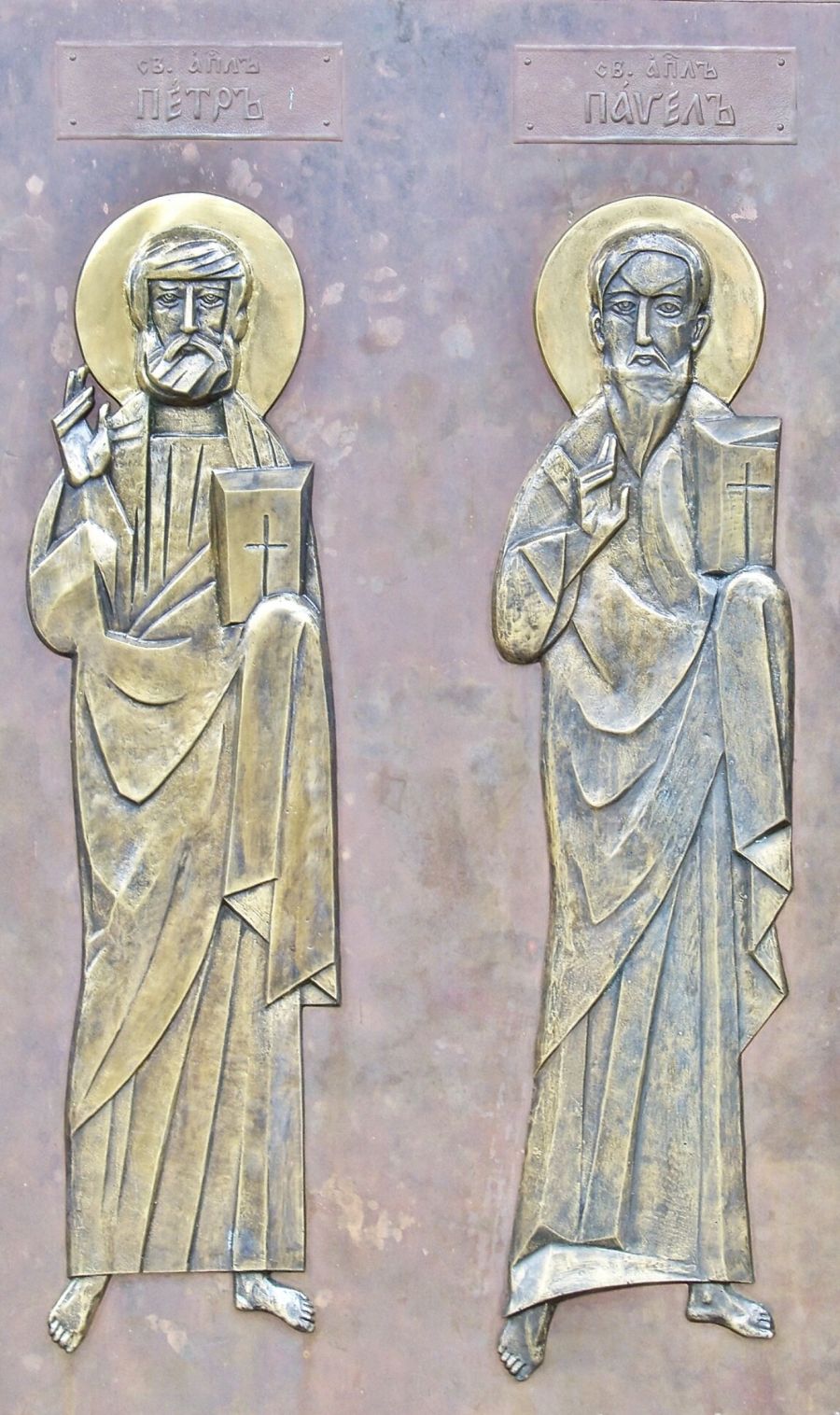
[St Peter and Paul, June 29]
Solemnity of Saints Peter and Paul, 29 June
Disparate: difference between religiosity and faith (the Church to come)
On the same date, the Church celebrates two dissimilar disciples.
Both are far removed from models of conformity and eccentricity - indeed, they are digressive, unsettling and restless.
One grows by accumulating uncertain experiences: a little like Peter (stubborn and hostile), a little like Simon (a disciple, but rarely), a little like Simon Peter (pro and con, with one foot in both camps).
The other grows, yes, but through an immediate fall from the ideology of being and feeling purer and higher than others:
in an instant, from the fiery 'steed' of the leaders and judges to the working class capable of listening and benevolence.
Suddenly, from Saul to Paul.
The first, an apostle out of eagerness and long habit [in coming and going], the other by direct calling. Not by the laying on of hands by superiors with pious lives who should have known better than him.
An immediate vocation - it upsets and overturns the way of seeing things.
Neither of the two protagonists was a devout and obedient son: both were rather stubborn and eager, but each in his own way; one uncertain and diplomatic, the other sharp.
For a long time they were restless and even opposed to Christ.
Even in the Proclamation, Catechesis, Animation, Pastoral Care and works of charity, we begin to realise that the starting point of Evangelisation is not the usual, reassuring one, which only teaches others [and transmits false security].
The input is to raise questions that involve people personally.
And any initiative is useful first and foremost to improve those who propose it - not the crowds who would otherwise remain unaware.
This is the cornerstone of the attitude towards the fullness of good and the fulfilment of every human being.
In the unity of the Faith, diverse gifts come together.
We are not called to be paternalistic or firefighters, rushing to extinguish fires that we do not even know about but which burn brightly (only beyond the chimney of our own homes).
The Church of the future also depends on our mindset.
The cornerstone of living Tradition is believing in the world to come - not despite, but because of its differences.
Divine love manifests itself, makes itself present, intervenes in many ways.
The sparks that fuel the Flame of the Spirit are varied: they all illuminate and warm the world... unless we build a wall of refractory material around them.
This sometimes happens in the territory, at the hands of consortia. With young people's cunning already normalised, or old fogies afraid of losing the privileges on which they float.
A scene of cunning and still waters, already reeking of death.
But in the personal Christ, even our insecurity opens unexplored paths to new worlds.
Every missionary knows that his 'certainty' is the fruit of a question mark.
An added value that he does not know; the product of a primordial force that arises from the chaos of his own or others' predictability.
The varied formation and even the turmoil of the facets become a place of Peace.
Possibility of the Immense, rather than a foothold for retreat under penalty of punishment typical of religious condemnation.
While doctrine and discipline instil certainties and stubborn expectations that would make us travel only on tracks already laid out, Faith allows itself to be guided by Providence manifested in real life, which surprises us.
An adherence, a creative relationship - Faith - with a mysterious Energy, always pure, clear, transparent, intact, uncontaminated.
An appeal by name that brings us face to face with ourselves and God, without ever depersonalising.
Only in this way can we achieve harmony. This is the church of the future.
In fact, those who are uncertain and cannot immediately draw conclusions go all the way: they do not abandon, marginalise or betray; they do not use their religious position as a weapon of blackmail.
They do no harm.
«When the weaver raises one foot, the other lowers. When the movement stops and one of the feet stops, the fabric is no longer woven. His hands throw the shuttle from one to the other, but no hand can hope to hold it. Like the weaver's gestures, it is the union of opposites that weaves our life».
[African Peul oral tradition]
Homage to the Polyhedron and not to the Sphere. Diversity and Plurality mean space for each of us, as we are. Expanded, not 'better'.
Not homogeneous, not regular, not standardised. Even if the local chain of command does not want it.
Homage to the Church? Not the uniform and standard one. The strange couple Peter and Paul were not.
Homage to the Church, Homage to Life.








