


19th Sunday in Ordinary Time (year A) [9 August 2026]
First Reading from the First Book of Kings (19:9a, 11–13a)
In the 9th century BC, in the Kingdom of Israel, Queen Jezebel, wife of King Ahab, introduced the worship of the god Baal in Samaria. Faced with the spread of idolatry, the prophet Elijah stands up with great zeal to defend the faith of his people. Convinced that God’s superiority must be demonstrated through signs of power, Elijah foretells a long drought and subsequently organises a contest on Mount Carmel between the priests of Baal and the God of Israel. Two altars are prepared, and it is decided that the true God will be the one who answers by sending fire from heaven. The priests of Baal pray in vain; when Elijah, however, calls upon the Lord, divine fire consumes the sacrifice. The people acknowledge the victory of the God of Israel. Nevertheless, Elijah, driven by his fervour, has the priests of Baal put to death – an act which God had not asked him to perform. When Jezebel learns of what has happened, she swears to take revenge and to kill Elijah. The prophet flees into the desert and, exhausted, comes to long for death. On his journey to Mount Horeb, he undergoes a profound inner crisis which becomes the starting point of his conversion. Elijah gradually realises that he had imagined God as a deity of strength and power, not unlike the very deities he had been fighting against. On Mount Horeb, where Moses too had once encountered God, the Lord reveals himself to him in an unexpected way. It is not in the storm, nor in the earthquake, nor in the fire, but in the ‘still small voice’ The Hebrew text uses the expression: קוֹל דְּמָמָה דַקָּה
Qôl demāmāh daqqāh. Literally, this means: qôl = voice, sound; demāmāh = silence, deep stillness, calm; daqqāh = subtle, delicate, faint. A very faithful translation might be: ‘a voice of subtle silence’, or ‘the sound of a delicate silence’.
Elijah thus discovers that true divine power is not expressed through violence, clamour or coercion, but through gentleness, patience, mercy and discretion. The account represents a fundamental stage in biblical revelation: God teaches his prophet to move from a form of religiosity based on force to a faith founded on trust and gentleness. Elijah’s great discovery is that God does not conquer through fear, but through love.
Responsorial Psalm (84/85) Psalm 84/85 was composed almost 50 years after the return of the people of Israel from the Babylonian exile (538 BC). When the exiles returned to their land full of enthusiasm and hope, they believed that a new life was beginning, that God had wiped the slate clean and that everything could start afresh. However, reality proved more difficult than expected. Breaches of the Covenant resurfaced; conversion was not automatic; and the returnees—often born in exile or having left as young people—encountered obstacles, misunderstandings and resistance, even in the reconstruction of the Temple. For this reason, the psalmist expresses conflicting feelings. On the one hand, he gives thanks to God for bringing his people back to the Promised Land and for forgiving their sins; on the other, seeing that the difficulties persist, he wonders whether divine wrath is not still present and pleads: ‘Show us your love, Lord, and grant us your salvation’. The central theme of the psalm is the dual meaning of the verb ‘to return’: the people have already physically returned to their land, but they must still make the most important return of all – that of the heart to God. True conversion is a gift from God, but it also requires human commitment, a willingness to listen to and follow his word. This is why the psalmist declares: ‘I will listen to what the Lord says’, recognising that peace springs from trusting obedience to God. The final part of the psalm is a magnificent hymn of hope. The poet looks forward to the day when God’s plan will be fully realised: ‘Love and truth shall meet; justice and peace shall kiss’. This is not a naïve dream, but the certainty that God is guiding history towards a future of reconciliation, brotherhood and peace amongst humankind.
Second Reading from the Letter of Saint Paul the Apostle to the Romans (9:1–5)
In chapters 9–11 of the Letter to the Romans, Saint Paul addresses an issue particularly close to his heart: if many Jews have not recognised Jesus Christ as the Messiah, does this perhaps mean that God has rejected his people? Paul is well aware of this problem because he himself, before his conversion on the road to Damascus, had been a strict Jew and even a persecutor of Christians. After his encounter with Christ, he realised that the Christian faith does not contradict the faith of Israel, but rather fulfils it. However, the majority of the Jewish people do not accept this conviction and, indeed, often oppose Paul’s preaching. This gives rise to his question: if Israel does not recognise the Messiah, is it perhaps excluded from the Covenant? And if God were to revoke his promises to Israel, how could Christians trust in his faithfulness? To answer this, Paul traces the entire course of sacred history. He recalls that Israel has received unique gifts: adoption as God’s children, the glory of his presence, the covenants, the Law, worship, the promises, the patriarchs and even the privilege that the Messiah should be born of his people. The whole of biblical history bears witness to God’s irrevocable commitment to Israel. Paul’s conclusion is clear: God has not abandoned the Jewish people. His promises are definitive, because God is faithful to himself. The Covenant has not been annulled. For Paul, the rejection of Jesus by many Jews remains a mystery, but it does not call into question the election of Israel. This final certainty is expressed in a decisive statement: ‘God remains faithful, for he cannot deny himself’ (2 Tim 2:13). The central message of the text is therefore that God’s faithfulness is stronger than human unfaithfulness.
From the Gospel according to Matthew (14:22–33)
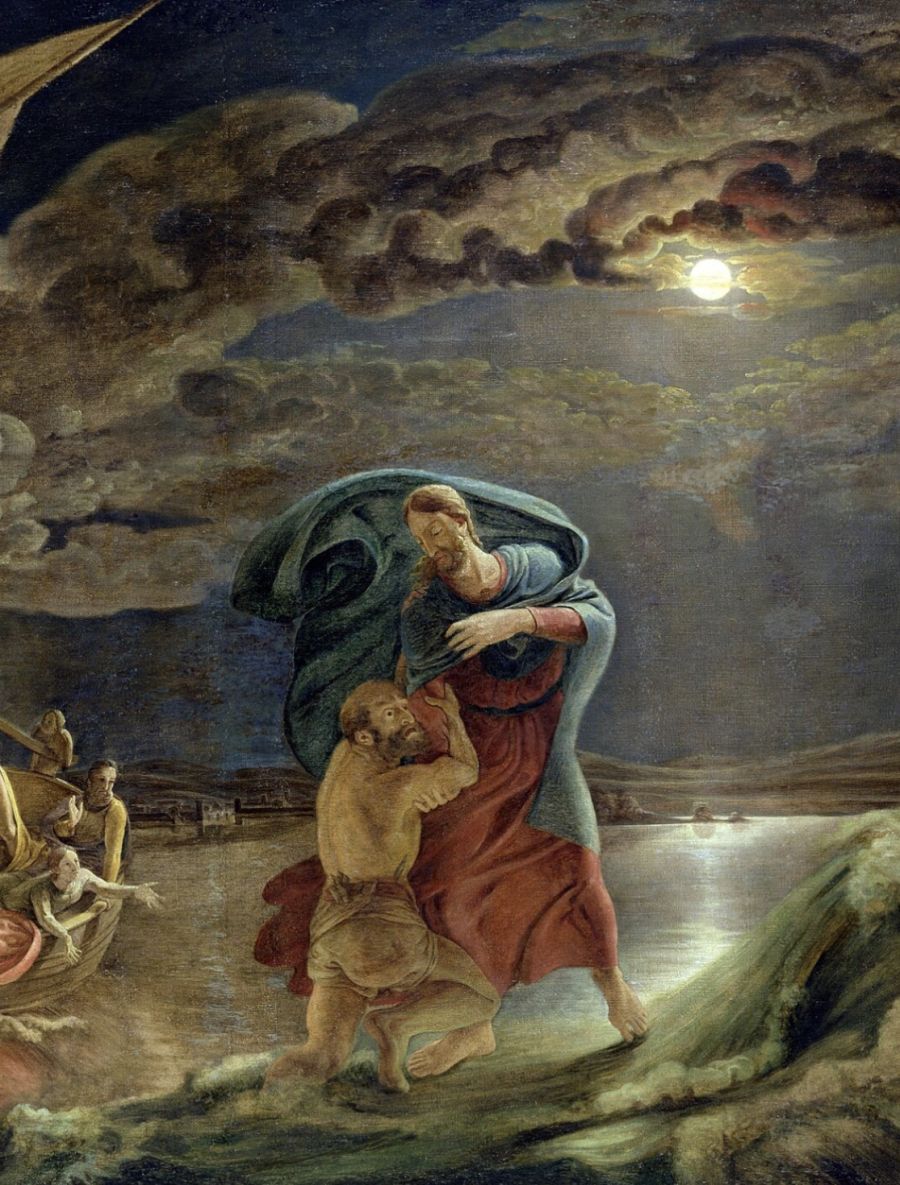
This Gospel episode takes place immediately after the feeding of the five thousand. After feeding the crowd, Jesus Christ instructs the disciples to leave and goes up the mountain alone to pray. On the one hand, his mission cannot stop at the success of the moment; on the other, Jesus wishes to avoid the risk of triumphalism and spectacle, a temptation he had already faced in the desert. Prayer enables him to remain in deep communion with the Father and to discern the path to follow. Meanwhile, the disciples’ boat is being tossed about by the waves of the Sea of Tiberias. During the night, they see a figure walking on the water and, terrified, think it is a ghost. But Jesus reassures them with words that run through the entire Gospel: ‘Take heart! It is I; do not be afraid.’ At that point, Peter, trusting in the Master’s voice, asks to be allowed to go to him by walking on the water. Jesus simply replies: ‘Come.’ Peter then accomplishes the impossible and walks on the water, but when he takes his eyes off Jesus and focuses on the force of the wind, he is overcome by fear and begins to sink. In this action, Peter represents every disciple: generous and sincere in his enthusiasm, yet fragile when put to the test. His fall does not stem from a lack of love, but from doubt and fear. Nevertheless, he makes the right choice: he cries out, ‘Lord, save me!’ Jesus reaches out his hand, seizes him and brings him to safety, asking him, ‘You of little faith, why did you doubt?’ The story teaches us that faith consists in keeping our gaze fixed on Christ even when difficulties seem to overwhelm us. Our frailties, doubts and even our failures are not the final word: what matters is that we continue to call upon his help. When Jesus steps into the boat, the wind dies down and the disciples come to understand more deeply who he is. They fall down before him and proclaim: ‘Truly, you are the Son of God.’ The central message of the passage is that the life of faith alternates between moments of strength and moments of weakness, as happened to Peter. But whenever a person is in danger of sinking, they can entrust themselves to Christ, and God’s hand is always ready to sustain them.
+Giovanni D’Ercole








