


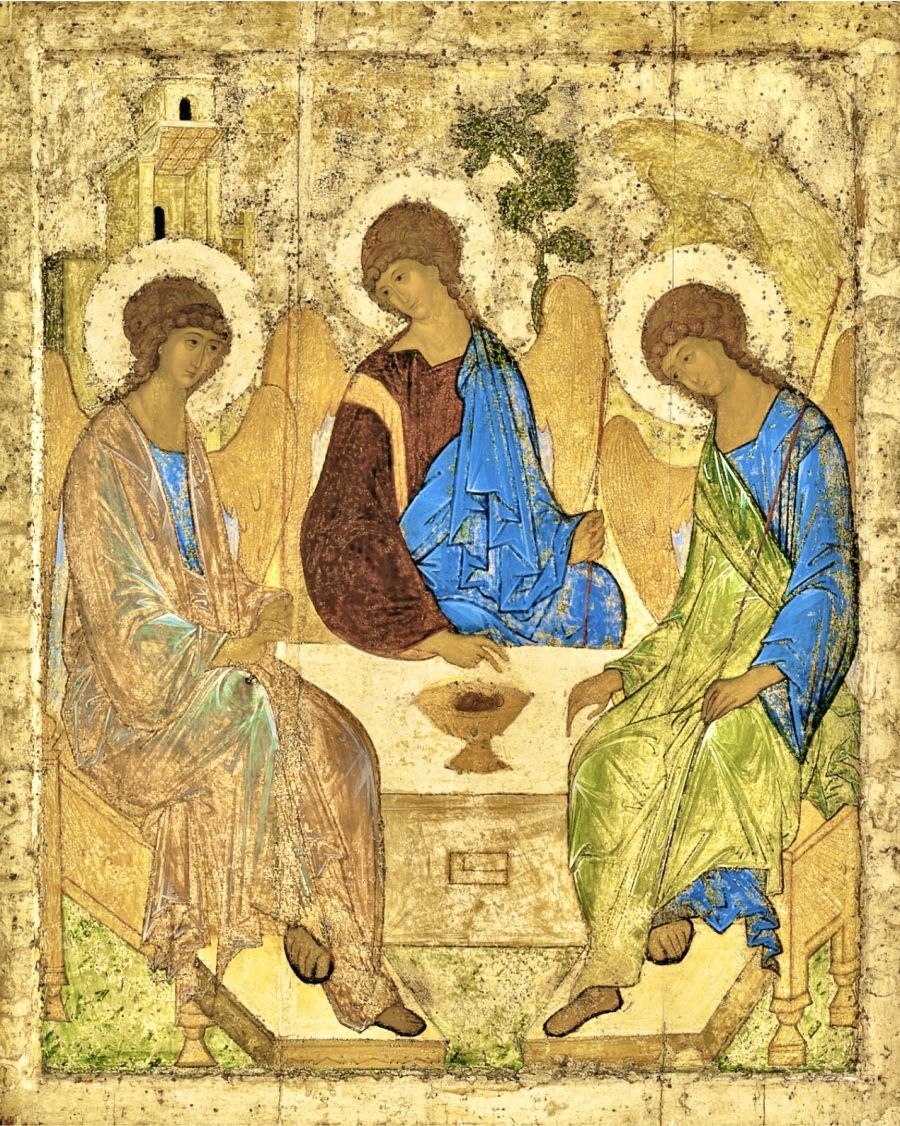
Most Holy Trinity
Prov 8:22-31; Rom 5:1-5; Jn 16:12-15 (year C)
Scripture testifies that the Lord proceeds with his people and manifests himself in history, but he is not bound to a particular territory or sacred ‘heights’, but to woman and man.
The Eternal is «God of Abraham and Isaac and Jacob» (Mt 22:32; Mk 12:26; Lk 20:37; cf. Ex 3:6).
He is «The One who Will Be» [Ex 3:14 Hebrew text] that is: in the unfolding of events, people have an essential experience of the Living One as Liberator, and Bridegroom [cf. Hosea's fluctuating affective story].
But in the fullness of His Heart, only Jesus manifests Him - still in the First Covenant confused with a sullen legislator, notary, judge who intervenes to cut or distinguish, then waits for the reckoning.
The Almighty dreams of spreading life and creating Family, not dividing uncontaminated friends from impure enemies, or capable and incapable.
Such becomes the intimate expression of the authentic woman and man; a cipher of the identity of the Church that does not pronounce itself to a minimum.
Sons’ identity card is the faith in a God who creates, makes covenants, is Close, redeems, allows flourishing in any event or age.
The first Reading highlights the Father's Plan, which unfolds his mastery being while being assisted by the delightful figure of Wisdom.
Creation reflects the purpose of divine Love, manifested in the enchantment of a joyful walk with us.
He desires to remain on earth, unconditionally.
His Bliss? The same as ours; of every creature, who loves to flourish in spite of conflicts.
This is precisely - if the son, though unsteady, does not feel himself to be the fruit of chance, but rather grasps the moments of confusion in life as if they were those of a building site [because the Design knows where to go].
Disorder, piled-up materials, mess, novelties at every turn; but you do not get lost: inside the soul is the prototype-image of a 'programme' that allows for trial and error, indeed relies on them.
It is a Project that recovers all the scattered energies and interrupted paths, creating unthinkable varieties, hence diverse essences. As would a Parent who rejoices in the rich offspring, in the different works of his intimates in the most varied fields, manifested in thousand facets.
If the guiding Plan is of the Creator, the apex and the Work belong to the Son.
The second Reading makes it clear that the Father did not consider his activity concluded by granting mere input to being and essences - then abandoning reality and men; by withdrawing up there.
By Grace, in the Faith we are partakers of God, we have direct access to His independent action, to Himself (Rom 5:2).
The Person and story of Jesus tell of a Kingdom in which holiness is not feared to be endangered by contact with the world.
There is only one problem that cuts through the Dialogue with the Most High (v.3): the believing that our boasting is of an obvious kind.
In front of our fellow men we glory in achievements, roles, titles and successes [it also happens in the path of religious perfection]. But the Son announces that the Father is only undeserved Understanding.
We finally learn that the obsession with being admired from the outside, and the pleasure of approval at any cost - are not “the” Way at all.
In fact, the true Shah - the genuine Work - is solely of the Son, who, having fully corresponded to the initiative of God the Father, Justifies.
The Inner Friend then does not 'make righteous' by dressing us outwardly and in a punctually manner, but in an existential process that shifts the balance (vv.3-4).
Lord works within through experience. He also does this by besieging “the other" self of ourselves that we have set aside.
Thus changing the shrunken heart and improving us with his passionate Friendship, re-proposed in new life opportunities.
The Gospel appeals to the mysterious, unknown sense of the total self-giving.
It is not easy to bear its «weight» [Jn 16:12: alludes to the Cross] nor to grasp its implications and imagine its paradoxical Fruitfulness.
The Development that flows out of it is the empathy, the deep reach, the action of the Spirit.
Unfolded Gesture that internalizes this not only strange, but absurd proposal: that of triumph in loss, and even of Life from death.
We experience it in act: in the inexplicable recoveries that give glory to God (v.14) [that is, they renew relationships] and put people who do not even have self-esteem back on their feet.
Only in this way can the Plan of Salvation be carried out.
Stepping out from the shadow of others, the opportunist becomes righteous, the doubter more secure, the unhappy person regains hope; all can live happily.
Accepted Diversity becomes an impulse for enrichment and a matrix for development.
Social identification is no longer involved. There is something else in us.
God Himself is «He who Will Be»: away from the ballasts, the Best is yet to Come. Reason not to run away from great Desires any more.
[Most Holy Trinity]








