Apr 18, 2026 Written by 

We can and must go out

«I Am the Gate of the sheep»

(Jn 10:1-10)


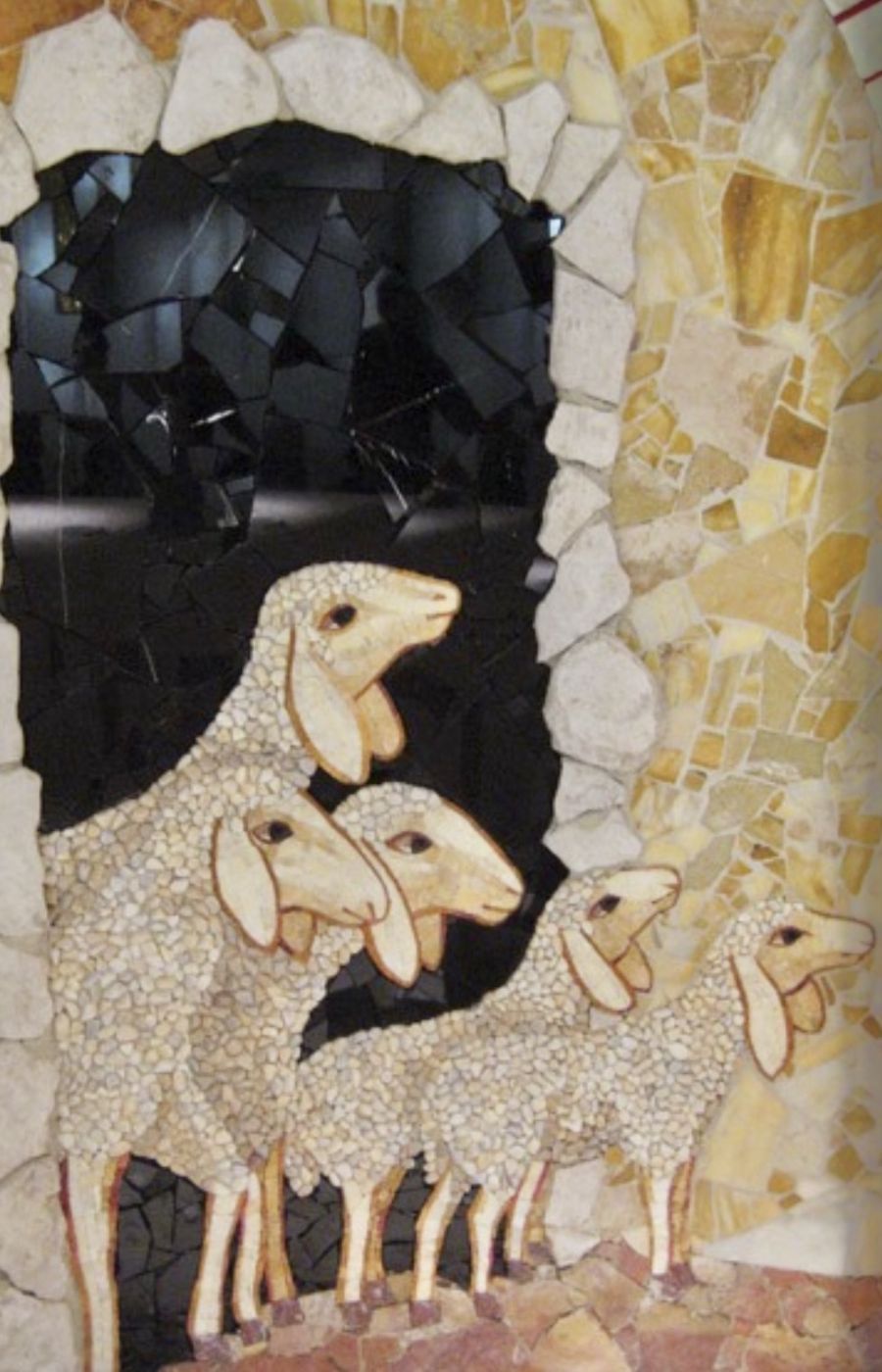
In the pastures, during the night the sheep were sheltered in stone enclosures on a slope and the shepherds (taking turns) placed themselves in defense of the flock by huddling in the position of the door down, armed with sticks, precisely as if they were a door, impassable for thieves and predators.

Life’s assiduity allowed the flock - even of different owners - to recognize the typical call and the voice of the corresponding shepherd. Not infrequently he designated each with an individual nickname (unrepeatable according to character).

In Jerusalem the great city Gates were opened in the morning and closed at sunset. They were fundamental points of urban social life, obligatory passages to enter and exit the walls.

After decades of deportation, the end of the Babylonian empire and the edict of Cyrus, the Sheep Gate was the first to be restored and the only one consecrated, because herds flowed through it to be sacrificed to the Temple.

Jesus takes a stand and explicitly denounces the abandonment’ situation of the true flock [the people] sacrificed to the interest and logic of the institution which is not interested in people's happiness but only in the defense of privileges.


He is the Shepherd who walks ahead (v.4); doesn’t hide behind the scenes: he takes risks personally. The Lord doesn’t come to take, but to give in abundance. Because God is looking for his people in shortage.

His is a Call by Name (v.3): He respects personal identity, doesn’t impose abstract or unsustainable rhythms, doesn’t force the times; He assesses the conditions of each.

For the authentic Shepherd there are no anonymous crowds.

Therefore He doesn’t close us within the ancient sacred enclosures (v.1 greek text) where mass obsessions lurk. Fences equipped with a guardian and gendarmes, where all are uniform - and the sensitive soul no longer breathes, kidnapped by opportunists (v.8).

From His Gate we can go out (vv.3-9). Indeed, it’s He who forces us to overcome it (v.3 greek text).

The authentic Guide leads to a different richness, more substantial pastures, unexpected amazements.

The true Shepherd obliges to make Exodus, pushing us (with force) out of the restricted sheepfolds.


The guide’s authoritativeness is confirmed both by the direct knowledge of the «guardian-gatekeeper» (v.3) and by that of the people, who recognize the Word, and follow it - pushed by that Call as by a thrill within.

Christ highlights the authority he has over the people, presenting Himself with the non-transitory formula «I Am» [full of eminent and profound resonances].

And actualizing, He specifies this expression with the metaphor of the Gate - not so much to close it, but above all to open it wide and let us pass.

In this way and unlike the old guides, the small flock follows Him not out of fear or calculation, as it would do with an inflexible master, but spontaneously.


Taking into account the presence of obstacles (without which we cannot grow) in the even excited journey, we will experience the invisible Friend as a Master of clarity, decision, constancy, flexibility, introspection.

Recognized in the Unknown Face that lurks within each of us, we will be made aware, motivated and free - so that we may be returned to Life.


[4th Sunday in Easter (year A), April 26, 2026]

230 Last modified on Sunday, 26 April 2026 11:59
don Giuseppe Nespeca

Giuseppe Nespeca è architetto e sacerdote. Cultore della Sacra scrittura è autore della raccolta "Due Fuochi due Vie - Religione e Fede, Vangeli e Tao"; coautore del libro "Dialogo e Solstizio".

There, however, in the place that should have been taken up by the encounter between God and man, he found livestock merchants and money-changers who occupied this place of prayer with their commerce […] In the temple's purification, however, it was a matter of more than fighting abuses. A new time in history was foretold (Pope Benedict)
Ma là dove doveva esservi lo spazio dell’incontro tra Dio e l’uomo, Egli trova commercianti di bestiame e cambiavalute che occupano con i loro affari il luogo di preghiera […] Nella purificazione del tempio, però, si tratta di più che della lotta agli abusi. È preconizzata una nuova ora della storia (Papa Benedetto)
«Ask Jesus for the grace to follow him closely», so as not to leave him alone, thus overcoming the temptations of looking at ourselves to «share the cake» of personal interests [Pope Francis]
«Chiedere a Gesù la grazia di seguirlo da vicino», per non lasciarlo solo, superando così le tentazioni di guardare noi stessi per «spartirsi la torta» degli interessi personali [Papa Francesco]
First, in Nazareth, he makes him grow, raises him, educates him, but then follows him: "Your mother is there" (Pope Francis)
Prima, a Nazareth, lo fa crescere, lo alleva, lo educa, ma poi lo segue: “La tua madre è lì” (Papa Francesco)
Unity is not made with glue [...] The great prayer of Jesus is to «resemble» the Father (Pope Francis)
L’Unità non si fa con la colla […] La grande preghiera di Gesù» è quella di «assomigliare» al Padre (Papa Francesco)
Divisions among Christians, while they wound the Church, wound Christ; and divided, we cause a wound to Christ: the Church is indeed the body of which Christ is the Head (Pope Francis)
Le divisioni tra i cristiani, mentre feriscono la Chiesa, feriscono Cristo, e noi divisi provochiamo una ferita a Cristo: la Chiesa infatti è il corpo di cui Cristo è capo (Papa Francesco)
The glorification that Jesus asks for himself as High Priest, is the entry into full obedience to the Father, an obedience that leads to his fullest filial condition [Pope Benedict]
La glorificazione che Gesù chiede per se stesso, quale Sommo Sacerdote, è l'ingresso nella piena obbedienza al Padre, un'obbedienza che lo conduce alla sua più piena condizione filiale [Papa Benedetto]
All this helps us not to let our guard down before the depths of iniquity, before the mockery of the wicked. In these situations of weariness, the Lord says to us: “Have courage! I have overcome the world!” (Jn 16:33). The word of God gives us strength [Pope Francis]
Tutto questo aiuta a non farsi cadere le braccia davanti allo spessore dell’iniquità, davanti allo scherno dei malvagi. La parola del Signore per queste situazioni di stanchezza è: «Abbiate coraggio, io ho vinto il mondo!» (Gv 16,33). E questa parola ci darà forza [Papa Francesco]
It does not mean that the Lord has departed to some place far from people and from the world. Christ's Ascension is not a journey into space toward the most remote stars […] Christ's Ascension means that he no longer belongs to the world of corruption and death that conditions our life. It means that he belongs entirely to God (Pope Benedict)
Non vuol dirci che il Signore se ne è andato in qualche luogo lontano dagli uomini e dal mondo. L’Ascensione di Cristo non è un viaggio nello spazio verso gli astri più remoti […] L’Ascensione di Cristo significa che Egli non appartiene più al mondo della corruzione e della morte che condiziona la nostra vita. Significa che Egli appartiene completamente a Dio (Papa Benedetto)

Due Fuochi due Vie - Vol. 1 Due Fuochi due Vie - Vol. 2 Due Fuochi due Vie - Vol. 3 Due Fuochi due Vie - Vol. 4 Due Fuochi due Vie - Vol. 5 Dialogo e Solstizio I fiammiferi di Maria

duevie.art

don Giuseppe Nespeca

Tel. 333-1329741


Disclaimer

Questo blog non rappresenta una testata giornalistica in quanto viene aggiornato senza alcuna periodicità. Non può pertanto considerarsi un prodotto editoriale ai sensi della legge N°62 del 07/03/2001.
Le immagini sono tratte da internet, ma se il loro uso violasse diritti d'autore, lo si comunichi all'autore del blog che provvederà alla loro pronta rimozione.
L'autore dichiara di non essere responsabile dei commenti lasciati nei post. Eventuali commenti dei lettori, lesivi dell'immagine o dell'onorabilità di persone terze, il cui contenuto fosse ritenuto non idoneo alla pubblicazione verranno insindacabilmente rimossi.






