Apr 17, 2026 Written by 

Go out into the whole world and proclaim, together with Him

(Mk 16:15-20)


The premises of today's passage are not entirely edifying: Jesus rebukes the Eleven for not believing.

They have resisted stubbornly because they cultivated contrary expectations.

Adherence to the Risen One was uncertain even on the part of those who knew Him personally and lived with Him.

Despite this, God considers only obstinacy to be guilty.

The Message to be proclaimed and personally adhered to is so unusual that at first it may create reluctance and skepticism - as it was even among the apostles, leaders of the nascent Church.

They too were weak and uncertain followers who were made convinced, stronger and more decisive, in the experience of interpersonal communion [described in filigree in the same mandate (vv.17-18)].


Sharing within a vital fraternity produced a growing afflatus.

On the wave of this energy chain, each Seed became consciousness that gradually learnt to respond to its call and not be disturbed by poisons.

This recognition of the divine Presence in his new Face was revealed and poured out on the marginalized and the sick - the minimal and imperfect previously considered in religions to be punished by fate or even cursed by God.

The atmosphere of friendship and understanding that had supplanted social and spiritual antagonism, and the feeling of being welcomed even in precarious conditions, favoured every care, every expression of gratuitousness.

Christ has thus continued to unfold his work in history, making himself alive in the human and divine people who bear witness to Him. His influence and triumph - victorious everywhere over the germs of death.

His sole 'power'.


In every person or group there are decisive events, stages of regeneration and new birth.

Mk attempts to describe the change in Jesus' Presence, which continues to guide the disciples step by step even in the first hesitations following His inglorious death.

The mission seemed not precisely defined [as vice versa in ancient religious ideologies] and superior to the forces at work.

By His inspiration and power, Christ wanted to remain forever present in his disciples, manifesting Himself alive in the signs mentioned in the text.

They are not demonstrative prodigies - although since the end of the 2nd century, apologetic frenzy has wanted to impose itself on the narrative of Faith, and we too have unfortunately inherited it.

The Proclamation is accompanied by the new language of love and by its wonders, which however are not clear evidences, but a ‘glad tidings’:

The Spirit of the living Christ in the Church is bringing about another kingdom.


The statement in v.19 is also theological: the image recalls the customs of Eastern courts.

Here it is useful to express God's inverse judgement of the Son's earthly defeat - and of His own intimates.

The concluding verse finally testifies to the disciples' conviction that they have the Lord beside them, that they are not alone and orphaned.

In this way and in the Spirit of genuine selflessness, the Resurrection has become a fact that spans time, right up to today.

Intimate Mystery and Wonder, our 'breath' and impetus - that the world may be a place conducive to the fullness of life for all.


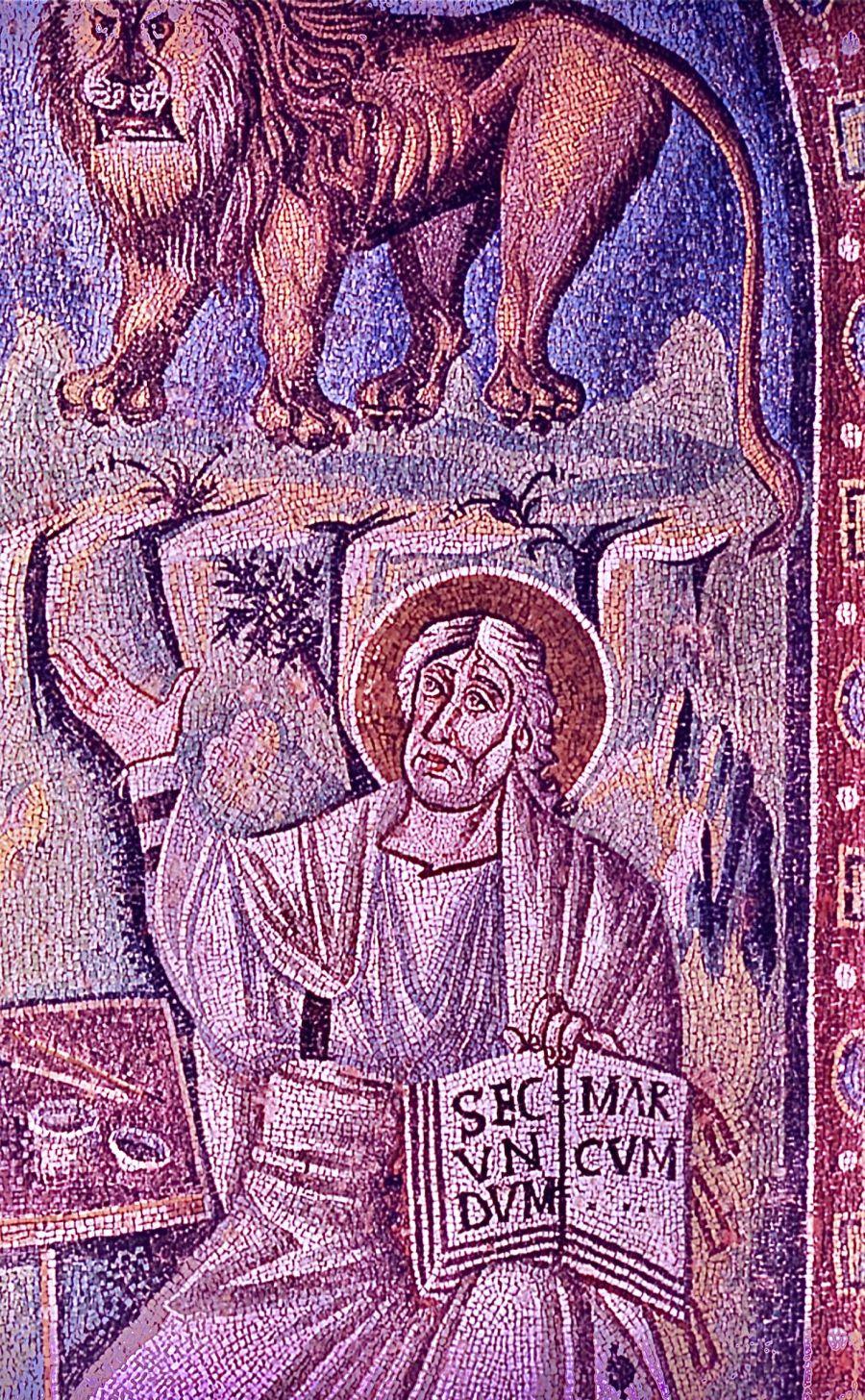
[St Mark the Apostle and Evangelist, April 25]

122 Last modified on Saturday, 25 April 2026 11:59
don Giuseppe Nespeca

Giuseppe Nespeca è architetto e sacerdote. Cultore della Sacra scrittura è autore della raccolta "Due Fuochi due Vie - Religione e Fede, Vangeli e Tao"; coautore del libro "Dialogo e Solstizio".

Jesus, Good Shepherd and door of the sheep, is a leader whose authority is expressed in service, a leader who, in order to command, gives his life and does not ask others to sacrifice theirs. One can trust in a leader like this (Pope Francis)
Gesù, pastore buono e porta delle pecore, è un capo la cui autorità si esprime nel servizio, un capo che per comandare dona la vita e non chiede ad altri di sacrificarla. Di un capo così ci si può fidare (Papa Francesco)
To be Christians means to be missionaries, to be apostles (cfr. Decree Apostolicam Actuositatem, n.2). It is not enough to discover Christ - you must bring Him to others! [John Paul II]
Essere cristiani significa essere missionari-apostoli (cfr. «Apostolicam Actuositatem», 2). Non basta scoprire Cristo - bisogna portarlo agli altri! [Giovanni Paolo II]
What is meant by “eat the flesh and drink the blood” of Jesus? Is it just an image, a figure of speech, a symbol, or does it indicate something real? (Pope Francis)
Che significa “mangiare la carne e bere il sangue” di Gesù?, è solo un’immagine, un modo di dire, un simbolo, o indica qualcosa di reale? (Papa Francesco)
What does bread of life mean? We need bread to live. Those who are hungry do not ask for refined and expensive food, they ask for bread. Those who are unemployed do not ask for enormous wages, but the “bread” of employment. Jesus reveals himself as bread, that is, the essential, what is necessary for everyday life; without Him it does not work (Pope Francis)
Che cosa significa pane della vita? Per vivere c’è bisogno di pane. Chi ha fame non chiede cibi raffinati e costosi, chiede pane. Chi è senza lavoro non chiede stipendi enormi, ma il “pane” di un impiego. Gesù si rivela come il pane, cioè l’essenziale, il necessario per la vita di ogni giorno, senza di Lui la cosa non funziona (Papa Francesco)
In addition to physical hunger man carries within him another hunger — all of us have this hunger — a more important hunger, which cannot be satisfied with ordinary food. It is a hunger for life, a hunger for eternity which He alone can satisfy, as he is «the bread of life» (Pope Francis)
Oltre alla fame fisica l’uomo porta in sé un’altra fame – tutti noi abbiamo questa fame – una fame più importante, che non può essere saziata con un cibo ordinario. Si tratta di fame di vita, di fame di eternità che Lui solo può appagare, in quanto è «il pane della vita» (Papa Francesco)
The Eucharist draws us into Jesus' act of self-oblation. More than just statically receiving the incarnate Logos, we enter into the very dynamic of his self-giving [Pope Benedict]
L'Eucaristia ci attira nell'atto oblativo di Gesù. Noi non riceviamo soltanto in modo statico il Logos incarnato, ma veniamo coinvolti nella dinamica della sua donazione [Papa Benedetto]
Jesus, the true bread of life that satisfies our hunger for meaning and for truth, cannot be “earned” with human work; he comes to us only as a gift of God’s love, as a work of God (Pope Benedict)
Gesù, vero pane di vita che sazia la nostra fame di senso, di verità, non si può «guadagnare» con il lavoro umano; viene a noi soltanto come dono dell’amore di Dio, come opera di Dio (Papa Benedetto)
The locality of Emmaus has not been identified with certainty. There are various hypotheses and this one is not without an evocativeness of its own for it allows us to think that Emmaus actually represents every place: the road that leads there is the road every Christian, every person, takes. The Risen Jesus makes himself our travelling companion as we go on our way, to rekindle the warmth of faith and hope in our hearts and to break the bread of eternal life (Pope Benedict)

Due Fuochi due Vie - Vol. 1 Due Fuochi due Vie - Vol. 2 Due Fuochi due Vie - Vol. 3 Due Fuochi due Vie - Vol. 4 Due Fuochi due Vie - Vol. 5 Dialogo e Solstizio I fiammiferi di Maria

duevie.art

don Giuseppe Nespeca

Tel. 333-1329741


Disclaimer

Questo blog non rappresenta una testata giornalistica in quanto viene aggiornato senza alcuna periodicità. Non può pertanto considerarsi un prodotto editoriale ai sensi della legge N°62 del 07/03/2001.
Le immagini sono tratte da internet, ma se il loro uso violasse diritti d'autore, lo si comunichi all'autore del blog che provvederà alla loro pronta rimozione.
L'autore dichiara di non essere responsabile dei commenti lasciati nei post. Eventuali commenti dei lettori, lesivi dell'immagine o dell'onorabilità di persone terze, il cui contenuto fosse ritenuto non idoneo alla pubblicazione verranno insindacabilmente rimossi.






