Jan 15, 2026 Written by 

Axis is to be with Him

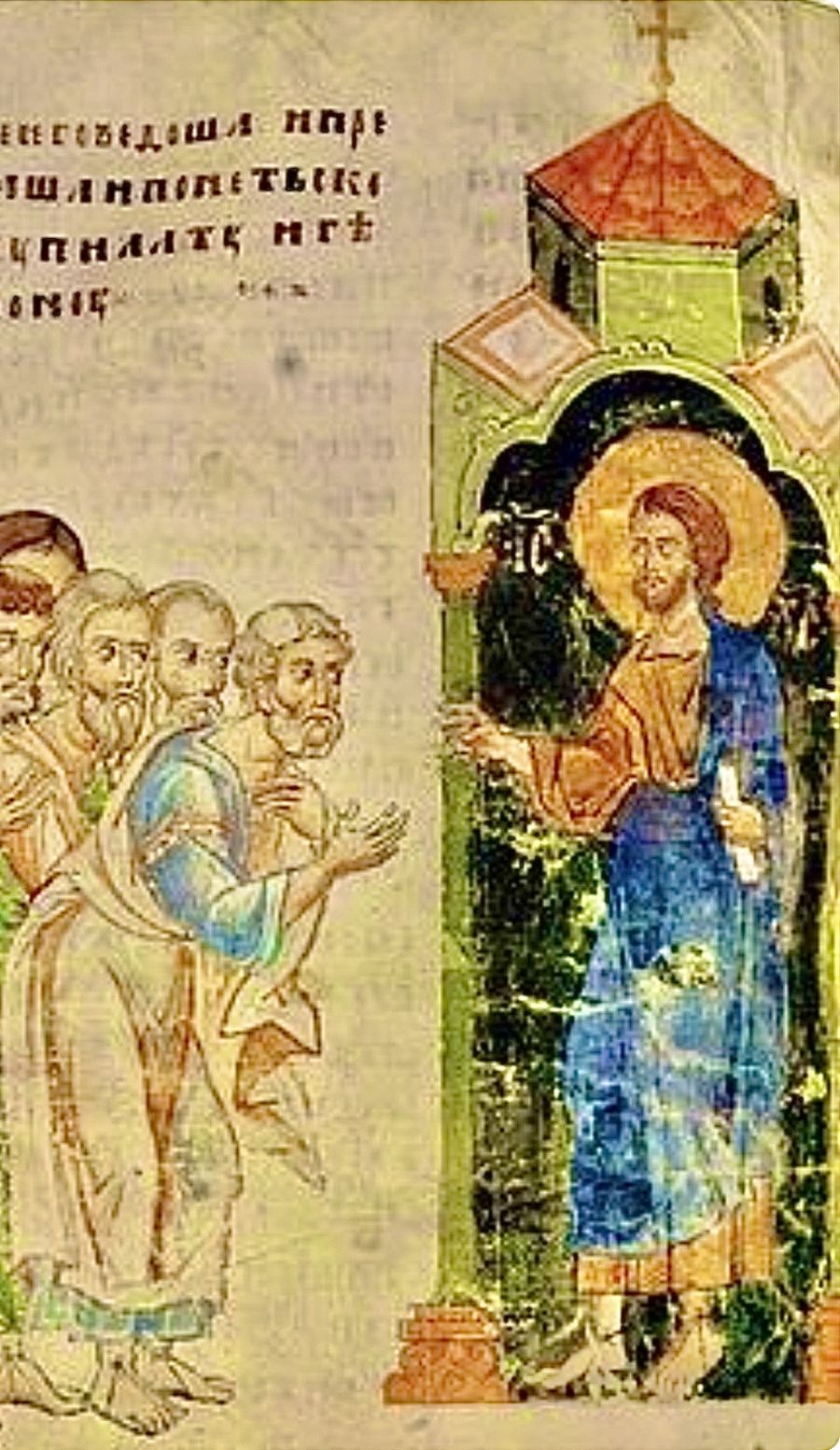
He calls to Himself and ‘makes’ the Twelve: big emergency, by small Name

(Mk 3:13-19)


In Christ, the physician of suffering humanity, the things of the soul seem different, and so do relationships.

All this leads his group to a different view of itself, history, world, multitudes (vv.7-9) and problems.

The axis is to be with Him (v.14) that is to form Church in Him. In fact, it is fundamental first to mature, wherever we live.

He who cultivates many cravings projects them; he procures others his own murky influences. This is why reflection is necessary; that critical, which really digs.

It conveys the sense of our getting on the field, and a righteous disposition.

Being with Jesus annihilates infidelities that do not propose simplicity of life and values of the spirit, that distance, building other temples and shrines.

The charge of universality contained in the rooting to values transmitted by dialogue with Him, questions us; in relationships as well as in self-knowledge.

We understand that... stimuli, flections, virtuous principles, gaps, hidden sides, achieved goals and bad-moments are complementary energy aspects.

It seems a paradox, but openness to the multitudes’ needs remains a exquisitely non-external problem.

It’s from themselves and from the already varied community that one looks at the world, knowing how to recover its opposite sides.

It is the Way of the Interior that penetrates the way of the outside.

It is the intimate road that can fight the power of evil that stifles the longings for life and annihilates personalities.


We must first heal what is essential and neighbour.

Of course, who do not accept risk cannot be missionary; the person who isn’t inserted among the poor people do not know their world.

But those who are not ‘made’ free [v.14: «(He) made (the) Twelve»] cannot free (v.15).

Who is not trained can’t educate; he can’t ‘remake history from the beginning’.

The only way to peer far and without borders is to ‘stick to the reason of things’.

Principle that is known in Christ Logos and only if we are not misled by the superficiality of reductions.

Understanding in God the nature of creatures, and conforming us to it, everyone is inspired to transmute and complete, without alienating forcings. 

By exercising a practice of ‘goodness even with themselves too’.

To understand this and approach the sense of their missional Uniqueness, the Son himself must ascend on «’the’ Mount» (v.13), assimilating himself to the Father’s Vision.

None of the apostles was in themselves worthy of the Call.

Most of them have typical names of Judaism, even of the patriarchs time - which indicates a cultural and spiritual extraction rooted more in common religion than in personal Faith; not easy to manage.

Yet made them his ‘intimates, by Name’ - chain that united Heaven with the fate of their healing mission, now without fences.

Announcement of new Light received in Gift: where precisely does not a single shape or a single color appears.


For a contagion that is neither alarmist nor unilateral, but thriving, multifaceted, sometimes "hidden" - and restless, disquieting.


[Friday 2nd wk. in O.T.  January 23, 2026]

175 Last modified on Friday, 23 January 2026 12:00
don Giuseppe Nespeca

Giuseppe Nespeca è architetto e sacerdote. Cultore della Sacra scrittura è autore della raccolta "Due Fuochi due Vie - Religione e Fede, Vangeli e Tao"; coautore del libro "Dialogo e Solstizio".

Today, as on the day of our Baptism, we hear the words of Jesus addressed to us: “Ephphatha, be opened!” Open your ears. Jesus, I want to open myself to your Word; Jesus, open myself to listening to you; Jesus, heal my heart from being closed, heal my heart from haste, heal my heart from impatience (Pope Francis)
Sentiamo rivolta a noi oggi, come nel giorno del Battesimo, quella parola di Gesù: “Effatà, apriti”! Apriti le orecchie. Gesù, desidero aprirmi alla tua Parola; Gesù, aprirmi al tuo ascolto; Gesù, guarisci il mio cuore dalla chiusura, guarisci il mio cuore dalla fretta, guarisci il mio cuore dall’impazienza (Papa Francesco)
And this is the problem: when the People put down roots in the land and are the depository of the Law, they are tempted to place their security and joy in something that is no longer the Word of God: in possessions, in power, in other ‘gods’ that in reality are useless, they are idols. Of course, the Law of God remains but it is no longer the most important thing, the rule of life; rather, it becomes a camouflage, a cover-up, while life follows other paths, other rules, interests that are often forms of egoism, both individual and collective. Thus religion loses its authentic meaning, which is to live listening to God in order to do his will — that is the truth of our being — and thus we live well, in true freedom, and it is reduced to practising secondary customs which instead satisfy the human need to feel in God’s place. This is a serious threat to every religion which Jesus encountered in his time and which, unfortunately, is also to be found in Christianity. Jesus’ words against the scribes and Pharisees in today’s Gospel should therefore be food for thought for us as well (Pope Benedict)
Ed ecco il problema: quando il popolo si stabilisce nella terra, ed è depositario della Legge, è tentato di riporre la sua sicurezza e la sua gioia in qualcosa che non è più la Parola del Signore: nei beni, nel potere, in altre ‘divinità’ che in realtà sono vane, sono idoli. Certo, la Legge di Dio rimane, ma non è più la cosa più importante, la regola della vita; diventa piuttosto un rivestimento, una copertura, mentre la vita segue altre strade, altre regole, interessi spesso egoistici individuali e di gruppo. E così la religione smarrisce il suo senso autentico che è vivere in ascolto di Dio per fare la sua volontà - che è la verità del nostro essere - e così vivere bene, nella vera libertà, e si riduce a pratica di usanze secondarie, che soddisfano piuttosto il bisogno umano di sentirsi a posto con Dio. Ed è questo un grave rischio di ogni religione, che Gesù ha riscontrato nel suo tempo, ma che si può verificare, purtroppo, anche nella cristianità. Perciò le parole di Gesù nel Vangelo di oggi contro gli scribi e i farisei devono far pensare anche noi (Papa Benedetto)
Salt, in the cultures of the Middle East, calls to mind several values such as the Covenant, solidarity, life and wisdom. Light is the first work of God the Creator and is a source of life; the word of God is compared to light (Pope Benedict)
Il sale, nella cultura mediorientale, evoca diversi valori quali l’alleanza, la solidarietà, la vita e la sapienza. La luce è la prima opera di Dio Creatore ed è fonte della vita; la stessa Parola di Dio è paragonata alla luce (Papa Benedetto)
Even after his failure even in Nazareth (vv.1-6) - his heralds gladly confused the Servant [who was educating them] with the victorious, sighed, respected and glorious Messiah…
Ancora dopo il suo fallimento persino a Nazareth (vv.1-6) - i suoi banditori hanno ben volentieri confuso il Servo [che li stava educando] col Messia vincitore, sospirato, rispettato e glorioso…

Due Fuochi due Vie - Vol. 1 Due Fuochi due Vie - Vol. 2 Due Fuochi due Vie - Vol. 3 Due Fuochi due Vie - Vol. 4 Due Fuochi due Vie - Vol. 5 Dialogo e Solstizio I fiammiferi di Maria

duevie.art

don Giuseppe Nespeca

Tel. 333-1329741


Disclaimer

Questo blog non rappresenta una testata giornalistica in quanto viene aggiornato senza alcuna periodicità. Non può pertanto considerarsi un prodotto editoriale ai sensi della legge N°62 del 07/03/2001.
Le immagini sono tratte da internet, ma se il loro uso violasse diritti d'autore, lo si comunichi all'autore del blog che provvederà alla loro pronta rimozione.
L'autore dichiara di non essere responsabile dei commenti lasciati nei post. Eventuali commenti dei lettori, lesivi dell'immagine o dell'onorabilità di persone terze, il cui contenuto fosse ritenuto non idoneo alla pubblicazione verranno insindacabilmente rimossi.






