Jan 14, 2026 Written by 

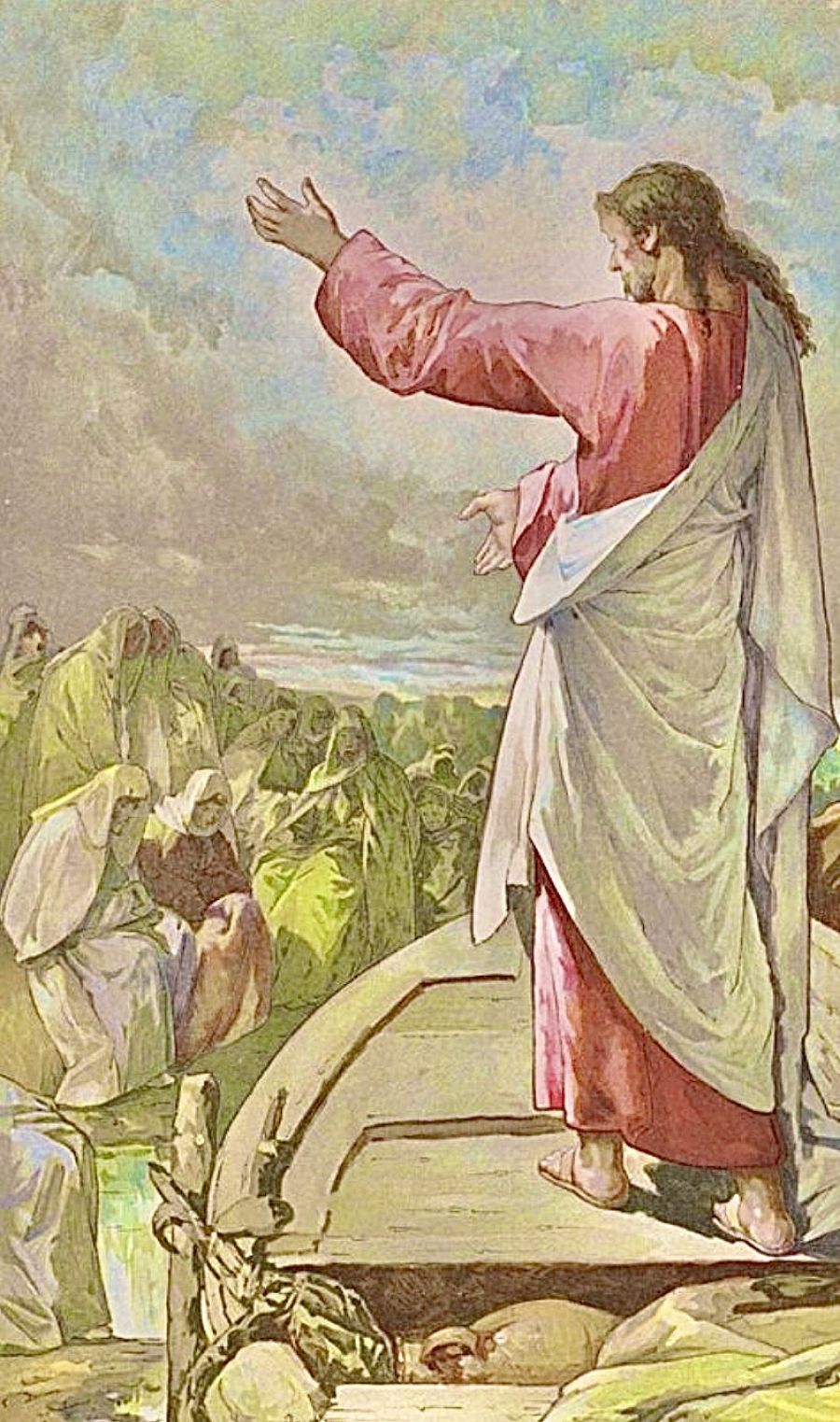
Opposite Face and small Boat: the (simple) expulsion of demons

(Mk 3:7-12)


The Kingdom of the Father announced by Jesus wasn’t at all tied to a creed any: God had not only a Face different from the ‘Empire system’ and the great Sovereign of religions, but even opposite.

This is the meaning of the happy news that his living Body pressed from everywhere and tossed by the waves [his fraternities, besieged] is always called to proclaim with the recovery works of people in difficulty, excluded from the circle of the strong.

In this very concrete sense, Mk’s Gospel insists on the expulsion of demons - starting from a kind of neutralization that is rooted in a quality of interior gaze and eminent relationships, devoid of instinct to competition. Even where it may seem impossible.

In Christ, the physician of suffering humanity, the things of the soul appear different, and so do relationships. All this leads his group to a different view of itself, history, world, multitudes (vv.7-9) and problems.

And with Him in the middle, his intimates are configured as the core of a society with simple ways, but with solid discernment, and divine relations.

At Mk’s time, in a moment of awareness of the crumbling of the golden age promised by the regime, here is the popular fear and belief in the dominance of unclean spirits over good.

On the other hand, instead of freeing people, all the authorities of the various religious expressions sucked their energies - just spreading fantasies and fears that ended up fueling widespread anguish.

On the basis of the alternative teaching and work of the Lord, the Church intended to free the subjugated people from heart-pounding and nightmare of scruples - through a life proposal that no longer relied on unworthiness and the phobias of the punishment of the gods.

The concrete example of the living Christ [in the «little Boat» here in v.9: the tiny Assembly of the sons] had to not let itself be crushed by epochal anxieties and feelings of guilt.

The false spiritual leaders of time inculcated in the people in need of everything an accentuation of the inadequacy feeling.

Thanks to their miseducation, simple people were not restored to themselves, but made radically insufficient.

For the intimates of the Lord, everyone must instead have ‘access’ - and new life.

And the troubled mob can become coexistence of new harmonies, of other alliances; but starting from its integrated, conciliated weakness - no longer because by way of ignorance and subtraction, or psychosis.

By adhering to Christ, we too have a precious experience: quality of support, vocation, naturalness, personal character, and concreteness, are combined.

So the Lord doesn’t want a “delirious” and empty institution - that can create a stir, or pyramids, and put awe. Not even magniloquent, but reduced to «small boat» [v.9 Greek text].

For this reason, Jesus never endured the quest for fame or exhibitionism (v.12), inconclusive ones.

His non-paternalistic Friendship accompanies us, understands, helps, recovers, and is also a step back.

Here is the Communion able to amalgamate people; with an intimate configuration which brings together and joins. The only convincing and lovable condition.


[Thursday 2nd wk. in O.T.  January 22, 2026]

251 Last modified on Thursday, 22 January 2026 12:11
don Giuseppe Nespeca

Giuseppe Nespeca è architetto e sacerdote. Cultore della Sacra scrittura è autore della raccolta "Due Fuochi due Vie - Religione e Fede, Vangeli e Tao"; coautore del libro "Dialogo e Solstizio".

And this is the problem: when the People put down roots in the land and are the depository of the Law, they are tempted to place their security and joy in something that is no longer the Word of God: in possessions, in power, in other ‘gods’ that in reality are useless, they are idols. Of course, the Law of God remains but it is no longer the most important thing, the rule of life; rather, it becomes a camouflage, a cover-up, while life follows other paths, other rules, interests that are often forms of egoism, both individual and collective. Thus religion loses its authentic meaning, which is to live listening to God in order to do his will — that is the truth of our being — and thus we live well, in true freedom, and it is reduced to practising secondary customs which instead satisfy the human need to feel in God’s place. This is a serious threat to every religion which Jesus encountered in his time and which, unfortunately, is also to be found in Christianity. Jesus’ words against the scribes and Pharisees in today’s Gospel should therefore be food for thought for us as well (Pope Benedict)
Ed ecco il problema: quando il popolo si stabilisce nella terra, ed è depositario della Legge, è tentato di riporre la sua sicurezza e la sua gioia in qualcosa che non è più la Parola del Signore: nei beni, nel potere, in altre ‘divinità’ che in realtà sono vane, sono idoli. Certo, la Legge di Dio rimane, ma non è più la cosa più importante, la regola della vita; diventa piuttosto un rivestimento, una copertura, mentre la vita segue altre strade, altre regole, interessi spesso egoistici individuali e di gruppo. E così la religione smarrisce il suo senso autentico che è vivere in ascolto di Dio per fare la sua volontà - che è la verità del nostro essere - e così vivere bene, nella vera libertà, e si riduce a pratica di usanze secondarie, che soddisfano piuttosto il bisogno umano di sentirsi a posto con Dio. Ed è questo un grave rischio di ogni religione, che Gesù ha riscontrato nel suo tempo, ma che si può verificare, purtroppo, anche nella cristianità. Perciò le parole di Gesù nel Vangelo di oggi contro gli scribi e i farisei devono far pensare anche noi (Papa Benedetto)
Salt, in the cultures of the Middle East, calls to mind several values such as the Covenant, solidarity, life and wisdom. Light is the first work of God the Creator and is a source of life; the word of God is compared to light (Pope Benedict)
Il sale, nella cultura mediorientale, evoca diversi valori quali l’alleanza, la solidarietà, la vita e la sapienza. La luce è la prima opera di Dio Creatore ed è fonte della vita; la stessa Parola di Dio è paragonata alla luce (Papa Benedetto)
Even after his failure even in Nazareth (vv.1-6) - his heralds gladly confused the Servant [who was educating them] with the victorious, sighed, respected and glorious Messiah…
Ancora dopo il suo fallimento persino a Nazareth (vv.1-6) - i suoi banditori hanno ben volentieri confuso il Servo [che li stava educando] col Messia vincitore, sospirato, rispettato e glorioso…
During more than 40 years of his reign, Herod Antipas had created a class of functionaries and a system of privileged people who had in their hands the government, the tax authorities, the economy, the justice, every aspect of civil and police life, and his command covered the territory extensively…
Durante più di 40 anni di regno, Erode Antipa aveva creato una classe di funzionari e un sistema di privilegiati che avevano in pugno il governo, il fisco, l’economia, la giustizia, ogni aspetto della vita civile e di polizia, e il suo comando copriva capillarmente il territorio…

Due Fuochi due Vie - Vol. 1 Due Fuochi due Vie - Vol. 2 Due Fuochi due Vie - Vol. 3 Due Fuochi due Vie - Vol. 4 Due Fuochi due Vie - Vol. 5 Dialogo e Solstizio I fiammiferi di Maria

duevie.art

don Giuseppe Nespeca

Tel. 333-1329741


Disclaimer

Questo blog non rappresenta una testata giornalistica in quanto viene aggiornato senza alcuna periodicità. Non può pertanto considerarsi un prodotto editoriale ai sensi della legge N°62 del 07/03/2001.
Le immagini sono tratte da internet, ma se il loro uso violasse diritti d'autore, lo si comunichi all'autore del blog che provvederà alla loro pronta rimozione.
L'autore dichiara di non essere responsabile dei commenti lasciati nei post. Eventuali commenti dei lettori, lesivi dell'immagine o dell'onorabilità di persone terze, il cui contenuto fosse ritenuto non idoneo alla pubblicazione verranno insindacabilmente rimossi.






