Nov 13, 2025 Written by 

Liberation and Personalization: difference between religiosity and Faith

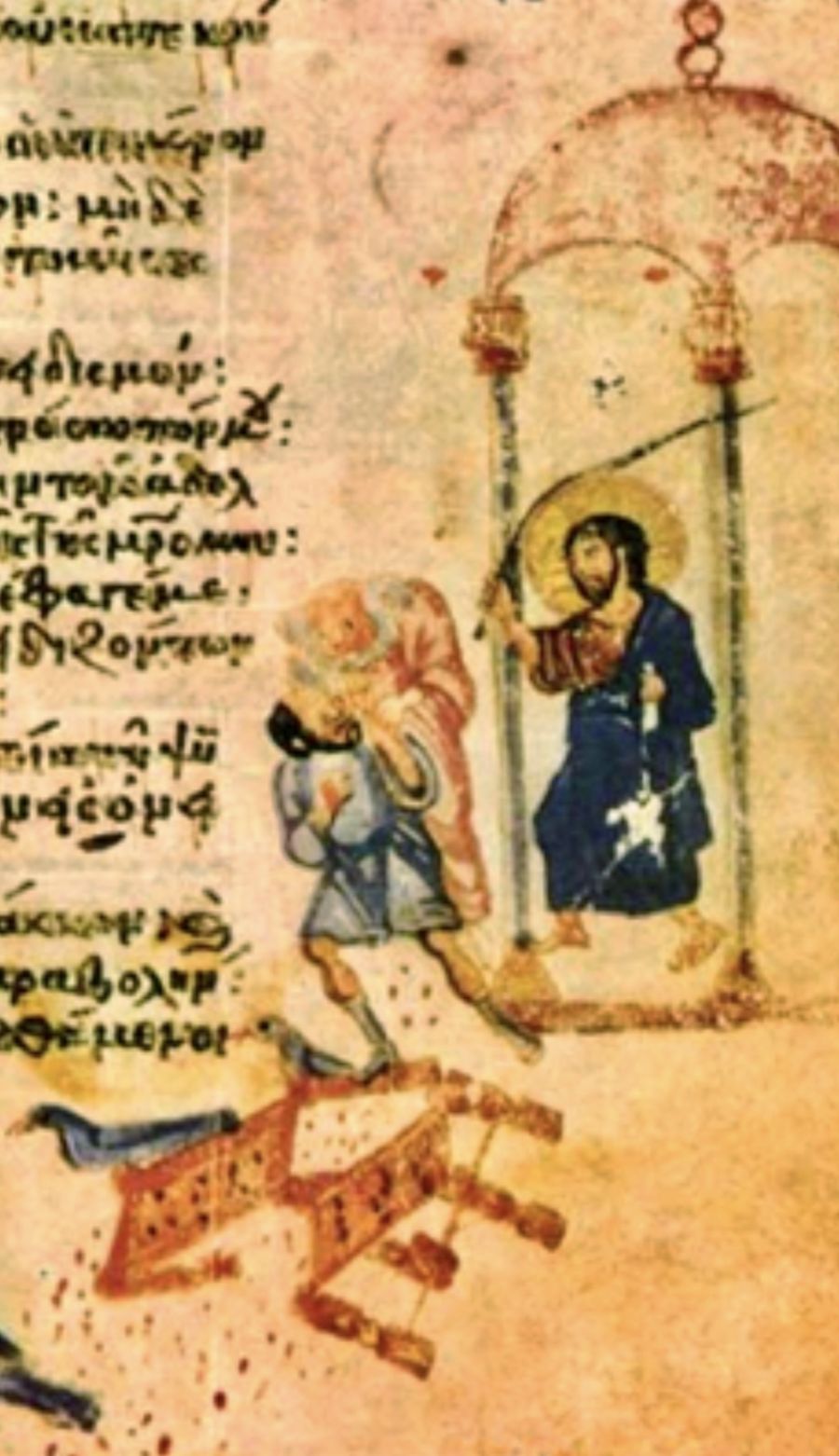
Little House of God? No more haggling with loan sharks

(Lk 19:45-48)


The teaching of Jesus in the sacred place is presented by Lk as enduring: «He was teaching every day» (v.47). Main topic: the Grace.

So over time we learn conviviality: encouraged to dialogue with our personal, unrepeatable Vocation, which captivates because it really corresponds.

And the intimate conviction is alone, incomparable, precious energy of transformative valence - which leads to not withdrawing from oneself, nor disregarding the reality of sisters and brothers.

Rather it induces to make Exodus, explore new conditions of being, transfigure perception into blissful action.


Hunting the false friends of religiosity, the Lord is not so much oriented to compensate the purity of the Place, nor to mend and revive the enamel of the sober original cult - as Prophets wanted.

He renders a holy service not to ancient God, but to people - by that system [or tangle] made totally unaware of their vocational dignity: only chained, milked, and sheared.

The first Tent of God is therefore humanity itself, its beating heart - not a delimited space:

Upon entering Jerusalem, the Master takes possession of the heavenly House - which is not the Temple, but the People.

He doesn’t teach to enter into habitual and formal armor accepted by the contour, but distant from persons.

Rather, He stimulates us not to restrain our true nature with costume hoods, according to which "it’s never enough".

Our inner world should not be hysterically regarded as a dangerous stranger.

Innate roots and our natural energy have the right to flourish and prevail over common manners or ideas: they are an experimental trace of the Divine.

In them there is a Personal bond, which wins every intimate torment.

We must therefore change our approach. He himself is the essential point of the Eternal’s worship.

In this light of Person in his Person, everyone can embrace proposals that are not of others and intruders; wich will not turn out to be ballasts.


The phantasmagorical ancient culmination is becoming periphery, it’s decaying. And to find ourselves, we have difficulties.

An opportunity not to be missed to proceed in a living and singular way, in tune with an ever new teaching on unprecedented Love, which takes our step.

It’s the burning Appeal of «the Mount», which focusses on ‘passion’: precisely on Desire.

No more a strict call to the "no" of great appearances - but finally Listening to the Voice in the soul, which amazes (v.48).

Authentic sacred of the temple.

No more loan sharks in power.

With what does not correspond, even from a cultural, social and spiritual point of view, we no longer haggle.


[Friday 33rd wk. in O.T.  November 21, 2025]

164 Last modified on Friday, 21 November 2025 11:59
don Giuseppe Nespeca

Giuseppe Nespeca è architetto e sacerdote. Cultore della Sacra scrittura è autore della raccolta "Due Fuochi due Vie - Religione e Fede, Vangeli e Tao"; coautore del libro "Dialogo e Solstizio".

Gospels make their way, advance and free, making us understand the enormous difference between any creed and the proposal of Jesus. Even within us, the life of Faith embraces all our sides and admits many things. Thus we become more complete and emancipate ourselves, reversing positions.
I Vangeli si fanno largo, avanzano e liberano, facendo comprendere l’enorme differenza tra credo qualsiasi e proposta di Gesù. Anche dentro di noi, la vita di Fede abbraccia tutti i nostri lati e ammette tante cose. Così diventiamo più completi e ci emancipiamo, ribaltando posizioni
We cannot draw energy from a severe setting, contrary to the flowering of our precious uniqueness. New eyes are transmitted only by the one who is Friend. And Christ does it not when we are well placed or when we equip ourselves strongly - remaining in a managerial attitude - but in total listening
Non possiamo trarre energia da un’impostazione severa, contraria alla fioritura della nostra preziosa unicità. Gli occhi nuovi sono trasmessi solo da colui che è Amico. E Cristo lo fa non quando ci collochiamo bene o attrezziamo forte - permanendo in atteggiamento dirigista - bensì nell’ascolto totale
The Evangelists Matthew and Luke (cf. Mt 11:25-30 and Lk 10:21-22) have handed down to us a “jewel” of Jesus’ prayer that is often called the Cry of Exultation or the Cry of Messianic Exultation. It is a prayer of thanksgiving and praise [Pope Benedict]
Gli evangelisti Matteo e Luca (cfr Mt 11,25-30 e Lc 10,21-22) ci hanno tramandato un «gioiello» della preghiera di Gesù, che spesso viene chiamato Inno di giubilo o Inno di giubilo messianico. Si tratta di una preghiera di riconoscenza e di lode [Papa Benedetto]
The human race – every one of us – is the sheep lost in the desert which no longer knows the way. The Son of God will not let this happen; he cannot abandon humanity in so wretched a condition. He leaps to his feet and abandons the glory of heaven, in order to go in search of the sheep and pursue it, all the way to the Cross. He takes it upon his shoulders and carries our humanity (Pope Benedict)
L’umanità – noi tutti - è la pecora smarrita che, nel deserto, non trova più la strada. Il Figlio di Dio non tollera questo; Egli non può abbandonare l’umanità in una simile miserevole condizione. Balza in piedi, abbandona la gloria del cielo, per ritrovare la pecorella e inseguirla, fin sulla croce. La carica sulle sue spalle, porta la nostra umanità (Papa Benedetto)
"Too bad! What a pity!" “Sin! What a shame!” - it is said of a missed opportunity: it is the bending of the unicum that we are inside, which every day surrenders its exceptionality to the normalizing and prim outline of common opinion. Divine Appeal of every moment directed Mary's dreams and her innate knowledge - antechamber of her trust, elsewhere
“Peccato!” - si dice di una occasione persa: è la flessione dell’unicum che siamo dentro, che tutti i giorni cede la sua eccezionalità al contorno normalizzante e affettato dell’opinione comune. L’appello divino d’ogni istante orientava altrove i sogni di Maria e il suo sapere innato - anticamera della fiducia
It is a question of leaving behind the comfortable but misleading ways of the idols of this world: success at all costs; power to the detriment of the weak; the desire for wealth; pleasure at any price. And instead, preparing the way of the Lord: this does not take away our freedom (Pope Francis)
Si tratta di lasciare le strade, comode ma fuorvianti, degli idoli di questo mondo [...] E di aprire invece la strada al Signore che viene: Egli non toglie la nostra libertà (Papa Francesco)

Due Fuochi due Vie - Vol. 1 Due Fuochi due Vie - Vol. 2 Due Fuochi due Vie - Vol. 3 Due Fuochi due Vie - Vol. 4 Due Fuochi due Vie - Vol. 5 Dialogo e Solstizio I fiammiferi di Maria

duevie.art

don Giuseppe Nespeca

Tel. 333-1329741


Disclaimer

Questo blog non rappresenta una testata giornalistica in quanto viene aggiornato senza alcuna periodicità. Non può pertanto considerarsi un prodotto editoriale ai sensi della legge N°62 del 07/03/2001.
Le immagini sono tratte da internet, ma se il loro uso violasse diritti d'autore, lo si comunichi all'autore del blog che provvederà alla loro pronta rimozione.
L'autore dichiara di non essere responsabile dei commenti lasciati nei post. Eventuali commenti dei lettori, lesivi dell'immagine o dell'onorabilità di persone terze, il cui contenuto fosse ritenuto non idoneo alla pubblicazione verranno insindacabilmente rimossi.






