May 29, 2026 Written by 

Without canceling the person, already naked of two cents

Small coins and festival of the voracious God, in solemn appearances

(Mk 12:38-44)


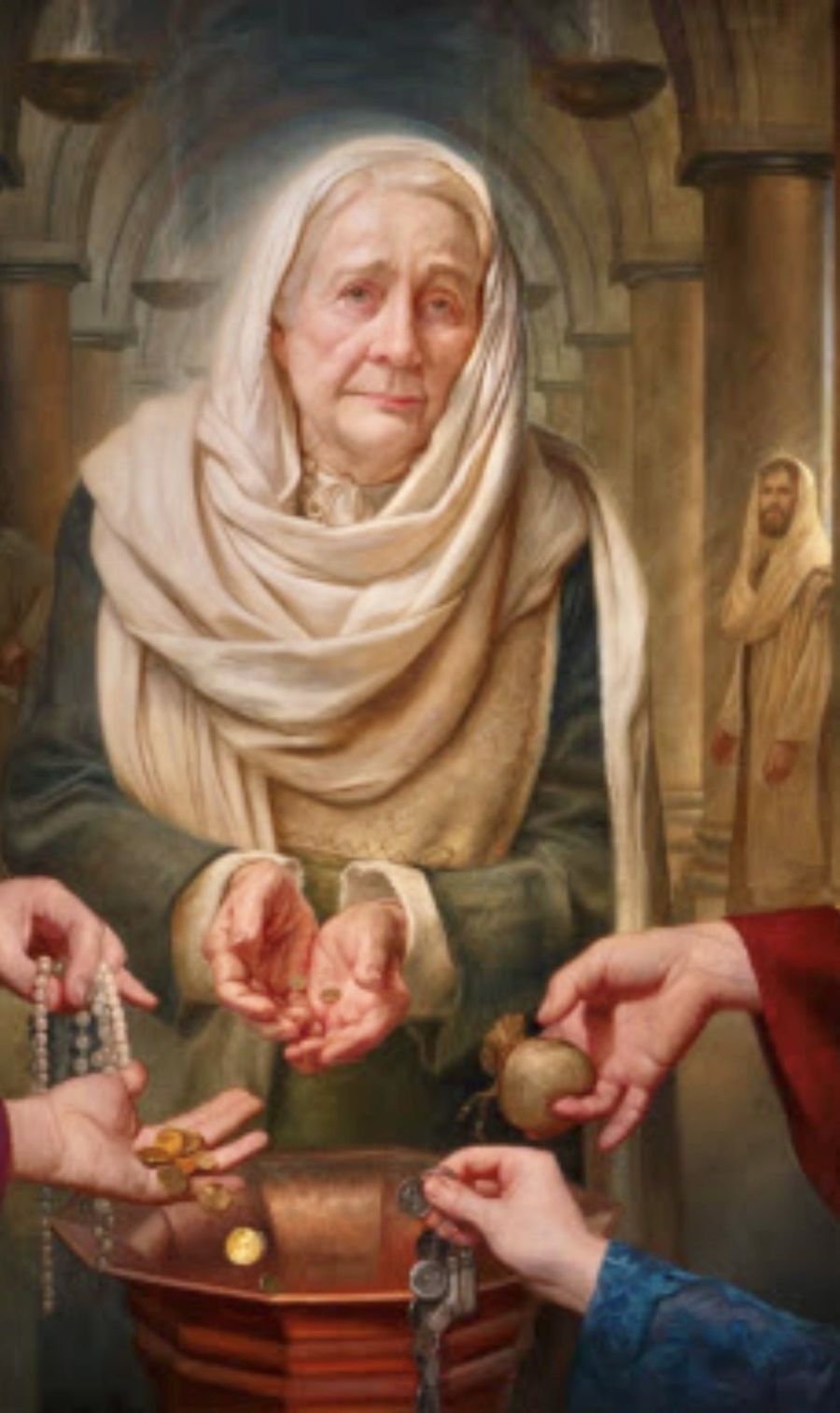
Jesus faces the treasure of the Temple, the true ‘god’ of the whole sanctuary. The comparison is ruthless: one as opposed to the other (v.41).

Enigma that could not be solved with a simple ‘purification’ of the sacred place, or a replenishment of devotion.

It will be surprising, but the Gospel passage does not sing praises of individual humility which by faith deprives itself of everything: it is rather a radical appeal to church leaders and to the sense of institution.

The Lord is saddened by every expropriation conditioned by awe. Indeed, fear takes life from those who do not enjoy fullness.

Christ weeps the subordinate condition of the poor and neglected: He does not make her take the chair. He does not credit the situation. He does not want the woman already naked by two cents to undress all.

He seems distraught for that one silent figure; to underline the difference between the voracious demands of the ancient religions’ God and those of a completely different sign - in our favor - of the Father in the Faith.


While Jesus noticed and was mourning on the minuteous gesture of the little woman, the Apostles did not even notice the irrelevant poor creature, continuing to gape at the magnificence of the Temple.

Who knows what they were dreaming about... seduced by honor.

To divert them from the fever of reputation and considerations they desired to boast of, there was a need for an awareness; but to move them out of their place and yardstick the miracles would not have been enough.

Thus Jesus seeks to convey in conscience the Good News that the Father is the exact opposite of how he had been painted to them by the spiritual guides of the time.

The Eternal disconcerts: He does not take, does not appropriate, does not plunder, nor does absorb or debilitate us - but He is the One who gives.

He does not punish if you do not placate Him with both the little coins you have, without withholding a single one - even if only by doing in half (v.2).

The honour to God is not exclusive, but inclusive.

Paraphrasing the encyclical Fratelli Tutti, we could say that in authentic communities [as in families] «everyone contributes to the common purpose; everyone works for the common good, not denying each person’s individuality but encouraging and supporting it» (n.230).


The Son notes with bitterness that the beautiful protagonists themselves «devour the houses of widows» (v.40) as vampires. So convincing as to make the souls of the simple even their supporters and victims.

Christ is saddened by such unconscious complicity, induced by the lack of knowledge of the Father’s Face - preached as a leech God.

In fact, in the path of personal Faith true believers are not repeaters of external roles (vv.38-40).

We collaborate with the creative and deifying work of the Eternal in offering ourselves as a vital food for the humanity to which the Bridegroom has been taken away - here in the figure of the poor «widow» who bleed out.

In short, we must no longer macerate and wear ourselves out, because of the glory of the Almighty, but enrich ourselves with Him and pronounce fully!

A God all substance, of little epidermal appearance.

Yet the antithesis of the rich and poor was resurfacing in the early communities... to the detriment of the isolated.

Here, precisely the reversal of the fortunes had to become characteristic of the adoring Church, which is immersed in the same rhythm of the supreme vital Source.


It will therefore be the amiable institution that will remain naked and pilgrim, even in the space of the small and unsteady.

And the action of the assemblies of believers will be able to activate a new, convivial world, humanizing disharmonies.

A reality that beats ‘time’. For a ‘Kingdom’ really not neutral. But where does the soul counts, not the curriculum.


[Saturday 9th wk. in O.T.  June 6, 2026]

94 Last modified on Friday, 29 May 2026 05:55
don Giuseppe Nespeca

Giuseppe Nespeca è architetto e sacerdote. Cultore della Sacra scrittura è autore della raccolta "Due Fuochi due Vie - Religione e Fede, Vangeli e Tao"; coautore del libro "Dialogo e Solstizio".

The kingdom of Christ is manifested, as the Council teaches, in the 'kingship' of man [John Paul II]
Il regno di Cristo si manifesta, come insegna il Concilio, nella “regalità” dell’uomo [Giovanni Paolo II]
In the middle of the dense forest of rules and regulations — to the legalisms of past and present — Jesus makes an opening through which one can catch a glimpse of two faces: the face of the Father and the face of the brother. He does not give us two formulas or two precepts: there are no precepts nor formulas. He gives us two faces [Pope Francis]
In mezzo alla fitta selva di precetti e prescrizioni – ai legalismi di ieri e di oggi – Gesù opera uno squarcio che permette di scorgere due volti: il volto del Padre e quello del fratello. Non ci consegna due formule o due precetti: non sono precetti e formule; ci consegna due volti [Papa Francesco]
Whoever is inscribed in God's name participates in God's life, and lives. Therefore to believe is to be inscribed in the name of God. Thus we are alive. Whoever has a share in God's name is not dead but rather belongs to the living God. In this sense we should be able to understand the dynamism of faith, which entails enrolling our names in the name of God and in this way entering into life [Pope Benedict]
Chi è scritto nel nome di Dio partecipa alla vita di Dio, vive. E così credere è essere iscritti nel nome di Dio. E così siamo vivi. Chi appartiene al nome di Dio non è un morto, appartiene al Dio vivente. In questo senso dovremmo capire il dinamismo della fede, che è un iscrivere il nostro nome nel nome di Dio e così un entrare nella vita [Papa Benedetto]
As sometimes happens in the Gospel, faced with the trap set for him by his enemies, Jesus, with his response, rises above the contingent controversy and goes far beyond the particular and mutually divergent positions (John Paul II)
Come talora accade nel Vangelo, di fronte al tranello mossogli dai suoi nemici, Gesù, con la sua risposta, s’innalza al di sopra della polemica contingente e va ben oltre le posizioni particolari e tra loro divergenti (Giovanni Paolo II)
This Name clearly expresses that the God of the Bible is not some kind of monad closed in on itself and satisfied with his own self-sufficiency but he is life that wants to communicate itself, openness, relationship [Pope Benedict]
Questo nome esprime dunque chiaramente che il Dio della Bibbia non è una sorta di monade chiusa in se stessa e soddisfatta della propria autosufficienza, ma è vita che vuole comunicarsi, è apertura, relazione [Papa Benedetto]
There, however, in the place that should have been taken up by the encounter between God and man, he found livestock merchants and money-changers who occupied this place of prayer with their commerce […] In the temple's purification, however, it was a matter of more than fighting abuses. A new time in history was foretold (Pope Benedict)
Ma là dove doveva esservi lo spazio dell’incontro tra Dio e l’uomo, Egli trova commercianti di bestiame e cambiavalute che occupano con i loro affari il luogo di preghiera […] Nella purificazione del tempio, però, si tratta di più che della lotta agli abusi. È preconizzata una nuova ora della storia (Papa Benedetto)
Hypocrisy: indeed, while they display great piety they are exploiting the poor, imposing obligations that they themselves do not observe (Pope Benedict)
Ipocrisia: essi, infatti, mentre ostentano grande religiosità, sfruttano la povera gente imponendo obblighi che loro stessi non osservano (Papa Benedetto)

Due Fuochi due Vie - Vol. 1 Due Fuochi due Vie - Vol. 2 Due Fuochi due Vie - Vol. 3 Due Fuochi due Vie - Vol. 4 Due Fuochi due Vie - Vol. 5 Dialogo e Solstizio I fiammiferi di Maria

duevie.art

don Giuseppe Nespeca

Tel. 333-1329741


Disclaimer

Questo blog non rappresenta una testata giornalistica in quanto viene aggiornato senza alcuna periodicità. Non può pertanto considerarsi un prodotto editoriale ai sensi della legge N°62 del 07/03/2001.
Le immagini sono tratte da internet, ma se il loro uso violasse diritti d'autore, lo si comunichi all'autore del blog che provvederà alla loro pronta rimozione.
L'autore dichiara di non essere responsabile dei commenti lasciati nei post. Eventuali commenti dei lettori, lesivi dell'immagine o dell'onorabilità di persone terze, il cui contenuto fosse ritenuto non idoneo alla pubblicazione verranno insindacabilmente rimossi.






