Feb 11, 2026 Written by 

Reputation: crossroads of the Truth of Faith

(Lk 9:22-25)


Yesterday we underlined how the worm of vanity in the search for the esteem leads to hypocrisy and ostentation.

We ask ourselves: what makes the Father intimate? Carrying the Cross - in the sense of being a devoted and obedient child? Is it necessary to give up living, accepting the various evils?

No, communion with God follows from a freely assumed commitment. That scaffold is not a requirement of the Father who would like to be ‘compensated’ at least by someone.

There are not many ways to choose from, but only two: victory or gift, and every moment is a time of decision.

Templates are no longer needed.


A comparison between the parallel texts in Greek (for example) of Mk 8:34;  Mt 10:38;  Lk 9:23 and 14:27 [Jn 12:26] makes us understand the meaning of «taking up» or «lifting up the cross» for a disciple who relives Christ and expands him in human history.

God doesn’t give any cross, nor are his sons called to "bear" it or even "offer it"! The Cross must be actively ‘taken’, because the friend of Jesus puts honor at stake.

Its vital wave reaches complete gift also under the profile of public consideration.


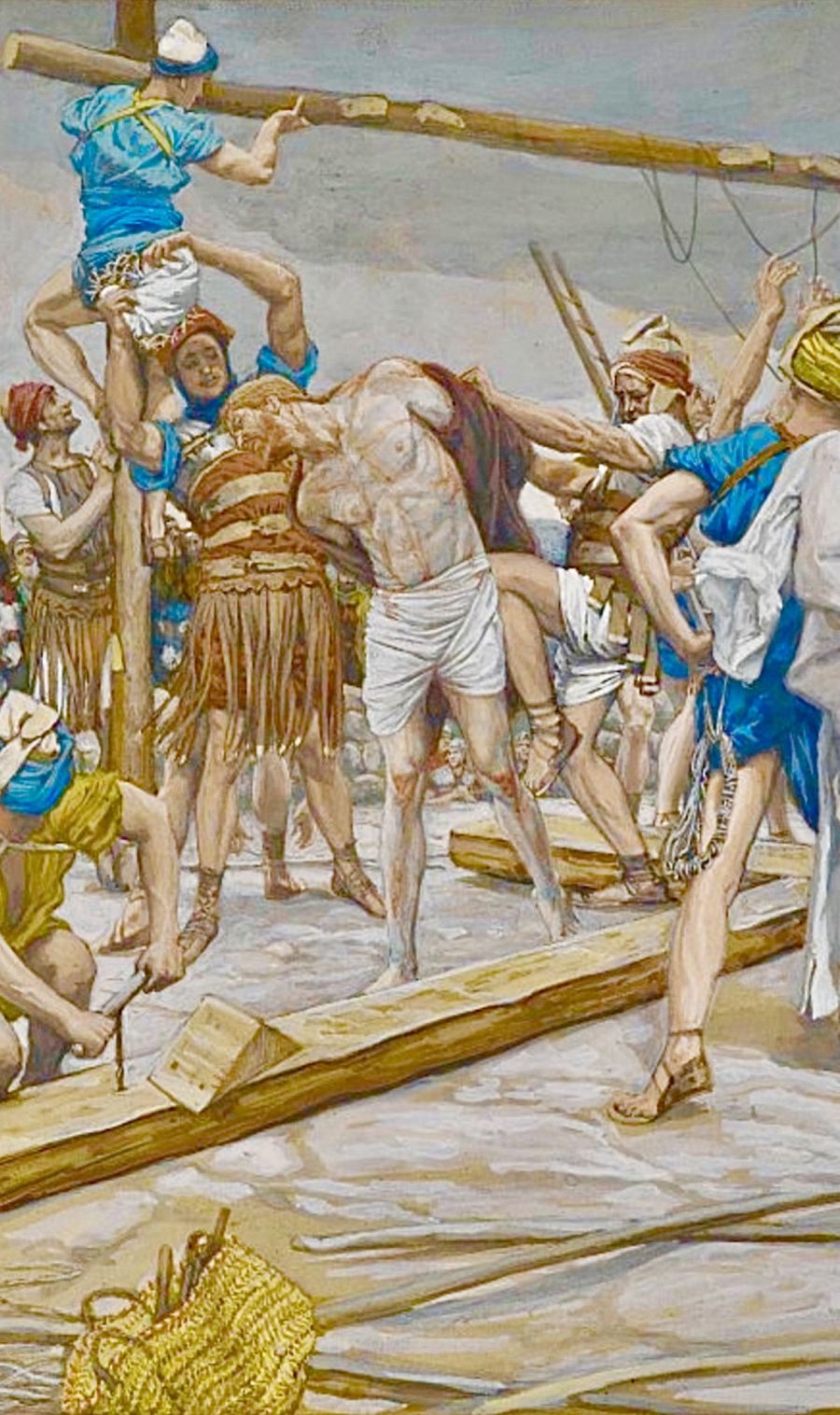
After the court sentence, the condemned man had to lift the horizontal arm of the gallows on his shoulders.

It was the most heartbreaking moment, because of maximum loneliness and perception of failure.

Thus the unfortunate and already shamed person had to proceed to the place of the crucifixion by passing between the crowd who, for religious duty, mocked and beat up the wretch, considered cursed by God.


Jesus doesn’t propose the Cross to us in the running sense of a necessary endurance of the inevitable setbacks of life which through asceticism chisels souls more capable of sketching [today we say: ‘resilient’].

Compared to the usual proposals of healthy discipline - external and internal - equal for all and useful only to keep the situation good, the young Rabbi is on the other hand suggesting a much more radical behavior.

The Lord proposes an asceticism totally different from that of religions - even overturned.

The believer must give up ‘reputation’. It’s the essential and decisive starting point of the person of Faith.

Those who are tied to their good names, roles, to the character to be played, to the job description, to the level acquired, will never resemble the Son.

Neither will those who do not expand the tribal dimension of the "family” interest.


From the earliest times, the announcement of the authentic Messiah created divisions: the ‘sword of his Person’ separated the story of each one from the world of values ​​of the clan to which they belong or from the idea of ​​respectability, even national.

The same thing happens today where someone proclaims the Gospel as it is, and attempts to renew the jammed mechanisms of the institutional, customary configuration.

In doing so, taking on the Cross of consequent mockery.

The separation and very clear cut with the criteria of greatness and success is for the new Unity, persecuted: the one that acts as a crossroads of Truth without duplicity.

Trying for believing.


It seems a meaningless dream, but this is what unites the Church to her Lord.

A crucifying path, where one gains what is lost - first of all in consideration.


[Thursday after the Ashes, February 19, 2026]

20 Last modified on Wednesday, 11 February 2026 05:46
don Giuseppe Nespeca

Giuseppe Nespeca è architetto e sacerdote. Cultore della Sacra scrittura è autore della raccolta "Due Fuochi due Vie - Religione e Fede, Vangeli e Tao"; coautore del libro "Dialogo e Solstizio".

St John Chrysostom urged: “Embellish your house with modesty and humility with the practice of prayer. Make your dwelling place shine with the light of justice; adorn its walls with good works, like a lustre of pure gold, and replace walls and precious stones with faith and supernatural magnanimity, putting prayer above all other things, high up in the gables, to give the whole complex decorum. You will thus prepare a worthy dwelling place for the Lord, you will welcome him in a splendid palace. He will grant you to transform your soul into a temple of his presence” (Pope Benedict)
San Giovanni Crisostomo esorta: “Abbellisci la tua casa di modestia e umiltà con la pratica della preghiera. Rendi splendida la tua abitazione con la luce della giustizia; orna le sue pareti con le opere buone come di una patina di oro puro e al posto dei muri e delle pietre preziose colloca la fede e la soprannaturale magnanimità, ponendo sopra ogni cosa, in alto sul fastigio, la preghiera a decoro di tutto il complesso. Così prepari per il Signore una degna dimora, così lo accogli in splendida reggia. Egli ti concederà di trasformare la tua anima in tempio della sua presenza” (Papa Benedetto)
And He continues: «Think of salvation, of what God has done for us, and choose well!». But the disciples "did not understand why the heart was hardened by this passion, by this wickedness of arguing among themselves and seeing who was guilty of that forgetfulness of the bread" (Pope Francis)
E continua: «Pensate alla salvezza, a quello che anche Dio ha fatto per noi, e scegliete bene!». Ma i discepoli «non capivano perché il cuore era indurito per questa passione, per questa malvagità di discutere fra loro e vedere chi era il colpevole di quella dimenticanza del pane» (Papa Francesco)
[Faith] is the lifelong companion that makes it possible to perceive, ever anew, the marvels that God works for us. Intent on gathering the signs of the times in the present of history […] (Pope Benedict, Porta Fidei n.15)
[La Fede] è compagna di vita che permette di percepire con sguardo sempre nuovo le meraviglie che Dio compie per noi. Intenta a cogliere i segni dei tempi nell’oggi della storia […] (Papa Benedetto, Porta Fidei n.15)
But what do this “fullness” of Christ’s Law and this “superior” justice that he demands consist in? Jesus explains it with a series of antitheses between the old commandments and his new way of propounding them (Pope Benedict)
Ma in che cosa consiste questa “pienezza” della Legge di Cristo, e questa “superiore” giustizia che Egli esige? Gesù lo spiega mediante una serie di antitesi tra i comandamenti antichi e il suo modo di riproporli (Papa Benedetto)
The Cross is the sign of the deepest humiliation of Christ. In the eyes of the people of that time it was the sign of an infamous death. Free men could not be punished with such a death, only slaves, Christ willingly accepts this death, death on the Cross. Yet this death becomes the beginning of the Resurrection. In the Resurrection the crucified Servant of Yahweh is lifted up: he is lifted up before the whole of creation (Pope John Paul II)
La croce è il segno della più profonda umiliazione di Cristo. Agli occhi del popolo di quel tempo costituiva il segno di una morte infamante. Solo gli schiavi potevano essere puniti con una morte simile, non gli uomini liberi. Cristo, invece, accetta volentieri questa morte, la morte sulla croce. Eppure questa morte diviene il principio della risurrezione. Nella risurrezione il servo crocifisso di Jahvè viene innalzato: egli viene innalzato su tutto il creato (Papa Giovanni Paolo II)

Due Fuochi due Vie - Vol. 1 Due Fuochi due Vie - Vol. 2 Due Fuochi due Vie - Vol. 3 Due Fuochi due Vie - Vol. 4 Due Fuochi due Vie - Vol. 5 Dialogo e Solstizio I fiammiferi di Maria

duevie.art

don Giuseppe Nespeca

Tel. 333-1329741


Disclaimer

Questo blog non rappresenta una testata giornalistica in quanto viene aggiornato senza alcuna periodicità. Non può pertanto considerarsi un prodotto editoriale ai sensi della legge N°62 del 07/03/2001.
Le immagini sono tratte da internet, ma se il loro uso violasse diritti d'autore, lo si comunichi all'autore del blog che provvederà alla loro pronta rimozione.
L'autore dichiara di non essere responsabile dei commenti lasciati nei post. Eventuali commenti dei lettori, lesivi dell'immagine o dell'onorabilità di persone terze, il cui contenuto fosse ritenuto non idoneo alla pubblicazione verranno insindacabilmente rimossi.






