


Revolution of healthy Tenderness
(Jn 1:29-34)
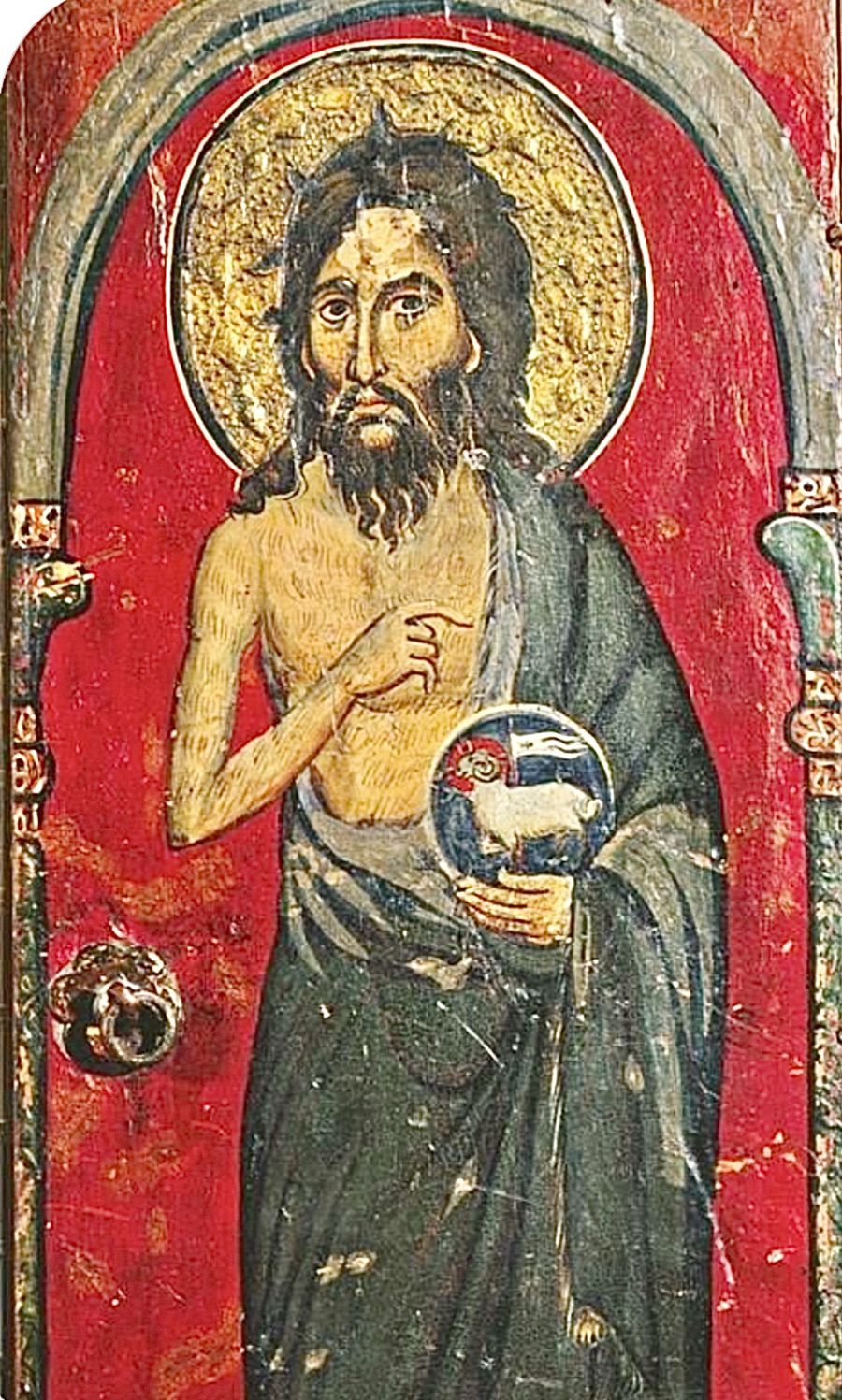
In the fourth Gospel the Baptist is not «the forerunner», but a «witness» of the Lamb Light that raises basic questions.
Alarmed, the authorities put him under investigation.
But it’s not he who sweeps away «sin», that is, the humiliation of unbridgeable distances - and the inability to correspond to the personal Vocation, for Life without limit.
Hindrance even underlined by the logic of the «world»: by the false teaching, by the very structure of the ancient official institution, so linked to the interweaving between religion and power.
Condemned to «noon-day» [culmination and full light] on Easter eve, Jesus crosses his earthly end with the hour when the priests of the Temple began to immolate the lambs of propitiation [originally, an apotropaic sacrifice that preceded transhumance].
As for the Lamb of the fathers in foreign land, who had spared them from the slaughter - his Blood gives impetus to cross the land of arid slavery, devoid of warmth and intimate consonance.
As is known, the effigy of the Lamb belongs to the sacrificial theological strand, stemming from the famous text of Isaiah 53 and from all the sacral imagery of the ancient East [which had elaborated a literature and a widespread thought on the King Messiah].
According to the biblical conception, the sovereign was a figure of the whole people and represented them. The Anointed would have had the ideal task of dragging away and atoning for human iniquities.
But Jesus does not "expiate" rather «extirpates». Not even "propitiates": the Father does not reject the precarious condition of his creatures.
In Christ who «supports and removes» all our shame and weaknesses, the Father’s Action is made intimate - for this reason decisive.
He doesn’t annihilate transgressions with a sort of amnesty, even vicarious: it would not be authentic salvation to touch only the suburbs and not the Core, to reactivate us.
An outer dress does not belong to us and will never be ours; it is not assimilated, nor does it become real life. Deletions don’t educate, far from it.
It’s true that a lamb in a world of cunning wolves has no escape. By introducing it you see it perish, but not as a designated victim: it was the only way for the beastmen who believe they were people, to understand that they were still only beasts.
Being considered strong, capable of commanding, excellent, untainted, magnificent, high-performing, extraordinary, glorious... damages people.
It puts a mask on us, makes us one-sided; it takes away understanding. It makes the character we are sitting in, float above reality.
The Risen One introduces into the world a new force, a different dynamism, a way of teaching the soul that becomes a conscious process.
Only by educating us, does the Most High-neighbour annihilate and overcome the instinct of the fairs feeding each other, believing themselves to be authentic human beings - even spiritual.
A third allusion to the figure of the Lamb insists on the votive icon and archetypal category associated with the sacrifice of Abraham, where God himself provides for the victim (Gn 22).
Of course he provides: he did not create us angelic, but malformed, transient. Yet, every divine Gift passes through our shaky ‘condition’ - which is not sin, nor guilt, but a matter of fact; so nourishment, and resource.
We are Perfect in the multiplicity of our creative slopes, even in the limit: a blasphemy for the ancient religious man... a reality for the person of Faith.
Authentic Lamb is not just a [moral] reference: the Meekness of those who are called to give everything of themselves, even their skin.
It is an image of the (blatant) ‘boundary’ of those who could never make it to genius in life, so they ‘let themselves be found’ and loaded on the shoulders.
In this way, no decision-making delirium.
It will be the Friend of our vocational nucleus who will transmit strength and devise the way to make us return to the House that is truly ours: the Tent that stitches together the scattered events.
Dwelling that rewires all the being we should - and maybe even could - have brought to fruit.
Incarnation here means that the Lamb is depiction of an accepted - unusual - globality of the divine Face in men.
Totality finally solid - paradoxical, conciliated - that recovers its opposite innocent, natural, spontaneous, incapable of miracle.
Thus, the Dove, an icon of modest, non-aggressive energy; an example of attachment to one's «own» Nest.
Healthy Tenderness, which starts with self-knowledge.
Lamb and Dove: the peaceful differences - between strong-willed, improper, irritable religiosity, and personal Faith.
[2nd Sunday in O.T. (year A), January 18, 2026]








