Jan 2, 2026 Written by 

The platform that makes the breakthrough

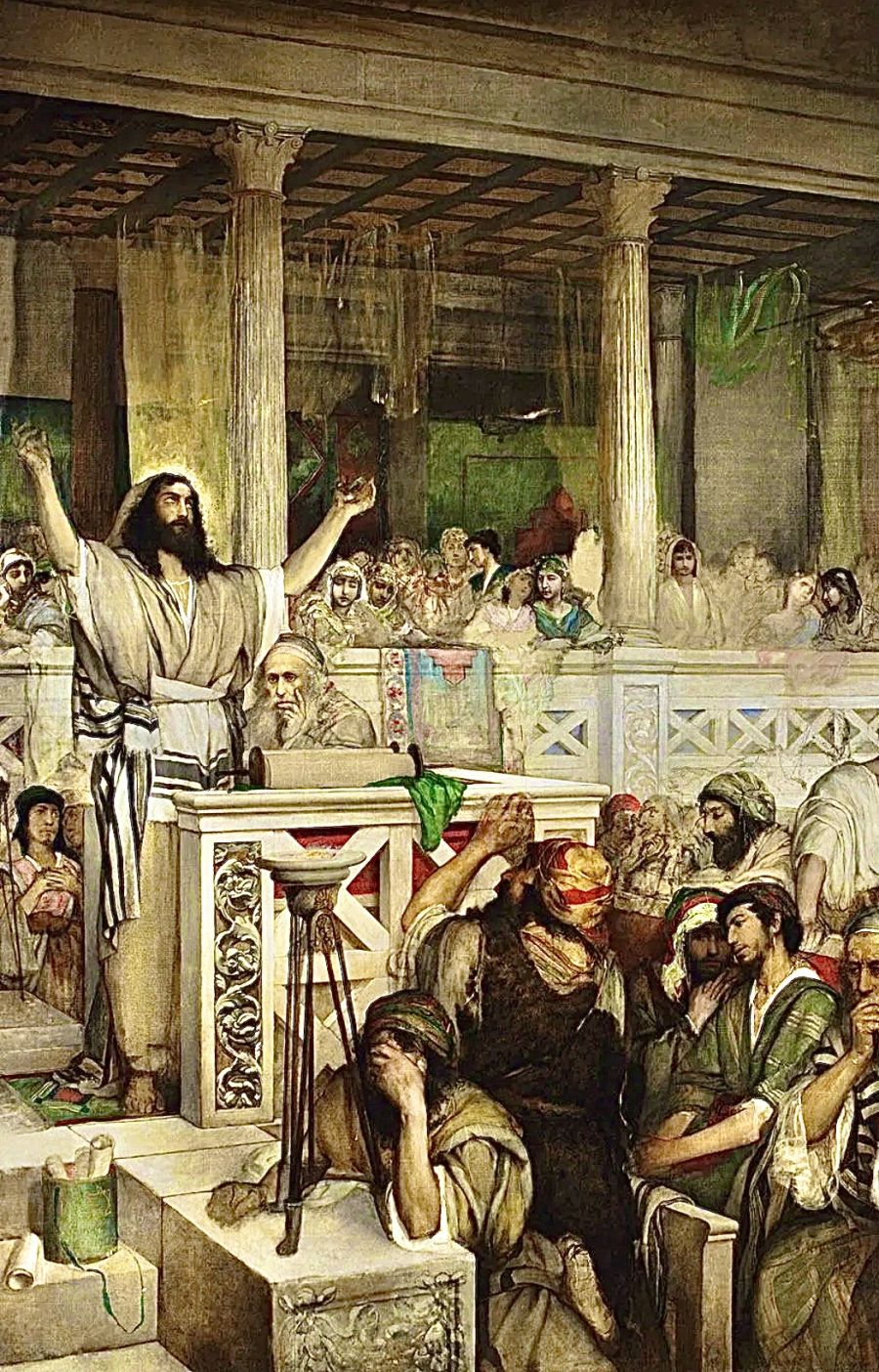
In the Synagogue and from the precipice

(Lc 4:14-22)


In ancient Israel, the patriarchal family, clan and community were the basis of social coexistence.

They ensured the transmission of the nation identity and provided protection for the afflicted.

But at the time of Jesus, Galilee was subject to the segregation dictated by Herod's policies, and suffered from the oppression of official religiosity.

The political and economic situation forced people to retreat into material and individual problems or those of small family.

A situation that was leading the least protected sections of the population to collapse.

Instead, Jesus wants to return to the Father's Dream: the ineradicable one of Fraternity, the only seal to salvation history.

Thus, according to Lk the first time Jesus enters a synagogue he makes a mess.

He does not go to pray, but to Teach what the Grace of God is [the one not weakened by chicanery or false instructions] in the real existence of people.

He chose a passage that reflected the situation of his people, oppressed by the power of the rulers, who were making the weak suffer confusion and poverty.

But his First Reading disregards the liturgical calendar.

He then dares to preach in his own way and personalizes the passage from Isaiah, from which he allows himself to censor the verse announcing God's “vengeance”.

So neither does He proclaim the expected passage of the Law.


Moreover, for the Son of God, the Spirit is not revealed in the extraordinary phenomena of the cosmos, but in the Year of Grace [«a year acceptable to the Lord»: v.19].


Is it possible that the divine likeness could manifest itself in a man who is considerate towards the less fortunate, who disregards official customs, does not believe in retaliation, and displays forms of uncontrolled spontaneity?

It is a reminder to us.

Like the Master, instead of reasoning with induced thoughts and being sequestered by the heaviness of rejections and fears, in Him we begin to think with the empathic codes of our Calling, which breaks through.

The unrepeatable and wide-ranging Vision-Relation (v.18a) - without reduction - then becomes strategic, because it possesses within itself the appeal of the radical essence, and all the resources to solve the real problems.

To listen to the proclamation of the Gospels (v.18b) is to listen to the echo of oneself and the people considered insignificant: intimate and fraternal choice.

And to be in it without the dead leaves of one-sidedness - by wandering freely in that same Appeal; not neglecting precious parts of oneself, nor amputating eccentricities, or the intuition proper to the subaltern classes.

In this way, we remain in the instinct to be and do happy, without ever allowing ourselves to be imprisoned by the craving for security on the side: a stagnant quest.


The Kingdom in the Spirit (cf. vv.14.18) knows what we need. It has ceased to be a goal of mere future.

It is the surprise that Christ arouses in us through his Dream, around his proposal with an extra gear.

The Lord does not neglect us: He extinguishes accusatory brooding and creatively redesigns.

He gives birth again and motivates, recovers dispersions and reinforces the plot.


It is divine because it is personal and social, the new Energy, empowered to create the authentic man.

This is the platform that works the breakthrough.


[Weekday Liturgy, January 10]

76 Last modified on Friday, 02 January 2026 05:53
don Giuseppe Nespeca

Giuseppe Nespeca è architetto e sacerdote. Cultore della Sacra scrittura è autore della raccolta "Due Fuochi due Vie - Religione e Fede, Vangeli e Tao"; coautore del libro "Dialogo e Solstizio".

«The Spirit of the Lord is upon me, because he has anointed me to preach good news to the poor» (Lk 4:18). Every minister of God has to make his own these words spoken by Jesus in Nazareth [John Paul II]
«Lo Spirito del Signore è sopra di me; per questo mi ha consacrato con l'unzione e mi ha mandato per annunziare un lieto messaggio» (Lc 4, 18). Ogni ministro di Dio deve far sue nella propria vita queste parole pronunciate da Gesù di Nazareth [Giovanni Paolo II]
It is He himself who comes to meet us, who lowers Heaven to stretch out his hand to us and raise us to his heights [Pope Benedict]
È Lui stesso che ci viene incontro, abbassa il cielo per tenderci la mano e portarci alla sua altezza [Papa Benedetto]
As said st. Augustine: «The Word of God which is explained to you every day and in a certain sense "broken" is also daily Bread». Complete food: basic and “compote” food - historical and ideal, in actuality
Come diceva s. Agostino: «La Parola di Dio che ogni giorno viene a voi spiegata e in un certo senso “spezzata” è anch’essa Pane quotidiano». Alimento completo: cibo base e “companatico” - storico e ideale, in atto
What begins as a discovery of Jesus moves to a greater understanding and commitment through a prayerful process of questions and discernment (John Paul II)
Quel che inizia come una scoperta di Gesù conduce a una maggiore comprensione e dedizione attraverso un devoto processo di domande e discernimento (Giovanni Paolo II)
John's Prologue is certainly the key text, in which the truth about Christ's divine sonship finds its full expression (John Paul II)
Il Prologo di Giovanni è certamente il testo chiave, nel quale la verità sulla divina figliolanza di Cristo trova la sua piena espressione (Giovanni Paolo II)
Innocence prepares, invokes, hastens Peace. But are these things of so much value and so precious? The answer is immediate, explicit: they are very precious gifts (Pope Paul VI)
L’innocenza prepara, invoca, affretta la Pace. Ma si tratta di cose di tanto valore e così preziose? La risposta è immediata, esplicita: sono doni preziosissimi (Papa Paolo VI)
We will not find a wall, no. We will find a way out […] Let us not fear the Lord (Pope Francis)
Non troveremo un muro, no, troveremo un’uscita […] Non abbiamo paura del Signore (Papa Francesco)
Raw life is full of powers: «Be grateful for everything that comes, because everything was sent as a guide to the afterlife» [Gialal al-Din Rumi]
La vita grezza è colma di potenze: «Sii grato per tutto quel che arriva, perché ogni cosa è stata mandata come guida dell’aldilà» [Gialal al-Din Rumi]
It is not enough to be a pious and devoted person to become aware of the presence of Christ - to see God himself, brothers and things with the eyes of the Spirit. An uncomfortable vision, which produces conflict with those who do not want to know
Non basta essere persone pie e devote per rendersi conto della presenza di Cristo - per vedere Dio stesso, i fratelli e le cose con gli occhi dello Spirito. Visione scomoda, che produce conflitto con chi non ne vuol sapere
An eloquent and peremptory manifestation of the power of the God of Israel and the submission of those who did not fulfill the Law was expected. Everyone imagined witnessing the triumphal entry of a great ruler, surrounded by military leaders or angelic ranks...

Due Fuochi due Vie - Vol. 1 Due Fuochi due Vie - Vol. 2 Due Fuochi due Vie - Vol. 3 Due Fuochi due Vie - Vol. 4 Due Fuochi due Vie - Vol. 5 Dialogo e Solstizio I fiammiferi di Maria

duevie.art

don Giuseppe Nespeca

Tel. 333-1329741


Disclaimer

Questo blog non rappresenta una testata giornalistica in quanto viene aggiornato senza alcuna periodicità. Non può pertanto considerarsi un prodotto editoriale ai sensi della legge N°62 del 07/03/2001.
Le immagini sono tratte da internet, ma se il loro uso violasse diritti d'autore, lo si comunichi all'autore del blog che provvederà alla loro pronta rimozione.
L'autore dichiara di non essere responsabile dei commenti lasciati nei post. Eventuali commenti dei lettori, lesivi dell'immagine o dell'onorabilità di persone terze, il cui contenuto fosse ritenuto non idoneo alla pubblicazione verranno insindacabilmente rimossi.






