


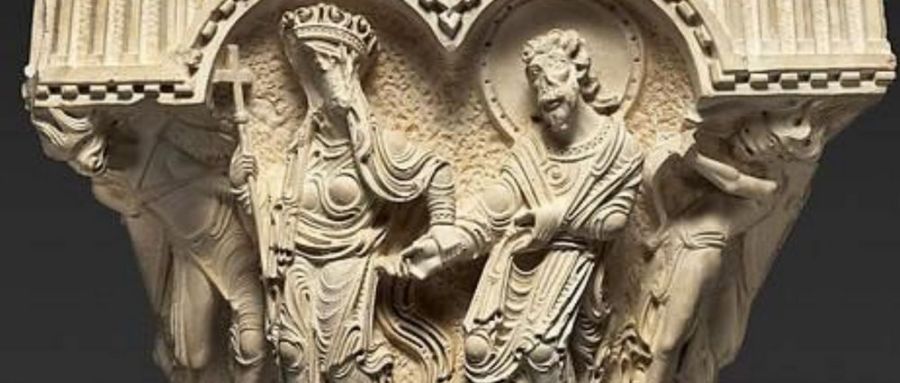
Affliction and joy in labour pains
(Jn 16:20-23a)
A widespread belief at the time of Jesus was that the last time would be preceded by an excess of tribulation and violence.
The joy of the coming golden age would be heralded by a period of unprecedented trials.
The image of the woman giving birth expressed the sense of the intensely painful history at the turn of the times.
Times that were not expected to be excessively long - compensated by a deliverance that would cause one to rejoice.
The spirit of self-sufficiency and feigned security of the surrounding world (even of the religious caste, preoccupied with safeguarding itself) would lead church members into terrifying loneliness.
The believers contradicted the pious and imperial way of looking at life, based on false certainties and a spirit of affirmation.
The moment in history seemed invaded by sadness and at the same time by an ineffable, radical expectation, which paradoxically arose from the same cause of persecution.
Exclusion produced a sense of discouragement, but it was also a spring that activated incisive glances, and action, for a reverse fulfilment - in the living experience of the divine Presence.
Social estrangement triggered a situation of Freedom: it became an unexpected, fruitful, tangible Gift.
Everything was shown to reconcile the multiplicity of faces with their own scattered history, brothers and sisters, God's future.
No more misunderstandings.
In the light of the real experience of the working Vision-Faith, even in the malaise there would be no questions to put forward: only answers.
The mystery of each person's existence was eloquently clarified, with no more scattering questions: rather, with inner guides.
In the figure of Jesus "greeting" his own, Jn introduces the Gift of the Paraclete. Spirit bearing the joy of the [silent] Presence of the Master.
Still in the midst - He was bringing the new world into being.
The frequent allusions to inner suffering in the text describe the reality of the Johannine communities in late 1st century Asia Minor, tormented by defections.
The oppression under Domitian was increasing, and many community brothers were impatient: they needed a profound key to interpretation, and perspective.
They would not have made it on their own, starting from themselves.
Jn intends to sustain the pains of the believers and to avoid flight, encouraging all to see in persecutions a generating mechanism of new life [labour pains: v.21].
Only in this way would those who had death before their eyes not be afraid to continue in their frankness as witnesses: they had to have a strong Hope.
On such a ray of light and in the wake of God in history, step by step everything became clear.
In the life of the woman and the man of Faith, melancholy and joy went hand in hand - indeed, it was the absolute and lacerating trials that unleashed the flow of life.
The death of Christ and his people made a new birth of humanity possible.
Mystery of life, of tribulations, and of being fully new creatures, from genesis to genesis.
In the Bible, Happiness is a perception of fullness of life, a place of celebration that transports the person and the entire fraternity from the ills of the journey - it is the great sign of the New World.
But the primitive communities experienced that intimate joy arose from the tears of a painful birth: this was also to be the case for the world to come; of unprecedented conquest and freedom.
From the labour pains arose a different, primordial life, filled with a different kind of exultation: dissonant from old forms, nomenclatures, and intentions, even for those giving birth.
In short, suffering did not deny the irradiation of the Spirit: it was a law of birth [not a negative force] that could indeed annihilate, but only those whose gaze was averted.
This was also the case with the Kingdom: its establishment happened within a struggle, never harmless - that even though it wounded outside and inside even the human substance, in the depths of the heart and relationships.
But it then reharmonised and more, in the thrill of discoveries, in the suggestions that throbbed - from which a new creation sprang.
To the official notes of the true Church [a holy catholic apostolic] one should perhaps add: harassed, scourged, nailed down. In this way, strengthened by a Word-Person that resonated within.
From all this came an unimpeded 'taste' from the earliest times, which immediately incurs worldly hostility. Nothing to do with empire and its pyramidal-feudal logic.
Precisely in the travail, each trial produced in the children of God the joy of a rediscovered Presence, in the long time of evangelisation - always in danger of going astray and in the temptation to yield.We must remember this rhythm: sadness of farewell and a new heart, joy and sadness....
Paradoxical synergy that can grow our engaging union with the Risen One, acknowledged Lord.
Spe Salvi
We somehow desire life itself, true life, which is then untouched even by death; but at the same time we do not know what we are being driven towards. We cannot cease striving towards it and yet we know that all that we can experience or realise is not what we long for. This unknown "thing" is the true "hope" that impels us and its being unknown is, at the same time, the cause of all despair as well as of all positive or destructive impulses towards the authentic world and authentic man. The word "eternal life" tries to give a name to this unknown known reality. Necessarily is an insufficient word that creates confusion. "Eternal', in fact, arouses in us the idea of the interminable, and this frightens us; 'life' makes us think of the life we know, which we love and do not want to lose, and which, however, is often at the same time more effort than fulfilment, so that while on the one hand we desire it, on the other hand we do not want it. We can only try to escape with our thoughts from the temporality of which we are prisoners and somehow presage that eternity is not a continuous succession of calendar days, but something like the moment filled with fulfilment, in which totality embraces us and we embrace totality. It would be the moment of diving into the ocean of infinite love, in which time - the before and the after - no longer exists. We can only try to think that this moment is life in the full sense, an ever new immersion in the vastness of being, while we are simply overwhelmed with joy. This is how Jesus expresses it in the Gospel of John: "I will see you again and your heart will rejoice and no one will be able to take your joy away" (16:22). We must think in this direction if we are to understand what Christian hope aims at, what we expect from faith, from our being with Christ.
[Pope Benedict, Spe Salvi n.12]








