


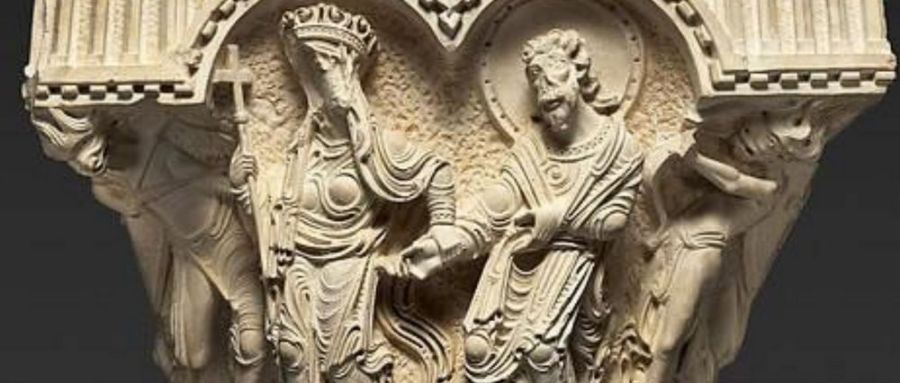
(Mt 25:31-46)
The famous Judgment passage presents the Risen One coming (v.31) as the "Son of Man", that is, the authentic and complete development of the divine plan for humanity: his kind of "verdict" follows.
God embraces the condition of limitation of his creatures, so the behaviour that fulfils our life is not about our religious attitude per se, but about our attitude towards our fellow human beings.
This is the evangelical call of the recent encyclical [October 2020] on fraternity and social friendship.
Aware of the situation, the Magisterium is now becoming the sting of every obvious and unimportant group spirituality, of every folklore mysticism, of every hollow, intimist, still sitting on the fence.... empty, intimist, still sitting in bedside armour.
In all ancient beliefs, the soul of the deceased was weighed on a notarial basis and judged according to its positive or negative balance.
According to the rabbis, divine mercy intervened in favour, only when good and bad deeds were balanced out.
Jesus does not speak of a tribunal that proclaims unchangeable negative judgements on the whole person, but of the traits of complete existence that - being in themselves indestructible because they are humanising - are saved and assumed, introduced into definitive existence.
"Life of the Eternal" (v.46 Greek text) alludes to a non-biological but relational kind of life and completeness of being, which we can already experience.
These are episodes in which our divine DNA, the Gold that inhabits us, has surfaced: when we have been able to respond to the needs not of God, but of life itself and of our brothers and sisters.
These are the moments when we have been deep listeners to nature, to the hope and vocation of all - sensitive to the needs of others.
Opportunities that have allowed us to bring the human condition closer to the heavenly one.
Comparing the "works" declared as "paradigm" with those in the lists of classical Judaism (Is 58:6-7) and other religions - even ancient Egypt [Book of the Dead, c.125] - we note the difference in v.36: "I was in prison and you came to me" (cf. vv.39.43).
The difference is remarkable precisely under the criterion of divine justice: it overrides forensic considerations, because it creates justice where there is none.
The Father lays down life in every case, because he is not good as is believed in all devout persuasions, but exclusively good.
The 'righteous' - then - did not even realise that they had done who knows what: they spontaneously corresponded to their innate and transparent nature as sons (v.39).
They have had sympathy for the "flesh" in the reality in which it is found - and where it is found - valuing it as family. They have loved with and like Jesus, in Him.
They have not loved for Jesus - as if the other's condition could be bracketed, and underneath considered a nuisance on which to build a fiction, albeit a sympathetic one.
The other observant people, on the other hand, all caught up in formalisms of ritual, doctrine and discipline that God does not care about, are surprised that the Father is not all there where they had imagined Him to be.
That is, respectable but empty and stagnant like them, caught up in the sentences of ordinary justice: "When did we see you [...] in prison and did not serve you?" (v.44).
The vocation to meet leads us spontaneously to transgress divisions: legalistic, of retribution, or prejudices, and gender of worship.
This is the eminent, weighty Salvation - lurking in the direct and genuine. Not so much in organised intentions; nor does it have any consistency on the basis of opinion.
We fulfil ourselves in responding to the instinctive call that arises from our own essential altruistic imprint: even minimal, ill-considered, or eccentric, shaky and unfulfilling - not extraordinary.
Without excessively external conditions, it is recognised to be disseminated in the soul and in the beneficial, divinising fullness of the 'Son of Man'.
Jesus' ultimate teaching: Distinguished, global and all-human judgement.
Not qualunquist or contraband response, to concept and account.
Jesus' identification with the little ones remains singular: "what you have done even to one of these brothers of mine, the least of these, you have done to me" (v.40).
Otherwise: "not even to me have you done" (v.45).
His Person has a central meaning, without distinction between friends and counter-legislators, between pious doers and non-doers.
Adherence to Christ is not judged on the basis of works far removed from the humanising Core.
Beautiful things that can also be accomplished without a spirit of benevolence [out of duty and culture, or even lustre and calculation] - but on love.
God is not obliged to reward merit.
Good works can also be displayed or performed against the Father: as if to bind his hands.
This is a typical misrepresentation of religions, which provide rewards for the pious.
Misunderstanding foreign to the experience of Faith, whose only security lies in the risk of exploration, growth, and the quality of relationships - indeed, humanising relationships.
Life and death are quite distinct ['right and left': proverbially, fortune and misfortune] according to the characteristics of authentic piety towards God Himself... because His honour is reflected in the promotion of woman and man, caught in their concrete situation.
The only non-negotiable principle is service to the good of each person.
Works of love are an expression of true Communion with Christ - in this way freed from cerebral tares and mannerisms: from any kind of limitation or judgement that conditions their value.
In short, there is no need to do targeted and extraordinary, or mechanical things, but to let God act - respecting and valuing the brother for what he is.
Even outside the visible realm of the kingdom of the apostles (or a doctrine-discipline) there is authentic 'Christianity': civilisation of children.
In short, no predestination to the condemnation of the distant or errant and imperfect, except for a lack of fraternity that retrieves the impossible - even 'counter-law'.
Authentic Kingship of Christ and His own.
In Palestine, in the evening, shepherds used to separate the sheep from the goats that needed shelter from the cold.
In order to emphasise its importance, the question raised by the evangelist adopts the colourful forms of rabbinic preaching.
The question is not who is saved and who is not.
If anything, the question is: on which occasions are we willingly out in the open even at 'night', and humanise - and on which do we behave in a more belligerent, closed manner, but without becoming... lambs?
In Christ, the victory over selfishness loses its meaning of annihilation of the possibilities of individual growth - which is not achieved by stubbornness.
His power is anything but stagnant and divisive. It does not conceal the capabilities we do not see, or what we do not know.
Opposite situations are the glorious moments of the same victory. This is evident in the continuation of the passage, which proclaims the other extreme of love: "the Son of Man is delivered up to be crucified" (Mt 26:2).
Thus, the purpose of Mt is not to describe the end of the world, but to provide guidance on how to live wisely [today] in order to form a family and not to be fascinated by the immediate glitter of false jewels - even well-prepared ones.
The Recall of the Gospels insists on contrasting this with a frivolous spirituality: the only appropriate distinction.
The man of God does not satisfy the lusts of even ecclesiastical careers, and every whim.
The Tao Tê Ching (iii) suggests, addressing even the wise ruler: 'Do not exalt the most capable, do not let the people contend; do not covet the goods that are difficult to obtain, do not let the people become thieves; do not obtain what you may covet, do not let the people's heart be troubled.
Commented Master Wang Pi: "When you exalt the most capable, you give prestige to their name; the glory goes beyond their office, and they are always binge-watching, comparing their abilities. When goods are prized beyond their usefulness, the greedy rush upon them, haggling; they drill walls, break into coffers, and become thieves at the risk of their lives'.
And Master Ho-shang Kung adds, about "those whom the world judges to be excellent": "With their specious talk, they adapt themselves to the circumstances, distancing themselves from the Tao; they stick to form, rejecting substance.
The Lord's Appeal emphasises the qualitative aspects, of Person in relation: He illustrates how life is worth betting on.
This is so that all may experience fullness of being - which is not the result of opportunism.
Nor is it the result of belonging: all discrimination between 'called' in the visible Church and those far from it is suspended.
The strong images of the Gospel passage serve to make us reflect, to open our eyes, to shift the horizon, to impress on our conscience what is worth putting into play: everything, about the choices to be made.
Genuine love that moves heaven and earth is that which succeeds in making the wicked right - in the free Gift, free of conditions and forms of self-love. Even exempt from sacred evaluations.
Intuates the Tao (xxxiii): "Who does these things? Heaven and Earth [...] Those who give themselves to the Tao identify with the Tao.
The genuine arises and flourishes from the disinterested and spontaneous way, without any effort or contrived purpose.
Here man is a different Subject, far richer - firm in himself, but expanding into the divine and human You, even destitute.
"In today's Gospel page, Jesus identifies himself not only with the shepherd-king, but also with the lost sheep. We could speak of a "double identity": the king-shepherd, Jesus, also identifies himself with the sheep, that is, with the smallest and neediest brothers and sisters. And he thus indicates the criterion of the judgement: it will be taken on the basis of the concrete love given or denied to these people [...] Therefore, the Lord, at the end of the world, will review his flock, and he will do so not only on the side of the shepherd, but also on the side of the sheep, with whom he has identified himself. And he will ask: "Have you been a little shepherd like me?" [...] And we only go home with this sentence: "I was there. Thank you!" or: "You forgot about me"'".
(Pope Francis)








