Jun 21, 2026 Written by 

Giants of the Church

Francis of Assisi had great respect for the Church, which he considered mother, holy, catholic, apostolic, Roman:

«At the beginning of my new life, when I separated from the world and my earthly father, the Lord placed his Word on the lips of the bishop of Assisi, that he might counsel me wisely in the service of Christ and give me comfort.

For this reason and for the other eminent qualities that I recognise [...] I want to love [...] and consider as my lords not only the bishops, but also the humble priests» (FF 1562).

Furthermore, the Sources attest how Francis went with eleven companions to the Pope's Curia to inform him of his new and original plan of life and to obtain confirmation of the Rule he had composed.

We read: "Seeing that the Lord was increasing his brothers [...] he addressed the eleven of the group:

«Brethren, I see that the merciful Lord wants to increase our community.

Let us therefore go to our mother, the holy Roman Church, and communicate to the supreme pontiff what the Lord has begun to do through us, in order to continue our mission, according to his will and dispositions» " (FF1455).

He was thus presented to the supreme pontiff who begged Francis to ask God if that kind of life really corresponded to his will.

In obedience to his request, the Poverello, after long prayer, confirmed the holy intention as coming from God, convincing the Pope with a parable received by divine inspiration.

He embraced the saint and approved the Rule.

"Having received the blessing from Innocent III, they went to visit the tombs of the Apostles [...] Then the man of God set out from Rome with his brothers, heading for the evangelisation of the world" (FF 1460-1462).

On the other hand Francis, praying in front of the Crucifix of the church of San Damiano "which was threatening ruin, old as it was [...] he heard with the ears of his body a voice descending towards him and saying three times:

«Francis, go and repair my house which, as you see, is all in ruins!» "(FF 1038).

This referring not only and not so much to the walls as "to that Church which Christ purchased with his Blood, as the Holy Spirit would have him understand and as he himself later revealed to the friars".

(FF 1038).


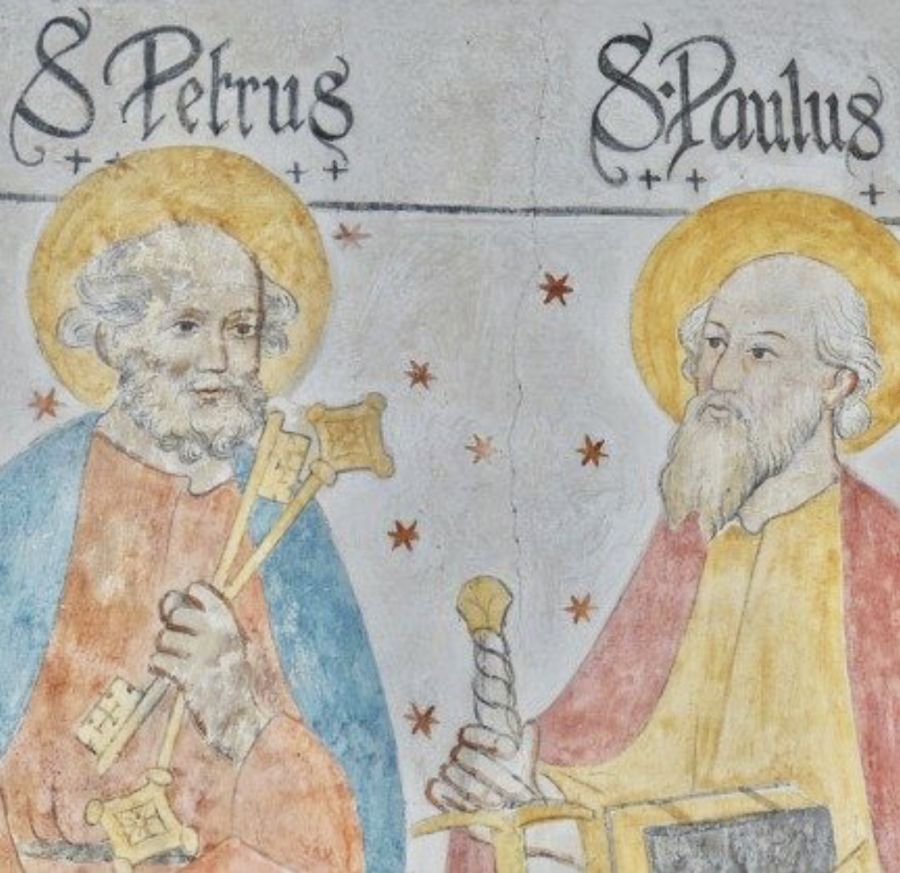
Saints Peter and Paul Ap. (Mt 16:13-19)

80 Last modified on Sunday, 21 June 2026 04:13
Teresa Girolami

Teresa Girolami è laureata in Materie letterarie e Teologia. Ha pubblicato vari testi, fra cui: "Pellegrinaggio del cuore" (Ed. Piemme); "I Fiammiferi di Maria - La Madre di Dio in prosa e poesia"; "Tenerezza Scalza - Natura di donna"; co-autrice di "Dialogo e Solstizio".

Email This email address is being protected from spambots. You need JavaScript enabled to view it.
May we obtain this gift [the full unity of all believers in Christ] through the Apostles Peter and Paul, who are remembered by the Church of Rome on this day that commemorates their martyrdom and therefore their birth to life in God. For the sake of the Gospel they accepted suffering and death, and became sharers in the Lord's Resurrection […] Today the Church again proclaims their faith. It is our faith (Pope John Paul II)
Ci ottengano questo dono [la piena unità di tutti i credenti in Cristo] gli Apostoli Pietro e Paolo, che la Chiesa di Roma ricorda in questo giorno, nel quale si fa memoria del loro martirio, e perciò della loro nascita alla vita in Dio. Per il Vangelo essi hanno accettato di soffrire e di morire e sono diventati partecipi della risurrezione del Signore […] Oggi la Chiesa proclama nuovamente la loro fede. E' la nostra fede (Papa Giovanni Paolo II)
God's grace does not suppress or suffocate the freedom of those who face martyrdom; on the contrary it enriches and exalts them: the Martyr is an exceedingly free person, free as regards power, as regards the world; a free person [Pope Benedict]
La grazia di Dio non sopprime o soffoca la libertà di chi affronta il martirio, ma al contrario la arricchisce e la esalta: il martire è una persona sommamente libera, libera nei confronti del potere, del mondo; una persona libera [Papa Benedetto]
For Jesus, faith has a decisive importance for the purposes of salvation. St Paul will develop Christ's teaching when, in conflict with those who wished to base the hope of salvation on observance of the Jewish law, he forcefully affirms that faith in Christ is the only source of salvation: "We hold that a man is justified by faith apart from works of law" (Rom 3:28) [John Paul II]
Ai fini della salvezza, la fede ha per Gesù un'importanza decisiva. San Paolo svilupperà l'insegnamento di Cristo quando, in contrasto con quanti volevano fondare la speranza di salvezza sull'osservanza della legge giudaica, affermerà con forza che la fede in Cristo è la sola fonte di salvezza: "Noi riteniamo, infatti, che l'uomo è giustificato per la fede, indipendentemente dalle opere della legge" (Rm 3,28) [Giovanni Paolo II]
Jesus did not shun contact with that man; on the contrary, impelled by deep participation in his condition, he stretched out his hand and touched the man — overcoming the legal prohibition [Pope Benedict]
Gesù non sfugge al contatto con quell’uomo, anzi, spinto da intima partecipazione alla sua condizione, stende la mano e lo tocca – superando il divieto legale [Papa Benedetto]
In the heart of every man there is the desire for a house [...] My friends, this brings about a question: “How do we build this house?” (Pope Benedict)
Nel cuore di ogni uomo c'è il desiderio di una casa [...] Amici miei, una domanda si impone: "Come costruire questa casa?" (Papa Benedetto)
Every time we open ourselves to God's call, we prepare, like John, the way of the Lord among men (John Paul II)
Tutte le volte che ci apriamo alla chiamata di Dio, prepariamo, come Giovanni, la via del Signore tra gli uomini (Giovanni Paolo II)
Christian beatitude, as a synonym for holiness, is not separated from a component of suffering or at least of difficulty [...] But the kingdom of heaven is for the nonconformists (John Paul II)
La beatitudine cristiana, come sinonimo di santità, non è disgiunta da una componente di sofferenza o almeno di difficoltà […] Ma il regno dei cieli è per gli anticonformisti (Giovanni Paolo II)

Due Fuochi due Vie - Vol. 1 Due Fuochi due Vie - Vol. 2 Due Fuochi due Vie - Vol. 3 Due Fuochi due Vie - Vol. 4 Due Fuochi due Vie - Vol. 5 Dialogo e Solstizio I fiammiferi di Maria

duevie.art

don Giuseppe Nespeca

Tel. 333-1329741


Disclaimer

Questo blog non rappresenta una testata giornalistica in quanto viene aggiornato senza alcuna periodicità. Non può pertanto considerarsi un prodotto editoriale ai sensi della legge N°62 del 07/03/2001.
Le immagini sono tratte da internet, ma se il loro uso violasse diritti d'autore, lo si comunichi all'autore del blog che provvederà alla loro pronta rimozione.
L'autore dichiara di non essere responsabile dei commenti lasciati nei post. Eventuali commenti dei lettori, lesivi dell'immagine o dell'onorabilità di persone terze, il cui contenuto fosse ritenuto non idoneo alla pubblicazione verranno insindacabilmente rimossi.






