Mar 23, 2026 Written by 

Passion and compassion

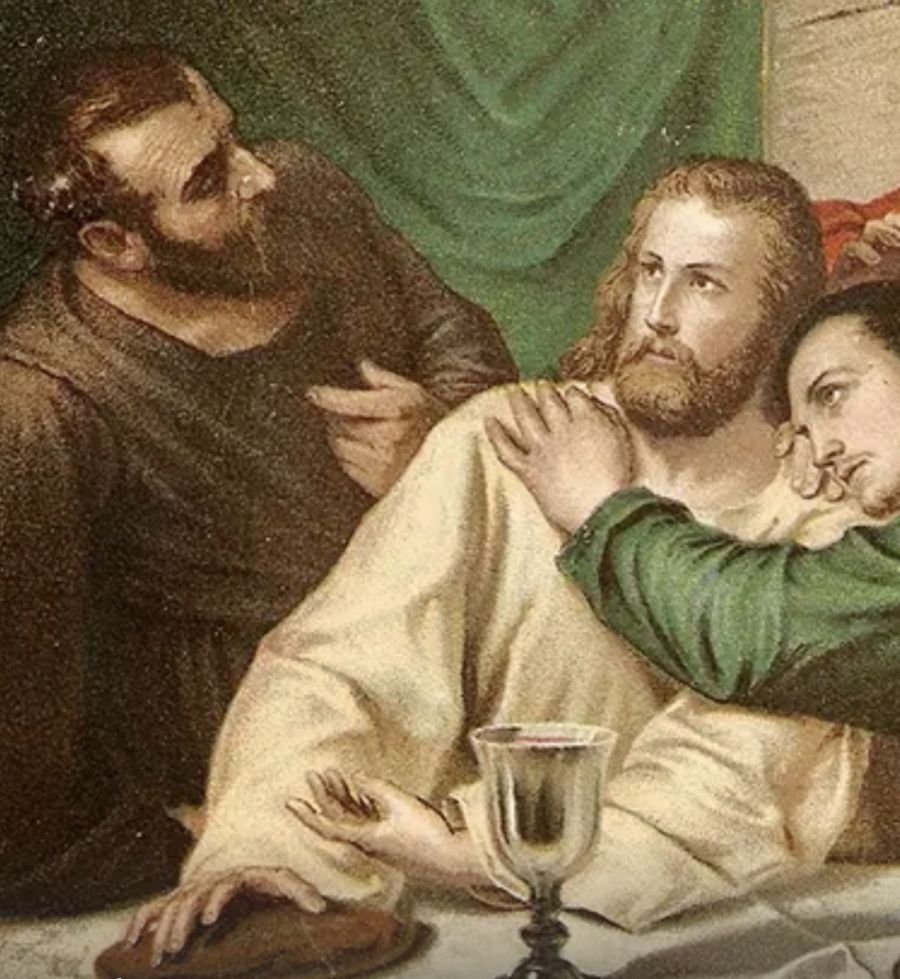
Jesus' agitation over the imminent betrayal-delivery of Judas had caused questioning, pain and sadness in the disciple He loved and in all His intimates.

Francis (like John) was indeed «the one Jesus loved», as he lived with his head reclining on the heart of Christ, feeling all the pulsations and twitches of his being handed over to his tormentors.

The morsel dipped and given to Judas Iscariot had caused Francis to place himself before the Cross, contemplating it.

Looking at it, he loved to call himself «a new madman», referring to St Paul, to the madness of the Cross (cf. 1 Cor 1:18-25).

The Poverello's madness consisted in wanting to live according to the Gospel, as Christ had outlined it.

According to some accounts he used to repeat: «Love is not loved». This was the cry that resounded in his heart and on his lips.

"Once he went alone near the church of Santa Maria della

Portiuncula, weeping and lamenting in a loud voice.

A pious man, hearing this, assumed that he was suffering from some illness or sorrow and, moved by compassion, asked him why he was weeping so.

Francis said:

«I weep for the passion of my Lord. For love of him I should not be ashamed to go moaning aloud for all the world».

Then the devout man also joined in Francis' lamentations.

Often, on rising from prayer, his eyes seemed to be full of blood, so reddened were they from weeping.

And he did not confine himself to tears, but, in memory of the sufferings of Christ, abstained from eating and drinking" (FF 1413).

In the soul of Francis, that morsel dipped and given to Judas was enough to abstain from all food, such was the pain and bitterness in Christ, delivered from human gain.

Clare of Assisi, who also understood the Passion of Jesus, continually meditated on the mysteries of the Cross.

"The Crucified beloved returns the lover, and she who is so inflamed with love for the mystery of the Cross, is by virtue of the Cross made luminous by signs and miracles.

For when he traced the sign of the life-giving Cross on the sick, he prodigiously removed sickness from them" (FF 3218).


«Having dipped the morsel therefore, He took it and gave it to Judas, the son of Simon Iscariot» (Jn 13:26)


Holy Tuesday  (Jn 13:21-33.36-38)

158 Last modified on Monday, 23 March 2026 04:21
Teresa Girolami

Teresa Girolami è laureata in Materie letterarie e Teologia. Ha pubblicato vari testi, fra cui: "Pellegrinaggio del cuore" (Ed. Piemme); "I Fiammiferi di Maria - La Madre di Dio in prosa e poesia"; "Tenerezza Scalza - Natura di donna"; co-autrice di "Dialogo e Solstizio".

Email This email address is being protected from spambots. You need JavaScript enabled to view it.
What does bread of life mean? We need bread to live. Those who are hungry do not ask for refined and expensive food, they ask for bread. Those who are unemployed do not ask for enormous wages, but the “bread” of employment. Jesus reveals himself as bread, that is, the essential, what is necessary for everyday life; without Him it does not work (Pope Francis)
Che cosa significa pane della vita? Per vivere c’è bisogno di pane. Chi ha fame non chiede cibi raffinati e costosi, chiede pane. Chi è senza lavoro non chiede stipendi enormi, ma il “pane” di un impiego. Gesù si rivela come il pane, cioè l’essenziale, il necessario per la vita di ogni giorno, senza di Lui la cosa non funziona (Papa Francesco)
In addition to physical hunger man carries within him another hunger — all of us have this hunger — a more important hunger, which cannot be satisfied with ordinary food. It is a hunger for life, a hunger for eternity which He alone can satisfy, as he is «the bread of life» (Pope Francis)
Oltre alla fame fisica l’uomo porta in sé un’altra fame – tutti noi abbiamo questa fame – una fame più importante, che non può essere saziata con un cibo ordinario. Si tratta di fame di vita, di fame di eternità che Lui solo può appagare, in quanto è «il pane della vita» (Papa Francesco)
The Eucharist draws us into Jesus' act of self-oblation. More than just statically receiving the incarnate Logos, we enter into the very dynamic of his self-giving [Pope Benedict]
L'Eucaristia ci attira nell'atto oblativo di Gesù. Noi non riceviamo soltanto in modo statico il Logos incarnato, ma veniamo coinvolti nella dinamica della sua donazione [Papa Benedetto]
Jesus, the true bread of life that satisfies our hunger for meaning and for truth, cannot be “earned” with human work; he comes to us only as a gift of God’s love, as a work of God (Pope Benedict)
Gesù, vero pane di vita che sazia la nostra fame di senso, di verità, non si può «guadagnare» con il lavoro umano; viene a noi soltanto come dono dell’amore di Dio, come opera di Dio (Papa Benedetto)
The locality of Emmaus has not been identified with certainty. There are various hypotheses and this one is not without an evocativeness of its own for it allows us to think that Emmaus actually represents every place: the road that leads there is the road every Christian, every person, takes. The Risen Jesus makes himself our travelling companion as we go on our way, to rekindle the warmth of faith and hope in our hearts and to break the bread of eternal life (Pope Benedict)
La località di Emmaus non è stata identificata con certezza. Vi sono diverse ipotesi, e questo non è privo di una sua suggestione, perché ci lascia pensare che Emmaus rappresenti in realtà ogni luogo:  la strada che vi conduce è il cammino di ogni cristiano, anzi, di ogni uomo. Sulle nostre strade Gesù risorto si fa compagno di viaggio, per riaccendere nei nostri cuori il calore della fede e della speranza e spezzare il pane della vita eterna (Papa Benedetto)
Romano Guardini wrote that the Lord “is always close, being at the root of our being. Yet we must experience our relationship with God between the poles of distance and closeness. By closeness we are strengthened, by distance we are put to the test” (Pope Benedict)
Romano Guardini scrive che il Signore “è sempre vicino, essendo alla radice del nostro essere. Tuttavia, dobbiamo sperimentare il nostro rapporto con Dio tra i poli della lontananza e della vicinanza. Dalla vicinanza siamo fortificati, dalla lontananza messi alla prova” (Papa Benedetto)

Due Fuochi due Vie - Vol. 1 Due Fuochi due Vie - Vol. 2 Due Fuochi due Vie - Vol. 3 Due Fuochi due Vie - Vol. 4 Due Fuochi due Vie - Vol. 5 Dialogo e Solstizio I fiammiferi di Maria

duevie.art

don Giuseppe Nespeca

Tel. 333-1329741


Disclaimer

Questo blog non rappresenta una testata giornalistica in quanto viene aggiornato senza alcuna periodicità. Non può pertanto considerarsi un prodotto editoriale ai sensi della legge N°62 del 07/03/2001.
Le immagini sono tratte da internet, ma se il loro uso violasse diritti d'autore, lo si comunichi all'autore del blog che provvederà alla loro pronta rimozione.
L'autore dichiara di non essere responsabile dei commenti lasciati nei post. Eventuali commenti dei lettori, lesivi dell'immagine o dell'onorabilità di persone terze, il cui contenuto fosse ritenuto non idoneo alla pubblicazione verranno insindacabilmente rimossi.






