


don Giuseppe Nespeca
Giuseppe Nespeca è architetto e sacerdote. Cultore della Sacra scrittura è autore della raccolta "Due Fuochi due Vie - Religione e Fede, Vangeli e Tao"; coautore del libro "Dialogo e Solstizio".
The platform that makes the breakthrough
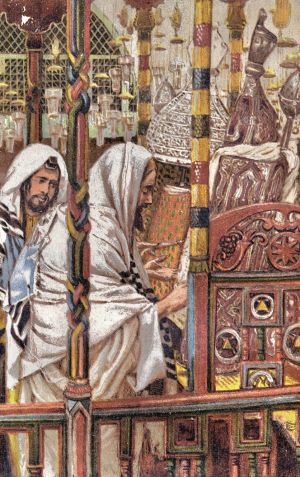
In the Synagogue and from the precipice
(Lc 4:16-30)
In ancient Israel, the patriarchal family, clan and community were the basis of social coexistence.
They ensured the transmission of the nation identity and provided protection for the afflicted.
But at the time of Jesus, Galilee was subject to the segregation dictated by Herod's policies, and suffered from the oppression of official religiosity.
The political and economic situation forced people to retreat into material and individual problems or those of small family.
A situation that was leading the least protected sections of the population to collapse.
Instead, Jesus wants to return to the Father's Dream: the ineradicable one of Fraternity, the only seal to salvation history.
Thus, according to Lk the first time Jesus enters a synagogue he makes a mess.
He does not go to pray, but to Teach what the Grace of God is [the one not weakened by chicanery or false instructions] in the real existence of people.
He chose a passage that reflected the situation of his people, oppressed by the power of the rulers, who were making the weak suffer confusion and poverty.
But his First Reading disregards the liturgical calendar.
He then dares to preach in his own way and personalizes the passage from Isaiah, from which he allows himself to censor the verse announcing God's “vengeance”.
So neither does He proclaim the expected passage of the Law.
Moreover, for the Son of God, the Spirit is not revealed in the extraordinary phenomena of the cosmos, but in the Year of Grace [«a year acceptable to the Lord»: v.19].
Is it possible that the divine likeness could manifest itself in a man who is considerate towards the less fortunate, who disregards official customs, does not believe in retaliation, and displays forms of uncontrolled spontaneity?
It is a reminder to us.
Like the Master, instead of reasoning with induced thoughts and being sequestered by the heaviness of rejections and fears, in Him we begin to think with the empathic codes of our Calling, which breaks through.
The unrepeatable and wide-ranging Vision-Relation (v.18a) - without reduction - then becomes strategic, because it possesses within itself the appeal of the radical essence, and all the resources to solve the real problems.
To listen to the proclamation of the Gospels (v.18b) is to listen to the echo of oneself and the people considered insignificant: intimate and fraternal choice.
And to be in it without the dead leaves of one-sidedness - by wandering freely in that same Appeal; not neglecting precious parts of oneself, nor amputating eccentricities, or the intuition proper to the subaltern classes.
In this way, we remain in the instinct to be and do happy, without ever allowing ourselves to be imprisoned by the craving for security on the side: a stagnant quest.
The Kingdom in the Spirit (cf. vv.14.18) knows what we need. It has ceased to be a goal of mere future.
It is the surprise that Christ arouses in us through his Dream, around his proposal with an extra gear.
The Lord does not neglect us: He extinguishes accusatory brooding and creatively redesigns.
He gives birth again and motivates, recovers dispersions and reinforces the plot.
It is divine because it is personal and social, the new Energy, empowered to create the authentic man.
This is the platform that works the breakthrough.
[Monday 22nd wk. in O.T. August 31st, 2026]
In the Synagogue and from the precipice

Lk 4:16-30 (16-37)
Jesus' transgressions and ours (reinforcing the plot)
(Lk 4:14-22)
"The Spirit of the Lord is upon me, therefore he has anointed me to proclaim the Good News to the poor" (Lk 4:18).
In ancient Israel, the patriarchal family, clan and community were the basis of social coexistence.
They guaranteed the transmission of the identity of the people and provided protection for the afflicted.
Defending the clan was also a concrete way of confirming the First Covenant.
But at the time of Jesus, Galilee suffered both the segregation dictated by Herod Antipas' policy and the oppression of official religiosity.
The ruler's spineless collaborationism had increased the number of homeless and unemployed.
The political and economic situation forced people to retreat into material and individual problems or those of a small family.
At one time, the identity glue of clan and community guaranteed a (domestic) character of a nation of solidarity, expressed in the defence and relief given to the less well-off of the people.
Now, this fraternal bond was weakened, a little congealed, almost contradicted - also due to the strict attitude of the religious authorities, fundamentalist and lovers of a saccharine purism, opposed to mixing with the less well-off classes.
The Law [written and oral] ended up being used not to favour the welcoming of the marginalised and needy, but to accentuate detachment and ghettoisation.
Situations that were leading to the collapse of the least protected sections of the population.
In short, traditional devotion - loving the alliance between throne and altar - instead of strengthening the sense of community was being used to accentuate hierarchies; as a weapon to legitimise a whole mentality of exclusions (and confirm the imperial logic of divide and rule).
Instead, Jesus wants to return to the Father's Dream: the ineliminable one of fraternity, the only seal to salvation history.
That is why his non-avoidable criterion was to link the Word of God to the life of the people, and in this way overcome divisions.
Thus, according to Lk, the first time Jesus enters a synagogue he messes up.
He does not go there to pray, but to teach what God's Grace is [undefiled by chicanery and false instructions] in the real existence of people.
He chooses a passage that reflects precisely the situation of the people of Galilee, oppressed by the power of the rulers, who were making the weak suffer confusion and poverty.
But his first Reading does not take into account the liturgical calendar.
Then he dares to preach in his own way and personalising the passage from Isaiah, from which he allows himself to censor the verse announcing God's vengeance.
Then he does not even proclaim the expected passage of the Law.
And he poses as if he were the master of the place of worship - in reality he is: the Risen One who 'sits' is teaching his [still Judaizing] people.
Moreover - we understand from the tone of the Gospel passage - for the Son of God the Spirit is not revealed in the extraordinary phenomena of the cosmos, but in the Year of Grace ("a year acceptable to the Lord": v.19).
The new energy that creates the authentic man is divine because it is personal and social.
This is the platform that works the turning point.
It becomes an engine, a motive and context, for a transformation of the soul and of relationships - at that time weighed down by even theological servility [of merits].
In a warp of vital relationships, the better understanding of the Gift becomes a springboard for a harmonious future of liberation and justice.
Christ believes that the Father's Kingdom arises by making the present, then mired in oppression, anguish and slavery, grow from within.
Says the Tao Tê Ching (XLVI): "When the Way is in force in the world, swift horses are sent to fertilise the fields".
The emancipation offered by the Spirit is addressed not to the great, but precisely to those who suffer forms of need, defect and penury: in Jesus... now all open to the jubilee figure of the new Creation.
In short, there seems to be total antagonism and unsuitability between the Lord and the practitioners of traditional religion - heavy-handed, selective, devoted to legalisms and reprisals; pyramidal, with no way out.
Obviously, both leaders and customaries ask themselves - on a ritual and venerable basis: is it possible that the divine likeness could manifest itself in a man who is considerate towards the less affluent, who disregards official customs, does not believe in reprisals, and displays forms of uncontrolled spontaneity?
This is a reminder for us. The person of authentic Faith does not allow himself to be conditioned by habitual, useless and quiet conformities.
The common thought - habituated and agreed upon but subtly competitive - becomes a backwards energy, too normal and swampy; not propulsive for the personal and social soul.If, on the other hand, we allow ourselves to be accompanied by the Dream of a super-eminent gestation from the Father, we will be animated through the regal and sacred Presence that directs us to fly over repetitions, or selections, marginalisations and fallacious recriminations.
As if we move our being into a horizon and a world of friendly relations that then acts as a magnet to reality and anticipates the future.
Like the Master and Lord, instead of reasoning with induced thoughts and allowing ourselves to be sequestered by the heaviness of rejections and fears, let us begin to think with the images of personal Vocation, with the empathic codes of our bursting Calling.
The unknown evolutionary resources that are triggered, immediately unravel a network of paths that the "locals" may not like, but avoid the perennial conflict with missionary identity and character.
The Vision-Relation (v.18a) unrepeatable and wide-meshed - without reduction - then becomes strategic, because it possesses in itself the call of the Quintessence, and all the resources to solve the real problems.
To listen to the proclamation of the Gospels (v.18b) is to listen to the echo of oneself and of the little people: an intimate and social choice.
And to be in it without the dead leaves of one-sidedness - to wander freely in that same Proclamation; not neglecting precious parts of oneself, nor amputating eccentricities, or the intuition proper to the subordinate classes.
This is to be able to manifest the quiet Root (but in its energetic state), our Character (in the lovable, non-separatist Friend) - to avoid stultifying it with another bondage.
All in the instinct to be and do happy, never allowing ourselves to be imprisoned by the lust for security on the side; stagnant pursuit.
The Kingdom in the Spirit (cf. vv.14.18) - who knows what we need - has ceased to be a goal of mere futurity.
It is the surprise that Christ arouses in us around his proposal with an extra gear.
He does not neglect us: he extinguishes accusatory brooding and creatively redesigns.
He gives birth again and motivates, recovers dispersions, and strengthens the plot.
To internalise and live the message:
How do I connect the Faith with the cultural and social situation?
What is Christ's Today with your Today, in the Spirit?
What is your form of apostolate that frees brothers and sisters from the debasement of dignity and promotes them?
The Spirit of the Lord is upon me (et vult Cubam)
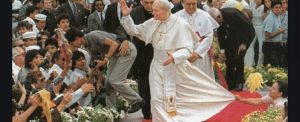
The Spirit of the Lord is upon me; therefore he anointed me and sent me forth to proclaim a glad tidings" (Lk 4:18). Every minister of God must make these words spoken by Jesus of Nazareth his own life. Therefore, as I stand here among you, I want to bring you the good news of hope in God. As a servant of the Gospel, I bring you this message of love and solidarity that Jesus Christ, with his coming, offers to people of all times. It is neither an ideology nor a new economic or political system, but a path of peace, justice and authentic freedom.
4. The ideological and economic systems that have succeeded one another in recent centuries have often emphasised confrontation as a method, since they contained in their programmes the seeds of opposition and disunity. This has deeply conditioned the conception of man and relations with others. Some of these systems also claimed to reduce religion to the merely individual sphere, stripping it of any social influence or relevance. In this sense, it is worth remembering that a modern state cannot make atheism or religion one of its political orders. The State, far from any fanaticism or extreme secularism, must promote a serene social climate and adequate legislation that allows each person and each religious denomination to live their faith freely, express it in the spheres of public life and be able to count on sufficient means and space to offer their spiritual, moral and civic riches to the life of the nation.
On the other hand, in various places, a form of capitalist neo-liberalism is developing that subordinates the human person and conditions the development of peoples to the blind forces of the market, burdening the less favoured peoples with unbearable burdens from its centres of power. Thus it often happens that unsustainable economic programmes are imposed on nations as a condition for receiving new aid. In this way we witness, in the concert of nations, the exaggerated enrichment of a few at the price of the growing impoverishment of the many, so that the rich get richer and the poor get poorer.
5. Dear brothers: the Church is a teacher in humanity. Therefore, in the face of these systems, she proposes the culture of love and life, restoring to humanity the hope and transforming power of love, lived in the unity willed by Christ. This requires a path of reconciliation, dialogue and fraternal acceptance of one's neighbour, whoever they may be. This can be said of the Church's social Gospel.
The Church, in carrying out its mission, proposes to the world a new justice, the justice of the Kingdom of God (cf. Mt 6:33). On several occasions I have referred to social issues. It is necessary to keep talking about them as long as there is injustice in the world, however small it may be, since otherwise the Church would not prove faithful to the mission entrusted to her by Jesus Christ. What is at stake is man, the person in the flesh. Even if times and circumstances change, there are always people who need the voice of the Church to acknowledge their anguish, pain and misery. Those who find themselves in such situations can be assured that they will not be defrauded, for the Church is with them and the Pope embraces, with his heart and his word of encouragement, all those who suffer injustice.
(John Paul II, after being applauded at length, added)
I am not against applause, because when you applaud the Pope can rest a little.
The teachings of Jesus retain their vigour intact on the threshold of the year 2000. They are valid for all of you, my dear brothers. In the search for the justice of the Kingdom, we cannot stop in the face of difficulties and misunderstandings. If the Master's invitation to justice, service and love is accepted as Good News, then hearts are enlarged, criteria are transformed and the culture of love and life is born. This is the great change that society awaits and needs; it can only be achieved if first the conversion of each person's heart takes place as a condition for the necessary changes in the structures of society.
6. "The Spirit of the Lord has sent me to proclaim release to the captives (...) to set at liberty those who are oppressed" (Lk 4:18). The good news of Jesus must be accompanied by a proclamation of freedom, based on the solid foundation of truth: "If you remain faithful to my word, you will truly be my disciples; you will know the truth, and the truth will set you free" (John 8:31-32). The truth to which Jesus refers is not just the intellectual understanding of reality, but the truth about man and his transcendent condition, his rights and duties, his greatness and limitations. It is the same truth that Jesus proclaimed with his life, reaffirmed before Pilate and, by his silence, before Herod; it is the same truth that led him to the salvific cross and glorious resurrection.
Freedom that is not grounded in truth conditions man to such an extent that it sometimes makes him the object rather than the subject of the social, cultural, economic and political context, leaving him almost totally deprived of initiative with regard to personal development. At other times, this freedom is individualistic and, taking no account of the freedom of others, locks man into his own selfishness. The conquest of freedom in responsibility is an unavoidable task for every person. For Christians, the freedom of God's children is not only a gift and a task; its attainment also implies an invaluable witness and a genuine contribution to the liberation of the entire human race. This liberation is not reduced to social and political aspects, but reaches its fullness in the exercise of freedom of conscience, the basis and foundation of other human rights.
(Responding to the invocation raised by the crowd: "The Pope lives and wants us all to be free!", John Paul II added:)
Yes, he lives with that freedom to which Christ has set you free.
For many of today's political and economic systems, the greatest challenge continues to be to combine freedom and social justice, freedom and solidarity, without any of them being relegated to a lower level. In this sense, the Social Doctrine of the Church constitutes an effort of reflection and a proposal that seeks to enlighten and reconcile the relationship between the inalienable rights of every man and social needs, so that the person may fulfil his deepest aspirations and his own integral realisation according to his condition as a child of God and citizen. Consequently, the Catholic laity must contribute to this realisation through the application of the Church's social teachings in the various environments, open to all people of good will.
7. In the Gospel proclaimed today, justice appears intimately linked to truth. This is also observed in the lucid thinking of the Fathers of the Fatherland. The Servant of God Father Félix Varela, animated by Christian faith and fidelity to his priestly ministry, sowed in the hearts of the Cuban people the seeds of justice and freedom that he dreamed of seeing germinate in a free and independent Cuba.José Martí's doctrine of love among all people has profoundly evangelical roots, thus overcoming the false conflict between faith in God and love and service to the homeland. Martí writes: 'Pure, unselfish, persecuted, martyred, poetic and simple, the religion of the Nazarene has seduced all honest men... Every people needs to be religious. It must be so not only in its essence, but also for its utility.... A non-religious people is doomed to die, for nothing in it nourishes virtue. Human injustice despises it; it is necessary for heavenly justice to guarantee it'.
As you know, Cuba possesses a Christian soul, and this has led it to have a universal vocation. Called to overcome its isolation, it must open up to the world, and the world must draw closer to Cuba, to its people, to its children, who undoubtedly represent its greatest wealth. The time has come to embark on the new paths that the times of renewal in which we live demand, as we approach the Third Millennium of the Christian era!
8. Dear brothers: God has blessed this people with authentic formators of the national conscience, clear and firm exponents of the Christian faith, which is the most valid support of virtue and love. Today the Bishops, together with priests, consecrated men and women and the lay faithful, strive to build bridges to bring minds and hearts closer together, propitiating and consolidating peace, preparing the civilisation of love and justice. I am here among you as a messenger of truth and hope. This is why I wish to repeat my call to let Jesus Christ enlighten you, to accept without reserve the splendour of his truth, so that all may follow the path of unity through love and solidarity, avoiding exclusion, isolation and confrontation, which are contrary to the will of the God-Love.
May the Holy Spirit enlighten with his gifts all those who have different responsibilities towards this people, whom I hold in my heart. May the "Virgen de la Caridad de El Cobre", Queen of Cuba, obtain for her children the gifts of peace, progress and happiness.
This wind today is very significant, because the wind symbolises the Holy Spirit. "Spiritus spirat ubi vult, Spiritus vult spirare in Cuba". The last words are in Latin because Cuba also belongs to the Latin tradition. Latin America, Latin Cuba, Latin language! "Spiritus spirat ubi vult et vult Cubam'. Goodbye.
(John Paul II, homily "José Martí" Square Havana 25 January 1998)
Person, extemporaneity, synagogues
Two Names of God
(Lk 4:21-30)
Today's Gospel - taken from the fourth chapter of St Luke - is a continuation of last Sunday's Gospel. We find ourselves again in the synagogue of Nazareth, the town where Jesus grew up and where everyone knew him and his family. Now, after a period of absence, He has returned in a new way: during the Sabbath liturgy, He reads a prophecy from Isaiah about the Messiah and announces its fulfilment, implying that the word refers to Him, that Isaiah has spoken of Him. This fact provokes the bewilderment of the Nazarenes: on the one hand, "all bore witness to him and were amazed at the words of grace that came out of his mouth" (Lk 4:22); St Mark reports that many said: "Where do these things come from him? And what wisdom is this that has been given him?" (6:2). On the other hand, however, his countrymen know him all too well: 'He is one like us', they say, 'His pretension can only be presumption' (cf. The Infancy of Jesus, 11). "Is not this the son of Joseph?" (Lk 4:22), as if to say: a carpenter from Nazareth, what aspirations can he have?
Precisely knowing this closure, which confirms the proverb "no prophet is welcome in his own country", Jesus addresses the people in the synagogue with words that sound like a provocation. He mentions two miracles performed by the great prophets Elijah and Elisha in favour of non-Israelites, to show that sometimes there is more faith outside Israel. At that point the reaction is unanimous: everyone gets up and throws him out, and even tries to throw him off a cliff, but he calmly sovereignly passes through the angry people and leaves. At this point the question arises: why did Jesus want to cause this disruption? At first, the people admired him, and perhaps he could have obtained some consensus... But this is precisely the point: Jesus did not come to seek the consensus of men, but - as he will say at the end to Pilate - to "bear witness to the truth" (Jn 18:37). The true prophet does not obey anyone other than God and puts himself at the service of the truth, ready to pay for it himself. It is true that Jesus is the prophet of love, but love has its own truth. Indeed, love and truth are two names of the same reality, two names of God. In today's liturgy, these words of St Paul also resonate: "Charity ... does not boast, is not puffed up with pride, is not disrespectful, does not seek its own interest, is not angry, does not take account of evil received, does not rejoice in injustice but rejoices in the truth" (1 Cor 13:4-6). Believing in God means renouncing one's prejudices and accepting the concrete face in which He revealed Himself: the man Jesus of Nazareth. And this way also leads to recognising and serving Him in others.
In this, Mary's attitude is illuminating. Who more than she was familiar with the humanity of Jesus? But she was never as scandalised by it as the people of Nazareth. She kept the mystery in her heart and knew how to welcome it again and again, on the path of faith, until the night of the Cross and the full light of the Resurrection. May Mary also help us to tread this path with fidelity and joy.
[Pope Benedict, Angelus 3 February 2013].
Jesus is annoying and generates suspicion in those who love external schemes, because he proclaims only Jubilee, instead of harsh confrontation and vengeance.
In the synagogue his village is puzzled by this overly understanding love - just what we need.
The place of worship is where believers have been brought up backwards!
Their grumpy character is the unripe fruit of a hammering religiosity, which denies the right to express ideas and feelings.
The 'synagogal' code has produced fake believers, conditioned by a disharmonious and split personality.
Even today and from an early age, this intimate laceration manifests itself in the over-controlling of openness to others.
Consequence: an accentuation of youthful uncertainty - under which who knows what smoulders - and a rigid character as adults.
In short, religious hammering that does not make the leap of Faith blocks us, prevents us from understanding, and pollutes our whole life.
Even in Jesus' time, archaic teaching exacerbated nationalism, the very perception of trauma or violation, and paradoxically the very caged situations from which one wanted to get out.
Exclusive spirituality: it is empty - crude or sophisticated.
Selective thinking is the worst disease of worldviews - which are then always telling us how we should be.
So in concrete life, not a few believers prefer to have friends without conformist blindness or the same bonds of belonging.
On closer inspection, even the most devout lay realities manifest a pronounced and strange dichotomy of relationships - tribal and otherwise.
Pope Francis expressed it crisply:
"It is a scandal that of people who go to church, who are there every day and then live hating others and speaking ill of people: better to live as an atheist than to give a counter-witness to being a Christian".
The real world awakens and stimulates flexibility of standards, it does not inculcate some old-fashioned, hypnosis-like truism.
Today's global reality helps to blunt the edges of conventicle [which have their regurgitations, in terms of seduction and sucking].
In the face of such beliefs and illusions, the Prophet marks distance; he works to spread awareness, not reassuring images - nor disembodied ideas.
But the critical heralds violently irritate the crowd of regulars, who suddenly turn from curiosity to vengeful indignation.
As in the village, so - we read in a watermark - in the Holy City [Mount Zion] from which they immediately want to throw you down (Lk 4:29).
Wherever there is talk of a real person and eternal dreams: his, not others'.
In the hostility that surrounds them, the Lord's intimates openly challenge normalised beliefs, acquired from the environment and not reworked.
For them, it is not only the calculated analogy to a mean outline that counts. They see other goals and do not just want to 'get there'.
If they are overwhelmed, they leave behind them that trail of intuition that will sooner or later make both harmful clansmen and useless opportunists reflect.
Thus, in Friends and Brothers it is the Risen One himself who escapes. And he resumes the path, crossing those who want to do him in (v. 30) for reasons of self-interest or neighbourhood advantage.
At all times, the witnesses make one think: they do not seek compliments and pleasant results, but recover the opposite sides and accept the happiness of others.
They know that Oneness must run its course: it will be wealth for all, and on this point they do not let themselves be inhibited by nomenclature.
Although surrounded by the envious and deadly hatred of cunning idiots and established synagogues, they proclaim Love in Truth - neither burine hoaxes (approved as empty) nor ulterior motives (solid utility).
In fact, without milking and shearing the uninformed, such missionaries give impetus to the courage and growth of others, to the autonomy of choices.
All this, by fostering the coexistence of the invisible and despised; in an atmosphere of understanding and spontaneity.They love the luxuriance of life, so they discriminate between religion and Faith: they do not stand as repeaters of doctrines, prescriptions, customs.
Based on the Father's personal experience, the inspired faithful value different approaches, creating an unknown esteem.
They confront young sectarian monsters [the Pontiff would say], old marpions and their fences, with an open face, advocating new attitudes - different ways of relating to God.
Not to add proselytes and consider themselves indispensable.
Even though 'at home' (v. 24) they are inconvenient characters for the ratified mentality, the none-Prophets make Jesus' personalism survive, wrenching it from those who want it dormant and sequestered.
Like Him, at the risk of unpopularity and without begging for approval.
With the scars of what is gone, for a new Journey.
To internalise and live the message:
In the 'homeland' are you considered a local child, or a prophet? A ratified character, or inconvenient? In fashion, or unpopular?
Is your testimony transgressive or conformist? Does it make Jesus' personalism survive, wrenching it from those who want it dormant and sequestered?
God wants faith, they want miracles: God for their own benefit
Last Sunday, the liturgy had proposed to us the episode in the synagogue of Nazareth, where Jesus reads a passage from the prophet Isaiah and at the end reveals that those words are fulfilled "today", in Him. Jesus presents Himself as the one on whom the Spirit of the Lord has rested, the Holy Spirit who consecrated Him and sent Him to fulfil the mission of salvation on behalf of humanity. Today's Gospel (cf. Lk 4:21-30) is a continuation of that story and shows us the amazement of his fellow citizens at seeing that one of their countrymen, "the son of Joseph" (v. 22), claims to be the Christ, the Father's envoy.
Jesus, with his ability to penetrate minds and hearts, immediately understands what his countrymen think. They think that, since He is one of them, He must prove this strange "claim" of His by performing miracles there, in Nazareth, as He did in the neighbouring countries (cf. v. 23). But Jesus does not want and cannot accept this logic, because it does not correspond to God's plan: God wants faith, they want miracles, signs; God wants to save everyone, and they want a Messiah for their own benefit. And to explain God's logic, Jesus brings the example of two great ancient prophets: Elijah and Elisha, whom God had sent to heal and save people who were not Jewish, from other peoples, but who had trusted his word.
Faced with this invitation to open their hearts to the gratuitousness and universality of salvation, the citizens of Nazareth rebel, and even assume an aggressive attitude, which degenerates to the point that "they got up and drove him out of the city and led him to the edge of the mountain [...], to throw him down" (v. 29). The admiration of the first moment turned into an aggression, a rebellion against Him.
And this Gospel shows us that Jesus' public ministry begins with a rejection and a threat of death, paradoxically precisely from his fellow citizens. Jesus, in living the mission entrusted to him by the Father, knows well that he must face fatigue, rejection, persecution and defeat. A price that, yesterday as today, authentic prophecy is called upon to pay. The harsh rejection, however, does not discourage Jesus, nor does it stop the journey and fruitfulness of his prophetic action. He goes on his way (cf. v. 30), trusting in the Father's love.
Even today, the world needs to see in the Lord's disciples prophets, that is, people who are courageous and persevering in responding to the Christian vocation. People who follow the 'thrust' of the Holy Spirit, who sends them to announce hope and salvation to the poor and excluded; people who follow the logic of faith and not of miracles; people dedicated to the service of all, without privileges and exclusions. In short: people who are open to accepting the Father's will within themselves and are committed to faithfully witnessing it to others.
Let us pray to Mary Most Holy, that we may grow and walk in the same apostolic ardour for the Kingdom of God that animated Jesus' mission.
[Pope Francis, Angelus 3 February 2019]
As a provocation

Once again we find ourselves in the Synagogue of Nazareth, the village where Jesus grew up, where every knew him and his family. Then, after a period of absence, he returned there in a new way: during the Sabbath liturgy he read a prophecy on the Messiah by Isaiah and announced its fulfilment, making it clear that this word referred to him, that Isaiah had spoken about him. The event puzzled the Nazarenes: on the one hand they “all spoke well of him and wondered at the gracious words which proceeded out of his mouth” (Lk 4:22).
St Mark reported what many were saying: “Where did this man get all this? What is the wisdom given to him?” (6:2). On the other hand, however, his fellow villagers knew him too well: “He is one like us”, they say, “His claim can only be a presumption (cf. The Infancy Narratives, English edition, p. 3). “Is not this Joseph’s son?” (Lk 4:22), as if to say “what can a carpenter from Nazareth aspire to?”.
Well-acquainted with this imperviousness which confirms the proverb: “no prophet is acceptable in his own country”, to the people in the synagogue Jesus addressed words that resonate like a provocation. He cited two miracles wrought by the great prophets Elijah and Elisha for men who were not Israelites in order to demonstrate that faith is sometimes stronger outside Israel. At this point there was a unanimous reaction. All the people got to their feet and drove him away; and they even tried to push him off a precipice. However, passing through the midst of the angry mob with supreme calmness he went away. At this point it comes naturally to wonder: why ever did Jesus want to stir up this antagonism? At the outset the people admired him and he might perhaps have been able to obtain a certain consensus.... But this is exactly the point: Jesus did not come to seek the agreement of men and women but rather — as he was to say to Pilate in the end — “to bear witness to the truth” (Jn 18:37). The true prophet does not obey others as he does God, and puts himself at the service of the truth, ready to pay in person. It is true that Jesus was a prophet of love, but love has a truth of its own. Indeed, love and truth are two names of the same reality, two names of God.
[Pope Benedict, Angelus 3 February 2013]
Passage that surpasses history
7. In his activity as a teacher, which began in Nazareth and extended to Galilee and Judea up to the capital, Jerusalem, Jesus knows how to grasp and make the most of the abundant fruits present in the religious tradition of Israel. He penetrates it with new intelligence, brings out its vital values, and highlights its prophetic perspectives. He does not hesitate to denounce men's deviations from the designs of the God of the covenant.
In this way he works, within the one and the same divine revelation, the passage from the "old" to the "new", without abolishing the Law, but instead bringing it to its full fulfilment (cf. Mt 5:17). This is the thought with which the Letter to the Hebrews opens: "God, who had already spoken in ancient times many times and in various ways to the fathers through the prophets, has lately, in these days, spoken to us through his Son . . ." (Heb 1:1).
8. This transition from the 'old' to the 'new' characterises the entire teaching of the 'Prophet' of Nazareth. A particularly clear example is the Sermon on the Mount in the Gospel of Matthew. Jesus says: "You have heard that it was said to the ancients: Do not kill . . . But I say unto you, whosoever is angry with his brother shall be brought into judgment' (Matthew 5: 21-22). "You have heard that it was said, Do not commit adultery; but I say to you, whoever looks at a woman to lust after her has already committed adultery with her in his heart" (Mt 5:27-28). "You have heard that it was said, 'You shall love your neighbour and hate your enemy; but I say to you, love your enemies and pray for your persecutors . . ." (Mt 5:43-44).
Teaching in this way, Jesus at the same time declares: "Do not think that I have come to abolish the Law or the Prophets; I have not come to abolish, but to fulfil" (cf. Mt 5:17).
9. This "fulfilment" is a key-word that refers not only to the teaching of the truth revealed by God, but also to the whole history of Israel, that is, of the people whose son Jesus is. This extraordinary history, guided from the beginning by the powerful hand of the God of the covenant, finds its fulfilment in Jesus. The plan that the God of the covenant had inscribed in this history from the beginning, making it the history of salvation, tended towards the "fullness of time" (Gal 4:4), which is fulfilled in Jesus Christ. The Prophet of Nazareth does not hesitate to speak of this from his very first speech in the synagogue of his city.
10. Particularly eloquent are the words of Jesus reported in the Gospel of John when he says to his opponents: "Abraham, your father, rejoiced in the hope of seeing my day . . .", and in the face of their disbelief: "Are you not yet fifty years old and have you seen Abraham?", Jesus confirms even more explicitly: "Verily, verily, I say unto you, before Abraham was, I am" (John 8: 56-58). It is evident that Jesus affirms, not only that he is the fulfilment of God's salvific designs, inscribed in Israel's history since Abraham's time, but that his existence precedes Abraham's time, to the point of identifying himself as "he who is" (Ex 3:14). But for this very reason he, Jesus Christ, is the fulfilment of Israel's history, because he "surpasses" this history with his mystery.
[Pope John Paul II, General Audience 4 February 1987]
"You are one of us!" Nice prayer!
Gospel [...] tells us about the disbelief of Jesus’s fellow villagers. After preaching in other villages in Galilee, Jesus returned to Nazareth where he had grown up with Mary and Joseph; and, one sabbath, he began to teach in the synagogue. Many who were listening asked themselves: “Where does he get all this wisdom? But, isn’t he the son of the carpenter and Mary, that is, of our neighbours that we know so well?” (cf. vv. 1-3). Confronted with this reaction, Jesus confirms the truth that had even become a part of popular wisdom: “A prophet is not without honour, except in his own country, and among his own kin, and in his own house” (v. 4). We say this many times…
Let us reflect on the attitude of Jesus’s fellow villagers. We could say they knew Jesus, but they did not recognise him. There is a difference between knowing and recognizing. In essence, this difference makes us understand that we can know various things about a person, form an idea, rely on what others say about that person, we might perhaps meet that person every now and then in the neighbourhood; but all that is not enough. This is a knowledge, I would say ordinary, superficial, that does not recognise the uniqueness of the person. We all run this risk: we think we know so much about a person, even worse, we use labels and close the person within our own prejudices. Jesus’s fellow villagers knew him for thirty years in the same way and they thought they knew everything! “But isn’t this the boy we saw growing up, the son of the carpenter and Mary? Where do these things come from?”. The distrust…in reality, they never realised who Jesus truly was. They remained at the exterior level and refused what was new about Jesus.
And here, we enter into the true crux of the problem: when we allow the convenience of habit and the dictatorship of prejudice to have the upper hand, it is difficult to open ourselves to what is new and allow ourselves to be amazed. We control: through attitudes, through prejudices… It often happens in life that we seek from our experiences and even from people only what conforms to our own ideas and ways of thinking so as never to have to make an effort to change. And this can even happen with God, and even to us believers, to us who think we know Jesus, that we already know so much about Him and that it is enough to repeat the same things as always. And this is not enough with God. But without openness to what is new and, above all – listen well – openness to God’s surprises, without amazement, faith becomes a tiring litany that slowly dies out and becomes a habit, a social habit.
I said a word: amazement. What is amazement? Amazement happens when we meet God: “I met the Lord”. But we read in the Gospel: many times the people who encountered Jesus and recognised him felt amazed. And we, by encountering God, must follow this path: to feel amazement. It is like the guarantee certificate that the encounter is true and not habitual.
In the end, why didn’t Jesus’s fellow villagers recognise and believe in Him? But why? What is the reason? In a few words, we can say that they did not accept the scandal of the Incarnation. They did not know this mystery of the Incarnation, but they did not accept the mystery: they did not know it. They did not know the reason and they thought it was scandalous that the immensity of God should be revealed in the smallness of our flesh, that the Son of God should be the son of a carpenter, that the divine should be hidden in the human, that God should inhabit a face, the words, the gestures of a simple man. This is the scandal: the incarnation of God, his concreteness, his ‘daily life’. And God became concrete in a man, Jesus of Nazareth, he became a companion on the way, he made himself one of us. “You are one of us”, we can say to Jesus. What a beautiful prayer! It is because one of us understands us, accompanies us, forgives us, loves us so much. In reality, an abstract, distant god is more comfortable, one that doesn’t get himself involved in situations and who accepts a faith that is far from life, from problems, from society. Or we would even like to believe in a ‘special effects’ god who does only exceptional things and always provokes strong emotions. Instead, brothers and sisters, God incarnated Himself: God is humble, God is tender, God is hidden, he draws near to us, living the normality of our daily life.
And then, the same thing happens to us like Jesus’s fellow villagers, we risk that when he passes by, we will not recognize him. I repeat that beautiful phrase from Saint Augustine: “I am afraid of God, of the Lord, when he passes by”. But, Augustine, why are you afraid? “I am afraid of not recognising him. I am afraid that when the Lord passes by: Timeo Dominum transeuntem. We do not recognize him, we are scandalised by Him, we think with our hearts about this reality.
Now, in prayer, let us ask the Madonna, who welcomed the mystery of God in her daily life in Nazareth, for eyes and hearts free of prejudices and to have eyes open to be amazed: “Lord that we might meet you!”, and when we encounter the Lord there is this amazement. We meet him in the normal: eyes open to God’s surprises, at His humble and hidden presence in daily life.
[Pope Francis, Angelus 4 July 2021]
Cross and Son of Man: Messiah and against-Messiah in comparison
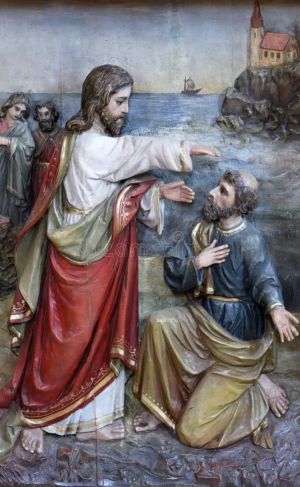
(Mt 16:21-27)
Common mentality evaluated the life’ success - and the truth of a religion - on the basis of glory, domination, enrichment, and security in general.
This is why Peter and the disciples wanted to return to the usual idea of «the» Messiah [cf. vv.16.20 Greek text] expected by everyone.
An all too normal canvas, incapable of regenerating us.
Everything we do - even in the risk - is motivated by the quest for fullness of being and happiness. We are passionate about the way in the Spirit for the same reason: to have an increase in life.
But in the Master’s proposal we perceive a disconcerting logic: to be protected from vain illusions that degrade, we must not rush to grab prestigious roles, goods, relationships that matter.
The most attractive and showy things remain external and infertile. They do not regenerate us.
Instead... waiting, listening, exercising passive virtues, bitterness and defeat, call to re-enter ourselves - and they are preparing the most pertinent and well-founded future developments, precisely in favor of a full existence.
But in the misunderstanding, even those who are not afraid of sacrifices can swing, because the Way of Christ seems to lead us immediately to social contempt, to failure.
Even for Jesus the evangelization of the Apostles and the "neighbours" - all intent on softening and attenuating his immoderate Dreams - was not a child’s play.
Yet the Master does not be taken like hostage - indeed, it is He who has put the disciples’ leader back in his place (vv.22-23).
The cross was the death penalty and perennial shame reserved for rebellious slaves; bandits, subversives, misfits who refused their position of civil marginalization.
And agreeing to lift the horizontal arm of the public scaffold behind Jesus means still today forgetting the "reputation", being covered with shame.
Not by asceticism, nor particular perfectionism. But so that time is left to Providence, for preparing us.
The coming life will appeal to other energies, arrange events in a more mysterious than obvious way.
It will bring into play different personal and social virtues - confluent - cosmic and intimately humanizing; acutely fascinating and springy.
In the storm, the passion of love has its preparatory stages, mysterious [of higher calibre], that will bring out authentic awareness. And the fraternal spirit that is nestled in the soul.
The perspective is in this sense personal, but not individualistic, rather that of the «Son of Man» that allows us intuiting the human, accessible and deifying aspect: let’s help ourselves to grasp Him Present (vv.27-28)!
«Son of man» is the One who, having pushed himself to the maximum of love in the fullness of Person, comes to reflect the divine condition, shows it and radiates in eminent marks.
Embraced by our own identifying Call, we will experience the Father providing for us. In this way, we will succeed in lifting the flowered Cross that fertilizes the soul and the world around.
On this ray of light, even in the great hardships of our time we will be like the Friend-Guide: genuine, not homologated; lying on the core of being, but standing on unexplored roads.
Simultaneously engaged and serene. Less banal, for personal contact.
To internalize and live the message:
In what sense did you experience life gained, after having “lost” it? Contacting what dormant energies? On which unexplored roads?
[22.a Domenica T.O. (anno A), August 30, 2026]
The Cross and the Son of Man: Messiah and anti-messiah compared

(Mt 16:13–27)
Who I Am, the Keys, the Faith, the Name
(Mt 16:13-23)
More than halfway through his public life, Jesus has not yet offered any formulas, but poses a challenging question – one that demands far more of us than the usual legalistic expressions.
Broadly speaking, the crowd may have likened him to eminent figures such as John the Baptist [he who proved himself a stranger to courtly flattery] or Elijah [for his denunciation of idols] or Jeremiah [the opponent of the buying and selling of blessings].
But He did not come – like the ancient prophets – to improve the situation or patch up devotions, nor to purify the Temple, but rather to replace it!
Traditional imagery depicts Christ in many ways (for atheists, a philanthropist), the most widespread of which is still that of an ancient Lord, the guarantor of conventional behaviour.
He, however – to make us reflect – takes the disciples to a building site [in northern Palestine, Caesarea Philippi was under construction], far from the self-serving nomenclature of the ‘holy’ City.
The common mindset judged the success of life – and the truth of a religion – on the basis of success, dominance, enrichment, and security in general.
The question Jesus poses to his disciples reveals a novelty that supplants the entire system: the Call is addressed to every single person.
It is a proposal of the margins, akin to the symbolic geographical location of the capital of the kingdom of Philip, one of the three sons and heirs of Herod the Great: in Palestine, the point furthest from the centre of conformist religiosity.
The Face of the ‘Son of Man’ is recognisable only by placing oneself at the greatest possible distance from political schemes and the established order – otherwise we too would be unable to perceive his personal ‘light’.
In the community described in Matthew, there was indeed an experience of an ever-increasing participation of pagans, who previously felt excluded but were gradually integrating.
In our way of thinking, house keys are used to lock and bolt the door, to keep out intruders.
In the Semitic mindset, they were rather a symbol of opening the door.
In Perugino’s famous masterpiece on the north wall of the Sistine Chapel, Jesus hands the head of the Church two keys: the golden key to Paradise and the silver key to Purgatory.
But the meaning of the passage is not the Afterlife – indeed, it is not even institutional. In Hebrew, the term ‘key’ derives from the verb ‘to open’!
The primary missionary task of community leaders is to keep the Kingdom of Heaven wide open, that is, to ensure a welcoming Church!
Peter must not embody the type of arrogant monarch, an image of authority; a substitute for the emperor.
Simon must take primary responsibility for welcoming those who are outside.
This seems strange to any ancient conception, where it was assumed that God feared becoming defiled through contact with the world.
The Father is the One who dares the most.
This is why Jesus strictly imposes total messianic silence (v.20) upon the lips and the ancient minds of the Apostles.
Peter and the disciples wanted to return to the customary idea of ‘the’ Messiah [cf. Greek text] awaited by all.
A plotline that is all too ordinary, incapable of renewing us.
But who do you say that I am? Peter’s Faith
Distancing oneself from what is hoped for
Jesus leads his own away from the realm of the ideology of power and from the sacred centre of the official religious institution – Judea.
The Lord wants his inner circle to distance themselves from limitations and expectations.
The relative success achieved by the Master in Galilee had in fact rekindled the apostles’ hopes of (one-sided) glory.
The region of Caesarea Philippi, in the far north of Palestine, was enchanting; renowned for its fertility and lush pastures. An area famous for the beauty of its surroundings and the abundance of flocks and herds.
Even the disciples were captivated by the landscape and the comfortable life of the region’s inhabitants; not to mention the magnificence of the palaces.
The allusion to the setting refers to the comforts that pagan religion generally offers; excessive prosperity that enchanted the Twelve.
Christ asks the apostles – in effect – what the people expected of Him. In this way, He wants them to realise the harmful effects of their own preaching.
A ‘proclamation’ that readily conflated material and spiritual blessings.
Whilst the gods showed themselves capable of showering their devotees with riches – and a lavish court life that (precisely) captivated everyone – what does Christ offer?
The Master realises that the disciples were still heavily influenced by the propaganda of the political and religious establishment [vv. 6, 11] which promised prosperity [vv. 5–12; cf. Mt 15:32–38].
And Jesus instructs them further, so that at least his messengers might overcome the blindness and the crisis brought about by his Cross (v. 21), by the commitment required in the spirit of self-giving.
He is not merely a follower of the Baptist’s uncompromising stance, never inclined to compromise with the courts or opulence; nor is he one of the many restorers of the Law of Moses, with the zeal of Elijah.
Nor did he wish merely to purify religion of spurious elements, but even to take the place of the Temple [Mt 21:12–17, 18–19, 42; 23:2, 37–39; 24:30] – the place of encounter between the Father and his children.
On this matter, at that time the divisions were particularly acute, not only with regard to paganism, but also the conflicts between Jews who had converted to the Lord and those who observed the tradition.
Indeed, the sacred books of late Judaism spoke of great figures who had left their mark on the history of Israel, and who were expected to reappear to usher in the messianic age.
Even within the persecuted communities of Galilee and Syria, Matthew notes a lack of understanding and the great difficulty in embracing the new proposal – which offered no guarantee of success or recognition, nor any immediate rewards.
(From the very first generations, it was realised that Faith does not easily align with our first human impulses: indeed, it is disconcerting, given our obvious views and instincts).
Thus the Master contradicts Peter himself [vv.20.23], whose opinion remained tied to the conformist and popular notion of ‘the’ [vv.16.20: ‘that’] expected Messiah.
In short, the leader of the apostles – so weak in Faith – must stop pointing out to Christ which path to follow ‘behind’ him [v.23], leading him astray!
Simon must start being a disciple again; he must stop laying out recognised and opportunistic paths for everyone, hijacking God in God’s name.
The Lord is the One who dares the most.
A special note on the subject of the Name:
Whilst in our culture it is often merely a label, among Eastern peoples the name is one and the same with the person, and designates them in a special way.
As can be seen, for example, in the ‘second’ commandment, the power of the Name carries great weight: it is a matter of knowing the (divine) Subject in essence and in the sense of action; almost a taking hold of His power.
Even in our own tradition of prayer, spirituality and mysticism, the proper Name (e.g. Jesus) has often been regarded almost as an acoustic icon of the person, embodying his virtues; evocative of his presence and power.
In ancient cultures, uttering the name meant being able to grasp the seed, the pregnant and all-encompassing core of the figure in question.
Not infrequently, even in our own mindset, it has been intended to express an omen, a mandate, a wish, a blessing, a vocation, a destiny, a task, a call, a mission [nomen (est) omen].
But here lies the difference between a sacred mindset and Faith. In religions, the proper name that the master or founder bestows upon the disciple is a sort of signpost: he who lacks the insight or fortune, strength and courage to realise it would diminish in dignity.
Christ, however, with his appellations, calls us to walk a path, certainly – but one deeply commensurate with the essence.
He urges us to set out on a journey – not according to set patterns – because first he brings the person back into themselves. So that we all commit ourselves deeply and to the extent that is required.
First step: to encounter ourselves in our entirety; in our various facets, even the surprising, unexpressed or unknown ones – generally, traits unimaginable according to rules and classifications.
Even our eccentric, ambiguous, hidden or even personally rejected ways of being: along the Way, these will reveal the best sides of ourselves.
Only on this plural track do we find the path to an adventure rich in meaning; not mechanical, nor repetitive – but rather like life itself: always new and authentic.
Not starting from superficial appearances or calculation: there is an Author’s signature that precedes us, in the building of ourselves and the world.
Passing through the various building sites in the city of Philip, Jesus instead chose to compare Simon to the inert, piled-up materials (even in a haphazard manner) that lay before him.
That condition struck at the root of the apostles’ expectations!
The disciples had not yet made room within themselves for the Mystery, for the idea of a secret salvation that bursts forth with its own innate energy; that surpasses common dreams.
Cephas, in fact, derives from the Aramaic Kefas: a building stone; something hard: practically, a stubborn man like so many others; nothing special, quite the contrary. Jesus gives Simon a negative nickname!
In fact, the Greek term ‘petros’ [v.18] is not a proper name: it denotes a stone (picked up from the ground) which can indeed be useful for building – provided, of course, it is shaped to fit. And which not only supports, but is supported; which not only brings together, but is brought together.
Note: the Greek term ‘petra’ [v.18] is not the feminine form of ‘petros’: it means ‘rock’, and refers to the Person of Christ, our only security (together with Faith in Him).
A name that unpredictably changes a whole life. For it is only the inner Friend who draws from our [even flawed] baggage the unexpected that springs forth.
Each one is chiselled by the Lord according to the name Peter, in the sense of a particular piece, an individual and special element.
Placed in a unique way yet within a great mosaic: that of the history of salvation, where each one is simultaneously oneself and in a continuous phase of regeneration.
The sole sense of belonging among the many building stones (all living): the conviviality of differences, the communion of disparate fraternal members within the ministerial Church.
None forever, but everywhere (ceaselessly) pulsating nuclei of a humble institution, entirely gathered from the earth... Freed without cost.
Reputation: the crossroads of the Cross
(Mt 16:24-27)
To lose one’s life or to forfeit it? To save it or to find it? Christ desires to lead us to the Homeland that corresponds to us deeply.
He proposes this by sharing the pilgrimage, in exploration; together with Him and our brothers and sisters.
As we proceed, what we do is motivated by the search for the fullness of being and happiness – even the risk.
We have become passionate about the journey in the Spirit for the very same reason: to experience an increase in life.
Yet in the Master’s proposal we discern a disconcerting logic.
To shield ourselves from vain illusions (which degrade us), we must not rush to seize prestigious roles, possessions or relationships that matter.
The most attractive and conspicuous things remain external and barren. They do not regenerate.
Instead… waiting, listening, the practice of passive virtues, bitterness and defeat, call us to turn inwards.
Setback is a call that is preparing the most relevant and well-founded future developments, precisely in favour of a full life.
Of course, those who do not join in the rush for titles and the charade of social ceremonies may immediately suffer the worst. But this is better than losing the quality and fruitfulness of life, squandering them in misunderstanding.
Often our ‘leaving everything behind’ to follow Christ is itself for an expected and hoped-for gain. Even a ‘good’ one: immediately relational, qualitative, and cultural, for example
[The guides spoke to us in this regard of the vice of “spiritual gluttony”: the aim is to learn interesting things, to have good and substantial company, to increase one’s knowledge, to find well-founded ways to be praised, etc.].
The point is that the imagined positive outcome is always shaped by old intentions. Ultimately, to assert oneself, to shine and to command; not to “lose”.
Not to ‘give in’. Not to allow other energies and horizons to enter into situations, and to surface – paradoxically – within us.
On this unappealing terrain – which in Christ will become overflowing with grace, fruitful, and deeply formative – even those who do not fear sacrifice may waver, because the Way of the Crucified One seems to lead us straight to mockery and failure.
Yet the profound and seemingly absurd rationale of the new Magisterium emerges; without ulterior motives.
Engagement with the Word helps us increasingly to realise that it is necessary to introduce into the soul of each person a new frame of reference: personal, social, communal.
The old, secure and triumphant context helped to build an impressive framework, but one that clashes with the meaning of the Good News of Salvation.
Life as the saved is for everyone. A transparent Proclamation, now: of boundless Beatitudes in favour of the meek, the humiliated and the neglected, those in need of everything.
Even for Jesus, the evangelisation of the Apostles and of his ‘neighbours’ – all intent on softening and toning down his immoderate Dreams – was no walk in the park.
Just like the Lord, even today true Proclaimers must already reckon with afflictions, and traps, shoves, mockery, derision (the most surprising of all).
But we must not give up, not least because the embarrassment of those who suddenly find themselves led not onto a triumphant path is understandable. Not onto a breathtaking trail, dotted with honourable and exhilarating milestones.
Rather, a path of truth and self-giving that is discarded and rejected – no longer sugar-coated, superficial, or contraband.
One can tolerate this, after all, with a sense of realism; just as Jesus did with his Peter. In short, this strand too may form part of the new balance that the Spirit is building.
Yes, the institutional and compromising [“Petrine”] aspect often seeks to take the initiative and exorcise Jesus’ Call; to silence it, in favour of displaying its superpowers.
Yet the Master does not allow himself to be held hostage – indeed, it is He who has put the leader of the disciples in his place (vv.22-23).
The cross was a death penalty and a perpetual disgrace reserved for rebellious slaves; outlaws, subversives, misfits who refused their position of social marginalisation.
This is what it all comes down to: agreeing to raise the horizontal beam of the public gallows behind Jesus still means, even today, forgetting one’s ‘reputation’, being shamed.
Not for the sake of asceticism, nor any particular form of perfectionism.
To strip oneself of superfluous possessions, to lose prestige and status, to be shamed, to let others go ahead [even if they manipulate us: for sooner or later they will realise].
So that we may allow Providence time to prepare us.
The life to come will call upon other energies, arranging events in a manner more mysterious than obvious.
It will bring into play diverse – converging – personal and social virtues that are cosmic and intimately humanising; acutely fascinating and springing forth.
We are experiencing this in a time of crisis and turmoil, for a ‘rebirth’ that demands new beginnings; one that seems to have no desire whatsoever to conform to the past age.
Indeed, in the storm, the passion of love has its preparatory stages, of the highest order, which sooner or later will bring forth authentic and eminent awareness. And the fraternal spirit nestled in everyone’s soul.
The perspective is, in this sense, personal, but not individualistic; rather, it is that of the ‘Son of Man’: He who allows us to glimpse the human dimension, accessible and divinising.
But we must be aware of it: let us help one another to grasp Him as Present (vv. 27–28)!
Indeed, in the Gospels, the ‘Son of God’ is Christ who reveals the Father, unveiling God in the human condition. The ‘Son of Man’ is Jesus who reveals man in the divine condition.
The ‘Son of Man’ is He who, having pushed himself to the utmost of love in the fullness of Personhood, comes to reflect the divine condition, displaying and radiating it in eminent signs.
He does so without the narrow perspectives typical of religions; without even a legacy of ‘correct’ and unchanging ideas, or forces of increasing intensity and ever-improving performance.
‘Son of Man’ is the successful Son: the Person who has taken the definitive step.
The Word who became our neighbour, who within us aspires to the fullness spread throughout history, to an indestructible calibre within everyone he approaches (and encounters heartfelt divine figures, sublime traits of humanisation).
We therefore risk living ‘with’ and ‘for’ others, setting aside the pursuit of esteem, and losing credit [not seeking to gain it at all costs].
We do so with conviction; embracing our own distinctive Calling, experiencing the Father who provides for us.
In this way, we shall succeed in lifting up the blossoming Cross, which fertilises the soul and the world around us.
An experience from which there is no turning back – so sublime is it, with boundless horizons, impossible to imagine or set as a goal, due to sterile ‘nature’.
On this ray of light and with a new Name, even amidst the great hardships of our time we shall be like the Friend-Guide: genuine, not conformist; resting on the core of being, yet standing firm on unexplored paths.
Simultaneously committed and serene. Less mundane, through personal contact.
To internalise and live the message:
In what sense have you experienced life gained, after having ‘lost’ it? By drawing on which dormant energies? On which unexplored paths?
Two opposing ways of thinking

Dear Brothers and Sisters,
Today too, the Apostle Peter, like last Sunday, appears in the foreground of the Gospel. However, whereas last Sunday we admired him for his forthright faith in Jesus, whom he proclaimed the Messiah and Son of God, this time, in the episode that immediately follows, he shows a faith that is still immature and too closely bound to the mentality of "this world" (cf. Rm 12: 2). Indeed, when Jesus begins to speak openly of the fate that awaits him in Jerusalem, in other words that he will have to suffer many things and be killed in order subsequently to be raised, Peter protests saying: "God forbid, Lord! This shall never happen to you" (Mt 16: 22). It is obvious that the Teacher and the disciple follow two opposite ways of thinking. Peter, in accordance with a human logic, is convinced that God would never permit his Son to end his mission by dying on the Cross. Jesus, on the contrary, knows that in his immense love for mankind the Father sent him to give his life for them and that if this should involve the Passion and the Cross, it is right that it should happen in this manner. Moreover he knows that the last word will be the Resurrection. Although Peter's protest was spoken in good faith and for sincere love of the Master, to Jesus it sounds like a temptation, an invitation to save himself, whereas it is only by losing his life that he will receive new and eternal life for us all.
If, to save us, the Son of God had to suffer and die on the Cross, it was certainly not by a cruel design of the heavenly Father. The reason is the gravity of the illness from which he came to heal us: it was such a serious, mortal disease that it required all his Blood. Indeed, it was with his death and Resurrection that Jesus defeated sin and death and re-established God's lordship. Yet the battle is not over. Evil exists and resists in every generation, as we know, in our day too. What are the horrors of war, violence to the innocent, the wretchedness and injustice unleashed against the weak other than the opposition of evil to the Kingdom of God? And how is it possible to respond to so much wickedness except with the unarmed and disarming power of love that conquers hatred and of life that has no fear of death? It is the same mysterious power that Jesus used, at the cost of being misunderstood and abandoned by many of his own.
Dear brothers and sisters, in order to bring the work of salvation fully to completion, the Redeemer continues to associate to himself and his mission men and women who are prepared to take up their cross and follow him. Consequently, just as for Christ carrying the cross was not an option but a mission to be embraced for love, so it is for Christians too. In our world today, where the forces that divide and destroy seem to dominate, Christ does not cease to offer to all his clear invitation: anyone who wants to be my disciple must renounce his own selfishness and carry the cross with me. Let us invoke the help of the Blessed Virgin who followed Jesus first and to the very end on the way of the Cross. May she help us to walk in the Lord's footsteps with determination, to experience from this moment, even in trial, the glory of the Resurrection.
[Pope Benedict, Angelus, 31 August 2008]
Culminating and central point
1. In Jesus’ messianic mission there is a culminating and central point, towards which we have gradually been drawing in the previous catechesis: Christ was sent by God into the world to bring about the redemption of humankind through the sacrifice of his own life. This sacrifice was to take the form of ‘emptying’ himself in obedience even unto death on the cross: a death which, in the eyes of his contemporaries, bore a particular mark of ignominy.
Throughout his preaching and in all his conduct, Jesus is guided by a profound awareness of God’s plans for his life and death within the economy of the messianic mission, with the certainty that these plans spring from the Father’s eternal love for the world and, in particular, for humankind.
2. If we consider the years of his adolescence, the words of the twelve-year-old Jesus, addressed to Mary and Joseph at the time of his ‘rediscovery’ in the Temple in Jerusalem, give much food for thought: ‘Did you not know that I must be about my Father’s business?’ (Luke 2:49). What was on his mind and in his heart? We can deduce this from many other expressions of his thoughts throughout his public life. From the very beginning of his messianic ministry, Jesus insisted on instilling in his disciples the concept that ‘the Son of Man . . . must suffer greatly’ (Luke 9:22), that is, that he must be ‘rejected by the elders, the chief priests and the scribes, and then put to death (and, after three days, rise again)’ (Mark 8:31). But all this does not stem solely from human beings, from their hostility towards his person and his teaching; rather, it constitutes the fulfilment of God’s eternal plans, as foretold in the Scriptures containing divine revelation: “How is it written concerning the Son of Man? That he must suffer greatly and be despised” (Mk 9:12).
3. When Peter tries to deny this possibility (‘… this will never happen to you’) (Mt 16:22), Jesus rebukes him with particularly harsh words: ‘Get behind me, Satan! For you are not setting your mind on the things of God, but on the things of men’ (Mk 8:33). The eloquence of these words is striking; through them, Jesus seeks to make Peter understand that to oppose the way of the cross is to reject the very plans of God himself. ‘Satan’ is precisely the one who, ‘from the very beginning’, has been in opposition to ‘what is of God’.
4. Jesus is therefore aware both of humanity’s responsibility for his death on the cross—which he will face as a result of a sentence handed down by earthly courts—and of the fact that through this human sentence the eternal divine plan will be fulfilled: that ‘which is of God’, that is, the sacrifice offered on the cross for the redemption of the world. And even though Jesus (like God himself) does not will the evil of the ‘deicide’ committed by men, he nevertheless accepts this evil in order to bring about the good of the world’s salvation.
5. After the Resurrection, whilst walking unrecognised with two of his disciples towards Emmaus, he explains the ‘Scriptures’ of the Old Testament to them in these terms: ‘Was it not necessary that the Christ should suffer these things and enter into his glory?’ (Lk 24:26). And on the occasion of his final meeting with the apostles, he declared: ‘These are the words I spoke to you whilst I was still with you: everything written about me in the Law of Moses, the Prophets and the Psalms must be fulfilled’ (Luke 24:44).
6. In the light of the events of Easter, the apostles came to understand what Jesus had told them beforehand. Peter, who—out of love for the Master, but also through a lack of understanding—seemed to oppose his cruel fate in particular, would say to his listeners in Jerusalem on the day of Pentecost, speaking of Christ: “This man . . . who, according to God’s predetermined plan and foreknowledge, was handed over to you; you, by the hands of lawless men, nailed him to the cross and put him to death . . .” (Acts 2:22–23). And he will add once more: “God has thus fulfilled what he had foretold through all the prophets, namely that his Christ would die” (Acts 3:18).
7. The passion and death of Christ were foretold in the Old Testament not as the end of his mission, but as the indispensable ‘passage’ required for him to be exalted by God. This is made clear to us in particular by the song of Isaiah, which speaks of the Servant of the Lord as the ‘Man of Sorrows’: ‘Behold, my servant shall prosper; he shall be exalted and lifted up, and greatly exalted’ (Isaiah 52:13). And Jesus himself, when he foretells that ‘the Son of Man . . . will be killed’, also adds that ‘after three days he will rise again’ (cf. Mk 8:31).
8. We are therefore faced with a divine plan which, even though it appears so evident when considered in the light of the events described in the Gospels, remains nonetheless a mystery that cannot be fully explained by human reason. In this spirit, the Apostle Paul expresses himself with that magnificent paradox: ‘For what is foolishness to God is wiser than human wisdom, and what is weakness to God is stronger than human strength’ (1 Cor 1:25). These words of Paul concerning the cross of Christ are irreplaceable. But it is also true that whilst it is difficult for human beings to find a rationally satisfactory answer to the question ‘why the cross of Christ?’, the answer to this question comes to us once again from the Word of God.
9. Jesus himself formulates this answer: ‘For God so loved the world that he gave his only Son, so that everyone who believes in him might not perish but might have eternal life’ (John 3:16). When Jesus spoke these words during his night-time conversation with Nicodemus, his interlocutor probably could not yet have imagined that the phrase ‘gave his Son’ meant ‘gave him up to death on the cross’. But John, who recounts this in his Gospel, understood its meaning perfectly well. The unfolding of events had shown that this was precisely the meaning of the answer to Nicodemus: God ‘gave’ his only Son for the salvation of the world, giving him up to death on the cross for the sins of the world, giving him out of love: ‘God . . . so loved the world’, creation, mankind! Love remains the definitive explanation of redemption through the cross. It is the only answer to the question ‘why?’ concerning Christ’s death as part of God’s eternal plan.
The author of the Fourth Gospel, in which we find the text of Christ’s reply to Nicodemus, will return to the same concept again in one of his letters: ‘This is what love consists in: not that we loved God, but that he loved us and sent his Son as a sacrifice of atonement for our sins’ (1 John 4:10).
10. This is a love that transcends justice itself. Justice may concern and apply to the one who has committed a wrong. If it is an innocent person who suffers, then there is no question of justice. If an innocent person who is holy, like Christ, freely offers himself up to suffering and death on the cross, in order to fulfil the Father’s eternal plan, this means that God, in the sacrifice of his Son, goes, in a certain sense, beyond the order of justice to reveal himself in this Son and through him in all the richness of his mercy — Rich in Mercy (Eph 2:4) — almost as if to introduce, together with this crucified and risen Son, his mercy, his merciful love, into the history of the relationship between humankind and God.
It is precisely through this merciful love that humankind is called to overcome evil and sin within themselves and in relation to others: ‘Blessed are the merciful, for they shall obtain mercy’ (Mt 5:7). ‘God demonstrates his love for us in that, whilst we were still sinners, Christ died for us’, as Saint Paul would write (Rom 5:8) .
11. The Apostle returns to this theme at various points in his letters, in which the triad of ‘redemption – justice – love’ frequently recurs.
‘All have sinned and fall short of the glory of God, but they are justified freely by his grace, through the redemption that is in Christ Jesus . . . through his blood . . .’ (Rom 3:23–25). In this way, God shows that he is not content merely with the rigour of justice—which punishes evil when it sees it—but that he has chosen to triumph over sin in another way, namely by offering the possibility of deliverance from it. God has chosen to reveal his righteousness in a positive way by giving sinners the opportunity to become righteous through their faith in Christ the Redeemer. Thus God ‘is just and justifies’ (Rom 3:26). This takes place in a profoundly astonishing way, for ‘God made him who knew no sin to be sin for us, so that in him we might become the righteousness of God’ (2 Cor 5:21).
12. He who ‘knew no sin’ – the Son consubstantial with the Father – took upon himself the terrible yoke of the sin of all humanity, in order to secure our justification and sanctification. Here is God’s love revealed in the Son. Through the Son, the love of the Father was revealed: “who did not spare his own Son, but gave him up for us all” (Rom 8:32). To grasp the full significance of these words—“did not spare”—it may be helpful to recall the sacrifice of Abraham, who had shown himself ready to “not spare his beloved son” (Gen 22:16) ; God, however, had spared him (Gen 22:12). His own only-begotten Son, on the other hand, God “did not spare, but handed him over” to death for our salvation.
13. From this springs the Apostle’s certainty that no one and nothing—“neither death, nor life, nor angels . . . nor any other creature—will ever be able to separate us from the love of God in Christ Jesus our Lord” (Rom 8:38–39). Together with Paul, the whole Church is certain of this love of God “which surpasses all things”, the final word of God’s self-revelation in the history of humankind and the world, the supreme self-communication which takes place through the cross, at the heart of the Paschal Mystery of Jesus Christ.
[John Paul II, General Audience, 7 September 1988]
Faith that is still immature
Today’s Gospel passage (cf. Mt 16:21-27) is linked to that of last Sunday (cf. Mt 16:13-20). After Peter, on behalf of the other disciples as well, has professed his faith in Jesus as Messiah and Son of God, Jesus himself begins to speak to them about his Passion. Along the path to Jerusalem, he openly explains to his friends what awaits him at the end in the Holy City: he foretells the mystery of his death and Resurrection, of his humiliation and glory. He says that he will have to “suffer many things from the elders and chief priests and scribes, and be killed, and on the third day be raised” (Mt 16:21). But his words are not understood, because the disciples have a faith that is still immature and too closely tied to the mentality of this world (cf. Rom 12:2). They think of too earthly a victory, and therefore they do not understand the language of the cross.
At the prospect that Jesus may fail and die on the cross, Peter himself rebels and says to Him: “God forbid, Lord! This shall never happen to you!” (v. 22). He believes in Jesus — Peter is like this — he has faith, he believes in Jesus; he believes; he wants to follow him, but does not accept that his glory will pass through the Passion. For Peter and the other disciples — but for us too! — the cross is an uncomfortable thing, the cross is a “hindrance”, whereas Jesus considers the “hindrance” escaping the cross, which would mean avoiding the Father’s will, the mission that the Father has entrusted to him for our salvation. For this reason Jesus responds to Peter: “Get behind me, Satan! You are a hindrance to me; for you are not on the side of God, but of men” (v. 23). Ten minutes earlier, Jesus had praised Peter. He had promised him he would be the base of his Church, its foundation; ten minutes later he says to him, “Satan”. How can this be understood? It happens to us all! In moments of devotion, of fervour, of good will, of closeness to our neighbour, we look to Jesus and we go forward; but in moments in which we approach the cross, we flee. The devil, Satan — as Jesus says to Peter — tempts us. It is typical of the evil spirit, it is typical of the devil to make us stray from the cross, from the cross of Jesus.
Addressing everyone then, Jesus adds: “If any man would come after me, let him deny himself and take up his cross and follow me” (v. 24). In this way he indicates the way of the true disciple, showing two attitudes. The first is “to renounce oneself”, which does not mean a superficial change, but a conversion, a reversal of mentality and of values. The other attitude is that of taking up one’s own cross. It is not just a matter of patiently enduring daily tribulations, but of bearing with faith and responsibility that part of toil, and that part of suffering that the struggle against evil entails. The life of Christians is always a struggle. The Bible says that the life of Christians is a military undertaking: fighting against the evil spirit, fighting against Evil.
Thus the task of “taking up the cross” becomes participating with Christ in the salvation of the world. Considering this, let us make sure that the cross hanging on the wall at home, or that little one that we wear around our neck, is a sign of our wish to be united with Christ in lovingly serving our brothers and sisters, especially the littlest and most fragile. The cross is the holy sign of God’s Love, it is a sign of Jesus’ Sacrifice, and is not to be reduced to a superstitious object or an ornamental necklace. Each time we fix our gaze on the image of Christ crucified, let us contemplate that he, as the true Servant of the Lord, has accomplished his mission, giving life, spilling his blood for the pardoning of sins. And let us not allow ourselves to be drawn to the other side by the temptation of the Evil One. Therefore, if we want to be his disciples, we are called to imitate him, expending our life unreservedly out of love of God and neighbour.
May the Virgin Mary, united to her Son unto Calvary, help us not to retreat in the face of the trials and suffering that witnessing to the Gospel entails.
[Pope Francis, Angelus, 30 August 2020]
He is “the very stone which the builders rejected” (cf. Mt 21:42), because they judged him to be hostile to the law and a danger to public order [Pope Benedict]
Egli è “la pietra che i costruttori hanno scartato” (cfr Mt 21,42), perché l’hanno giudicato nemico della legge e pericoloso per l’ordine pubblico [Papa Benedetto]
"His" in a very literal sense: the One whom only the Son knows as Father, and by whom alone He is mutually known. We are now on the same ground, from which the prologue of the Gospel of John will later arise (Pope John Paul II)
“Suo” in senso quanto mai letterale: Colui che solo il Figlio conosce come Padre, e dal quale soltanto è reciprocamente conosciuto. Ci troviamo ormai sullo stesso terreno, dal quale più tardi sorgerà il prologo del Vangelo di Giovanni (Papa Giovanni Paolo II)
That 'always seeing the face of the Father' is the highest manifestation of the worship of God. It can be said to constitute that 'heavenly liturgy', performed on behalf of the whole universe [John Paul II]
Quel “vedere sempre la faccia del Padre” è la manifestazione più alta dell’adorazione di Dio. Si può dire che essa costituisce quella “liturgia celeste”, compiuta a nome di tutto l’universo [Giovanni Paolo II]
But what moves me even more strongly to proclaim the urgency of missionary evangelization is the fact that it is the primary service which the Church can render to every individual and to all humanity [Redemptoris Missio n.2]
Ma ciò che ancor più mi spinge a proclamare l'urgenza dell'evangelizzazione missionaria è che essa costituisce il primo servizio che la chiesa può rendere a ciascun uomo e all'intera umanità [Redemptoris Missio n.2]
Freedom and love coincide! On the contrary, obeying one’s selfishness leads to rivalry and conflict (Pope Benedict)
Libertà e amore coincidono! Al contrario, obbedire al proprio egoismo conduce a rivalità e conflitti (Papa Benedetto)
Are they not all spirits charged with a ministry, sent to serve those who are to inherit salvation? (Heb 1:14)
Non sono essi tutti spiriti incaricati di un ministero, inviati per servire coloro che devono ereditare la salvezza? (Eb 1,14)
The Church with its permanent contradiction: between the ideal and reality, the more annoying contradiction, the more the ideal is affirmed sublime, evangelical, sacred, divine, and the reality is often petty, narrow, defective, sometimes even selfish (Pope Paul VI)
La Chiesa con la sua permanente contraddizione: tra l’ideale e la realtà, tanto più fastidiosa contraddizione, quanto più l’ideale è affermato sublime, evangelico, sacro, divino, e la realtà si presenta spesso meschina, angusta, difettosa, alcune volte perfino egoista (Papa Paolo VI)
At first they say “yes” to God’s will, but their piety becomes routine and God no longer matters to them [Pope Benedict]
Essi, prima, dicono “sì” alla volontà di Dio. Ma la loro religiosità diventa routine, e Dio non li inquieta più [Papa Benedetto]
And «each of us can say: "for love to me"» (Pope Francis)
E «ognuno di noi può dire: “per amore a me”» (Papa Francesco)
This can only take place on the basis of an intimate encounter with God, an encounter which has become a communion of will, even affecting my feelings (Pope Benedict)
Questo può realizzarsi solo a partire dall'intimo incontro con Dio, un incontro che è diventato comunione di volontà arrivando fino a toccare il sentimento (Papa Benedetto)








duevie.art
don Giuseppe Nespeca
Tel. 333-1329741
Disclaimer
Questo blog non rappresenta una testata giornalistica in quanto viene aggiornato senza alcuna periodicità. Non può pertanto considerarsi un prodotto editoriale ai sensi della legge N°62 del 07/03/2001.
Le immagini sono tratte da internet, ma se il loro uso violasse diritti d'autore, lo si comunichi all'autore del blog che provvederà alla loro pronta rimozione.
L'autore dichiara di non essere responsabile dei commenti lasciati nei post. Eventuali commenti dei lettori, lesivi dell'immagine o dell'onorabilità di persone terze, il cui contenuto fosse ritenuto non idoneo alla pubblicazione verranno insindacabilmente rimossi.