


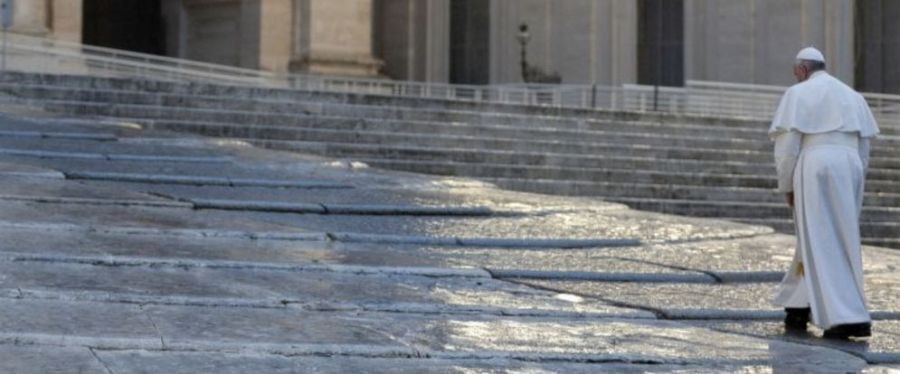
"A true Christian cannot be a hypocrite and a hypocrite is not a true Christian": against the temptation of the "double face" Pope Francis used direct language, without equivocation. He did so in the Mass celebrated at Santa Marta on Tuesday 6 June, during which he examined the passage from Mark's Gospel (12, 13-17) in which "some Pharisees and Herodians" try to catch Jesus in the act.
"In the Gospel passage," he noted, "there is a word that Jesus uses a lot to qualify the doctors of the law: 'But he knew their hypocrisy': 'hypocrites' is the word he uses most to qualify them". They, Francis explained, are "hypocrites because they make people see one thing but think another": they in fact, he added alluding to the Greek etymology of the word, "they speak, they judge, but from below it is something else". Nothing could be further from Jesus: hypocrisy, in fact, "is not the language of Jesus. Hypocrisy is not the language of Christians'. It is an absolutely "clear" fact.
But if Jesus is concerned to highlight this characteristic, it is good to understand it in depth and thus bring out "how they proceed", how the hypocrites behave.
First of all, the Pope said, 'the hypocrite is always an adulator, either in a major tone or in a minor tone, but he is an adulator'. Thus, for example, they address Jesus saying to him: 'Master, we know that you are truthful and not in awe of anyone because you do not look anyone in the face but teach the way of God according to the truth'. That is, they use 'that flattery that softens the heart and softens life'.
So, the "hypocrites always begin with flattery. And then they ask a question'. The techniques of flattery also include 'not telling a truth', 'exaggerating', and 'raising vanity'. In this regard, the Pontiff recalled a priest - "I met a long time ago, not here" - who, "poor man, he drank all the flattery they gave him, it was his weakness. And his companions said of him that he had learned the liturgy badly", because he had not understood the true meaning of "incensation".
Therefore, the Pope continued, 'flattery begins like this, but with a bad intention'. This is also well understood by rereading the Gospel passage: the Pharisees, in order to test Jesus, "flatter so that he will believe this and slip". It is the technique of the hypocrite: 'he makes you see that he loves you, always inflating you, to achieve his goal'.
There is then, Francis added, "a second aspect" to underline that is found in "what Jesus does". Faced with the gesture of the hypocrite who, with his "double face", asks a just question but "with an unjust intention" - they ask: "Is it right to pay to Caesar, is it fair?" - Jesus "knowing their hypocrisy, says clearly: 'Because you want to test me, bring me money, I want to see it'. This is Jesus' method: always "to the hypocrites and ideologues he responds with reality. Reality is like that, everything else is either hypocrisy or ideology".
Therefore, Jesus says, "bring me money". He wants to show "reality" and answer "wisely": "What is Caesar's render it to Caesar - the reality was that money had the image of Caesar - and what is God's to God".
Finally, the Pontiff said, it is necessary to highlight a "third aspect" related to the "language of hypocrisy" and that is that it "is the language of deception, it is the same language of the serpent to Eve, it is the same. He begins with flattery: 'No... if you eat of this you will be great, you will know everything...', in order to destroy it".
Hypocrisy in fact, the Pope explained, 'destroys, hypocrisy kills, it kills people, it even rips out a person's personality and soul. He kills communities'. He added: 'When there are hypocrites in a community there is a great danger there, there is a very bad danger'. Therefore "the Lord Jesus told us: 'Let your speech be: yes, yes, no. The superfluous proceeds from the evil one". It has been clear'. And in this regard, Francis recalled, "James in his letter is even stronger: 'Let your yes be yes and your no be no'".
Clear words that make us understand today 'how much harm' hypocrisy does to the Church. How much harm they cause "those Christians who fall into this sinful attitude that kills". Because, the Pontiff reiterated, 'the hypocrite is capable of killing a community. He is speaking softly, he is judging a person harshly. The hypocrite is a slayer". In conclusion, the Pope summed up his reflection by recalling that hypocrisy "begins with flattery", that it can only be answered "with reality", and that hypocrisy uses "the same language as the devil who sows that bifid tongue in communities to destroy them". Therefore, he suggested, "let us ask the Lord to guard us so that we do not fall into this vice of hypocrisy, of making up our attitude but with bad intentions. May the Lord give us this grace: 'Lord, may I never be a hypocrite, may I be able to tell the truth and if I cannot tell it, be silent, but never, never, a hypocrite'".
[Pope Francis, S. Marta homily, in L'Osservatore Romano 07/06/2017]








