Apr 12, 2026 Written by 

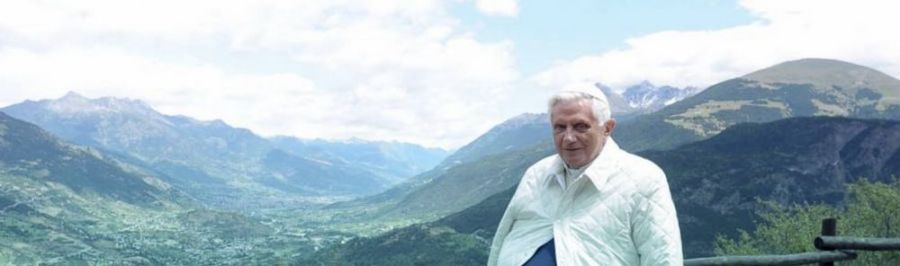
Opening the horizon

We are in the synagogue of Capharnaum where Jesus was giving his well-known discourse after the multiplication of the loaves. The people had sought to make him king but Jesus had withdrawn, first, to the mountain with God, with the Father, and then to Capharnaum. Since they could not see him, they began to look for him, they boarded the boats in order to cross the lake to the other shore and had found him at last. However, Jesus was well aware of the reason for this great enthusiasm in following him and he says so, even clearly: “you seek me, not because you saw signs, [because you were deeply impressed] but because you ate your fill of the loaves” (v. 26). 

Jesus wants to help the people go beyond the immediate satisfaction — albeit important — of their own material needs. He wants to open them to a horizon of existence that does not consist merely of the daily concerns of eating, of being clothed, of a career. Jesus speaks of a food that does not perish, which it is important to seek and to receive. He says: “do not labour for the food which perishes, but for the food which endures to eternal life, which the Son of man will give to you” (v. 27). 

The crowd does not understand, it believes that Jesus is asking for the observance of precepts in order to obtain the continuation of that miracle, and asks: “what must we do, to be dong the works of God?” (v. 28). Jesus’ answer is unequivocal: “This is the work of God, that you believe in him whom he has sent” (v. 29). The centre of existence — which is what gives meaning and certain hope in the all too often difficult journey of life — is faith in Jesus, it is the encounter with Christ. 

We too ask: “what must we do to have eternal life?”. And Jesus says: “believe in me”. Faith is the fundamental thing. It is not a matter here of following an idea or a project, but of encountering Jesus as a living Person, of letting ourselves be totally involved by him and by his Gospel. Jesus invites us not to stop at the purely human horizon and to open ourselves to the horizon of God, to the horizon of faith. He demands a single act: to accept God’s plan, namely, to “believe in him whom he has sent” (v. 29).

Moses had given Israel manna, the bread from heaven with which God himself had nourished his people. Jesus does not give some thing, he gives himself: he is the “true bread that which comes down from heaven”. He is the living Word of the Father; in the encounter with him we meet the living God. 

“What must we do, to be doing the works of God?” (v. 28), the crowd asks, ready to act in order to perpetuate the miracle of the loaves. But Jesus, the true bread of life that satisfies our hunger for meaning and for truth, cannot be “earned” with human work; he comes to us only as a gift of God’s love, as a work of God to be asked for and received. 

Dear friends, on days that are busy and full of problems, but also on days of rest and relaxation, the Lord asks us not to forget that if it is necessary to be concerned about material bread and to replenish our strength, it is even more fundamental to develop our relationship with him, to reinforce our faith in the One who is the “bread of life” which satisfies our desire for truth and love.

[Pope Benedict, Angelus 5 August 2012]

103 Last modified on Sunday, 12 April 2026 04:45
don Giuseppe Nespeca

Giuseppe Nespeca è architetto e sacerdote. Cultore della Sacra scrittura è autore della raccolta "Due Fuochi due Vie - Religione e Fede, Vangeli e Tao"; coautore del libro "Dialogo e Solstizio".

Email This email address is being protected from spambots. You need JavaScript enabled to view it.
Whoever is inscribed in God's name participates in God's life, and lives. Therefore to believe is to be inscribed in the name of God. Thus we are alive. Whoever has a share in God's name is not dead but rather belongs to the living God. In this sense we should be able to understand the dynamism of faith, which entails enrolling our names in the name of God and in this way entering into life [Pope Benedict]
Chi è scritto nel nome di Dio partecipa alla vita di Dio, vive. E così credere è essere iscritti nel nome di Dio. E così siamo vivi. Chi appartiene al nome di Dio non è un morto, appartiene al Dio vivente. In questo senso dovremmo capire il dinamismo della fede, che è un iscrivere il nostro nome nel nome di Dio e così un entrare nella vita [Papa Benedetto]
As sometimes happens in the Gospel, faced with the trap set for him by his enemies, Jesus, with his response, rises above the contingent controversy and goes far beyond the particular and mutually divergent positions (John Paul II)
Come talora accade nel Vangelo, di fronte al tranello mossogli dai suoi nemici, Gesù, con la sua risposta, s’innalza al di sopra della polemica contingente e va ben oltre le posizioni particolari e tra loro divergenti (Giovanni Paolo II)
This Name clearly expresses that the God of the Bible is not some kind of monad closed in on itself and satisfied with his own self-sufficiency but he is life that wants to communicate itself, openness, relationship [Pope Benedict]
Questo nome esprime dunque chiaramente che il Dio della Bibbia non è una sorta di monade chiusa in se stessa e soddisfatta della propria autosufficienza, ma è vita che vuole comunicarsi, è apertura, relazione [Papa Benedetto]
There, however, in the place that should have been taken up by the encounter between God and man, he found livestock merchants and money-changers who occupied this place of prayer with their commerce […] In the temple's purification, however, it was a matter of more than fighting abuses. A new time in history was foretold (Pope Benedict)
Ma là dove doveva esservi lo spazio dell’incontro tra Dio e l’uomo, Egli trova commercianti di bestiame e cambiavalute che occupano con i loro affari il luogo di preghiera […] Nella purificazione del tempio, però, si tratta di più che della lotta agli abusi. È preconizzata una nuova ora della storia (Papa Benedetto)
«Ask Jesus for the grace to follow him closely», so as not to leave him alone, thus overcoming the temptations of looking at ourselves to «share the cake» of personal interests [Pope Francis]
«Chiedere a Gesù la grazia di seguirlo da vicino», per non lasciarlo solo, superando così le tentazioni di guardare noi stessi per «spartirsi la torta» degli interessi personali [Papa Francesco]
First, in Nazareth, he makes him grow, raises him, educates him, but then follows him: "Your mother is there" (Pope Francis)
Prima, a Nazareth, lo fa crescere, lo alleva, lo educa, ma poi lo segue: “La tua madre è lì” (Papa Francesco)
Unity is not made with glue [...] The great prayer of Jesus is to «resemble» the Father (Pope Francis)
L’Unità non si fa con la colla […] La grande preghiera di Gesù» è quella di «assomigliare» al Padre (Papa Francesco)
Divisions among Christians, while they wound the Church, wound Christ; and divided, we cause a wound to Christ: the Church is indeed the body of which Christ is the Head (Pope Francis)

Due Fuochi due Vie - Vol. 1 Due Fuochi due Vie - Vol. 2 Due Fuochi due Vie - Vol. 3 Due Fuochi due Vie - Vol. 4 Due Fuochi due Vie - Vol. 5 Dialogo e Solstizio I fiammiferi di Maria

duevie.art

don Giuseppe Nespeca

Tel. 333-1329741


Disclaimer

Questo blog non rappresenta una testata giornalistica in quanto viene aggiornato senza alcuna periodicità. Non può pertanto considerarsi un prodotto editoriale ai sensi della legge N°62 del 07/03/2001.
Le immagini sono tratte da internet, ma se il loro uso violasse diritti d'autore, lo si comunichi all'autore del blog che provvederà alla loro pronta rimozione.
L'autore dichiara di non essere responsabile dei commenti lasciati nei post. Eventuali commenti dei lettori, lesivi dell'immagine o dell'onorabilità di persone terze, il cui contenuto fosse ritenuto non idoneo alla pubblicazione verranno insindacabilmente rimossi.






