Mar 16, 2026 Written by 

Elevated with the Son

John presents the cross as the exaltation of Jesus and thereby emphasises that the crucifixion - in appearance only death and defeat - is in reality the glorious revelation of God's love and the ascension of Jesus to the Father.

In Francis of Assisi, the uplifted [crucified] Christ was a constant object of his meditation and conformation.

The Poverello, over time, was visited by many infirmities and sorrows borne with dignity and joy, keeping his gaze fixed on the Son of God.

The Sources do not fail to remind us:

"Francis was infirm and full of pains on every side. Seeing him like this, one day one of his companions said to him:

"Father, you have always found a refuge in the Scriptures; they have always offered you a remedy for your sorrows. Please, even now let the prophets read to you: perhaps your spirit will exult in the Lord'.

The saint replied:

«It is good to read the testimonies of Scripture, and it is good to seek in them the Lord our God.

But, as for me, I have already taken so much from the Scriptures as to be more than sufficient for my meditation and reflection.

I need no more, my son: I know Christ poor and crucified» (FF 692).

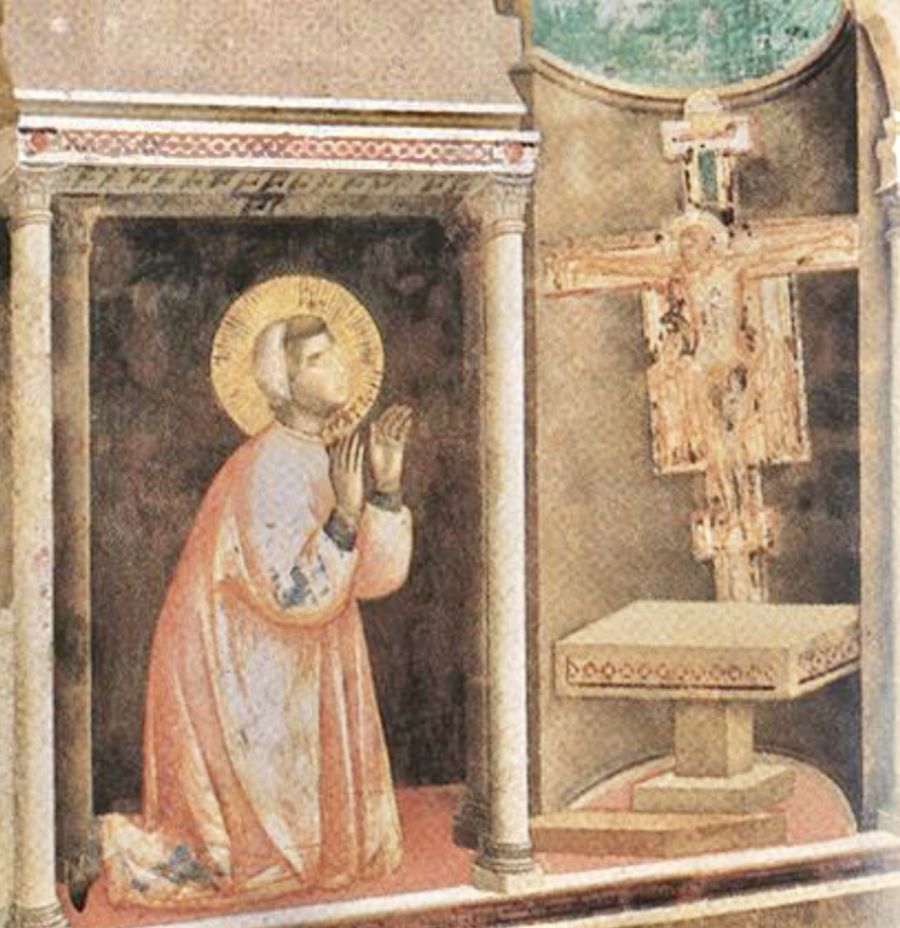
Francis always kept alive in his conscience his encounter with the Crucifix of San Damiano.

Having entered that place to pray, led there by the Spirit, that experience radically marked his existence.

"He entered to pray, prostrated himself in supplication and devotion before the Crucifix and, touched in an extraordinary way by divine Grace, found himself totally changed.

While he is so deeply moved, suddenly - which is unheard of! - the image of Christ Crucified, from the painting* speaks to him, moving His lips.

«Francis - He says to him, calling him by name - go, repair my house which, as you see, is all in ruins».

Francis is trembling and full of astonishment, and almost loses his senses at these words. But he immediately disposes himself to obey and concentrates everything on this invitation" (FF 593).

It is the Crucified One who then conforms him fully to Himself on the mountain of La Verna, reliving in the Minim's limbs His Passion.

The entire parable of the life of the Poor Man of Assisi is imbued with the Presence of the uplifted Christ.

He thus becomes an icon of reference in the journey of faith to draw every man in search to Jesus.

The mission entrusted to him by the Crucifix of San Damiano stigmatises his life, elevates him and makes him a friend of God, a place of encounter with the Divine.

Embraced by Christ, Francis began by doing what was necessary, then what was possible, and suddenly, surprisingly, he found himself doing the impossible, creating novelties and doing things pleasing to God.

Thus he allowed Love to be revealed in him and through him.

«When you have raised up the Son of Man, then you will recognise that I Am and do nothing of myself, but as the Father has taught me, these things I speak» (Jn 8:28)


*It is a tempera panel in Byzantine style, still visible in the basilica of St Clare in Assisi.


Tuesday 5th wk. in Lent  (Jn 8,21-30)

86 Last modified on Monday, 16 March 2026 05:12
Teresa Girolami

Teresa Girolami è laureata in Materie letterarie e Teologia. Ha pubblicato vari testi, fra cui: "Pellegrinaggio del cuore" (Ed. Piemme); "I Fiammiferi di Maria - La Madre di Dio in prosa e poesia"; "Tenerezza Scalza - Natura di donna"; co-autrice di "Dialogo e Solstizio".

Email This email address is being protected from spambots. You need JavaScript enabled to view it.
Jesus seems to say to the accusers: Is not this woman, for all her sin, above all a confirmation of your own transgressions, of your "male" injustice, your misdeeds? (John Paul II, Mulieris Dignitatem n.14)
Gesù sembra dire agli accusatori: questa donna con tutto il suo peccato non è forse anche, e prima di tutto, una conferma delle vostre trasgressioni, della vostra ingiustizia «maschile», dei vostri abusi? (Giovanni Paolo II, Mulieris Dignitatem n.14)
Here we can experience first hand that God is life and gives life, yet takes on the tragedy of death (Pope Francis)
Qui tocchiamo con mano che Dio è vita e dona vita, ma si fa carico del dramma della morte (Papa Francesco)
The people thought that Jesus was a prophet. This was not wrong, but it does not suffice; it is inadequate. In fact, it was a matter of delving deep, of recognizing the uniqueness of the person of Jesus of Nazareth and his newness. This is how it still is today: many people draw near to Jesus, as it were, from the outside (Pope Benedict)
La gente pensa che Gesù sia un profeta. Questo non è falso, ma non basta; è inadeguato. Si tratta, in effetti, di andare in profondità, di riconoscere la singolarità della persona di Gesù di Nazaret, la sua novità. Anche oggi è così: molti accostano Gesù, per così dire, dall’esterno (Papa Benedetto)
Because of this unique understanding, Jesus can present himself as the One who revealsr the Father with a knowledge that is the fruit of an intimate and mysterious reciprocity (John Paul II)
In forza di questa singolare intesa, Gesù può presentarsi come il rivelatore del Padre, con una conoscenza che è frutto di un'intima e misteriosa reciprocità (Giovanni Paolo II)
Yes, all the "miracles, wonders and signs" of Christ are in function of the revelation of him as Messiah, of him as the Son of God: of him who alone has the power to free man from sin and death. Of him who is truly the Savior of the world (John Paul II)
Sì, tutti i “miracoli, prodigi e segni” di Cristo sono in funzione della rivelazione di lui come Messia, di lui come Figlio di Dio: di lui che, solo, ha il potere di liberare l’uomo dal peccato e dalla morte. Di lui che veramente è il Salvatore del mondo (Giovanni Paolo II)
It is known that faith is man's response to the word of divine revelation. The miracle takes place in organic connection with this revealing word of God. It is a "sign" of his presence and of his work, a particularly intense sign (John Paul II)
È noto che la fede è una risposta dell’uomo alla parola della rivelazione divina. Il miracolo avviene in legame organico con questa parola di Dio rivelante. È un “segno” della sua presenza e del suo operare, un segno, si può dire, particolarmente intenso (Giovanni Paolo II)
In the rite of Baptism, the presentation of the candle lit from the large Paschal candle, a symbol of the Risen Christ, is a sign that helps us to understand what happens in the Sacrament. When our lives are enlightened by the mystery of Christ, we experience the joy of being liberated from all that threatens the full realization (Pope Benedict)
God approached man in love, even to the total gift, crossing the threshold of our ultimate solitude, throwing himself into the abyss of our extreme abandonment, going beyond the door of death (Pope Benedict)
Dio si è avvicinato all’uomo nell’amore, fino al dono totale, a varcare la soglia della nostra ultima solitudine, calandosi nell’abisso del nostro estremo abbandono, oltrepassando la porta della morte (Papa Benedetto)

Due Fuochi due Vie - Vol. 1 Due Fuochi due Vie - Vol. 2 Due Fuochi due Vie - Vol. 3 Due Fuochi due Vie - Vol. 4 Due Fuochi due Vie - Vol. 5 Dialogo e Solstizio I fiammiferi di Maria

duevie.art

don Giuseppe Nespeca

Tel. 333-1329741


Disclaimer

Questo blog non rappresenta una testata giornalistica in quanto viene aggiornato senza alcuna periodicità. Non può pertanto considerarsi un prodotto editoriale ai sensi della legge N°62 del 07/03/2001.
Le immagini sono tratte da internet, ma se il loro uso violasse diritti d'autore, lo si comunichi all'autore del blog che provvederà alla loro pronta rimozione.
L'autore dichiara di non essere responsabile dei commenti lasciati nei post. Eventuali commenti dei lettori, lesivi dell'immagine o dell'onorabilità di persone terze, il cui contenuto fosse ritenuto non idoneo alla pubblicazione verranno insindacabilmente rimossi.






