


[1–2 November]
First Reading from the Book of Revelation (Rev 7:2–4, 9–14)
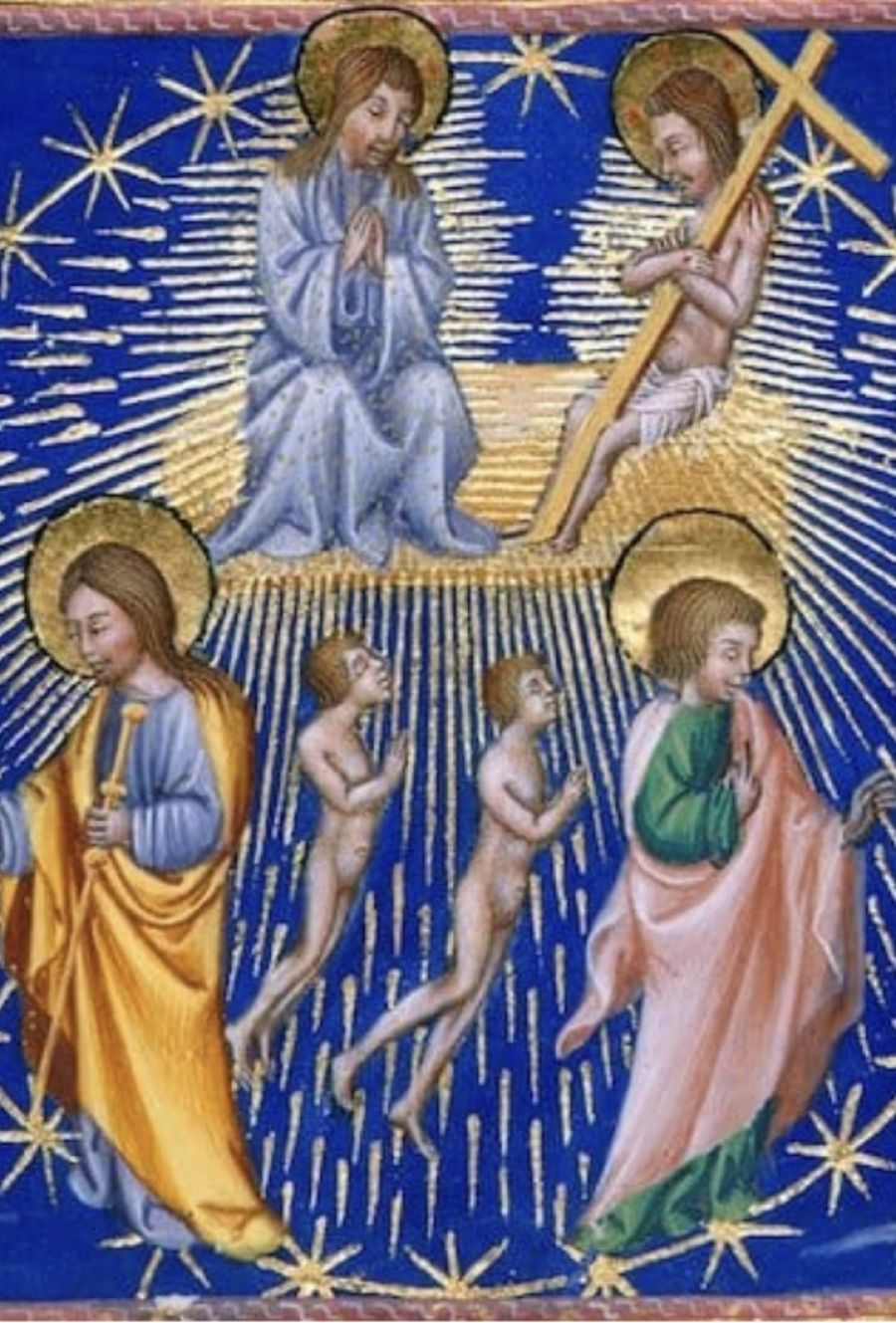
1. Saint John recounts and describes a vision: ‘I, John, saw an angel ascending from the east, from where the sun rises, and afterwards I saw a vast multitude, which no one could count.’ Let us contemplate, together with the apostle, a mystical vision – in other words, a symbolic representation which should not, however, be interpreted literally. To understand the message the author intends to convey, we must look beyond the images he describes. John describes a great procession made up of two distinct groups. The first group consists of 144,000 people, whom he calls servants of God. This number is not to be understood literally, but symbolically, and these people bear the seal of the living God, which represents Baptism. They are therefore the baptised, that is, the Christians of that time who were being persecuted, to whom John addresses himself in the Book of Revelation, the final book of the Bible. The second group consists of an immense and innumerable multitude, coming from every nation, tribe, people and language, representing the whole of humanity. The number four, present symbolically in this list, refers to the created world, the cosmos and all human beings, perhaps also through the reference to the four cardinal points. But what is the meaning of these symbols? The immense crowd is dressed in white robes, stands before the throne of God and the Lamb, and holds palm branches in their hands; all these elements have a specific meaning: the white robes signify purity and the wedding garment, a symbol of salvation; standing signifies the state of those who have been raised from the dead and have conquered death; and the palm branches are a symbol of victory; the throne of God and the Lamb depicts the divine presence before which the multitude of the saved gathers. All these symbols prove that these people have attained salvation, and the multitude itself proclaims this, affirming that salvation belongs to God, who sits on the throne, and to the Lamb.
2. But what is the relationship between the baptised and the multitude of the saved? An important point is that the second multitude—that immense crowd drawn from all humanity—does not bear the seal of Baptism described for the first group. This raises a question: who contributed to the salvation of this multitude? According to the interpretation proposed by the text, a fundamental role is played precisely by the 144,000, that is, by John’s contemporary Christians. At the end of the first century, these Christians faced terrible persecution under Emperor Domitian (81–96 AD). Despite their suffering and difficulties, they were called to remain faithful to their faith and to continue bearing witness to the Gospel. Their perseverance was important not only for themselves, but also because it could bear fruit for others. The main message that John wishes to convey to persecuted Christians is a call not to lose faith and to persevere even in the most difficult situations, for the sufferings endured during persecution are not in vain: through their witness, Christians can contribute to the salvation of all humanity.
3. Here the apostle speaks of the ‘great trial’, referring to the persecutions that Christians at that time were forced to endure. It is precisely in this trial that a profound meaning is found: fidelity to God, especially when it involves suffering, becomes a means through which other people are led to salvation. The vision, therefore, is not merely intended to reassure persecuted Christians, but also to show that their witness has universal value. The message is clear: through this image, the Book of Revelation teaches that when Christians remain faithful in the face of persecution, their witness bears fruit that extends far beyond their own community; and by persevering faithfully through trials and often cruel martyrdom, believers contribute to the salvation of all humanity. The vision thus conveys a message of hope: the harsher the trials, the more the Christian becomes an instrument of conversion and salvation for many. Note: the Roman army used to place a mark on the foreheads of recruits; in the same way, the baptised person becomes a soldier of the King of Heaven, and this protective seal was also known in the Old Testament (Ex 12:7; Ez 9:4). Furthermore, in the Book of Revelation, John sees the victory of the poor and the lowly as a revelation of God’s victory over the forces of evil.
Responsorial Psalm (23/24)
1. We find ourselves in the Temple of Jerusalem. A great procession approaches and, upon reaching the gates of the Temple, two choirs begin to sing in turn, engaging in a dialogue: ‘Who shall ascend the mountain of the Lord? Who may stand in his holy place?’ The prophet Isaiah had already compared God, thrice Holy, to a consuming fire and asked this question: ‘Who among us can stand before this consuming fire? Who can stand before these eternal flames?’ (Isaiah 33:14). The meaning is that humankind, on its own, would be unable to bear the sight of God and the splendour of his glory. The psalm expresses the joy and triumph of the chosen people, who are welcomed into God’s presence through no merit of their own.
2. One of the great revelations to the people of Israel is that God is the Holy One, completely distinct from every other reality, yet at the same time draws near to humankind. Despite his holiness and greatness, God allows man to stand in his presence and to live in communion with him. This psalm is linked to the feast of All Saints because the saints are those who have ascended the Lord’s mountain and have been welcomed into his presence, and now join the angels in their song of praise. During Mass, Christians sing the Sanctus, uniting themselves spiritually with the multitude of angels and saints; and today, on the Feast of All Saints, the liturgy commemorates this immense multitude, which no one can count.
3. The psalm then describes the answer to the initial question: namely, the person who may stand before God is ‘one who has innocent hands and a pure heart’ and does not put their trust in idols. The primary meaning of ‘purity’ does not concern moral behaviour, for the people know that they are accepted by God not because of their own merits, but because of His benevolence; and the fundamental requirement is to remain faithful to the one true God by rejecting idols. In the Bible, the word ‘pure’ can be compared to its meaning in chemistry: a substance is pure when it is not mixed with other substances. In the same way, a pure heart is a heart that turns solely to God. Purity of heart, therefore, means above all total fidelity to God, and the psalm teaches that a person may stand in His presence not because they are perfect or have accumulated merits, but because they strive to live in fidelity to the one true God.
Second Reading from the First Letter of Saint John (3:1–3)
1. ‘Beloved, see…’: with these words, Saint John invites us to contemplate, for learning to see is fundamental to our life of faith. The entire history of humanity can be seen as a journey through which humankind learns to see in the right way. Jesus said: ‘They have eyes to see, yet they do not see.’ This is the tragedy of humankind: having eyes yet failing to recognise the truth, failing to see God’s love for humanity. Here, Saint John invites us to learn to see with the eyes of faith. The theme of seeing runs throughout the Bible and always carries the same meaning: knowing how to see and opening our eyes means discovering the true face of God, who is love.
2. Conversely, our way of looking can be distorted and lead us to misinterpret reality. As happened in the Garden of Eden, where everything depended on the way Adam and Eve looked at and interpreted their surroundings. At the centre of the Garden of Eden stand the tree of life and the tree of the knowledge of good and evil. God allows man to eat the fruit of all the trees, including the tree of life, but forbids him to eat the fruit of the tree of the knowledge of good and evil. The serpent asks the woman a seemingly innocent question: ‘Is it true that God has told you not to eat the fruit of any tree in the garden?’ The mere act of listening to the serpent begins to alter her perspective. Eve, in fact, starts to regard the forbidden tree as central, rather than the tree of life. Her attention shifts from the goodness of the gifts received from God to what has been forbidden to her. This detail is important because it shows how, at times, simply listening to a deceitful voice is enough to begin seeing reality in the wrong light. The serpent continues to deceive Eve, promising her that, if she eats the fruit, she will not die, but will become like God, knowing good and evil. The woman then looks at the tree and sees that it is good to eat, a delight to the eyes and desirable for gaining wisdom. The narrative deliberately emphasises words relating to sight and perception. She takes the fruit, eats it and offers it to Adam, who in turn eats it. At that point, the text states that both their eyes are opened and they see their own nakedness. Not only have they not become like God, but they begin to experience their nakedness—that is, their fragility and fundamental poverty—as a source of pain. The story thus shows that a deceived gaze can lead man away from the truth and cause him to lose sight of God’s goodness.
3. What connection exists between the story of Adam and Eve and this Reading? The story of Adam and Eve has always been regarded as a key to understanding humanity’s unhappiness and suffering. Mankind, having been deceived, comes to suspect God and regard him as someone who wishes to prevent them from being happy. St John, on the other hand, invites us to do the opposite: ‘Look!’, that is, learn to see and open your eyes. The message is that we must learn to recognise the true face of God and his love for us. When God sets a limit on humankind, he does not do so to prevent us from being happy; on the contrary, he desires the good of humankind. This is why it is important to learn to look at reality through the lens of faith, without allowing ourselves to be deceived by what leads us to doubt his love. By following the example of the saints we commemorate today, let us learn to look with the eyes of faith, so that we may recognise God’s love and his plan for humanity; let us open our eyes to recognise the true face of God. The message is clear: God does not wish to deprive us of good, but loves us and desires our good. To live our faith authentically, we must therefore learn to look beyond appearances and recognise God’s goodness and love in our lives.
From the Gospel according to Saint Matthew (5:1–12a)
1. “When Jesus saw the crowds, he went up the mountain; he sat down, and his disciples came to him. He began to speak and teach them, saying…” . Jesus ascends the mountain like Moses on Sinai, but whilst Moses came down bearing stone tablets and a Law with prescriptive rules, Jesus ascends the mountain—that is, he takes his place with authority; he sits down, which is the gesture of the Master, of the Rabbi who teaches with authority—and opens his mouth not to command anything, but to proclaim the gospel of holiness: ‘Blessed are…’. He does not, therefore, lay down precepts; rather, he paints a portrait; he does not say ‘you must be like this’, but exhorts: ‘you are already blessed if…’. The Beatitudes are not, therefore, eight new commandments, more difficult than the previous ones. They are, in truth, eight names of Jesus, the portrait of his life and his mission, his identity card which we can recognise in the lives of those who wish to follow him without compromise. And today, in the liturgy that invites us to contemplate all the saints in the glory of Heaven, we recognise holiness in its myriad forms. The saints are not, in fact, supermen, but people in whom the Beatitudes have taken flesh in such a way that their lives become a concrete realisation of them. In the diversity of their charisms, they remind us that it is possible for everyone – absolutely everyone – to become a saint, because Jesus, ‘the Holy One par excellence’, shows us the example and assures us of his constant support. Through Baptism we are all saints; in other words, we belong to God by his free mercy, and life is given to us as a concrete opportunity to embody the divine will within ourselves. And today, in the splendour of Heaven’s triumph, we recognise the myriad faces that holiness takes on in the stories of people with such diverse spiritual experiences. Whilst every day of the year the liturgical calendar presents us with ‘Blessed and Saints’ recognised and proclaimed as such by the Church, today we embrace a vast multitude of simple and humble people—faces and names that are part of everyday life— people who quietly embody the Gospel Beatitudes, in each of which an aspect of God’s holiness shines forth.
2. “Blessed are the poor in spirit, for theirs is the kingdom of heaven.” The poor in spirit are not those who have nothing, but those who know they are not self-sufficient. They are the opposite of the ‘artificial intelligence’ man, who must optimise everything and control everything. The poor person says: ‘Lord, I need You’, and God in Jesus, who ‘though He was rich, became poor’ (2 Cor 8:9), needs to become a beggar for love, and God’s holiness becomes small. How many men and women, whose names we do not know, have lived in simplicity and poverty like St Francis, now known to all; and blessed, then, are those who do not build their lives on image, reputation or success, but entrust themselves to the fatherly hands of God. ‘Blessed are those who mourn, for they shall be comforted.’ Here God reveals himself as the Comforter. Weeping is not weakness; it is the truest form of prayer, for God is not the God who wipes away tears with a quick fix, but the One who weeps with us. Jesus weeps over Jerusalem; he weeps for Lazarus. The believer’s tears are the holiness of God, who shares in the wounds of every human body; and blessed are those who do not flee from pain through endless distractions, but dwell within it and offer it up. “Blessed are the meek, for they shall inherit the earth.” The meek are not the weak who never get angry, but those who have strength and do not use it to crush others. God is meek: “Learn from me, for I am meek and humble of heart” (Mt 11:29). Meekness will conquer the world, and blessed are those who, in their families, at work and on social media, do not expect to win all the time. “Blessed are those who hunger and thirst for righteousness, for they shall be filled.” Righteousness here is not legalism, but tzedekah – that is, the ardent desire for God to reign and for human beings to be respected. God hungers for justice and cannot bear the harm done to the poor; and blessed are those who are not content to say ‘that’s just how everyone is’, but who hunger for a more just world. ‘Blessed are the merciful, for they shall obtain mercy.’ Mercy is the heart of God—or rather, rachamim, his maternal compassion. God, therefore, does not have an algorithm that calculates; He has a heart that is moved, and blessed is the one who forgives seventy times seven, who pours oil—not vinegar—onto the wounds of every person. ‘Blessed are the pure in heart, for they shall see God.’ Pure is not the one who has never sinned, but the one whose heart is undivided. Cor mundum: a simple heart without ulterior motives. God is pure, transparent; He is light without shadow, and the pure-hearted see because they have no filters of self-interest. Blessed, then, are those who are clear-hearted, without masks, and do not live for ‘likes’. “Blessed are the peacemakers, for they shall be called children of God.” Note: it does not say ‘blessed are the peaceful’, those who are calm, but ‘the peacemakers’, the builders of peace. In Hebrew, shalom is not the absence of war; it is the fullness of life. God is a peacemaker because he has broken down the wall between heaven and earth and acts within every heart thirsting for true peace. Blessed are those who do not harbour resentment, those who work for reconciliation, those who switch off their mobile phones at home to foster dialogue and become apostles of listening even where it seems impossible. “Blessed are those who are persecuted for righteousness’ sake, for theirs is the kingdom of heaven.” This is the final seal. God is the one who is persecuted: from the manger to the cross, he has always been opposed and rejected. True holiness is a thorn in the side, for it unmasks the truth; and blessed are those who remain faithful even when it costs them dearly, those who do not sell their conscience for the sake of convenience. Ultimately, every beatitude reiterates: do not lose heart, and listen to Jesus, who points out the concrete path to happiness that not even death can annul. The world proclaims: blessed are the rich, the powerful, those who never weep, the cunning, the heartless, the violent, the victors. Jesus points to the exact opposite, and history shows that he is right. For example, who today remembers or glorifies Herod, Pilate and other figures who, over the centuries, seemed all-powerful? The Gospel, on the other hand, continues to change hearts and to sow saints along the paths of history. The multitude of saints we celebrate today are, as Pope Francis said, ‘the saints next door’: Grandmothers, mothers who pray and often weep in silence, fathers who bear the burden of the family without complaint, young people who choose purity in a world that embraces every kind of perversion, children, young people and sick adults who offer everything to Jesus for the conversion of sinners, priests who continue to bear witness to the joy of the Gospel even when everything seems too arduous and even futile. Ultimately, a saint is someone who, in their heart—despite their frailties and sins—allows themselves to be loved by God and follows Him, seeking to face life’s obstacles with persevering courage.
Commemoration of All the Faithful Departed [2 November]
Today, every priest is permitted to celebrate three Holy Masses, and specific readings are provided for each one. I shall limit myself here simply to commenting on three readings and a responsorial psalm.
First Reading from the Book of Job (19:1–23–27)
1. The sacred author reflects on the meaning of suffering, of faith and of God as liberator, taking as his starting point the biblical figure of Job, the symbol of every person who suffers. Job represents the people of Israel and, more generally, all human beings who face the problem of evil, suffering, pain and death. He is not necessarily a historical figure: rather, he is a symbolic figure in whom billions of people recognise themselves, including ourselves when we suffer. The biblical writer is courageous because he dares to cry out and rebel against suffering in all its forms, but despite the pain, Job remains a man of faith, and his faith is founded on the conviction that God is close to every person who suffers. This certainty has accompanied the people of Israel ever since Moses’ experience before the burning bush (Exodus chapter 3), and Job considers this faith so important that he wishes his words to be engraved forever in stone, with an iron and lead chisel, so that no one may erase them. In ancient times, in fact, lead was poured into the engraved letters to make them more legible.
2. My Redeemer lives. The word ‘Redeemer’ actually means ‘liberator’ and derives from the Hebrew term Go’el, which refers to the next of kin, responsible for freeing a family member who has fallen into slavery because of debt. In ancient Israel, if a person was forced to sell themselves into slavery to pay off debts, the nearest relative had to intervene to redeem them, paying the creditor and restoring their freedom (Leviticus 25:47–49). Similarly, if someone was forced to sell their land, the relative had the right to buy it back in order to preserve the family heritage (Leviticus 25:25). Financial payment was necessary, but it was not the main purpose: the fundamental aim was to free the person from slavery. This institution expresses an important principle: every member of God’s people must be free. For this reason, no Israelite should accept that a member of their family should remain a slave, and the people of Israel apply this idea to God as well, recognising him as their closest kinsman and their liberator. They therefore call him Go’el. God has proved Himself to be the liberator of Israel on several occasions, beginning with the deliverance from slavery in Egypt. Even during the exile in Babylon, the prophet Isaiah upheld the people’s hope by promising their deliverance.
3. In this brief text, which recalls Isaiah’s promise, it is worth recalling a few fundamental concepts. Job represents every person who suffers and questions the nature of evil, pain and death. Faith is trust in a God who is close to those who suffer, even in the most difficult moments. Job’s cry shows that believing does not mean not suffering or not protesting against pain. God the Deliverer shows that Israel recognises God as its Go’el, the one who frees from slavery and restores hope. Freedom is the central value of redemption; money is merely a means to achieve it. The central message is that biblical faith does not deny suffering, but affirms that God is close to those who suffer and acts as a liberator and, according to some manuscripts, even as the ‘avenger of blood’ (Numbers 35:19), offering hope and freedom.
Responsorial Psalm (62/63)
1. The expression ‘I rejoice in the shadow of your wings’ comes from a psalm that describes the intimacy between God and his people. To understand it, one must imagine the Temple in Jerusalem before its destruction in 587 BC by Nebuchadnezzar. In the holiest part of the Temple, the Holy of Holies (literally, ‘Holy of the holy things’), stood the Ark of the Covenant, a chest of precious wood overlaid with gold, which held the tablets of the Law. Above the Ark stood two large statues of cherubim. The cherubim were celestial figures originating from the Mesopotamian tradition, depicted with the body and paws of a lion, a human face and large wings. In Mesopotamia they were worshipped as deities, whilst in Israel they were regarded as mere creatures in the service of God. Their outstretched wings symbolically protected the Ark and were considered the footstool of the divine throne. The priest who prayed in the Temple, beneath those wings, thus felt enveloped by God’s tenderness and protection, from dawn until nightfall. The other images in the psalm also draw on the lives of the Levites, those entrusted with religious service in the Temple. The phrase ‘I have beheld you in the sanctuary’ recalls that only the Levites were permitted to enter the holy part of the Temple. The words ‘All my life I will bless you’ indicate that their existence was consecrated to the praise of God, whilst ‘hands raised in invocation of your name’ describes their posture during prayer. The image of being satisfied as at a banquet recalls the sacrifices followed by communal meals and the portion of the sacrificial meat set aside for the Levites’ sustenance. Finally, the remembrance of God during the night recalls the lives of those who served in the Temple and spent their time there.
2. In reality, the psalm is a metaphor: the Levite represents the whole people of Israel, who from the very beginning of their history until the end of time seek God and long to live in intimacy with him. When the psalm says ‘I seek you from the dawn’, it refers not only to the beginning of the day, but to the dawn of time—that is, to Israel’s search for God throughout its history. The words ‘My soul thirsts for you, my body longs for you, like parched land, thirsty and without water’ profoundly express this longing. The image of the barren land awaiting rain to come back to life was particularly vivid for the people of Israel, who were accustomed to experiencing drought. In the same way, the soul needs God to regain life and hope. The central message is that Israel has thirsted for God from the very beginning of its history, and this thirst becomes even more intense because the people have already experienced his presence and closeness. The most authentic prayer springs precisely from an awareness of our spiritual poverty and our need for God, like the cry of a dehydrated person who pleads: ‘I am thirsty’.
Second Reading from the Letter of Saint Paul the Apostle to the Romans (8:14–23)
1. On the occasion of the commemoration of All Souls’ Day—that is, of those who have already returned to the Father—we are inevitably confronted with the mystery of death. The Church invites us to reflect on God’s great plan, which encompasses our entire lives, our deaths and those of all people. In his Letter to the Romans, Paul describes this plan as a birth: that of a new creation and a new humanity. This is why he states that the whole of creation groans and suffers as if in the pangs of childbirth. This image suggests that God’s plan is being realised gradually, like a birth that requires time and suffering. Creation, therefore, is not merely an event of the past, but a project that is constantly unfolding. The people of Israel lived in expectation of God’s promises; Paul, who shared this hope, came to understand that expectation in a new light after encountering the risen Jesus.
2. Everything depends on the resurrection of Christ: if Christ had not risen, our faith and our hope would collapse; if, however, he has risen, then the world has changed, because love and life have triumphed over hatred and death, and the Kingdom of God has already begun. Through the resurrection of Jesus, we have already entered the new world and can live as new people. In his first letter, John states that we are already children of God, even though what we will be has not yet been fully revealed. When Christ appears, we shall be like him, for we shall see him as he is (1 John 3:2–3). The hope of Christians is that Christ’s resurrection will reach all humanity and transform it, spreading like a contagion. Jesus himself said: ‘I have come to set the earth on fire, and how I wish it were already ablaze!’ (Luke 12:49).
Our mission is therefore to spread the fire of God’s love throughout the world, knowing that the Holy Spirit is always at our side. It is the Holy Spirit who continues to work in the world to draw it towards God. As Paul reminds us, we have already received the Holy Spirit, but we are still awaiting our full adoption as children of God and the redemption of our bodies. Ultimately, the central message of this text is that death is not the end of God’s plan. Thanks to Christ’s resurrection, we are called to live in the hope of a new creation and, whilst awaiting the full realisation of our lives as children of God, to bear witness to love and to spread the fire of the Holy Spirit throughout the world.
From the Gospel according to Matthew (25:31–46).
1. Yesterday we celebrated the multitude of the saved, praising God in the glory of the Trinity. Today we come to the cemetery and pause to pray for our dear departed who are journeying towards that same destination. The Church, as a wise mother, invites us to listen to the most demanding Gospel passage: the final judgement that awaits us at the end of life. Jesus says: ‘When the Son of Man comes in his glory, with all his angels, he will sit on the throne of his glory. And all the nations will be gathered before him.’ This is a truth we sometimes forget: for everyone, with death, the day of judgement will come, and with judgement, eternal destiny—heaven or hell. This is not a judgement reserved for just a few, and there is no way out, for death comes to everyone and that day is known only to God. Foolish, therefore, is the person who lives as if they were never to die: they build houses, careers, bank balances, dreams up all manner of plans, without ever lifting their gaze towards heaven, and does not bother to prepare for the encounter with the One who will examine our lives on our final day, a day unknown to us. Jesus, however, in his mercy, has already revealed to us the content and context of the examination that will mark that encounter. Who will be the judge? Not a cold-hearted official in a court of law, but the Son of Man, the King who reigned from the manger in Bethlehem to the utter abandonment of Golgotha, He who has already paid the price for us by giving His life for our salvation; the Good Samaritan of the parable who became our neighbour. The judgement, therefore, will not be an act of vengeance, but a revelation of the truth that saves, knowing every hidden intention of ours. And He will carry out this judgement like the shepherd who separates the sheep from the goats. He does not separate the good from the bad by judging on the basis of how much they have prayed or fasted, or how many rosaries they have recited. He separates on the basis of a single criterion: whether they have loved in a concrete way by performing the works of mercy: “ ‘I was hungry and you gave me food, thirsty and you gave me drink, a stranger and you welcomed me, naked and you clothed me, sick and you visited me, in prison and you came to see me.’ Not, therefore, a test of theology, but an examination of reality, a true test of love made flesh. ‘Lord, when did we see you hungry and feed you? ’ ‘When did we see you like that and fail to serve you?’ This judgement, in truth, begins right here and now, in every act of love towards our neighbour. Every time we visit an elderly person, feed the hungry, welcome a stranger, forgive, or comfort the despondent, we are already writing, of our own accord, the judgement we will deserve.
2. Just as it is foolish to live without ever realising that one might die at any moment, so too is it foolish to live in anguish at the thought of death. This passage from the Gospel was not written to terrify us, but to encourage us. Let us not forget that the Judge is the very same Jesus who said: ‘I have not come to judge the world, but to save the world’; he is the very same who, on the cross, forgave the thief: ‘Today you will be with me in paradise’; he is the very same who promised: ‘Blessed are the merciful, for they shall obtain mercy’. For the Christian, therefore, death will not be an encounter with a foreign and severe king and judge, but an embrace with divine mercy. If, then, we seek to recognise the face of Christ in the poor and in the people we meet on the streets of this world, at that very moment that same face will reveal itself to us in the splendour of an eternal ‘face-to-face’ encounter. But there remains one truth we must not forget: judgement is serious and true; heaven exists for those who have believed in divine love, and hell will be for those who, in full freedom and awareness, have decided to say ‘no to love’ forever.
3. At this point, a question arises: what do the dead tell us through their silence? When we visit them in cemeteries, we bring flowers and light candles – gestures that are undoubtedly commendable expressions of remembrance and love. But they implore us for a greater gift: to pray for them, for they need our prayers, the Holy Mass and indulgences. At the same time, they remind us that we can honour their memory in a tangible way when we visit the sick, welcome a stranger, help those who ask for support and forgive those who offend us: they remind us that every work of corporal and spiritual mercy is the only way to prepare ourselves for the Last Judgement. Ultimately, they tell us: ‘We have made many mistakes, but we have tried to love, and you must do the same; do not waste time, love today, for today is “the favourable day”’ . Ultimately, they urge us to fill our lives with actions, choices and decisions consistent with our faith; for when death knocks at our door, it will take love – and concrete love – to hear these words: ‘Come, you who are blessed by my Father; take your inheritance, the Kingdom prepared for you since the foundation of the world’.
+Giovanni D’Ercole








