33rd Sunday in Ordinary Time (year A) [15 November 2026]
First Reading from the Book of Proverbs (31:10–13, 19–20, 30–31)
This passage, which forms the conclusion of the Book of Proverbs, is one of the biblical texts dedicated to the figure of woman. It does not merely present an ideal wife according to the social standards of the time, but offers a portrait of the wise woman, capable of transforming her faith into concrete acts of love, diligence, solidarity and responsibility. It is an alphabetical poem: in Hebrew, each verse begins with the next letter of the alphabet, from Alef to Tau, and this structure suggests a certain completeness: from the first to the last letter, a model of wisdom is described that encompasses the whole of life. The text presents the so-called ‘eshet chayil’, a Hebrew expression which we can translate as ‘strong woman’, ‘woman of worth’ or ‘virtuous woman’.
The word chayil denotes not only moral virtue, but also strength, ability, courage, valour and competence. She is a woman who possesses inner resources and knows how to put them at the service of life. She is not confined to the home, but is enterprising; she works, trades, organises, helps the poor and takes on responsibilities.
The author begins with a rhetorical question: where can one find a woman of such worth? Worth that is not measured by outward beauty, wealth or social standing, but by the quality of the person; and the comparison with pearls is interesting because, in ancient culture, precious stones represented extraordinary wealth. Yet this woman is worth far more. Today, people’s worth is often measured by their appearance, efficiency, success and ability to produce, whilst the Bible reminds us that a person’s worth does not depend on what they possess, but on who they are and what they are able to give. True beauty is an inner beauty that manifests itself in relationships. The first element that emerges is trust. Her husband can rely on her because he knows he has by his side a loyal, responsible and trustworthy person, and the marital relationship is not built on fear, control or possession, but on mutual trust. The woman is not her husband’s property, but a partner to whom he can entrust his heart, and the text speaks precisely of the heart: in the Bible, the heart is the centre of the person, of their will, feelings and decisions. The strong woman does not seek only her own interests: she desires the good of the other, and the text emphasises continuity: ‘all the days of her life’. It is not, therefore, a love made up solely of exciting moments, but of daily faithfulness; and charity is not measured by grand gestures, but by the perseverance of small acts of kindness. ‘She procures wool and flax and works them willingly with her hands’ (v. 13). Here we are presented with a hard-working and creative woman who is not simply compelled to work, but who puts intelligence, skill and passion into what she does; and verses 19–20 add: ‘She stretches out her hand to the distaff, and her fingers hold the spindle. She opens her palms to the needy; she extends her hand to the poor.’ The distaff and spindle were tools used for spinning wool and linen, whilst manual labour was an important part of the ancient household economy. But the most beautiful detail is the transition from manual labour to solidarity. The hands that work are the same ones that reach out to the poor. There is a profound spiritual lesson here: if work does not become an activity confined to personal interest, it also fosters concern for others.
‘Charm is deceptive, and beauty is fleeting; but a woman who fears the Lord is to be praised’ (v. 30). After describing so many human qualities, the author arrives at the root of them all: the fear of the Lord. The Hebrew expression yir’at Adonai, ‘the fear of the Lord’, is the recognition of his greatness, loving respect, and the awareness that God is the centre and foundation of one’s existence. The woman described in the poem is beautiful above all because she lives before God and allows her relationship with him to guide her choices. Here we find a link to the entire Book of Proverbs, which begins by stating: ‘The fear of the Lord is the beginning of wisdom’ (Prov 1:7). Wisdom does not simply consist in knowing many things, but in knowing how to live according to God’s plan. ‘Let her children give her thanks for the fruit of her hands, and let her works praise her at the city gates’ (v. 31) The poem concludes with a call for public recognition. The city gates were the place where social gatherings, judicial decisions and public matters took place. A woman should not be praised merely within the privacy of the home: the value of her work deserves to be recognised by the whole community, for it is not merely her words that bear witness to her, but her deeds. Although this passage is dedicated to women, it contains a lesson that applies to all people, and we can summarise five key messages: A person’s dignity takes precedence over outward appearance, and one should not be judged by visible qualities, for true worth springs from inner richness. Love is demonstrated through daily faithfulness, expressed in gestures, thoughtfulness, responsibility and perseverance. Work must be at the service of life, for it is not merely a means of earning a living, but can become a collaboration with God in building a more humane world. Solidarity is the sign of true wealth, and those who live in God’s wisdom do not remain indifferent to the suffering of others.
The fear of God is the foundation of all authentic beauty, for a life centred on God acquires a value that does not fade with time.
Responsorial Psalm 126 (127)
Psalm 126, according to the Greek and liturgical numbering (127 in the Hebrew numbering), belongs to the so-called Psalms of Ascent (Ps 120–134), probably sung by pilgrims travelling up to Jerusalem for the great feasts.
It is a psalm that addresses three fundamental aspects of human life:
The building of the house and the city. Daily work and toil. The family and the gift of children. The central teaching is that man must strive, but cannot consider himself the absolute master of his own life: everything depends on God’s blessing. In the biblical mindset, the ‘house’ refers not only to the physical building, but also to the family, one’s descendants and the stability of life. Man builds, plans, works and organises, but if God is not the foundation, everything risks remaining fragile. The same applies to the city: the watchmen keep vigil, but ultimate security does not come from human vigilance alone. The psalm does not say that we must not build or keep watch, but that we must do so together with God. We may build a beautiful house and yet fail to build a family; we may have many material securities and yet live in inner insecurity.
‘In vain you rise early in the morning and go to bed late, you who eat the bread of toil.’ Here the psalmist does not condemn work, but warns against the illusion that everything depends on human effort. A person can become a slave to their own work, sacrificing rest, loved ones, family and even their relationship with God. Bread earned through toil is necessary, but it must not become the master of our existence. The following verse contains a beautiful expression: ‘To his beloved he will give it in sleep.’ Life is not merely the result of our efforts: it is, first and foremost, a gift of his providence, and the psalm reminds us that we are not merely what we do, but children loved by God. Learning to rest also means learning to trust. Rest thus becomes an act of faith: we recognise that God continues to watch over our lives even when we are not actively working. ‘Behold, children are a heritage from the Lord; the fruit of the womb is a reward.’ The psalm moves from work to the family. Children are not presented as an achievement or the property of their parents, but as a heritage—that is, a gift received from God. The image of arrows in a quiver (vv. 4–5) emphasises the strength and protection that a large family could represent in the ancient world. Today we can discern a further meaning: children do not belong to their parents as possessions, but are entrusted to their care. They are people to be guided, educated and prepared for life. To bring children into the world does not merely mean giving birth to them: it also means helping them to become free, responsible people capable of love. Parents are not called to mould their children according to their own expectations, but to help them discover their vocation and God’s plan for their lives. This principle can also be extended to spiritual fatherhood and motherhood: priests, consecrated persons, educators and catechists are called to bring others to the faith and to accompany their growth.
This psalm offers three lessons that we can apply to our daily lives: it is not enough to ask God to bless our plans; we must learn to build according to his plan. Our lives do not depend solely on our own abilities, for they are safeguarded by Divine Providence. The people God entrusts to us are not our possessions, but responsibilities and opportunities for love. And we may conclude with a question: If God were to enter the home and family we are building, would He find a central place, or would He have to make do with the space we leave free for Him?
Second Reading from the Letter of Saint Paul the Apostle to the Thessalonians (5:1–6)
This passage forms part of the discourse on the coming of the Lord and the fate of Christians who have died (1 Thess 4:13–18). After speaking of the resurrection of the dead and the encounter with Christ, Paul addresses a second question: when will all this take place, and what should be the Christian’s attitude whilst waiting? The core of the message is very clear: it is not important to know the day and hour of the Lord’s coming, but to live each day as people who belong to the light. He uses two Greek terms: Chrònoi: the ages, that is, the eras and their duration. Kairòi: the opportune moments, the occasions and the times appointed by God. The distinction is not absolute, but the two terms together denote the totality of time and its fulfilment. The community in Thessalonica was concerned about Christ’s return, and the Christians were living in anticipation of his glorious coming, eager to know when it would happen. Paul does not fuel curiosity about dates and chronological calculations, but shifts the focus from prediction to preparation. This is an important teaching: the Christian faith is not an anxious search for when the end will come, but a call to live the present responsibly. Here we find Paul’s advice not to let ourselves be dominated by fear or speculation, for we must not try to predict the future, but live the present in a holy manner. Paul notes that ‘The Day of the Lord will come like a thief in the night’ (v. 2). The expression ‘Day of the Lord’ has a long history in biblical tradition. In the Old Testament, it refers to the moment when God intervenes in history to judge evil, save his people and manifest his lordship. The prophet Amos, for example, warns those who long for the Day of the Lord without realising that it will also be a day of judgement (cf. 5:18). In the New Testament, this expectation finds its fulfilment in the glorious coming of Christ. Paul uses the image of a thief arriving at night, and the night represents above all unpredictability and surprise, given that human life is characterised by the unexpected. The Christian question is not when the Lord will come, but: if he were to come today, would he find me ready to welcome him? ‘When people say, “There is peace and security!”, then sudden destruction will overtake them’ (v. 3). Here, Paul introduces a clear contrast: on the one hand, we find tranquillity and security; on the other, the sudden onset of destruction. The expression ‘peace and security’ may also recall the language of Roman imperial propaganda, which presented the Empire as the guarantor of peace and order. Paul warns against the false sense of security held by those who think that economic, political and social structures can guarantee absolute stability. The reference to the labour pains of a pregnant woman adds an important detail: childbirth is inevitable and cannot be stopped by human will. The Christian’s true security does not lie in the absence of problems, but in the certainty of belonging to Christ. ‘But you, brothers and sisters, are not in darkness, so that that day should surprise you like a thief’ (v. 4). Here we find a turning point in Paul’s discourse. Having spoken of those who live under the illusion of security, the apostle addresses Christians directly: ‘But you’. They, too, do not know when that day will come, but the difference lies in the awareness that they are not in darkness because they have received the light of the Gospel and belong to Christ. To be in the light means to live in the truth, in communion with God, whilst to be in darkness means to live without reference to God, allowing oneself to be dominated by selfishness, sin and the illusion of self-sufficiency. ‘You are all children of the light and children of the day’ (v. 5). This is one of the most beautiful expressions in the passage. In biblical language, being children of the light means belonging to Christ, who is the light of the world (John 8:12). Christians must not merely seek the light, but live by the light they have received as a baptismal gift. The dignity of being children of the light is a gift, but it is also a responsibility. ‘We do not belong to the night, nor to the darkness. Let us not, therefore, sleep as others do, but let us keep watch and be sober’ (v. 6). Paul concludes with three spiritual exhortations: do not sleep, keep watch and be sober. The Greek verb used for ‘to sleep’ is katheudō. Here it takes on a spiritual meaning: to live in a state of unawareness, without realising one’s own condition or the nearness of the Lord. The verb grēgoreō, ‘to keep watch’, on the other hand, indicates a state of attentiveness, vigilance and awareness. Finally, we find nēphō, ‘to be sober’. Sobriety is not merely abstinence from material excesses, but also inner clarity and the ability not to allow oneself to be dominated by passions, illusions and distractions. These are three closely linked attitudes: those who keep watch do not allow their conscience to be lulled to sleep in the face of evil; those who do not become so accustomed to sin as to regard it as normal do not continually put off conversion; those who do not live distracted from what is essential do not allow worries to stifle prayer. Our ultimate security is Christ.
From the Gospel according to Matthew (25:14–30)
The parable of the talents is found in the fifth major discourse of Jesus in the Gospel of Matthew, the eschatological discourse (Mt 24–25), in which Jesus speaks of his final coming and calls on his disciples to live in vigilance. It is preceded by the parable of the ten virgins (Mt 25:1–13), which teaches the need to be ready to welcome the Bridegroom, and followed by the scene of the Last Judgement (Mt 25:31–46), in which the criterion for judgement will be concrete love for one’s brothers and sisters. We thus have a very significant progression: The virgins: one must be ready.
The talents: we must be industrious and responsible; the Last Judgement: we must put charity into practice. Christian vigilance is therefore not a passive waiting, but a life that bears fruit.
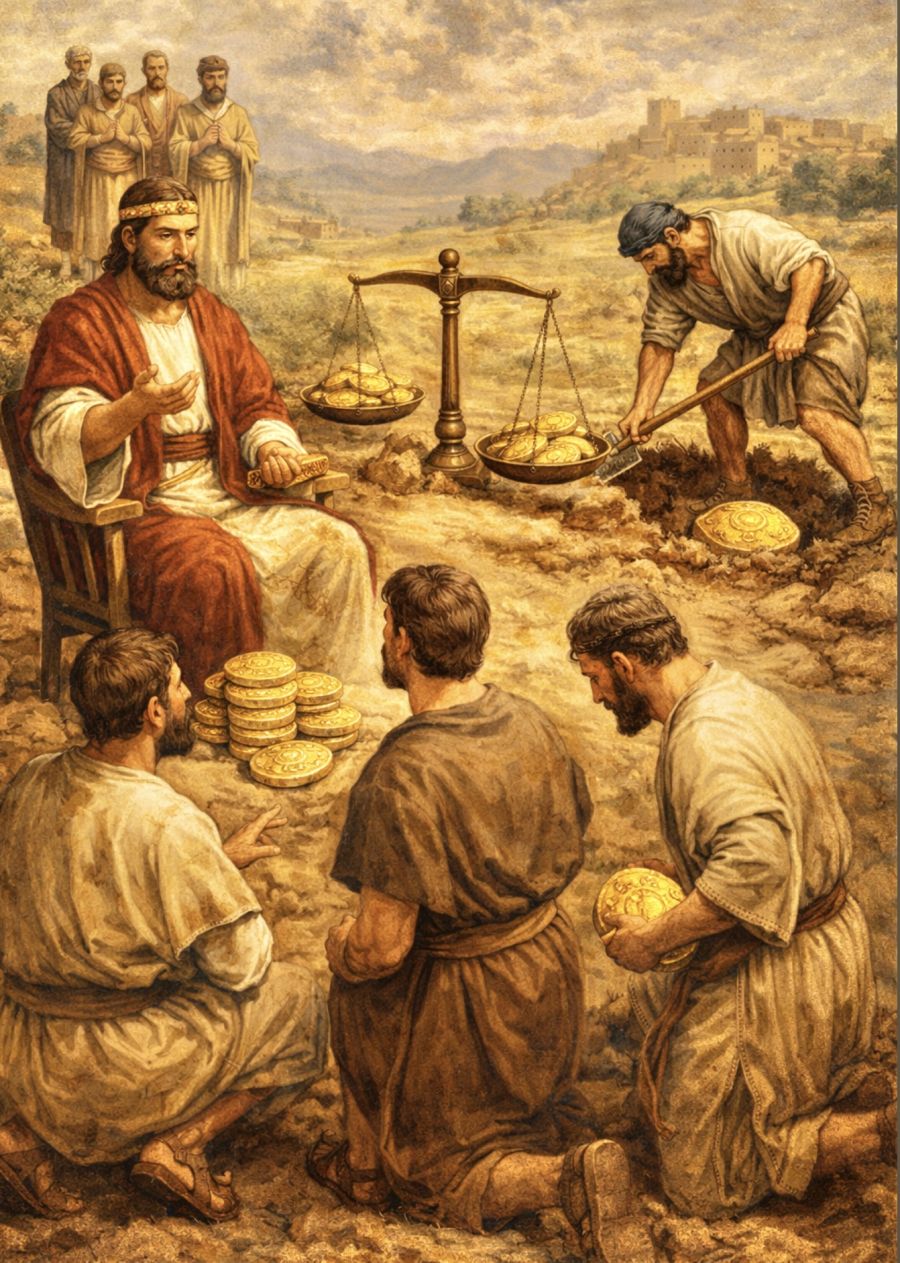
‘A man, setting out on a journey, called his servants and entrusted his possessions to them’ (v. 14).
The man who sets off on a journey and entrusts his possessions to his servants, in the context of the parable, represents Christ, who, after his earthly mission, returns to the Father, leaving his disciples with a responsibility: to safeguard and make fruitful what they have received. The verb ‘entrusted’ is significant. In Greek we find parédōken, from paradídōmi, which means to hand over, to entrust, to pass on. The master does not simply distribute riches but entrusts something that belongs to him. This detail is fundamental: we are not the absolute owners of the gifts we have received, but stewards of a wealth that comes from God. Our life, our faith, our time, our abilities, our responsibilities, our charisms and our opportunities to do good are gifts entrusted to our freedom—gifts we have received that must not be regarded as private property. ‘To one he gave five talents, to another two, and to another one, according to each one’s ability’ (v. 15).
A talent was not a coin of small value, but a unit of weight and monetary measure. One talent corresponded to a considerable quantity of precious metal, usually silver. Therefore, even the servant who receives just one talent is entrusted with a significant wealth. The master distributes them differently, ‘according to each one’s ability’. Not everyone receives the same amount, but everyone receives something. Here is an important lesson: God does not expect the same results from everyone, but asks each person to live responsibly according to the gifts they have received; and diversity is not a form of discrimination, but a source of richness. Indeed, equality of dignity must not be confused with the sameness of gifts. In the Christian community, in fact, everyone has a particular vocation, sensibility and task. St Paul elaborates extensively on this concept in 1 Corinthians 12, where he compares the Church to a body made up of many different members, all of which are necessary. The parable invites us to move beyond the logic of comparison. The issue is not how many talents we have received, but what we do with them; and a community grows when each person stops envying the gifts of others and begins to make their own available.
‘At once the one who had received five talents went off to put them to work’ (vv. 16–17).
The first two servants set to work immediately. The text emphasises their initiative: they do not wait for further instructions, they do not ask for guarantees, they do not put it off. They take responsibility for what has been entrusted to them, and the result is that both double the talents they have received. It is interesting to note that the servant with five talents gains another five, whilst the one with two gains another two, showing that the results differ in quantity but are identical in terms of faithfulness. The master does not assess the magnitude of the result in absolute terms, but rather how well it corresponds to the responsibility entrusted to them. Even within the Church, there is a temptation to always wait for others to take action. We wait for the parish priest to take the lead, for the organiser to make arrangements, for the priest to put forward ideas, for someone else to take on a role. But the community is not an audience merely watching the activities of a few key figures. The community is a living organism in which everyone is called to participate. It is not enough to ask what the Church can do for me; rather, we must ask ourselves what the Lord wants to do through me for the Church and for others.
‘The one who had received a single talent went off and dug a hole in the ground and hid his master’s money there’ (v. 18).
Here we see the completely different behaviour of the third servant. He does not lose the talent, nor does he squander it or use it for personal gain, but he hides it. On the surface, this seems like prudent behaviour, but this is precisely where the problem lies: he received a gift to make it bear fruit, yet he turns it into something to be hoarded. His is a prudence that masks fear. In the ancient world, burying money underground was a well-known way of protecting it from theft. The servant acts according to a logic of security, but not according to the logic of trust. The talent is not lost, but neither does it produce anything. The opposite of faithfulness is not merely wastefulness: it can also be inaction. This is probably the most thought-provoking aspect of the parable for our communities. We may have a sound spiritual tradition, but without passing it on to the younger generations; we may have structures and organisations, but without genuine fraternal life; we may have capable and generous people, but who are not actively involved. Many projects, but little ability to reach out to those who are far away: in short, a faith that is preserved but not borne witness to. A community thus becomes a repository of memories, habits and past activities, rather than a place where the Gospel continues to generate life. The hidden talent can also be a vocation never embraced, a charism never made available, a kind word never spoken, a person we have never tried to reach out to.
‘Lord, I know that you are a hard man…’ (vv. 24–25).
When the master returns, the servants give an account of their actions. The first two present the fruits of their labour. The third, however, tries to justify himself. The most interesting detail is the reason he gives: ‘I was afraid, so I went and hid your talent in the ground’.
Fear is this servant’s real problem because he has a distorted image of his master: he regards him as a harsh, demanding, almost unjust man. He did not trust him and did not understand the meaning of entrustment. His behaviour stems from this false image. The way we think of God profoundly shapes the way we live out our faith: if God is a severe judge, religion becomes a matter of fear and self-defence; if he is the Father who loves us, faith becomes a response of love, trust and responsibility. In communities, we encounter people who do not get involved because they are afraid of making mistakes, of being judged, of not measuring up or of not being recognised. The community must not stifle initiatives, but support them; it must not foster competition, but encourage collaboration. Yet this does not mean abandoning responsibility and fraternal correction, so as to create an environment in which everyone can offer what they have received.
‘You wicked and lazy servant…’ (v. 26).
The master does not rebuke the servant because he produced little, but because he did nothing at all. His is a failure to fulfil his responsibility. The laziness of which Jesus speaks is not simply a lack of willingness to work; it is an inner closed-off attitude, a refusal to take responsibility for the gift received. The master points out to him that he could at least have deposited the money with the bankers to earn interest.
In other words, even if he had not been capable of making a large investment, he could at least have done something. The parable therefore condemns inaction: evil consists not only in committing wicked deeds, but also in failing to do the good that is possible. St James writes: ‘Whoever, then, knows the right thing to do and fails to do it, commits sin’ (Jas 4:17).
‘For to everyone who has, more will be given, and they will have an abundance; but from the one who has not, even what they have will be taken away’ (v. 29).
This statement may seem paradoxical and even unjust. How can anything be taken away from someone who already has so little? In the context of the parable, Jesus is speaking of the dynamics of the spiritual life. A gift that is received, used and allowed to bear fruit grows; a gift that is rejected and left unused ends up being lost. We can also understand this dynamic through everyday experience: a skill that is not practised weakens; a relationship that is not nurtured deteriorates; a faith that is not nourished risks fading away. Grace is not capital to be kept static, but a life to be nurtured and allowed to grow. The parable enables us to examine our consciences within our communities, for it calls us to move from delegation to shared responsibility, as the mission cannot be sustained by just a few people; everyone must feel responsible for the common mission. It calls us to move from competition to complementarity, for different gifts must not create rivalry but rather collaboration, and one person’s talent does not diminish another’s. It encourages us to move from preservation to mission, since faith is not a treasure to be kept in a safe, but a wealth to be shared; and a community that does not evangelise risks turning in on itself. Finally, it invites us to move from fear to trust, for we must not be afraid to put our gifts to the test. We may make mistakes; we must learn and correct ourselves, but we cannot allow fear to paralyse us. There is one further point to emphasise: the master does not ask the servants simply to return what he had entrusted to them; he asks them to account for the fruits. This means that God has not given us life so that we might simply keep it intact, but so that it might bear fruit. He has not given us faith so that we might keep it only for ourselves, but so that it might also enlighten others. He has not given us charisms so that we might feel superior to others, but so that we might serve the community. He has not given us time so that we might waste it, but so that we might transform it into an opportunity for love. And there is another important point: the first two servants receive exactly the same praise, even though they produced different amounts. ‘Well done, good and faithful servant… share in your master’s joy.’
God does not ask us all to be the same, nor to do the same things. He asks us to be faithful to our vocation. Holiness does not consist in having many talents, but in not burying any of the gifts that God has entrusted to us. The concluding question to put to the community might be: If the Lord were to come today to ask for an account of the talents he has entrusted to us, would he find a community that has merely preserved the past, or a community that, through prayer, fellowship and mission, has brought forth new life?
+Giovanni D’Ercole