


Pentecost Sunday (year A) [24 May 2026]
First Reading from the Acts of the Apostles (2:1–11)
Jerusalem is not only the city where Jesus instituted the Eucharist, but the city where he rose from the dead and where the Spirit was poured out upon humanity. In Christ’s time, the Jewish feast of Pentecost was of the utmost importance because it was the feast of the giving of the Law, one of the three annual feasts for which people made a pilgrimage to Jerusalem. The list of all the nationalities gathered in Jerusalem for the occasion is proof of this. Jerusalem was therefore teeming with people from all over, thousands of devout Jews, some of whom had travelled from far away. It was the year of Jesus’ death, but who among them knew this? I have deliberately said ‘the death’ of Jesus, without mentioning his resurrection, because for the time being his resurrection was still confidential news. These were people who had come from all over and who had perhaps never even heard of a certain Jesus of Nazareth.
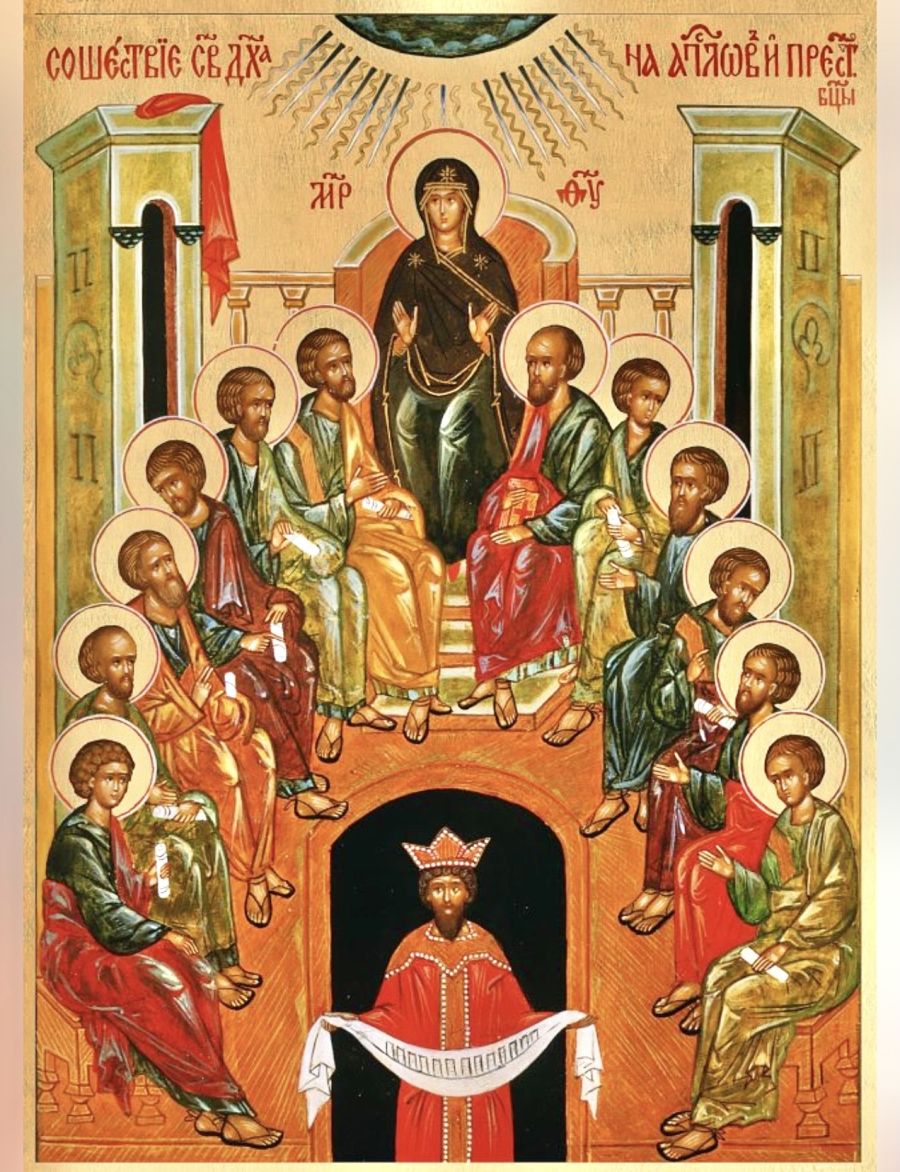
They came to Jerusalem in the fervour, faith and enthusiasm of a pilgrimage to renew the Covenant with God. For the disciples, however, this feast of Pentecost, fifty days after his resurrection, is unlike any other, for to them nothing is as it was before; yet this does not mean they expect what is about to happen. To help us understand clearly what is happening, Luke recounts it by carefully evoking three passages from the Old Testament: first, the giving of the Law at Sinai; second, a word from the prophet Joel; third, the episode of the Tower of Babel. First, let us begin with Sinai: the tongues of fire at Pentecost, the sound ‘like a mighty wind’, bring to mind what had happened at Sinai, when God gave the tablets of the Law to Moses, as we read in the Book of Exodus (19:16–19). By drawing a parallel with the event at Sinai, Saint Luke wants us to understand that this Pentecost, that year, is much more than a traditional pilgrimage: it is a new Sinai. Just as God had given his Law to his people to teach them how to live within the Covenant, so now God gives his own Spirit to his people. Now God’s Law, which is the only means of living truly free and happy, is no longer written on tablets of stone but on tablets of flesh, in the heart of man, to borrow an image from Ezekiel. Secondly, Luke wished to evoke a word of the prophet Joel: “I will pour out my Spirit upon all flesh” (3:1–2), says God; “all flesh” meaning every human being. In Luke’s view, these Jews from every nation under heaven, as he calls them, symbolise the whole of humanity for whom Joel’s prophecy is finally fulfilled. This means that the famous, long-awaited “Day of the Lord” has arrived. Thirdly, we can summarise the story of Babel in two acts: Act 1, all people spoke the same language: they had the same speech and the same words, and they decided to undertake a great project that would mobilise all their energies: the construction of an immense tower. Act 2: God intervenes to put a stop to it: He scatters them across the face of the earth and confuses their languages. From then on, people will no longer understand one another. Unless one wishes to judge God’s intentions, it is impossible to imagine that he acted for any reason other than our happiness. Therefore, if God intervenes, it is to spare humanity a false path: the path of a single mindset, of a single project; something like ‘my children, you seek unity, and that is good; but do not go astray: unity does not lie in uniformity. True unity in love can only be found in diversity’. The account of Pentecost in Luke fits well within the narrative of Babel: at Babel, humanity learns diversity; at Pentecost, it learns unity in diversity: now all the nations under heaven hear the one message proclaimed in their various languages: the wonders of God.
Note: The first reading and the psalm are common to the feasts of Pentecost across the three liturgical years. However, the second reading and the Gospel vary each year.
Responsorial Psalm (103/104)
Read in its entirety, this psalm offers thirty-six verses of pure praise, of wonder at the works of God. It is not surprising that it is proposed to us for the feast of Pentecost, given that Luke, in the Acts of the Apostles, recounts that on the morning of Pentecost the Apostles, filled with the Holy Spirit, began to proclaim the wonders of God in every language. One might observe that to marvel at creation there is no need to have faith, and in every civilisation one finds magnificent poems on the beauties of nature. In Egypt, on the tomb of a Pharaoh, a poem written by the famous Pharaoh Akhenaten was discovered: a hymn to the Sun-God. Amenhotep IV lived around 1350 BC, at a time when the Jews were probably in Egypt and would have known this poem. There are similarities in style and vocabulary between the Pharaoh’s poem and Psalm 103/104. The language of wonder is the same across all latitudes, but what is interesting are the differences, which are the hallmark of the Revelation given to the people of the Covenant. The first difference, and it is essential to the faith of Israel, is that God alone is God; there is no other God but him; and therefore the sun is not a god. The Bible puts the sun and the moon in their place: they are not gods but merely luminaries, creatures themselves: one of the verses of the psalm states this clearly: “You, God, have made the moon to mark the seasons and the sun that knows the hour of its setting.” There are verses not chosen for the feast of Pentecost which clearly present God as the sole Lord of Creation, and a wholly regal vocabulary is used: God is presented as a magnificent, majestic and victorious King. A second distinctive feature of the Bible: creation is only good, and one hears an echo of the poem in Genesis which repeats tirelessly, like a refrain, “And God saw that it was good!”. Psalm 103/104 evokes all the elements of creation with the same wonder: I rejoice in the Lord, and the psalmist adds, in a verse we do not hear this Sunday: “I will sing to the Lord as long as I live, I will sing hymns to my God as long as I exist…” Yet evil is not ignored: the end of the psalm clearly evokes it and hopes for its disappearance; but the people of the Old Testament had understood that evil is not God’s doing, for the whole of creation is good. And we know that one day God will remove all evil from the earth: the King who triumphs over the elements will overcome everything that stands in the way of human happiness. A third distinctive feature of the faith of Israel: creation is an enduring relationship between the Creator and his creatures. When we say in the Creed, “I believe in God the Almighty, Creator of heaven and earth”, we are not merely affirming our faith in an initial act of God, but we acknowledge ourselves to be in a relationship of dependence on him, and the psalm expresses this very well: “All wait for you… Hide your face: they fail; take away their breath: they die and return to their dust. Send forth your Spirit, they are created, and you renew the face of the earth.” Another distinctive feature of the faith of Israel is that at the summit of creation stands man, created to be the king of creation, filled with the very breath of God. And this is what we celebrate at Pentecost: the Spirit of God within us vibrates in his presence, and the psalmist sings, “Let the Lord rejoice in his works… I will rejoice in the Lord.” Finally, and this is very important, in Israel every reflection on creation is set within the perspective of the Covenant: having experienced God’s work of liberation, they meditated on creation in the light of this experience, and in this psalm we find traces of this: first of all, the name of God used here is the famous four-letter name, YHWH, which we translate as Lord, the revelation of the God of the Covenant.
Furthermore, “Lord, my God, how great you are!” The expression “my God” with the possessive is always a reference to the Covenant, since God’s plan in this Covenant was precisely stated in the formula “You shall be my people and I shall be your God”. This promise is fulfilled in the gift of the Spirit “to every person”, as the prophet Joel says. Now, every person is invited to receive the gift of the Spirit to truly become a child of God.
Second Reading from the First Letter of Saint Paul to the Corinthians (12:3b-7, 12-13)
Paul defines the Church as the place where “to each is given a manifestation of the Spirit for the common good”, not therefore for our own vanity, but for the good of all. And it is a free gift for all, just as the members of the body are freely at the service of the whole body. The work of the Spirit in the world resembles an immense mosaic with different pieces held together and united by the invisible action of the Spirit. As communities multiply, the mosaic spreads like wildfire and becomes ever more harmonious. In these communities, Jews and Gentiles, slaves and free men, break down the barriers of prejudice and division, recognising one another as brothers and sisters, members of a single body thanks to the one Baptism that incorporates us all into Christ. Paul certainly had good reasons to insist on unity, for the Christians in Corinth were of such diverse origins—Jews or Gentiles with conflicting sensitivities and religious traditions—and at times the early believers found it difficult to accept the newcomers. To place Jews and pagans on the same religious footing, given the weight that the election of Israel must have carried in Paul’s eyes, was nonetheless very bold! These issues and difficulties, present and highlighted by Paul in the Corinthian community, have not been absent over the centuries and persist even today within the Church. The law that animates believers is always the word of Jesus, who urged the apostles: “You know that the rulers of the nations lord it over them, and the great ones exercise authority over them. It shall not be so among you.” (Mt 20:25–26). Paul sees the Church not as a pyramid, but as a crowd gathered around Jesus Christ, the one Master, and, furthermore, as a living body made up of all the baptised, where those in authority do not view it as superiority, but as a mission in the service of all. Diversity becomes a mutual gift for everyone: “There are different charisms,” observes the Apostle, “and to each is given a manifestation of the Spirit for the common good.” Our differences thus become riches, and it is precisely through them that unity is built—a unity that is never uniformity, or worse, standardisation. Herein lies one of the great messages of Pentecost, where all the different languages come together to sing the same song, “the wonders of God”. Since then, the Church has sought to overcome differences in sensibility by learning to live through the labour of reconciliation, sustained by the Spirit given to us at Pentecost, the Spirit of love, forgiveness and reconciliation. The capacity for reconciliation and mutual respect is a true sign of the Spirit’s action and a witness that the world awaits: “By this everyone will know that you are my disciples: if you have love for one another,” said Jesus at the Last Supper (Jn 13:35). Unity in diversity is a beautiful challenge that we can overcome only because the Spirit has been given to us: the same Spirit, the Spirit of Love that unites the Father and the Son. From the lesson of Babel we understand that unity does not lie in uniformity, and from Pentecost we understand that true unity in love can only be found in diversity and is always a gift of the Spirit and an image on earth of the Trinitarian communion, the perichoresis between the Father, the Son and the Holy Spirit.
From the Gospel according to John (20:19–23)
To impart the Holy Spirit to his disciples, Jesus breathes on them; this brings to mind the famous phrase from the Book of Genesis, chapter 2: ‘The Lord God breathed into the man’s nostrils the breath of life, and the man became a living being’. And Psalm 103/104, which we also hear on this feast of Pentecost, comments on the text of Creation by singing: Send forth your Spirit, and all things shall be created. Now, it is the evening of Easter and Jesus takes up this gesture of the Creator. We can understand why Saint John notes: “It was the evening of that day, the first of the week”, a way of saying that it is the first day of the new creation. The Jews often recalled the creation that God had accomplished in seven days, as we read in the first chapter of Genesis, and awaited the eighth day, that of the Messiah. In his own way, John tells us: the eighth day has come and it is a true re-creation of humanity. Let us take up three phrases from the account of Pentecost that John offers us here. The first: “As the Father has sent me, so I send you”; the second: “He breathed on them and said: Receive the Holy Spirit”; and the third: “Whose sins you forgive are forgiven them”. The first and third phrases express a mission; the second speaks of the gift, namely the Holy Spirit given to fulfil the mission received. And this mission consists in “forgiving sins”. “As the Father has sent me, so I send you”. Jesus is the one sent by the Father, and we, who are sent by Jesus, have the same mission as him. This speaks to our responsibility, the trust placed in us, and concerns all the baptised, since the Church has always deemed it appropriate to confirm all the baptised. Jesus’ mission, to limit ourselves to the Gospel of John, is to take away the sin of the world, indeed to “eradicate” the sin of the world, being the Lamb of God, the one who takes away the sin of the world, as John the Baptist had prophesied. The Lamb, meek and humble of heart in the face of his executioners according to the prophecy of Isaiah 52–53, is the Paschal Lamb, who seals with his life the liberation of God’s people. Beyond the liberation of the chosen people from slavery in Egypt, the Gospel speaks to us of liberation from sin, hatred and violence. Jesus thus presents his mission: “God so loved the world that he gave his only Son, so that everyone who believes in him might not perish but might have eternal life.” We must keep these words of the Lord in mind to understand the phrase in today’s text that is not immediately clear: “Whose sins you forgive, they are forgiven; whose sins you do not forgive, they are not forgiven.” Or, according to another version, “Whose sins you remit, they are remitted; whose sins you do not remit, they are not remitted.” The first part of the sentence presents no difficulty, but the second may not be easily understood. It is impossible to think that God, who is Father, could fail to forgive us. The Old Testament had already highlighted that God’s forgiveness even precedes our repentance, for in God forgiveness is not a one-off act but defines his very being. God is gift and forgiveness. The hallmark of mercy is God’s bending down towards the wretched—that is, towards all of us. The power given to the disciples—indeed, the mission entrusted to them—is to communicate and pass on God’s forgiveness. Consequently, there is the terrible responsibility, expressed in the second part of the sentence, not merely to speak the word of God’s forgiveness, but to do everything possible so that the world does not ignore this forgiveness and thus fall prey to despair. God’s forgiveness, proclaimed through words and concrete actions, makes us ‘living forgiveness’, apostles of Divine Mercy. At Pentecost, God breathes the words of forgiveness, and the Holy Spirit continues to breathe words and gestures of forgiveness into our spirit, making us ‘lambs of God’ with the power to overcome the spiral of hatred and violence. “I am sending you out like lambs among wolves” to respond to violence and hatred with non-violence, meekness and forgiveness, thus hastening the arrival of the day when all humanity will live immersed in love and forgiveness: it will be the triumph of Divine Mercy!
+Giovanni D’Ercole








