


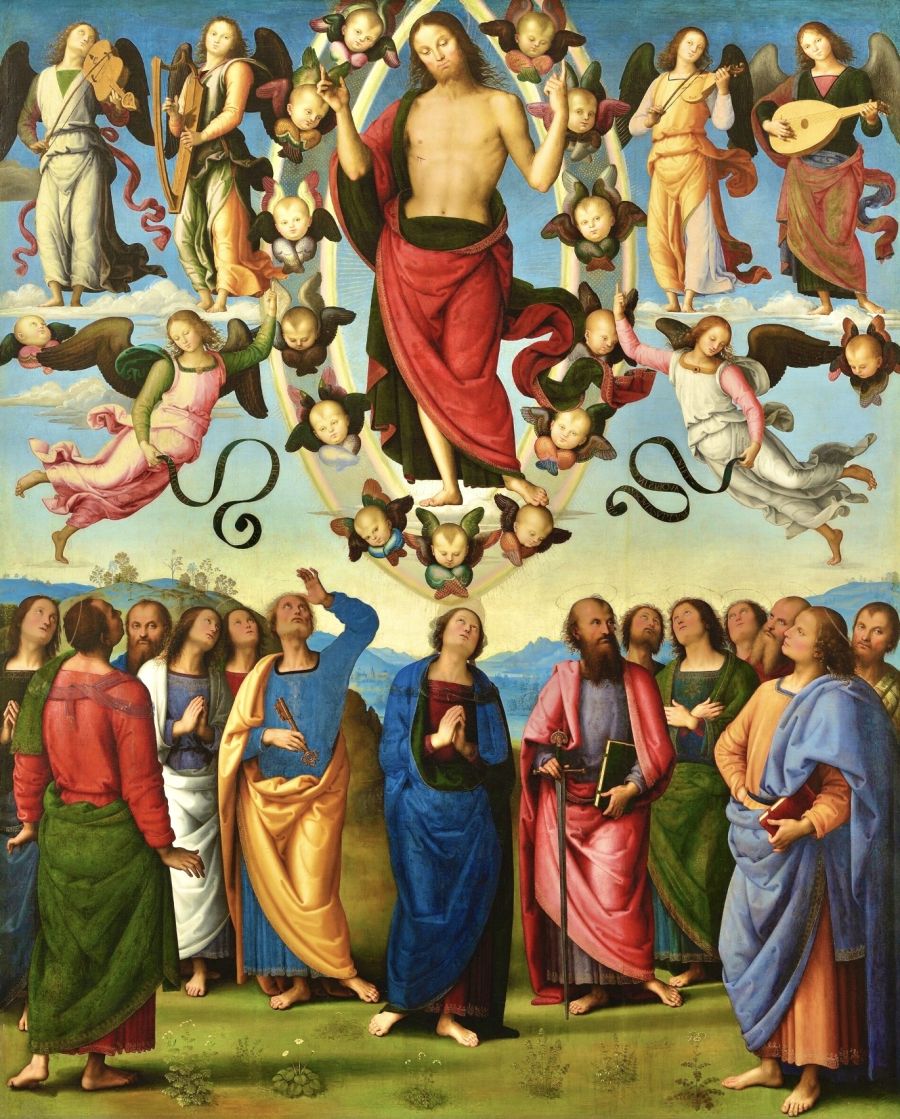
Ascension of the Lord (year A) and VII Easter Sunday [Thursday 14 May 2026]
First Reading from the Acts of the Apostles (1:1–11)
The opening verses serve as a bridge between the Acts of the Apostles and the Gospel of Luke, which is also dedicated to a certain Theophilus. One begins where the other ends, namely with the account of Jesus’ Ascension, even though the two accounts do not agree on everything. The Gospel recounts Jesus’ mission and preaching; the second is dedicated to the mission and preaching of the Apostles, hence the name “Acts of the Apostles”. The parallel can be taken further: the Gospel begins and ends in Jerusalem, the centre of the Jewish world and of the First Covenant; the Acts begin in Jerusalem, because the New Covenant is a continuation of the First, but they end in Rome, the crossroads of all the roads of the then-known world: the New Covenant now extends beyond the borders of Israel. For Luke, it is clear that this expansion is the work of the Holy Spirit. It is the very Spirit of Jesus and will be the inspiration of the Apostles from Pentecost onwards, so much so that the Acts are often called “the Gospel of the Spirit”. Just as Jesus had prepared for his mission with forty days in the desert after his Baptism, so too does he prepare the Church for forty days: “For forty days he appeared to them and spoke about the kingdom of God”. During a final meal, he gives his instructions: a command, a promise, a sending forth on mission. The command is almost surprising: to wait and not to move. “He instructed them not to leave Jerusalem, but to wait for the fulfilment of the Father’s promise.” That the Father’s promises would be fulfilled in Jerusalem certainly did not surprise the Eleven, all of whom were Jews, for the entire preaching of the prophets assigned Jerusalem a decisive role in the fulfilment of God’s plan. Luke specifies the content of the promise: “John baptised with water, but you will be baptised in the Holy Spirit in a few days’ time.” The apostles had in mind the prophecies of Joel: “I will pour out my Spirit upon all people” (Joel 3:1–2), and of Zechariah: “On that day there shall be a fountain opened for the house of David and for the inhabitants of Jerusalem, to cleanse them from sin and impurity” (Zech 13:1) and Ezekiel: “I will sprinkle clean water upon you, and you shall be cleansed… I will give you a new heart, and I will put a new spirit within you… I will put my Spirit within you” (Ezek 36:25–27).
The apostles’ question “Lord, is this the time when you will restore the kingdom to Israel?” shows that they had clearly understood that the famous Day of the Lord had dawned. Jesus’ reply should not surprise us: God calls upon human cooperation to bring about his plan, and the salvation of God, which has come through Jesus Christ, calls upon people to enter into it. For this to happen, people must know of it, and from this arises the mission and responsibility of the Apostles. The Spirit is given to them for this purpose: “You will receive power when the Holy Spirit comes upon you, and you will be my witnesses.” This means that between the gift of the Spirit and the definitive coming of the Kingdom there is an interval which is the time of witness: an interval that is all the longer the more the message is to be brought to all humanity. “You will be my witnesses in Jerusalem, throughout Judea and Samaria, and to the ends of the earth.” The Book of Acts follows this plan exactly. Just as on Easter morning “two men in dazzling robes” had torn the women away from their contemplation, saying, “Why do you seek the living among the dead? He is not here; he has risen”, so on the day of the Ascension two men in white robes do the same with the Apostles: “Men of Galilee, why do you stand gazing into the sky? This Jesus, who has been taken up from you into heaven, will come in the same way as you saw him go into heaven”. He will return, we are certain of it, and that is why we say at every Eucharist: “As we await the fulfilment of our blessed hope and the coming of our Saviour Jesus Christ”. In the Bible, the cloud is the visible sign of God’s presence, as at the crossing of the Red Sea or at the Transfiguration. The cloud that hides Jesus from human sight is the sign that he has now entered God’s realm: his physical and visible presence thus ceases to inaugurate his spiritual presence. It is impossible to reconstruct exactly what happened between Jesus’ Resurrection, on Easter night, and the day he definitively left his apostles to return to the Father. In Luke’s accounts, in both the Gospel and the Acts of the Apostles, the two narratives are very similar: Jesus’ departure takes place near Jerusalem, for the Gospel speaks of Bethany and the Acts of the Mount of Olives; in both, Luke specifies that Jesus instructs the disciples not to leave Jerusalem before they have received the Holy Spirit. The only difference concerns the timing: in the Gospel, it seems that the departure takes place on Easter evening itself; after appearing to the disciples on the road to Emmaus, they return to Jerusalem to tell the Eleven everything; and it is whilst they are talking together that Jesus appears, stays with them, and explains the Scriptures; then he leads them to Bethany and there disappears from their sight for good. In Acts, however, Luke specifies that forty days elapsed between Easter and the Ascension; and this is why we celebrate the the Ascension forty days after Easter. In the other Gospels there is almost nothing on this: in Matthew there is no account of the Ascension, but only an appearance of Jesus to two women who had gone to the tomb and then to the disciples in Galilee, during which he utters the phrase with which his Gospel concludes: “ Go therefore and make disciples of all nations, baptising them in the name of the Father and of the Son and of the Holy Spirit’ John gives a more detailed account of several appearances of the Risen One, one to Mary Magdalene and three to the disciples, the last by the Sea of Tiberias; but he does not recount the Ascension. As for Mark, he recounts the appearance to Mary Magdalene, then to two disciples who were going out into the countryside, and finally to the Eleven. Jesus sends them to preach the Gospel to the whole world, and Mark concludes by saying: “The Lord Jesus, after speaking to them, was taken up into heaven and sat at the right hand of God” . These differences between the Gospels prove that their details do not aim at historical or geographical reality: Matthew has his reasons for speaking of Galilee. Luke, on the other hand, has his own reasons for emphasising Jerusalem, because it was there that Jesus told them to wait for the gift of the Spirit, and Luke’s Gospel ends with Jesus’ final instruction: “And behold, I am sending upon you the one whom my Father has promised; but you must remain in the city until you are clothed with power from on high” (Lk 24:49).
Responsorial Psalm (46/47)
Here Israel sings and acclaims God as its king, and this is not surprising; but what is even more astonishing is that it says God is the king of the whole earth. Now, this was not always the view in Israel. Before the Babylonian Exile, none of the kings of Israel imagined that God was the Lord of the entire universe. This means that the psalm was composed late in the history of the chosen people. I shall focus on the first statement: God is the king of Israel. For a long period of biblical history, Israel had kings, like its neighbouring peoples, but its conception of kingship was unique, and this distinctiveness persisted throughout its history. In Israel, the king could never claim to be the highest authority in the land and did not hold absolute power, for God remained the sovereign. In other words, the true king in Israel was none other than God Himself. The king, for example, could not interpret the laws as he pleased and had, like everyone else, to submit to the Law of God given to Moses on Mount Sinai. According to the Book of Deuteronomy, he was required to read the entire Law every day of his life. Even whilst sitting on the throne, he was, in principle, merely an executor of God’s commands conveyed by the prophets. In the Books of Kings, in fact, we often see one king or another seeking the consent of the prophet of the day before going into battle or even, in David’s case, before undertaking the construction of the Temple. And on several occasions we see the prophets intervening freely in the lives of the kings and sometimes violently criticising their behaviour. The affirmation of God’s sovereignty was even a hindrance to the establishment of the monarchy. One recalls the very violent reaction of the prophet Samuel, in the time of the Judges, when the leaders of the tribes of Israel came to tell him that they wanted a king ‘to be like the other nations’. To desire to be ‘like the other nations’ when one had the honour of being the people chosen by God for the covenant was, in his eyes, a true blasphemy. He eventually yielded to the insistence of the tribal leaders, but not without warning them that they were bringing ruin upon themselves. And when he anointed the first king, Saul, he took care to specify that he was becoming the head of God’s inheritance. The people remained God’s people and not the king’s, and the king was but a servant of God. And throughout the monarchy in Israel, the prophets took it upon themselves to remind the kings of this fundamental truth. To the extent that the Books of Kings, when recounting the successive reigns, have but one criterion of judgement: the faithfulness of each king to God’s will. One phrase recurs constantly: ‘Such-and-such a king did what was right in the eyes of the Lord’, or conversely, ‘Such-and-such a king did what was evil in the eyes of the Lord’. It is therefore in honour of God himself that our psalm deploys here the entire vocabulary otherwise reserved for the kings of the earth. The very word ‘awesome’ is a compliment; it is a common term in courtly language and is reassuring: the enemies are warned, our king will be invincible. In every line of this psalm, it is clear that we are speaking of the God of Sinai, the Lord, who is acclaimed as God and King of the entire universe. This universal dimension is very much present in the psalm, to the point of stating that “God reigns over the pagan nations”. Now, the discovery of monotheism dates only to the Babylonian Exile: until then, the people of Israel were not yet monotheists. To be monotheists means to affirm that there is only one God, the same for the entire cosmos and humanity. Before the Exile, this was not the case: it is said that Israel was ‘monolatristic’; that is, it recognised for itself a single God, the God of the Sinai Covenant. But it believed that other peoples had their own gods. This psalm was therefore probably composed after the return from the Exile, and it was not in the throne room that these acclamations resounded, but in the rebuilt Temple of Jerusalem. Even now, the Jews already imagine the Day when God will finally be recognised for what He is, the Father of all goodness. We Christians, in turn, take up this psalm. And the phrase “God ascends amidst the acclamations” is most fitting for the celebration of the Ascension of Jesus Christ. Even though Christ’s kingship has not yet been fully realised and the evangelists do not recount any coronation ceremony for Christ. All the more reason to pay Jesus this magnificent tribute now, which merely anticipates the last day when all the children of God, finally gathered together, will sing: “All you peoples, clap your hands! Acclaim God with shouts of joy”
Second Reading from the Letter of Saint Paul the Apostle to the Ephesians (1:17–23)
The Letter to the Ephesians is divided into two parts: in chapters 1–3 there is a lengthy contemplation of God’s plan, and in chapters 4–6 an exhortation to the baptised to conform their lives to this mystery. For the feast of the the Ascension, the liturgy offers a passage from the first part in Year A and from the second part in Year B. The first part begins with a lengthy blessing formula in the Jewish style, which in our Christian liturgy we might call a ‘preface’, and it concerns God’s ‘merciful plan’ (Eph 1:3–6). The baptised already share in this mysterious plan of God which, one day, will be extended to all humanity. And Paul speaks of the privilege of us Christians who, having heard the word of truth, that is, the Gospel, have received the seal of the Holy Spirit, a pledge of our inheritance, whilst we await full redemption. We find all these terms in today’s reading, but in the form of a prayer, generally known as the ‘prayer for enlightenment’, since it takes the light of God to penetrate even a little into this mystery: “May he enlighten the eyes of your heart so that you may understand to what hope he has called you, what treasure of glory his inheritance among the saints holds…” And we know full well that the understanding of which he speaks is not a matter of reason but of the heart, a profound openness to being taught and enlightened. And Paul, as a Jew, knows full well that God’s wisdom is inaccessible to man unless God himself reveals himself to him: “May the God of our Lord Jesus Christ, the Father of glory, give you a spirit of wisdom and revelation for a deeper knowledge of him.” And what lies at the end of this knowledge towards which we are journeying? An inheritance of inestimable value, says Paul. The word “inheritance” in verse 18, and indeed in verse 14, recurs frequently in the Bible: in the Old Testament it refers to the land promised by God to the faithful. The same term is taken up in the New Testament, particularly in Paul’s letters, to denote the Kingdom and eternal life. For example: “The Spirit himself testifies with our spirit that we are children of God. And if we are children, we are also heirs: heirs of God, joint-heirs with Christ’ (Rom 8:16–17). ‘Giving thanks with joy to the Father who has qualified you to share in the inheritance of the saints in the light’ (Col 1:12). ‘ All nations are called, in Christ Jesus, to share in the same inheritance, to form the same body and to be partakers of the same promise through the Gospel” (Eph 3:8). James also develops this theme: “Has not God chosen those who are poor in the eyes of the world, who are rich in faith and heirs of the Kingdom, promised to those who love him?” (Jas 2:5) . And the Letter to the Hebrews, for its part, often takes up the theme: “God, who in times past spoke to our ancestors many times and in various ways through the prophets, has in these last days spoken to us through his Son, whom he appointed heir of all things and through whom he also made the world” (Heb 1:1–2); and a little further on: “That those who have been called may receive the eternal inheritance that was promised” (Heb 9:15) For, and this is the profound reason for Paul’s wonder, the Lord’s disciples are already associated with the triumph of their risen Master. Nothing in this world need frighten them any longer, for death has been conquered and the gates to eternal life are open. The work that God accomplishes in the hearts of believers is a true inner resurrection.
From the Gospel according to Matthew 28:16–20
Here is Jesus’ farewell discourse, after the Resurrection, in Galilee, commonly called the ‘crossroads of the Gentiles’, the ‘Galilee of the nations’, for the Apostles’ mission now concerns ‘all nations’ . The Gospel of Matthew seems to end abruptly: but in reality, the adventure is just beginning. It is like a film in which the word “THE END” appears on a road stretching out towards infinity. For it is precisely towards infinity that Jesus sends them: the immensity of the world and the infinity of the ages. “Go… Make disciples of all nations… Until the end of the world.” But were the disciples ready for such a mission? If Jesus were a business leader, he could not risk entrusting the future of his enterprise to collaborators like these, who seem not to have fully absorbed all the training he had provided over months. They are mistaken about the objective, the timing, and the nature of the enterprise. They even go so far as to doubt the reality they are experiencing, for Matthew clearly states, “some, however, doubted” (Mt 28:17). The mission entrusted to them, fraught with risks, is to promote a message that still surprises them. Folly, the wise would say; the wisdom of God, Saint Paul would reply. This is certainly no trivial undertaking: it surpasses everything the human spirit can imagine or conceive. It is a matter of communication between God and humankind. He who kindled the spark entrusts to his disciples the task of spreading the fire: “Go! Make disciples of all nations: baptise them in the name of the Father and of the Son and of the Holy Spirit”. “In the name of the Father and of the Son and of the Holy Spirit”: we do not often have the opportunity to dwell on this extraordinary formula of our faith. It is, in fact, the first formulation of the mystery of the Trinity: the expression “in the name of”, common in the Bible, signifies that there is indeed one God; at the same time, the three Persons are named and clearly distinguished: “ In the name of the Father, and of the Son, and of the Holy Spirit”. If we recall that, in the Bible, the Name is the person, and that to baptise etymologically means “to immerse”, this means that Baptism literally immerses us in the Trinity. We understand Jesus’s peremptory command to his disciples: “Go”; there is urgency. How can we not be eager to see all humanity take advantage of this offer? At the same time, it must be said that this formula, so familiar to us, was a true revolution for the generation of Christ! Proof of this is that when the apostles Peter and John healed the lame man at the Beautiful Gate, the authorities immediately asked: “By what power or in whose name have you done this?” (Acts 4:7), because it was not permitted to invoke any name other than that of God. Jesus speaks precisely of God, but his statement mentions three persons, whereas God was one; the prophets had made this clear enough. The Jews’ misunderstanding of Christ’s followers is recorded here; persecution was inevitable. Jesus knows this, and he had warned them on the last evening: “ They will expel you from the synagogues; indeed, the hour is coming when whoever kills you will think they are offering worship to God, that is, they will think they are defending God’s honour (Jn 16:2)… And Jesus added: ‘They will do this because they have not known either the Father or me’ (Jn 16:3). The mission entrusted to the apostles truly seems like madness; but they are not alone, and this must never be forgotten. Insofar as our commitment is not our own but His, we have no reason to worry about the results: “All authority in heaven and on earth has been given to me. Go!” (Mt 28:18–19). In other words, it is we who go, but it is he who has all power. It is said that a few days after his election, John XXIII received a visit from a friend: “Most Holy Father,” he said, “how heavy the task must be!” John XXIII replied: “It’s true, in the evening, when I lie down, I think: ‘Angelo, you are the Pope,’ and I struggle to fall asleep; but after a few minutes I say to myself: ‘Angelo, how stupid you are, you are not the one in charge of the Church, it is the Holy Spirit.’ Then I turn over and fall asleep!” For us too, evangelisation must be our passion, not our anguish. Jesus made it quite clear: “All authority in heaven and on earth has been given to me.” This sentence alone sums up the life of Christ: this takes place on a mountain, we do not know which one, but it evokes both the Mount of Temptation and the Mount of Transfiguration. On the Mount of Temptation, Jesus refused to receive power over creation from anyone other than the Father: “The devil took him up to a very high mountain and showed him all the kingdoms of the world and their splendour, and said to him: “All these things I will give you if you will fall down and worship me.” Then Jesus answered him, ‘Be gone, Satan! For it is written: “You shall worship the Lord your God, and him alone shall you serve”’ (cf. Mt 4:8–10). This power, which Jesus did not claim nor purchase, is given to him by the Father. And now this power is in our hands! “All authority in heaven and on earth has been given to me. Go! And Jesus adds, ‘I am with you always, even to the end of the age.’ The God of Presence revealed to Moses in the burning bush, the Emmanuel – which means ‘God with us’ – promised by Isaiah, are one in the Spirit of love that unites them. Ours is the mission to reveal to the world this loving presence of the Triune God.
Seventh Sunday in Easter (year A) [17 May 2026]
First Reading from the Acts of the Apostles (1:12–14)
The first sentence of the text sums up in a few words a crucial stage in the lives of the early Christians. For us it is the Ascension and we have made it a feast day, but, originally, was it not rather a day of mourning, a day of great departure? After the horror of Jesus’ Passion and death, after the splendour of the Resurrection, here they were, orphaned forever. But precisely for this reason they are closer to us, and their attitude can guide our own. Let us therefore look closely at their actions. Jesus had given them instructions: not to leave Jerusalem and to wait there for the gift of the Holy Spirit. Here is the account from the Acts: ‘While he was at table with them, he ordered them not to leave Jerusalem, but to wait for the fulfilment of the Father’s promise. “‘What,’ he said, ‘you have heard from me: John baptised with water, but you will be baptised in the Holy Spirit in a few days’” . And on the very day of his departure, on the Mount of Olives, he repeated: “You will receive power when the Holy Spirit comes upon you, and you will be my witnesses in Jerusalem, throughout Judea and Samaria, and to the ends of the earth.” I dwell on this expression “the power of the Spirit”, which should reassure us in every circumstance. And Luke recounts: “Having said this, whilst they were looking on, he was lifted up, and a cloud took him from their sight.” Obviously, they obeyed the Master’s command. It is therefore no surprise to find them in Jerusalem shortly afterwards; Luke notes that the Mount of Olives is very close to the city: the distance does not exceed what is known as the ‘Sabbath journey’, that is, the maximum distance one may travel without violating the Sabbath rest; it was just under a kilometre, two thousand cubits, and a cubit, as the name suggests, is the length of the forearm, about fifty centimetres. But why does Luke give this precise measurement? Are we to infer that it was the Sabbath? Or, by emphasising the proximity of the Mount of Olives, does Luke wish to suggest that everything is fulfilled in Jerusalem? It is there that God’s plan is fulfilled: there the Son was glorified, there the Covenant between God and humanity was renewed, there the Spirit will be given. It is in the holy city, therefore, that the life of the nascent Church begins; and Luke lists those who make up the group: the Eleven, some women, including Mary, the mother of Jesus, and some brothers, that is, probably disciples. Here too, the details are not merely anecdotal; we already knew the names of the apostles from Luke’s Gospel; if he gives us the list again, it is not to instruct us! Luke wishes to highlight the continuity within the community of the apostles: they are the very same who accompanied Jesus throughout his earthly life, and now they are committed to the mission. And they will be able to bear witness to the Resurrection only because they have been witnesses to the life, Passion and death of Jesus. We thus find again the group of people so different from one another whom Jesus had chosen: Peter, James, John and Andrew, fishermen on the Sea of Tiberias; Simon the Zealot—at the time of Jesus’ earthly life, this was not yet a political commitment, but it was already a sign of religious fanaticism. One wonders how he could stand alongside Matthew the tax collector, a tax collector in the pay of the occupying power and, for this reason, barred from worship! Not only did Jesus manage to bring them together around him, but they will now share the responsibility of continuing their Master’s mission. Christian tradition has identified Bartholomew with Nathanael, mentioned by Saint John, who was a specialist in the Law; if this were the case, it would have been a further point of diversity within the group of the Twelve. It is upon this community of men, so different from one another, that the proclamation of the Gospel now rests. A few brief observations: first of all, their group is not closed in on itself, but is already open to others, men and women; secondly, they begin this life of the Church in prayer, ‘devoted and of one accord’, as Luke emphasises. Perhaps the first miracle of the apostles is this praying together as one heart at the moment when the Master leaves them, and they find themselves seemingly left to their own devices and to their differences, which could have turned into divisions. In truth, they are only apparently left to their own devices: Jesus, though now invisible, is not absent. Matthew, in his Gospel, has preserved one of Jesus’ final words: “All authority in heaven and on earth has been given to me. Go therefore and make disciples of all nations, baptising them in the name of the Father and of the Son and of the Holy Spirit, teaching them to observe all that I have commanded you. And behold, I am with you always, to the end of the age.’ The apostles, therefore, do not pray for Jesus to draw near: his presence is assured; they pray to immerse themselves once more in his presence. This account from the Acts of the Apostles becomes for us a powerful lesson in hope: Jesus is with us always, his presence is assured, and the power of the Holy Spirit accompanies us!
Responsorial Psalm (26/27)
This psalm is for those going through difficult times. Believers are not exempt from life’s trials, and faith is no magic wand. Sometimes they suffer precisely because of their faith, as in religious wars or persecutions, or due to the hostility of atheists and the struggle to defend Christian values in a world that does not share them. We shall find an example of this in the Letter of Saint Peter, this Sunday’s second reading. But in their trials, believers know they are not alone, abandoned to their sad fate, for they have someone to turn to: “It is to God that my eyes weep,” said Job (Job 16:20). And they go to seek strength where it is found, that is, in God. “The Lord is my light and my salvation: whom shall I fear?” We do not know to which specific trials this psalm alludes; incidentally, it is much longer than the few verses read here, but the missing verses provide no historical details. Here and there one senses an allusion to external attacks: “The Lord is the bulwark of my life: before whom should I tremble?”. Ever since the great adventure of the Exodus, Israel has been threatened in its very existence on numerous occasions. The first verse, “The Lord is my light and my salvation”, is probably also an allusion to the Exodus under Moses’s leadership: in the Sinai desert, the pillar of cloud lit the way and signified God’s presence. Salvation, then, meant escaping from Pharaoh; in every age, salvation takes different forms, and Israel has experienced all manner of them, evoked through allusions in the psalm. To say “The Lord is the bulwark of my life” brings to mind the long period of wars, and the best bulwark is the strength that God gives us. “If you do not believe, you will not stand firm,” Isaiah said to King Ahaz (Is 7:9). Faith is the only strength that enables us to face everything: “Whom shall I fear?”. This means that God protects us from all fear and that we do not even fear Him. In all trials and sufferings, the believer knows that they can cry out to God: indeed, it is even recommended in the Bible, for groaning, weeping and praying is not cowardly, but simply human, and it is to God that we must groan, weep and pray. “Hear, O Lord, I call upon you,” says the psalm, and of one thing the chosen people are certain: that God hears our cry. Let us think of the great revelation of the Burning Bush: “The cry of the children of Israel has come to me,” God said to Moses (Ex. 3:7–9). And from that day Israel has known that God hears the cry of those who suffer. We read in the psalm: “One thing I have asked of the Lord, this alone I seek: to dwell in the house of the Lord all the days of my life”: like the Levite, admitted into the inner sanctum of the temple in Jerusalem, Israel asks for the grace to dwell in the presence of God. “Have mercy, answer me,” is a beggar’s cry and also a plea for forgiveness, for the expression that follows, “Seek my face,” is a call to conversion; for ever since settling in the Promised Land, the people have faced a new danger: that of unfaithfulness, that is, idolatry. However, when we read “Seek my face”, it is not God who thirsts for our homage and asks something of us for his own sake. God loves us, and all the commandments are for our happiness. St Augustine states: “Everything that man does for God benefits man and not God”. For God, the centre of the world is humanity, and He has no other purpose than our happiness—a happiness we find only when God is at the centre of our lives, for as St Augustine said: “You have made us for Yourself, Lord, and our hearts are restless until they rest in You.” It is interesting to compare Psalm 26/27 with the Canticle of Zechariah, which we sing every morning in the Liturgy of the Hours.
Second Reading from the First Letter of Saint Peter the Apostle (4:13–16)
In the early days of the Church, as we know from the Acts of the Apostles, the first disciples of Christ did not yet bear this name; they were called ‘Nazarenes’, because of Nazareth, and this name, used by the Jews who refused to recognise Jesus of Nazareth as the Messiah awaited by Israel, was a derogatory term. Later, when Barnabas and Paul were carrying out their mission in Antioch of Syria, it was probably pagans who had not yet converted to the Christian Church who gave Jesus’ disciples the name ‘Christians’, which means ‘of Christ, belonging to Christ’. This new title of ‘Christian’ was not an honour either. The unconverted pagans viewed with suspicion the radical change of life taking place within the community of the baptised. Shortly before, in his letter, Peter writes: ‘They find it strange that you no longer rush with them towards the same torrent of perdition, and they revile you’; ‘They slander you, treating you as evildoers’. Here, Saint Peter speaks of the sufferings—that is, the misunderstanding, the isolation, the slander—of which Jesus was a victim because he continued to proclaim his message without letting anyone stop him, with that fidelity that cost him his life. In turn, the early Christians face the same hostility, and Peter seeks to give them the courage to hold firm whilst awaiting the day when the glory of Christ will be revealed—that is, the day when Jesus will come to inaugurate his kingdom among men. Peter goes even further: not only must one not be ashamed, but on the contrary, the title of ‘Christian’ is, in his eyes, the highest dignity: “Rejoice,” he tells them, because of the name ‘Christian’, which means ‘belonging to Christ’. Furthermore, when he says: “To the extent that you share in the sufferings of Christ, rejoice…” he is speaking of the Beatitudes proclaimed by Jesus: “Blessed are you when they revile you, persecute you and, lying, say all sorts of evil against you on my account. Rejoice and be glad, for your reward in heaven is great!” . And Jesus, in saying this, was describing himself. Now Peter applies this description to those who, in turn, bear the name of Christ. He even says that “you share in the sufferings of Christ”, which means: “rejoice because you are intimately united with Christ in these sufferings you endure to remain faithful to his name and his mission. And since you are united to his sufferings, you will likewise be united to his glory on the day when the truth will burst forth.” It is clear, however, that suffering is not an end in itself, but the goal is to be united to Christ and to God in the Spirit of love, whatever the circumstances—happy or unhappy—may be in our lives. And Peter points to a way of facing persecution for the sake of Christ’s name: “To the extent that you share in the sufferings of Christ, rejoice…”. Here is a proclamation and an encouragement, for the day will come when Christ will be recognised by all, and you along with him; and on that day it will be recognised that you were not mistaken because Christ had deceived you. We therefore need the courage to persevere, for you have chosen the right path. The Book of Acts recounts that after being flogged, Peter and John “left the Sanhedrin, rejoicing that they had been counted worthy to suffer dishonour for the name of Jesus”. Peter was only able to do this after Pentecost: one must be filled with the Spirit of Jesus to have the courage to face persecution in his name and to know that mysterious joy of being in communion with him, even in suffering, that joy which no one can take from us! The Church offers us this text from Peter as we await Pentecost, a special time for rediscovering the role of the Holy Spirit in the life of our communities.
From the Gospel according to John (17:1b-11a)
These final words of Jesus: “I am coming to you” mysteriously draw us into Jesus’ prayer at the very moment he is about to reach the Father: “I am coming to you”. It is the Hour of the great passage: “Father, the hour has come”, that Hour of which he spoke many times during his earthly life, that Hour which he seemed both to desire and to fear. It is the decisive Hour, central to all human history, the Hour which all creation awaits as a birth: for it is the Hour of the fulfilment of God’s plan. From now on, nothing will ever be the same again. In this decisive Hour, the mystery of the Father will finally be revealed to the world: this is why Jesus repeatedly uses the words “glory” and “glorify”. A person’s glory, in the biblical sense, is not their fame or the recognition of others; it is their true worth. The glory of God is therefore God Himself, who reveals Himself to mankind in all the splendour of His holiness. The verb ‘to glorify’ can be replaced with ‘to reveal’. In this decisive Hour, God will be glorified, revealed in the Son, and believers will finally ‘know’ the Father; they will enter into that intimacy which unites the Son to the Father, and which the Son communicates to mankind. Those who accept this revelation and believe in Jesus will enter into this intimacy with the Father: they will enter into true life: “Eternal life is that they may know you, the one true God, and the one whom you have sent, Jesus Christ”. Here, from the very mouth of Jesus, is a definition of eternal life: Jesus speaks in the present tense and describes eternal life as the state of those who know God and Christ. We already live this life from the moment of our Baptism. Speaking of his disciples, Jesus says: “They have truly known that I came from you, and they have believed that you sent me.” At that moment, only a portion of humanity received this revelation and entered into the communion of love offered by the Father, accepting to take the path opened by the Son; and it is for these few alone that Jesus prays: “I pray for them; I do not pray for the world, but for those whom you have given me…” It is the mystery of God’s choices that is repeated: just as the Father had chosen Abraham to reveal his great plan to him, he chose certain members of Abraham’s lineage to bring the revelation of his mystery to fulfilment: “I have made your name known to the people you have given me from the world. They were yours, and you gave them to me, and they have kept your word. Now they know that everything you have given me comes from you…” . For this small chosen people, the hour has come to continue the work of revelation: “I am no longer in the world; they, however, are in the world, and I am coming to you.” Jesus passes the baton to us in a way: he has given us everything; now it is up to us to give it to others. We must let Jesus’ insistence on the word “give” resound within us: the Father has given authority to the Son… the Son will give eternal life to mankind… the Father has given mankind to the Son… the Father has given his words to the Son… and the Son has given these words to his brothers. Jesus’ emphasis on the verb ‘to give’ permeates the entire biblical meditation: our relationship with God is not a matter of calculation. It is enough for us to allow ourselves to be loved and continually filled with his grace. The word ‘grace’ means a free gift. The logic of the gift, of gratuitousness, is that of the Son who lives eternally in a dialogue of love with the Father. In the prologue to his Gospel, John says that the Son is eternally ‘turned towards the Father’ (Jn 1:18) (“No one has ever seen God; the only Son, who is in the Father’s bosom, he has made him known.” The expression “in the Father’s bosom” (from the Greek eis ton kolpon tou Patros) is interpreted as: “turned towards the Father”, “in intimate communion with the Father”, “in the Father’s intimacy”. Thus the idea that the Son is eternally “turned towards the Father” arises from this verse, even though the expression “turned towards the Father” is a theological paraphrase, not a literal quotation. And since there is no shadow between them, he reflects the Father’s glory: “Whoever has seen me has seen the Father”. Between them, everything is love, dialogue, sharing: “All that is mine is yours, and all that is yours is mine”. The Prologue of John’s Gospel is illuminated by the reading of this prayer of Jesus; it is, as it were, its transposition (Jn 1:1–18).
+Giovanni D’Ercole








