Aug 9, 2026 Written by 

Empty spirituality, or Spirituality of tangible goods-Relation

From customs with limits to the Spirituality of possessions-Relation

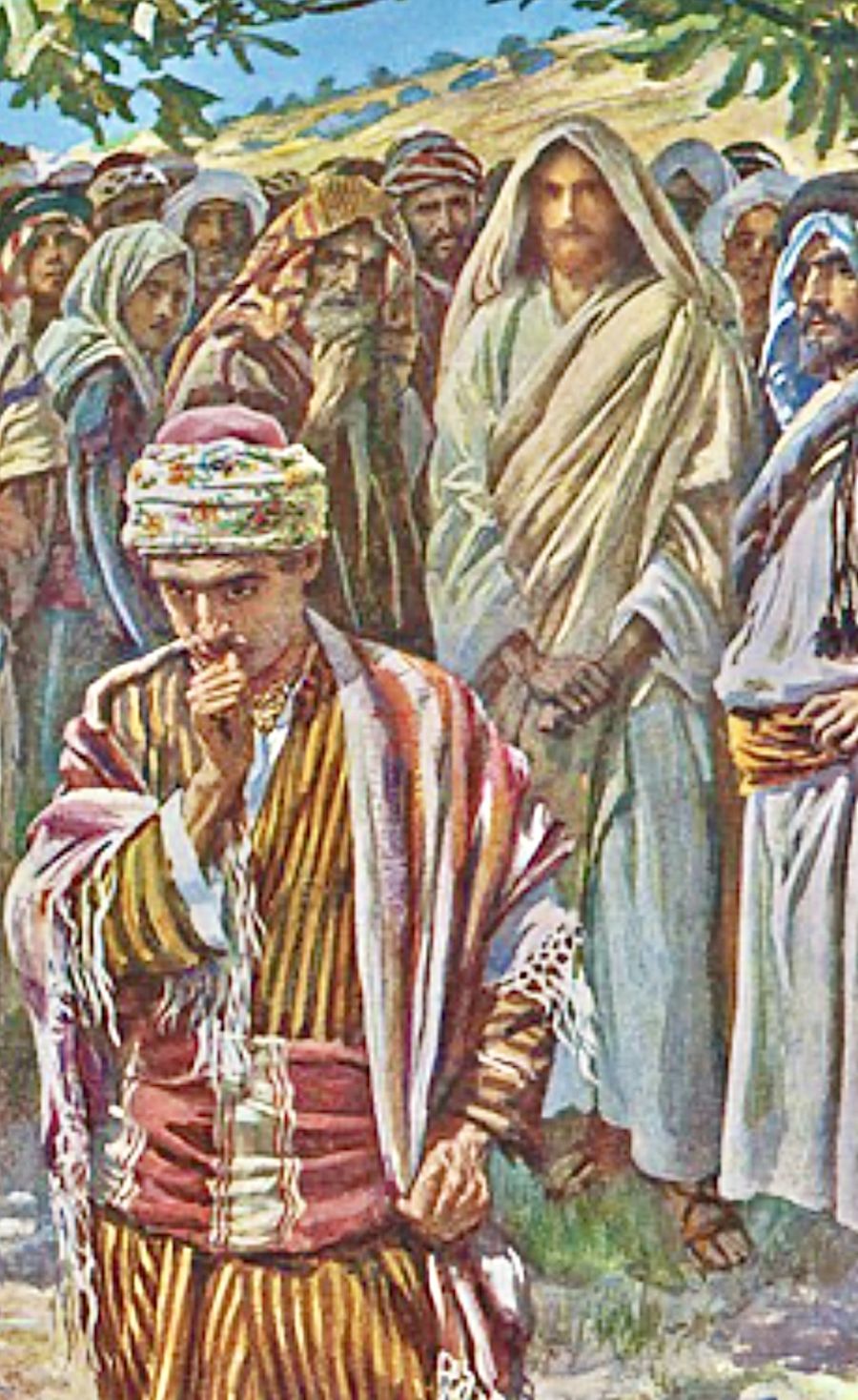
(Mt 19:16-22)


At the time of Jesus, people lived a moment of social collapse and disintegration of the communitarian dimension of life - in the past more related to family, clan and community.

Herod's policy guaranteed the Empire control of the situation: a reality of maximum exploitation and severe economic and civil repression.

Religious impositions even ensured the subjugation of consciences - and the spiritual authorities were happy to act as guarantors of this most covert form of slavery.

The condition of total (civil and religious) subjugation of the people everywhere tended to diminish the sense of interpersonal and group fraternity.

There was no lack of severe conditions of social and cultural exclusion, which accentuated the bewilderment of the people, who were marginalized, homeless and without references - even religious ones.

Some movements attempted to reweave the lacerations and propose shared forms of life, certainly - but united by an idea of nagging decontamination [Essenes, Pharisees, Zealots].

Jesus chooses the path of a decisive vital redemption, as opposed to the ideologies of the ascetic purism and custom rediscovery.

For a radical fulfilment of the spirit of the Law, it was necessary to go beyond doctrines. They excite some, yet they do not erase our inner sense of emptiness.


The community of sons does not keep itself within the 'limits', and does not live apart; thus it does not accentuate the torments of imperfection, or the perception of incompleteness, nor the marginalizations - but welcomes them.

It does not feel endangered by contact with the realities that the external legalism of devotion considered dangerous and cursed or in sin. It trembles for them.

The Church recognises the value of existential poverties: it feels it’s not enough to seek “good things” without 'fire' within.

It confesses the richness not of everything that is already recognizable and static, but of new positions and differing relationships, which dilate the present and open up creative visions of the future.

Faith, in short, is not a popularly identified belief capable of accrediting roles, tasks and characters.


In vv.18-19 Jesus does not enumerate commandments that would make the interlocutor [as they used to say] live 'more from near' to 'God alone', but the criteria that bring us close and alongside our sisters and brothers.

The honour reserved for the Father is not one of many forms of competitive love: the threshold is the neighbour.

The Son does not even mention the first commandments, those identifying the exalted Lord of his people.

Our hands embrace the time-less… in concrete love.

They trigger the dynamisms that annihilate the torments of the least, and thus in an unthinkable way help us rediscover the meaning and joy of life - letting the world be reborn [far more than with the usual forms of insurance].

Conscious living does not have to do with usage and clichés [which produce alibis] but with another serenity and joy: the wonder of the unusual and of new degrees, places, states, relationships, situations.

There is no other richness that can fill our days, while there is only sadness (v.22) in the old bonds without humanity. They lower us all into an artificial mental and emotional reality.

To detach oneself from immediate calculation seems an absurd choice, far-flung and destined to go wrong, but on the contrary, it is the winning move that opens the door to new Life of the Kingdom and to Happiness, which can be accessed precisely when tangible goods are transformed into Relationship.


Let us free ourselves from the plethora of misguided goals that crush our paths, making them swampy.

We have to reflect well on «that which is eminent» (v.17).


To internalize and live the message:


Have you learnt to embrace your life from the Goodness of God, or to be lulled and content with what is there - just within reach?


[Monday 20th wk. in O.T.  August 17, 2026]

227 Last modified on Monday, 17 August 2026 12:00
don Giuseppe Nespeca

Giuseppe Nespeca è architetto e sacerdote. Cultore della Sacra scrittura è autore della raccolta "Due Fuochi due Vie - Religione e Fede, Vangeli e Tao"; coautore del libro "Dialogo e Solstizio".

These divisions are seen in the relationships between individuals and groups, and also at the level of larger groups: nations against nations and blocs of opposing countries in a headlong quest for domination [Reconciliatio et Paenitentia n.2]
Queste divisioni si manifestano nei rapporti fra le persone e fra i gruppi, ma anche a livello delle più vaste collettività: nazioni contro nazioni, e blocchi di paesi contrapposti, in un'affannosa ricerca di egemonia [Reconciliatio et Paenitentia n.2]
Mary "Girl" [...] point of convergence and arrival of a complex of divine promises, mysteriously echoed in the very heart of history (Pope John Paul II)
Maria “Bambina” […] punto di convergenza e di arrivo di un complesso di promesse divine, echeggiate misteriosamente nel cuore stesso della storia (Papa Giovanni Paolo II)
Luke’s passage puts before the eyes a double slavery: that of man «with his hand paralyzed, slave of his illness», and that of the «Pharisees, scribes, slaves of their rigid, legalistic attitudes» (Pope Francis)
Il racconto di Luca mette davanti agli occhi una duplice schiavitù: quella dell’uomo «con la mano paralizzata, schiavo della sua malattia», e quella «dei farisei, degli scribi, schiavi dei loro atteggiamenti rigidi, legalistici» (Papa Francesco)
Origen says “we should practise this symphony” (Commentary on the Gospel according to Matthew, 14,1), in other words this harmony within the Christian community [Pope Benedict]
Dice Origene che “dobbiamo esercitarci in questa sinfonia” (Commento al Vangelo di Matteo 14, 1), cioè in questa concordia all’interno della comunità cristiana [Papa Benedetto]
Thus in communion with Christ, in a faith that creates charity, the entire Law is fulfilled. We become just by entering into communion with Christ who is Love (Pope Benedict)
Così nella comunione con Cristo, nella fede che crea la carità, tutta la Legge è realizzata. Diventiamo giusti entrando in comunione con Cristo che è l'amore (Papa Benedetto)
«Francis was reproaching his brethren too harsh towards themselves, and who came to exhaustion by means of vigils, fasts, prayers and corporal penances» [FS 1470]
«Francesco muoveva rimproveri ai suoi fratelli troppo duri verso se stessi, e che arrivavano allo sfinimento a forza di veglie, digiuni, orazioni e penitenze corporali» [FF 1470]
From a human point of view, he thinks that there should be distance between the sinner and the Holy One. In truth, his very condition as a sinner requires that the Lord not distance Himself from him, in the same way that a doctor cannot distance himself from those who are sick (Pope Francis)
Da un punto di vista umano, pensa che ci debba essere distanza tra il peccatore e il Santo. In verità, proprio la sua condizione di peccatore richiede che il Signore non si allontani da lui, allo stesso modo in cui un medico non può allontanarsi da chi è malato (Papa Francesco)
The life of the Church in the Third Millennium will certainly not be lacking in new and surprising manifestations of "the feminine genius" (Pope John Paul II)
The basis of Christian construction is listening to and the fulfilment of the word of Christ (Pope John Paul II)
Alla base della costruzione cristiana c’è l’ascolto e il compimento della parola di Cristo (Papa Giovanni Paolo II)

Due Fuochi due Vie - Vol. 1 Due Fuochi due Vie - Vol. 2 Due Fuochi due Vie - Vol. 3 Due Fuochi due Vie - Vol. 4 Due Fuochi due Vie - Vol. 5 Dialogo e Solstizio I fiammiferi di Maria

duevie.art

don Giuseppe Nespeca

Tel. 333-1329741


Disclaimer

Questo blog non rappresenta una testata giornalistica in quanto viene aggiornato senza alcuna periodicità. Non può pertanto considerarsi un prodotto editoriale ai sensi della legge N°62 del 07/03/2001.
Le immagini sono tratte da internet, ma se il loro uso violasse diritti d'autore, lo si comunichi all'autore del blog che provvederà alla loro pronta rimozione.
L'autore dichiara di non essere responsabile dei commenti lasciati nei post. Eventuali commenti dei lettori, lesivi dell'immagine o dell'onorabilità di persone terze, il cui contenuto fosse ritenuto non idoneo alla pubblicazione verranno insindacabilmente rimossi.






