


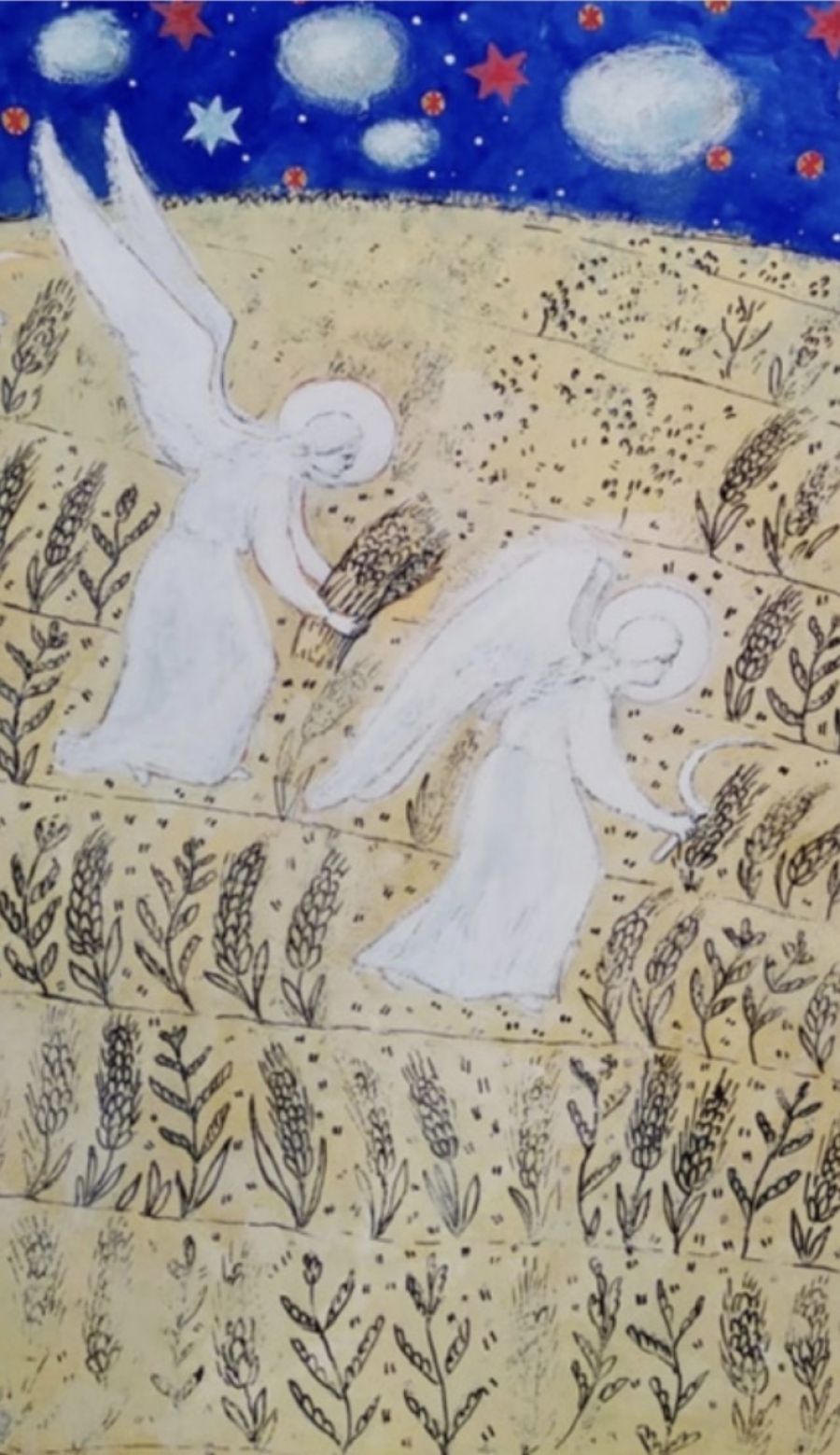
Weeds and possibilities: the sense of the happy Mystery - from the shortcomings
(Mt 13:24-30)
The metaphor that follows the initial parable is intended to emphasize that the presence of “evil” in the world is not to be attributed to the lack of vitality of the Seed, nor to the divine Work.
And Jesus upsets the precipitous cliché of apostolic morality:
«So You want us to go and gather them? But He declares: No, for by reaping the tares you may uproot the wheat with them. Let both grow together until the harvest.» (vv.28-30).
In his commentary on Tao Tê Ching xxxvi master Wang Pi writes: «By conforming to the nature of creatures, the best way to avoid future difficulties is to induce them to spontaneously run to ruin, without subjecting them to punishment».
Qualities are intertwined with errors, weaknesses and inconsistencies, but from the earliest days in the communities, some believers struggled to live with the different mentalities of their brethren of faith - a situation that nevertheless allowed life to teem.
It was experienced that time was the best medicine to make the parasitic weed spontaneously dry up: and it did not even was turning out to be so infertile; quite the contrary.
The parable of the good wheat and the weeds is meant to help us not to fall into exclusivism - not because of ideological issues, but vital ones.
The rough hands of some disciples would tear up all the intertwining of the various roots with the earth and each other.
Premature sorting would ruin everything good in the present, and the future itself.
The Lord's teaching is a reminder.
It is not immediate to understand the multifaceted significance of these preparatory energies, which from their magma and dissent will give birth to the unexpected attunements of God's inopinable future.
New opportunities also sprout from personal or institutional mediocrity. Even it a paradoxical condition of growth and prosperity of the Church, 'perfect' to the extent that it recognises itself on the path of conversion to Christ: «semper conformanda».
As in the Community, those who face life in the Spirit and wish their adventure to flourish, must learn to respect discomforts and make contradictions live within themselves.
The uniformity of fundamentalists or purists would like an external, immediate and decisive justice (in eloquent forms) but only God is able to plumb the depths of events.
Fraternities must not enclose themselves within suffocating hedges.
They have the mission to learn dialogue with differences and standing with disparate oppositions, so that life becomes rich through diverse relationships and the concrete exchange of personal gifts, in varied and even discordant contexts.
Such is the added value that opens up New Life, while the myth of indefectibility remains confined to sects.
In fact, not infrequently that very side of ourselves that we do not want, that we reject, that we would like to exclude or correct - and misjudged by others - has perhaps already revealed itself or will in time reveal itself to be the best part of us, both from the point of view of exceptional realisation of personality and of the Calling by missionary Name.
Each believer is both 'ally' and unfaithful at the same time, but in such friction lurks the new sparks [also of disappointment, but fruitful] and our completion - traversing the paradoxes of fallibility.
As well as unprecedented cultural, even economic, political and social paths.
The Church is imperceptible beginning, not extraordinary term
(Mt 13:31-35)
Jesus helps people to discover the things of God and man in everyday life.
The Master teaches that the extraordinary of the eternal world is hidden in ordinary things: life itself is a transparency of the Mystery.
He reveals the Kingdom becoming Present, describing precisely the essential characteristics of the community of disciples - and using here the simple comparisons of the «mustard seed» and the «leaven».
To say: the authentic Church is within reach of everyone, everywhere - nonetheless exiguous; inapparent, yet intimately dynamic.
In it, we experience a contrast between beginnings and term: we experience the Kingdom 'within' each one that welcomes the character of an inapparent Word-event, but one that activates transformative and hospitable capacities.
The first term of comparison related to the life of the people [the little seed] mentions the story of a very small grain: a common concrete event, which is not very noticeable.
Around the Lake of Galilee, mustard shrubs can reach a maximum height of 3 metres, no more.
It is not the same development as the majestic cedars of Lebanon - rather of just any small tree in the kitchen garden (v.32), however, capable of giving a little refreshment to the birds that take refuge there.
It indicates a presence of little fuss: quite normal, mixed in with aubergines, courgettes and cucumbers...
Nothing big, yet hospitable to those suffering from the powerful heat of those places.
In short, the fraternities that the Lord dreams of will have nothing magnificent and outward, but they will know how to give shelter and rest.
The strength of the «mustard speck» is intimate, yet strong-willed: it will grow - though not by much.
That is, the authentic Church should not resemble a majestic ocean liner.
Maybe it will be more like a small barque: no big deal - yet it will raise hopes of life.
It will do so through the discreet witness of amiable evangelisers, who still proclaim and work, radiating light, captivating people.
Whoever approaches the threshold of the churches - the reference is to the distant and pagan - must feel at ease, at home.
Even the 'wanderers' will be fully entitled to take up their position and build their nest [in such a common Abode] even if they then decide to take flight again as soon as they have used it.
The next comparison - of the «leaven» (v.33) - insists on caring for the life goals of other brethren, with respect to the Community of believers.
In this way, it is called to be a sign of the Father's concern for all his sons.
The leaven is not useful to itself, but to the mass.
Likewise, the Church shall not serve itself; it will not be concerned with its own celebration and development [material, or with a view to proselytism; and so on].
Every Fraternity in Christ is a function of people's lives alone, where and how they are - just as they are.
To internalize and live the message:
What seed had you neglected because of its smallness, and then it turned out to be essential for your growth and the needs of others as well?
Completeness: Duplicity
From the fascinating proposal of Faith to the fatigue of withdrawal
(Mt 13:24-43)
The parable of the Sower as historically narrated by Jesus (vv.3-8) and that of the tares (vv.24-30) denote the total positivity of his Message.
The Lord proclaimed a new world; above all a different, tolerant and benevolent Heaven.
Even vv.18-23 contain a Good News, rather than a judgment: in our field both good wheat and weeds arise spontaneously, but all this is not a curse; on the contrary (v.23c).
It must however be admitted that the metaphor of vv.37-43 transforms the original parable (vv.24-30) into a moral allegory.
With symbolic elements, the different figurative expressions take up the original narrative of Jesus, trying to interpret it according to the common codes of traditional rabbinic preaching.
As for the teachers of Israel, here too the [next] intent is to shake the listeners, in order to emphasize the personal, community and spiritual importance of the fundamental choices - in the present.
At House (v.36), that is, in the Church, a debate is created first of all on the explanation of why Jesus does not impose a preventive sterilization of the wheat field.
In the uncertainty, particular clarifications are attempted - according to which, however, the passage [which is the result of subsequent editing, debate and reflection] risks overturning the meaning of the Jesus parable itself.
Well, in his people of brethren and in society, the Master did not intend to erase a priori the profitable sense of the ineffable and mysterious dynamics of ‘mixing’: reality of this world with full rights.
Such is the essential, universalist Proclamation of the young Rabbi, in spite of the ancient purist clichés.
Legalist religiosity was selective, élitist, conformist; attentive to the maintenance of social hierarchies.
In this way, it constituted a dense-mesh cultural hood, and evaluated in an abstract, preventive mode, what should be considered good or bad for all.
Yet the idea of algid perfection [sterile of life] did not allow the energies of concrete existence to prepare the future and generate the same Novelty of the Spirit.
Christ's encounter with the believer changes everything in his life, certainly - but not from an assumed gradation of values, procedures and pre-written sentences.
In reality one becomes attentive to perceive the eccentricity of the sisters and brothers by the fact that one has experienced the blessing embrace of the Father on his own "defects".
Not for a sense of emotional paternalism, but because not infrequently the resources that solve real problems and activate the Redemption of God come from the whirlwind of precious contradictions and indigences that we have inside.
They make us less one-sided, more flexible and complete. Exceptional, alive; able to rely on the internal world, instead of the external one.
So capable to implement a turning point.
We see it: to make the world grow and reborn from the global crisis, each subject (even institutional) is called to reinvent itself outside of every score already arranged and recognized.
And today perhaps starting from what in the habit of thought was considered nothing but sin, or annoying dissonance; incompleteness, limit... so on.
Suddenly and blatantly, imbalances and fluctuations make a difference also in terms of quality. They become opportunities not to be missed: an extra gear; spring power, a drive to activate the unprecedented, and open up.
Here is a substantial difference between common religiosity and the life of Faith. The character of Duplicity makes us healthier and more perfect - and God is not biased.
Indeed, in the eyes of the Father it is precisely the unrepeatable uncertainties [not by protocol] that make every one of his sons special, unique.
In short, you grow, get richer, and correspond to your personal Vocation, only by putting into play, integrating and transmuting boundaries - not denying them.
«St Augustine commenting on the parable noted “many are at first tares but then become good grain”, and he added: “if these, when they are wicked, are not endured with patience they would not attain their praiseworthy transformation” (Quaest. septend. in Ev. sec. Matth., 12, 4: PL 35, 1371)»
[Pope Benedict; Angelus July 17, 2011]
[16th Sunday in O.T. (year A) July 19, 2026]








