


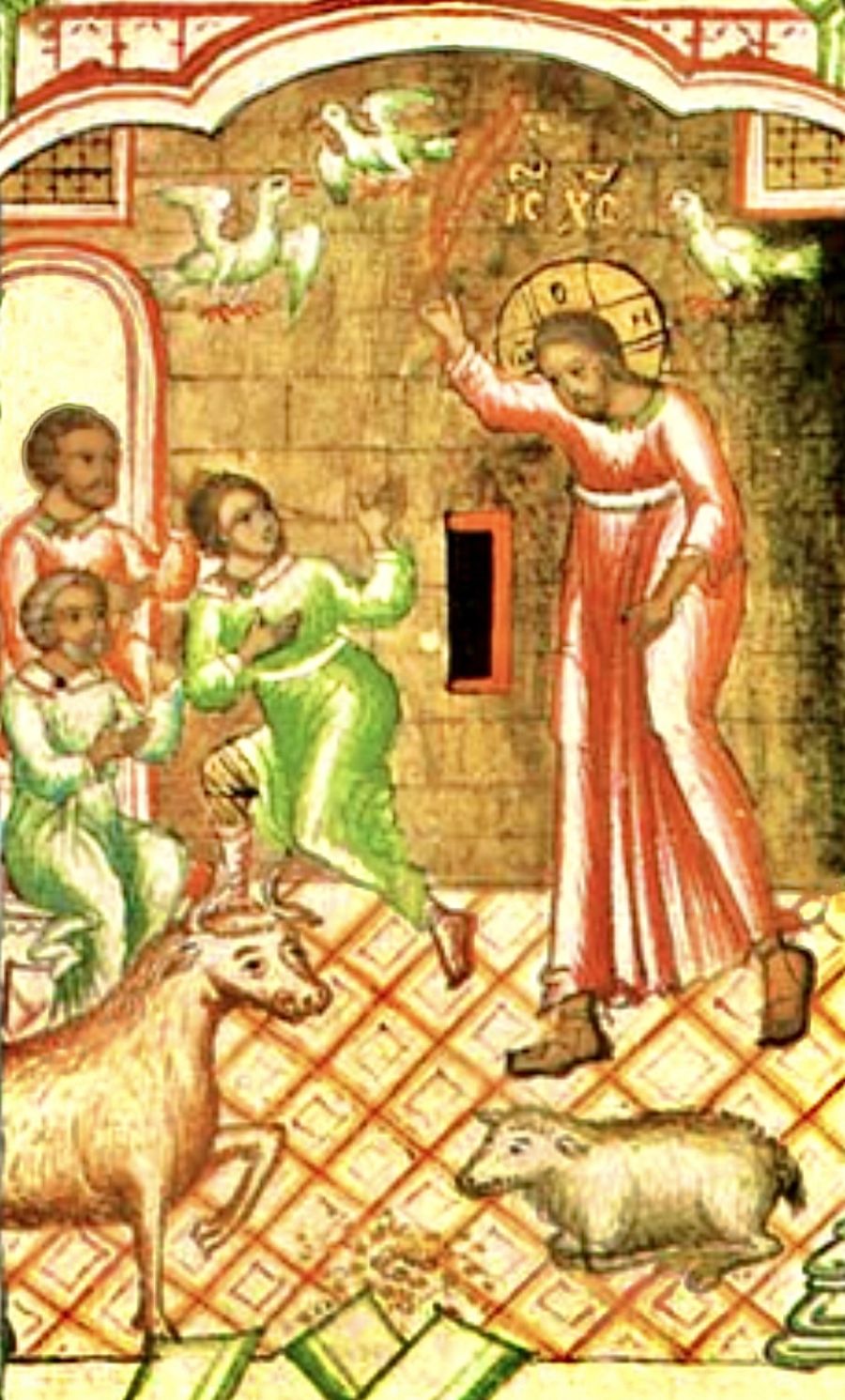
(Mk 11:11-25)
The curse spoken by Jesus (vv. 13–14) precedes the expulsion of the money-changers from the Temple, which had become a den of thieves and usurers (vv. 15–17).
It was the spark needed to set in motion the revolution against the systems that were stifling people’s lives.
Christ is not a devoted and obedient son of his culture and devotion; on the contrary, he is an adult who risks being disliked - without inferiority complexes towards the chain of command.
So the barren fig tree in the Gospel passage is not just Israel: above all, it is a figure of the Sanctuary, full of magnificence and devoid of tenderness.
It did not make hearts beat and leap for joy, rather it excluded the very weak.
But it was its twilight (v.11): the Lord preferred to exodus to a small family reality, of only sisters and brothers. In Bethany, there was no such creeping sense of compromise.
In this way, Christ - who with his intimates 'comes out' of the Temple - reveals himself to be the jealous [authentic] guardian of the sacred place, which has unfortunately become a sprawling organism.
Having recognized that oppressive root, with no further escape for conversion - shortly afterwards he will be forced to announce its defeat (13:1-2).
Free and fulminating insight: the Master does not simply proclaim a restyling, as they all did - even the prophets, who were finally content to preach a simple purification.
In short, the Father would have dreamed of the tasty, tender, sugary fruits of love from his sons, yet he had to be content with 'leaves' (v.13).
The transformation of the Temple of Jerusalem into a marketplace reflects the trend of many places of worship in antiquity: as elsewhere, the sacred place had become an external reality.
This is why Jesus proclaims the primacy of personal Faith over formal pious appearances (vv.22-24) where the ruling classes recycled everything.
Those most affected and harassed by the theatrical and disgusting situation were precisely the most insecure strata of the population.
For 'due' offerings, the wretched could turn not to the sellers of herds, but of doves [towards whom the Master's wrath is directed: v.15].
It was the shaky who were the true sacrificial victims of the beautiful official system.
The needy creatures were in fact manipulated like flocks, immolated to the logic of the institution - seized by vigilant customs officers.
After all, a large part of the population of the holy city lived off the Temple's economic inducement [«fig» with inedible fruit].
For this reason, the chosen people have become barren, and so has their characteristic, identity centre - now a withered tree (vv.20-21).
The eyes of the authorities were on ambition. They had everything but the idea of the House of Prayer (v.17) as a living sanctuary and universal meeting place.
Nothing to do with Faith, which is not ideological assent, but critical action, an exceptional and dissimilar gesture; capable of opening the door wide even to severe, sharp, not moneymaking judgements.
It starts from a Vision and appropriates it (v.24), attracting it like a magnet; by actualising and anticipating future. By discovering astonishing and different wonders precisely in what the religiosity of the moment, conformist, may consider impure, illicit, unadorned, inappropriate, unbecoming; unfashionable. And not profitable.
Let alone imagine that a new people with no strategic weight, with no military or diplomatic support, with no real means of deterrence, could supplant the pyramidal, “ideal” and productive mechanisms of fine manners and empire.
And provide a new global Message on the face of God, woman, man, the world... As impossible as imagining a mountain sinking into the sea (v.23).
The same applies to his unrepeatable expression in the prayer (v.24): a coup de main, even scratching - which follows the Hearing of a God who reveals himself in the soul of his 'envoy', without putting on too much of a show.
From the intimately amicable adherence derives a first-person involvement and a special sensitivity, which become intense Dialogue, Image-Vision, growing Discovery; anticipatory Action.
Only from a mind realized according to instinct and vocation will spontaneous forgiveness then arise (vv.25-26): because the gaze of one who has let in unexpected energies has already moved far beyond the spite received. Or indeed, the latter has been its fruitful matrix.
Faith and Prayer are therefore not intimist and swampy realities, as in normalised, epidermic and banal pious life, but propulsive of great - even epochal - novelties.
Here is drawn the comparison between Temple and Person, doctrine and Faith, discipline and behaviour, presumption and authentic Encounter.
Comparison analogous to the still all-current one: between institution and uniqueness, representation and reality, flag and generous 'sacrament'.
For the biblical faith - acutely personal - what is really worthwhile is to discover God revealing himself on one's own path, even made up of vile and opposing elements.
Hence giving in and allowing oneself to be led - not… representing it with spineless ideas, or with magnificent, epidermal, empty displays.
[Friday 8th wk. in O.T. May 29, 2026]








