May 20, 2026 Written by 

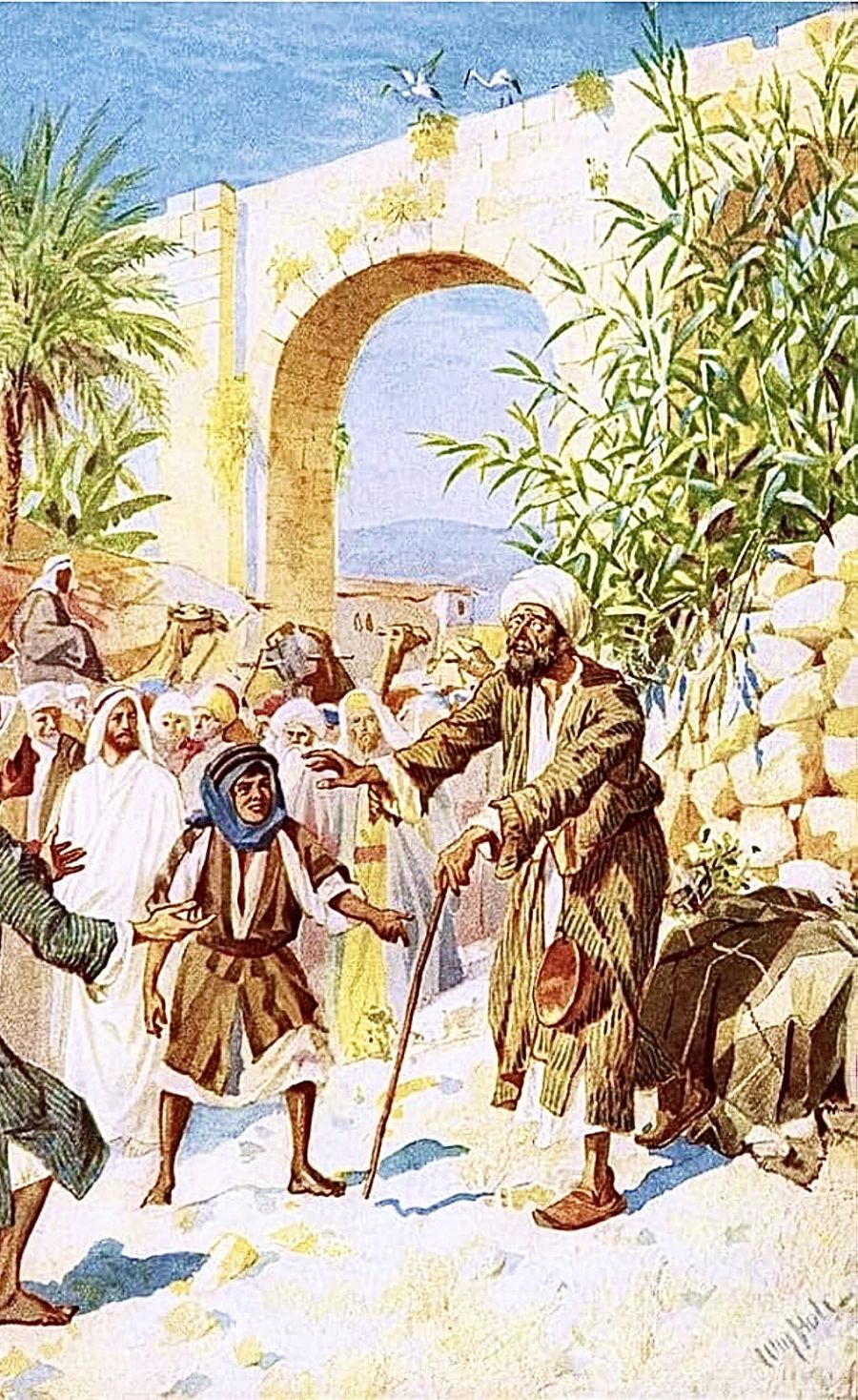
The movement of the priesthood of Christ: Bartimaeus lifts his gaze

(Mk 10:46-52)


The passage in Mk is the agile fruit of the interweaving of a catechesis explaining the immediately preceding passage [the Apostles' aims] and the teaching on the very first forms of baptismal liturgy reserved for the new believers, called 'photismòi-enlightened' [those who from the darkness of pagan life finally opened their eyes to the Light].

The passage illustrates what happens to a person when he meets Christ and receives his existential orientation: he abandons established but not personally reworked positions, and becomes a critical witness.

The narrative is set on the comparison between downward material gazes (such as those of pagans or arrogant followers) and open gazes, capable of lifting the human eye from the fetters of semblance, habit, and destructive outer or inner powers.

What, then, is needed to see with the perception of God, beyond appearances, and to lift oneself up from a grey life of handouts, literally on the ground? How to heal the vision of those who are disoriented?

Bartimaeus [verbatim, the 'son of the valued one'] represents us: he is not a free man, capable of activating himself - but influenced by a frantic search for prestige and recognition.

The «son of the honoured man» is not biologically blind, but one who adjusts himself haphazardly. He is unable to «look up» [the Greek key-verb in vv.51-52 is aná-blépein] because he does not cultivate ideals; he is content with what the environment around him grants, which anaesthetizes him.

If one finds oneself at this level of myopia, it is better to 'lift one's gaze' bent over one's navel for ridiculous and short-sighted things.

Bartimaeus is a man of habit, he is accompanied to the same places every day by the same people.

He is standing still, «sitting» (v.46) at the edge of a road where people are moving forward and not just surviving resignedly, as he does.

Bartimaeus types expect everything from the recognition of others; they live only by begging. They repeat words and gestures that are always identical.

Their horizon at hand does not allow them to enter the flow of the Way where people are busy building, evolving, expressing themselves, providing for their less fortunate sisters and brothers.

An existence dragged along the fringes of any interest, other than one's own lazy pouch.

They live off the movement of others; they feel gratified by the petty benevolences and opinions bartered by those who pass by, by ideas that are never sifted and made their own.

But the Word of the Nazarene triggers the indolent. And his new attitude becomes that of the 'newborn'. In this way, he engages in an industrious, creative, practical - futuristic model of life.

He rises again dynamically, getting rid of the rags on which he expected others to lay something in his favour.

The old garment ends up in the dust - cast far away as in the ancient baptismal liturgies: at any age it undertakes, outclassing small cabotage securities.

He changes his life, looks it in the face; even though he knows he is complicating it, making it challenging and countercurrent.

Personal contact with Jesus corrected his gaze, made him regain his ideal perspective.

Now he understands the primordial and regenerating - indeed, recreating - sense of the Newness of God.

The face-to-face Meeting gave him a diametrically opposite model of a successful man; not subservient to tactics.

In short, Jesus corrects the inert myopia of those who are fond of their mediocre place.


Religiousness or personal Faith: the choice is decisive.

It means lazily adapting to fashions of circumstance or the old dress of already “said” behaviours and usual friendships, just waiting for some solution-lightning that does not involve too much…

Or leave there, reinvent their lives, abandon the 'mantle' [cf. Mk 10:50] on which comments and common mites were collected.

By opening his eyes and «lifting them up», as an already divine man would do. Pocketing nothing but pearls of light, instead of handouts.

On muddy roads we may get dirty and be uncertain, but we can proceed there in the movement of Christ's priesthood, with sound perception.

In fact - as in this episode - the Gospels not infrequently insist on the (devoutly absurd) criterion that the enemy of God is not sin, but the 'average, passive life' of the «honoured man», identified and placed.


[Thursday 8th wk. in O.T.  May 28, 2026]

241 Last modified on Thursday, 28 May 2026 12:12
don Giuseppe Nespeca

Giuseppe Nespeca è architetto e sacerdote. Cultore della Sacra scrittura è autore della raccolta "Due Fuochi due Vie - Religione e Fede, Vangeli e Tao"; coautore del libro "Dialogo e Solstizio".

The drama of prayer is fully revealed to us in the Word who became flesh and dwells among us. To seek to understand his prayer through what his witnesses proclaim to us in the Gospel is to approach the holy Lord Jesus as Moses approached the burning bush: first to contemplate him in prayer, then to hear how he teaches us to pray, in order to know how he hears our prayer (Catechism of the Catholic Church n.2598)
L’evento della preghiera ci viene pienamente rivelato nel Verbo che si è fatto carne e dimora in mezzo a noi. Cercare di comprendere la sua preghiera, attraverso ciò che i suoi testimoni ci dicono di essa nel Vangelo, è avvicinarci al santo Signore Gesù come al roveto ardente: dapprima contemplarlo mentre prega, poi ascoltare come ci insegna a pregare, infine conoscere come egli esaudisce la nostra preghiera (Catechismo della Chiesa Cattolica n.2598)
“Love is an excellent thing”, we read in the book the Imitation of Christ. “It makes every difficulty easy, and bears all wrongs with equanimity…. Love tends upward; it will not be held down by anything low… love is born of God and cannot rest except in God” (III, V, 3) [Pope Benedict]
«Grande cosa è l’amore – leggiamo nel libro dell’Imitazione di Cristo –, un bene che rende leggera ogni cosa pesante e sopporta tranquillamente ogni cosa difficile. L’amore aspira a salire in alto, senza essere trattenuto da alcunché di terreno. Nasce da Dio e soltanto in Dio può trovare riposo» (III, V, 3) [Papa Benedetto]
For Christians, non-violence is not merely tactical behaviour but a person's way of being (Pope Benedict)
La nonviolenza per i cristiani non è un mero comportamento tattico, bensì un modo di essere (Papa Benedetto)
The Angel does not enter our room visibly, but the Lord has a plan for each of us, he calls each one of us by name (Pope Benedict)
Nella nostra camera l’Angelo non entra in modo visibile, ma con ciascuno di noi il Signore ha un suo progetto, ciascuno viene da Lui chiamato per nome (Papa Benedetto)
A mysterious love, which in the texts of the New Testament is revealed to us as God’s boundless and passionate love for mankind. God does not lose heart in the face of ingratitude (Pope Benedict)
Un amore misterioso, che nei testi del Nuovo Testamento ci viene rivelato come incommensurabile passione di Dio per l'uomo. Egli non si arrende dinanzi all'ingratitudine (Papa Benedetto)
Jesus showed us with a new clarity the unifying centre of the divine laws revealed on Sinai […]  Indeed, in his life and in his Paschal Mystery Jesus brought the entire law to completion.  Uniting himself with us through the gift of the Holy Spirit, he carries with us and in us the “yoke” of the law, which thereby becomes a “light burden” (Pope Benedict)
Gesù ci ha mostrato con una nuova chiarezza il centro unificante delle leggi divine rivelate sul Sinai […] Anzi, Gesù nella sua vita e nel suo mistero pasquale ha portato a compimento tutta la legge. Unendosi con noi mediante il dono dello Spirito Santo, porta con noi e in noi il "giogo" della legge, che così diventa un "carico leggero" (Papa Benedetto)
An ancient hermit says: “The Beatitudes are gifts of God and we must say a great ‘thank you’ to him for them and for the rewards that derive from them, namely the Kingdom of God in the century to come and consolation here; the fullness of every good and mercy on God’s part … once we have become images of Christ on earth” (Peter of Damascus) [Pope Benedict]

Due Fuochi due Vie - Vol. 1 Due Fuochi due Vie - Vol. 2 Due Fuochi due Vie - Vol. 3 Due Fuochi due Vie - Vol. 4 Due Fuochi due Vie - Vol. 5 Dialogo e Solstizio I fiammiferi di Maria

duevie.art

don Giuseppe Nespeca

Tel. 333-1329741


Disclaimer

Questo blog non rappresenta una testata giornalistica in quanto viene aggiornato senza alcuna periodicità. Non può pertanto considerarsi un prodotto editoriale ai sensi della legge N°62 del 07/03/2001.
Le immagini sono tratte da internet, ma se il loro uso violasse diritti d'autore, lo si comunichi all'autore del blog che provvederà alla loro pronta rimozione.
L'autore dichiara di non essere responsabile dei commenti lasciati nei post. Eventuali commenti dei lettori, lesivi dell'immagine o dell'onorabilità di persone terze, il cui contenuto fosse ritenuto non idoneo alla pubblicazione verranno insindacabilmente rimossi.






