May 11, 2026 Written by 

Testament in prayer: Mysticism of the Glory (for each son)

(Jn 17:1-11a)


Even in the fourth Gospel the Last Supper is followed by Jesus’ prayer, but unlike the Synoptics, Jn places it in the same Upper Room.

In the narrative of the first three Gospels, several notes tell of the Lord's intimate repugnance to the Cross - from which, however, He does not shy away, from which He does not allow himself to be overcome.

Here He only asks the Father for the indestructible quality of the Life of the Eternal in favour of his own, who have already come to know the intimacy of God: it opens up every reverberation.

To acknowledge the Son of Man as Lord is to accept a new form of existence in the Spirit.

Like a Wind that [regenerating us from within] makes itself the medium and continuer of the work of creation.

We are witnesses to a founding, glorious Relationship, that is of such value that it reactivates all destiny - beyond concatenations.

Such a platform overcomes the sense of unworthiness.

On it, here we are enabled to become passionate ‘inventors of roads’ everywhere.

Introduced into a Communion which is already here and now «Life of the Eternal» (vv.2-3). It comes from the ‘knowing’ the Father and the Son.

And it is concentrated in an Hour (v.1): an allusion that had run through the entire fourth Gospel.

Jesus' existence converges in the fruitful rawness of that point, which gives depth to everything.


The text differs from previous catecheses in that it is more amicable than teaching.

The Master retraces his story as a commitment to manifest the Father, to make us become signs of his Face.

Christ understands that the children are subject to seductions, and they risk losing the meaning of the believing in Him. Indeed, they still find it difficult to understand that Glory is not the fruit of worldly victory.

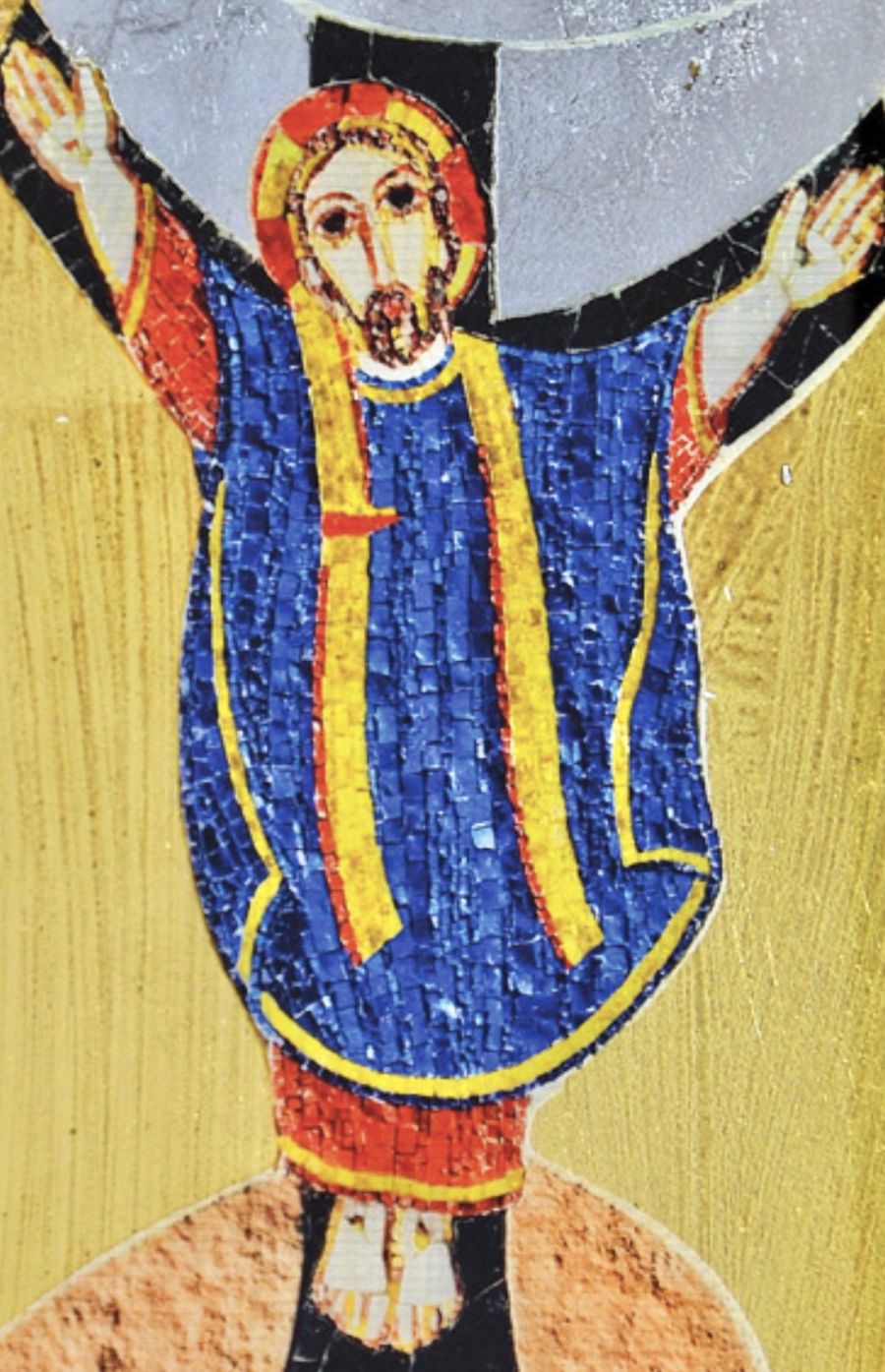
«Glory» in Jn stands for the manifestation of the Face of Eternal Love in the raising of the Cross.

Presence of the God-With - unveiling of His confidence, understanding, tenderness, recovery of opposing sides.

In this way, Glory of the Risen One is not a Relationship that remains closed in Heaven, between Father and Son.

The latter has given his intimates the «Name» (vv.6.11) i.e. revealed the Father and given access to his real Person - including the struggles undertaken.

Person who feeds us with the Word, and the sense of His events.

Such an unmistakable Voice reminds that every travail can lead us deeper with Jesus into the Glory and eternity of the Father.

God's intimate life is intensity of understanding; reciprocity that flows into expanded, open, fervent union, tending to transmute every tribulation into an appeal to new kabôd-glory.

It is about the specific [qualitative] weight that the believer assumes in a Heaven also perceivable by the senses.


Any difficulty, anguish, insecurity, now even becomes a point to converge on.

Like the Lord, the disciples do not go to death, but to the Way of complete Life that annihilates distance.

All this through a unity that deflects habits and puts one in touch with the energies of the intimate primordial bond, source-and-culmination, Father-Son.


[Tuesday 7th wk. in Easter, May 19, 2026]

223 Last modified on Tuesday, 19 May 2026 12:00
don Giuseppe Nespeca

Giuseppe Nespeca è architetto e sacerdote. Cultore della Sacra scrittura è autore della raccolta "Due Fuochi due Vie - Religione e Fede, Vangeli e Tao"; coautore del libro "Dialogo e Solstizio".

Jesus showed us with a new clarity the unifying centre of the divine laws revealed on Sinai […]  Indeed, in his life and in his Paschal Mystery Jesus brought the entire law to completion.  Uniting himself with us through the gift of the Holy Spirit, he carries with us and in us the “yoke” of the law, which thereby becomes a “light burden” (Pope Benedict)
Gesù ci ha mostrato con una nuova chiarezza il centro unificante delle leggi divine rivelate sul Sinai […] Anzi, Gesù nella sua vita e nel suo mistero pasquale ha portato a compimento tutta la legge. Unendosi con noi mediante il dono dello Spirito Santo, porta con noi e in noi il "giogo" della legge, che così diventa un "carico leggero" (Papa Benedetto)
An ancient hermit says: “The Beatitudes are gifts of God and we must say a great ‘thank you’ to him for them and for the rewards that derive from them, namely the Kingdom of God in the century to come and consolation here; the fullness of every good and mercy on God’s part … once we have become images of Christ on earth” (Peter of Damascus) [Pope Benedict]
Afferma un antico eremita: «Le Beatitudini sono doni di Dio, e dobbiamo rendergli grandi grazie per esse e per le ricompense che ne derivano, cioè il Regno dei Cieli nel secolo futuro, la consolazione qui, la pienezza di ogni bene e misericordia da parte di Dio … una volta che si sia divenuti immagine del Cristo sulla terra» (Pietro di Damasco) [Papa Benedetto]
"How will we be able to live without him?". In these words of St Ignatius we hear echoing the affirmation of the martyrs of Abitene: "Sine dominico non possumus" [Pope Benedict]
"Come potremmo vivere senza di Lui?". Sentiamo echeggiare in queste parole di Sant’Ignazio l’affermazione dei martiri di Abitene: "Sine dominico non possumus" [Papa Benedetto]
The kingdom of Christ is manifested, as the Council teaches, in the 'kingship' of man [John Paul II]
Il regno di Cristo si manifesta, come insegna il Concilio, nella “regalità” dell’uomo [Giovanni Paolo II]
In the middle of the dense forest of rules and regulations — to the legalisms of past and present — Jesus makes an opening through which one can catch a glimpse of two faces: the face of the Father and the face of the brother. He does not give us two formulas or two precepts: there are no precepts nor formulas. He gives us two faces [Pope Francis]
In mezzo alla fitta selva di precetti e prescrizioni – ai legalismi di ieri e di oggi – Gesù opera uno squarcio che permette di scorgere due volti: il volto del Padre e quello del fratello. Non ci consegna due formule o due precetti: non sono precetti e formule; ci consegna due volti [Papa Francesco]
Whoever is inscribed in God's name participates in God's life, and lives. Therefore to believe is to be inscribed in the name of God. Thus we are alive. Whoever has a share in God's name is not dead but rather belongs to the living God. In this sense we should be able to understand the dynamism of faith, which entails enrolling our names in the name of God and in this way entering into life [Pope Benedict]
Chi è scritto nel nome di Dio partecipa alla vita di Dio, vive. E così credere è essere iscritti nel nome di Dio. E così siamo vivi. Chi appartiene al nome di Dio non è un morto, appartiene al Dio vivente. In questo senso dovremmo capire il dinamismo della fede, che è un iscrivere il nostro nome nel nome di Dio e così un entrare nella vita [Papa Benedetto]
As sometimes happens in the Gospel, faced with the trap set for him by his enemies, Jesus, with his response, rises above the contingent controversy and goes far beyond the particular and mutually divergent positions (John Paul II)

Due Fuochi due Vie - Vol. 1 Due Fuochi due Vie - Vol. 2 Due Fuochi due Vie - Vol. 3 Due Fuochi due Vie - Vol. 4 Due Fuochi due Vie - Vol. 5 Dialogo e Solstizio I fiammiferi di Maria

duevie.art

don Giuseppe Nespeca

Tel. 333-1329741


Disclaimer

Questo blog non rappresenta una testata giornalistica in quanto viene aggiornato senza alcuna periodicità. Non può pertanto considerarsi un prodotto editoriale ai sensi della legge N°62 del 07/03/2001.
Le immagini sono tratte da internet, ma se il loro uso violasse diritti d'autore, lo si comunichi all'autore del blog che provvederà alla loro pronta rimozione.
L'autore dichiara di non essere responsabile dei commenti lasciati nei post. Eventuali commenti dei lettori, lesivi dell'immagine o dell'onorabilità di persone terze, il cui contenuto fosse ritenuto non idoneo alla pubblicazione verranno insindacabilmente rimossi.






