Apr 1, 2026 Written by 

In the midst and wounded, or ghost

(Lk 24:35-48)


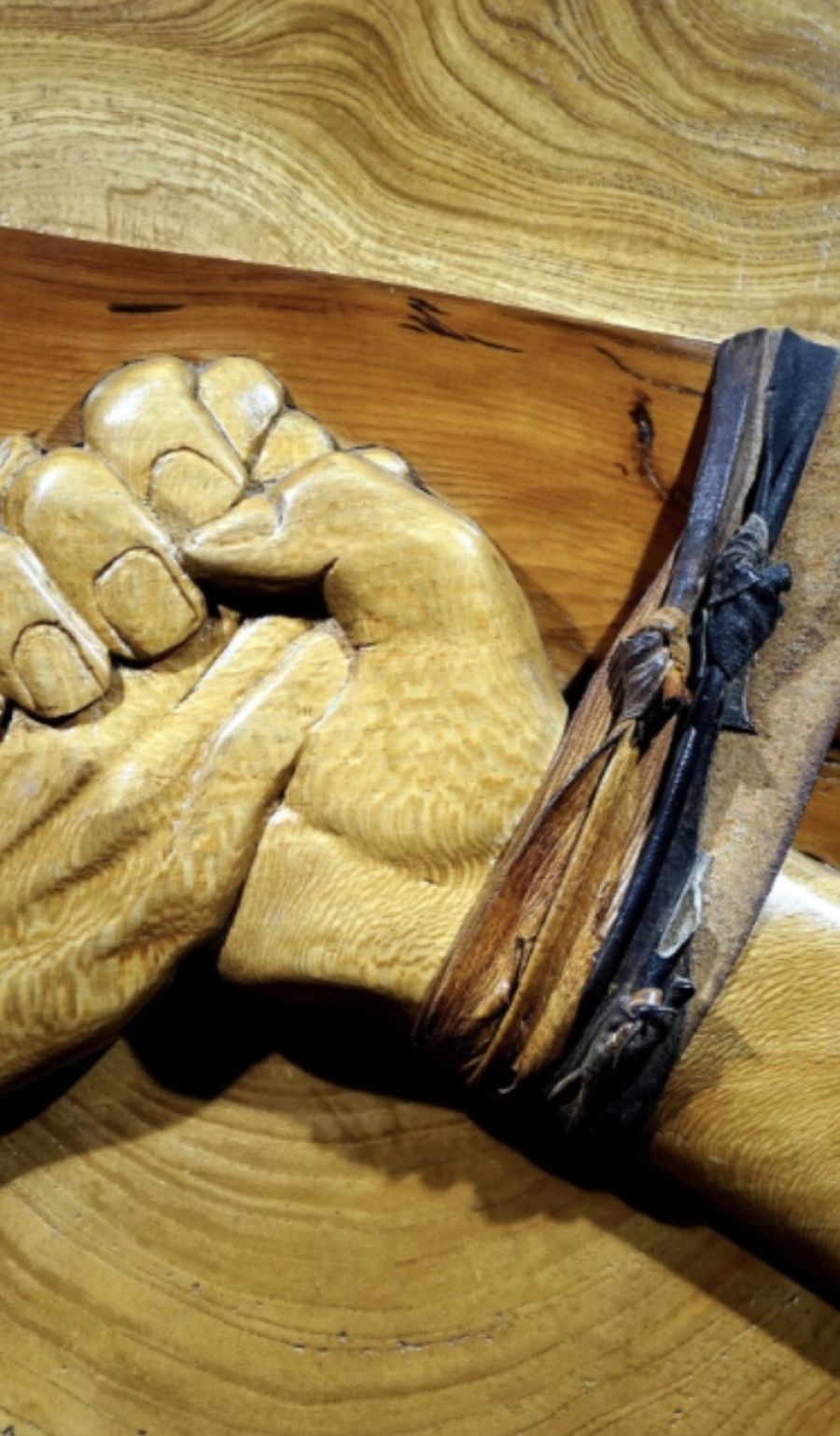
We do not recognize a person by hands and feet (v.39).

The Risen One has a life that escapes the perception of the senses, however the Resurrection does not cancel the ‘person’, but expands it.

The identity and the being that distinguishes it is of another nature, but the heart is that, characterizing. Love to the end: unsparing action [hands] and walk [feet], which non-faith marginalizes, humiliates, kills.

One does not grasp Christ outside the experience of sharing, witnessing, Mission - tip of the text - that extends among all people.

An evangelization starting from direct heralds and enthusiastic auctioneers. Centered ones in the nucleus of the Announcement, which moves everything and gives access (vv.35ff).

And finally, thanks to the intelligence of the Scriptures - which brings us out of commonplaces and vague interpretative automatisms.

All of this, in the specific listening and forgiveness that makes us participate; in the commitment that risks, walks, and talks.


The human plan of the Creator has assumed a pedagogical configuration in the Law; it was taken up, actualized and purified by the prophets, and sung in the psalms (v. 44).

But those who «see and touch» are disciples who involve themselves to the point of making their soul movements, their exoduses to the peripheries, and their passionate gestures, coincide with the own love wounds of the Master: «Palpate me and see» (v.39).

In the early days, believers - here and there - made it through thanks to the help of fraternities in which the Person of the Lord ‘manifested’ himself persuasively, because «in the midst» (v.36).

Not "on top" or "in front", but brother to brother: a testimony of the divine (v.48).

He ‘revealed’ himself as Living, in Conviviality - a key Word, climax of the entire Bible.

Sharing that also found the ways of sensitive, personal intimacy and confidence: «They handed him a portion» (v.42).

For this reason the Proclamation had to start from Jerusalem, the first of the «pagan peoples» [v.47 Greek text] in need of evangelization!

And thereby not making Christ a ghost (v.37).


In the early communities, listening to the personal and communal inner world was especially pronounced, because the direction of travel proposed by the Master seemed to be all backwards [in the opposite of institution].

Despite the chaos of external securities, the crossing fear-to-Freedom came from a tolerant perception - starting from visceral cores of experience.

The very bottlenecks accentuated change and internalization, and wrenched disciples out of the habit of setting up conformist harmonies.

One then relied more willingly on the tracks of the soul, thus meeting one's deep nature; new axis of life, starting from the ‘roots’.

The search for a new compass for one's paths, the loss of predictable references, social discomfort, all this made one in contact with oneself and others, authentically.


That feeling of anxiety, malaise and sores, allowed them to know their Calling... even if the external way they saw themselves and dealt with normal or spiritual existence, could already satisfy [the outside].

Having to move from the habits, no one escaped the most precious revelation anymore: of the primordial and humanizing intimacy deposited in the fraternity of the new crucified Way.

Educated by the paradox of narrowness, the uncertain apostles thus became step by step the seekers of a trace, of a more pertinent course.

Pilgrims of unexpected codes. «Witnesses» (v. 48): mothers and fathers  of a new humanity.


[Thursday between the Easter Octave, April 9, 2026]

177 Last modified on Thursday, 09 April 2026 12:08
don Giuseppe Nespeca

Giuseppe Nespeca è architetto e sacerdote. Cultore della Sacra scrittura è autore della raccolta "Due Fuochi due Vie - Religione e Fede, Vangeli e Tao"; coautore del libro "Dialogo e Solstizio".

Dear friends, the mission of the Church bears fruit because Christ is truly present among us in a quite special way in the Holy Eucharist. His is a dynamic presence which grasps us in order to make us his, to liken us to him. Christ draws us to himself, he brings us out of ourselves to make us all one with him. In this way he also inserts us into the community of brothers and sisters: communion with the Lord is always also communion with others (Pope Benedict)
Cari amici, la missione della Chiesa porta frutto perché Cristo è realmente presente tra noi, in modo del tutto particolare nella Santa Eucaristia. La sua è una presenza dinamica, che ci afferra per farci suoi, per assimilarci a Sé. Cristo ci attira a Sé, ci fa uscire da noi stessi per fare di noi tutti una cosa sola con Lui. In questo modo Egli ci inserisce anche nella comunità dei fratelli: la comunione con il Signore è sempre anche comunione con gli altri (Papa Benedetto)
«Doctrina eius (scilicet Catharinae) non acquisita fuit; prius magistra visa est quam discipula» [Pope Pius II, Canonization Edict]
«Doctrina eius (scilicet Catharinae) non acquisita fuit; prius magistra visa est quam discipula» [Papa Pio II, Bolla di Canonizzazione]
In this passage, the Lord tells us three things about the true shepherd:  he gives his own life for his sheep; he knows them and they know him; he is at the service of unity [Pope Benedict]
In questo brano il Signore ci dice tre cose sul vero pastore: egli dà la propria vita per le pecore; le conosce ed esse lo conoscono; sta a servizio dell'unità [Papa Benedetto]
Let us permit St Augustine to speak once more: "If only good shepherds be not lacking! Far be it from us that they should be lacking, and far be it from divine mercy not to call them forth and establish them. It is certain that if there are good sheep, there are also good shepherds: in fact it is from good sheep that good shepherds are derived." (Sermones ad populum, Sermo XLIV, XIII, 30) [John Paul II]
Lasciamo ancora una volta parlare Sant’Agostino: “Purché non vengano a mancare buoni pastori! Lungi da noi che manchino, e lungi dalla misericordia divina il non farli sorgere e stabilirli. Certo è che se ci sono buone pecore, ci sono anche buoni pastori: infatti è dalle buone pecore che derivano i buoni pastori” (S. Agostino, Sermones ad populum, I, Sermo XLIV, XIII, 30) [Giovanni Paolo II]
Jesus, Good Shepherd and door of the sheep, is a leader whose authority is expressed in service, a leader who, in order to command, gives his life and does not ask others to sacrifice theirs. One can trust in a leader like this (Pope Francis)
Gesù, pastore buono e porta delle pecore, è un capo la cui autorità si esprime nel servizio, un capo che per comandare dona la vita e non chiede ad altri di sacrificarla. Di un capo così ci si può fidare (Papa Francesco)
To be Christians means to be missionaries, to be apostles (cfr. Decree Apostolicam Actuositatem, n.2). It is not enough to discover Christ - you must bring Him to others! [John Paul II]
Essere cristiani significa essere missionari-apostoli (cfr. «Apostolicam Actuositatem», 2). Non basta scoprire Cristo - bisogna portarlo agli altri! [Giovanni Paolo II]
What is meant by “eat the flesh and drink the blood” of Jesus? Is it just an image, a figure of speech, a symbol, or does it indicate something real? (Pope Francis)
Che significa “mangiare la carne e bere il sangue” di Gesù?, è solo un’immagine, un modo di dire, un simbolo, o indica qualcosa di reale? (Papa Francesco)

Due Fuochi due Vie - Vol. 1 Due Fuochi due Vie - Vol. 2 Due Fuochi due Vie - Vol. 3 Due Fuochi due Vie - Vol. 4 Due Fuochi due Vie - Vol. 5 Dialogo e Solstizio I fiammiferi di Maria

duevie.art

don Giuseppe Nespeca

Tel. 333-1329741


Disclaimer

Questo blog non rappresenta una testata giornalistica in quanto viene aggiornato senza alcuna periodicità. Non può pertanto considerarsi un prodotto editoriale ai sensi della legge N°62 del 07/03/2001.
Le immagini sono tratte da internet, ma se il loro uso violasse diritti d'autore, lo si comunichi all'autore del blog che provvederà alla loro pronta rimozione.
L'autore dichiara di non essere responsabile dei commenti lasciati nei post. Eventuali commenti dei lettori, lesivi dell'immagine o dell'onorabilità di persone terze, il cui contenuto fosse ritenuto non idoneo alla pubblicazione verranno insindacabilmente rimossi.






