Apr 2, 2026 Written by 

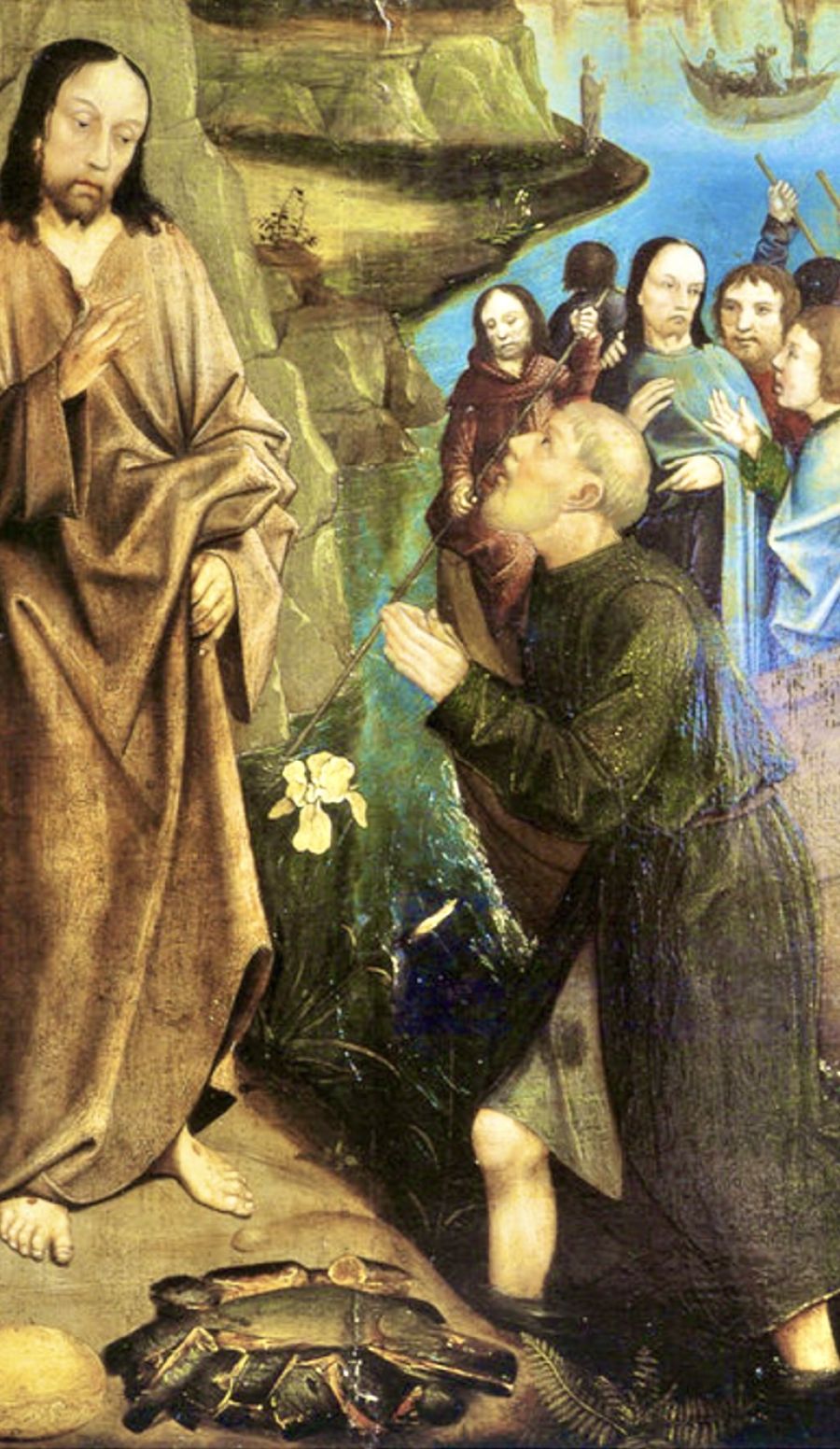
Apron co-workers, on a small boat

(Jn 21:1-14)


The same sign of overfishing, in Lk 5:1-11, is even placed on the day when Jesus invites the first disciples to follow him to become "fishers" of men.

The prodigy of the Vocation expands the believer's journey in Christ and affects every experience we can have of the Risen One in our ordinary work - and what Mission we are entrusted with to experience him Alive.

The Church is not composed of phenomena, but of a stubborn, eager and insecure leader (Peter). Some are in and out (Thomas), others remain tied to the past (Nathanael), and there is no shortage of fanatics (the sons of Zebedee); plus, the anonymous (all of us).

Peter realises that before giving orders, it is he who must do and expose himself: if so, the others will decide spontaneously (v.3).

But without the torch of the Word, no results. Following Peter is not enough.

Here is Jesus: on the Shore of the ultimate condition He calls us and leads the way, guides the activity, and it is finally Light - the Dawn.


The “net” must be cast on the «side right» (v.6), that is, on the good side!

To bring people up from the abyss of polluted waters and waves of death, we need to start and aim for the best in everyone, to bring out the good [that is there, always].

Appeal for us.

Therefore Peter - each responsible of community - must have no preconceived notions, but take off the cassock of a group leader and put on the apron of a servant [v.7: Greek verb is that of the ‘washing of the feet’].

For work that gives results according to God (love), one must wear the same robe as Christ - the only badge: the garment of someone who does not give orders, but receives them.

It is the trait of the authentic Church - nothing big: it does not arrive on an ocean liner, but on a «little boat» [v.8 Greek text].

And it remains low in size: like a bit of yeast, to embrace anyone.


All this shapes a different awareness of inadequacy: the one in the Faith - only positive, because it understands the brethen. It recognizes them in the depths of itself, and knows how to justify resistance to the Announcement.

We are collaborators of the apron, to dialogue with those in need of recovery, in whatever vortex or peripheral condition they find themselves.

Therefore, «to shepherd» (vv. 15-17) means to precede and feed, not to command.

Those who “lead” must be a sign of a God who is neither fed up nor spiteful.

Lovable and inviting face of the One who is capable of surprising and putting Simon back on his feet as well. The chief apostle, who had been called to freedom and had chosen the condition of lackey [cf. Jn 21:9 with the «fire of embers» in Jn 18:18].

So the "enemy" of God is the pursuit of the ‘average life’. Mire where no one throws himself.


[A reflection for the scoutmaster  reads: «Remember, scout leader: if you slow down, they stop; if you yield, they back off; if you sit down, they lie down. If you walk ahead, they will overtake you; if you give your hand, they will give their skin»].

Now the Message is making one with our body.


(Friday between the Octave of Easter, April 10, 2026)

191 Last modified on Friday, 10 April 2026 12:02
don Giuseppe Nespeca

Giuseppe Nespeca è architetto e sacerdote. Cultore della Sacra scrittura è autore della raccolta "Due Fuochi due Vie - Religione e Fede, Vangeli e Tao"; coautore del libro "Dialogo e Solstizio".

Work is part of God’s loving plan, we are called to cultivate and care for all the goods of creation and in this way share in the work of creation! Work is fundamental to the dignity of a person. Work, to use a metaphor, “anoints” us with dignity, fills us with dignity, makes us similar to God, who has worked and still works, who always acts (cf. Jn 5:17); it gives one the ability to maintain oneself, one’s family, to contribute to the growth of one’s own nation [Pope Francis]
Il lavoro fa parte del piano di amore di Dio; noi siamo chiamati a coltivare e custodire tutti i beni della creazione e in questo modo partecipiamo all’opera della creazione! Il lavoro è un elemento fondamentale per la dignità di una persona. Il lavoro, per usare un’immagine, ci “unge” di dignità, ci riempie di dignità; ci rende simili a Dio, che ha lavorato e lavora, agisce sempre (cfr Gv 5,17); dà la capacità di mantenere se stessi, la propria famiglia, di contribuire alla crescita della propria Nazione [Papa Francesco]
Dear friends, the mission of the Church bears fruit because Christ is truly present among us in a quite special way in the Holy Eucharist. His is a dynamic presence which grasps us in order to make us his, to liken us to him. Christ draws us to himself, he brings us out of ourselves to make us all one with him. In this way he also inserts us into the community of brothers and sisters: communion with the Lord is always also communion with others (Pope Benedict)
Cari amici, la missione della Chiesa porta frutto perché Cristo è realmente presente tra noi, in modo del tutto particolare nella Santa Eucaristia. La sua è una presenza dinamica, che ci afferra per farci suoi, per assimilarci a Sé. Cristo ci attira a Sé, ci fa uscire da noi stessi per fare di noi tutti una cosa sola con Lui. In questo modo Egli ci inserisce anche nella comunità dei fratelli: la comunione con il Signore è sempre anche comunione con gli altri (Papa Benedetto)
«Doctrina eius (scilicet Catharinae) non acquisita fuit; prius magistra visa est quam discipula» [Pope Pius II, Canonization Edict]
«Doctrina eius (scilicet Catharinae) non acquisita fuit; prius magistra visa est quam discipula» [Papa Pio II, Bolla di Canonizzazione]
In this passage, the Lord tells us three things about the true shepherd:  he gives his own life for his sheep; he knows them and they know him; he is at the service of unity [Pope Benedict]
In questo brano il Signore ci dice tre cose sul vero pastore: egli dà la propria vita per le pecore; le conosce ed esse lo conoscono; sta a servizio dell'unità [Papa Benedetto]
Let us permit St Augustine to speak once more: "If only good shepherds be not lacking! Far be it from us that they should be lacking, and far be it from divine mercy not to call them forth and establish them. It is certain that if there are good sheep, there are also good shepherds: in fact it is from good sheep that good shepherds are derived." (Sermones ad populum, Sermo XLIV, XIII, 30) [John Paul II]
Lasciamo ancora una volta parlare Sant’Agostino: “Purché non vengano a mancare buoni pastori! Lungi da noi che manchino, e lungi dalla misericordia divina il non farli sorgere e stabilirli. Certo è che se ci sono buone pecore, ci sono anche buoni pastori: infatti è dalle buone pecore che derivano i buoni pastori” (S. Agostino, Sermones ad populum, I, Sermo XLIV, XIII, 30) [Giovanni Paolo II]
Jesus, Good Shepherd and door of the sheep, is a leader whose authority is expressed in service, a leader who, in order to command, gives his life and does not ask others to sacrifice theirs. One can trust in a leader like this (Pope Francis)

Due Fuochi due Vie - Vol. 1 Due Fuochi due Vie - Vol. 2 Due Fuochi due Vie - Vol. 3 Due Fuochi due Vie - Vol. 4 Due Fuochi due Vie - Vol. 5 Dialogo e Solstizio I fiammiferi di Maria

duevie.art

don Giuseppe Nespeca

Tel. 333-1329741


Disclaimer

Questo blog non rappresenta una testata giornalistica in quanto viene aggiornato senza alcuna periodicità. Non può pertanto considerarsi un prodotto editoriale ai sensi della legge N°62 del 07/03/2001.
Le immagini sono tratte da internet, ma se il loro uso violasse diritti d'autore, lo si comunichi all'autore del blog che provvederà alla loro pronta rimozione.
L'autore dichiara di non essere responsabile dei commenti lasciati nei post. Eventuali commenti dei lettori, lesivi dell'immagine o dell'onorabilità di persone terze, il cui contenuto fosse ritenuto non idoneo alla pubblicazione verranno insindacabilmente rimossi.






