Feb 21, 2026 Written by 

Against the tide Transfiguration

Faith and Metamorphosis

(Mk 9:2-13)


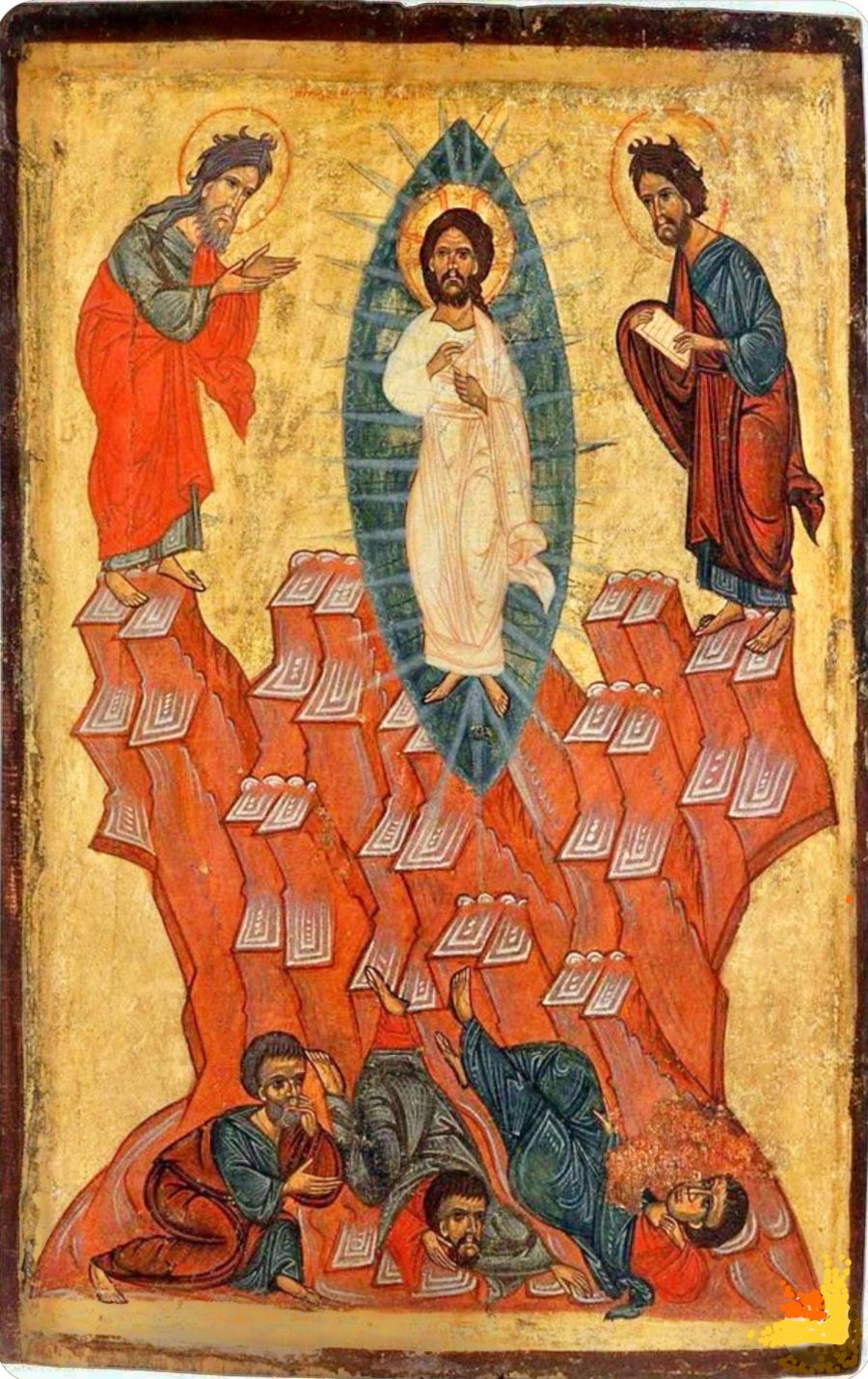
In biblical language, the experience of «the Mount» is an icon of the Encounter between God and man. Yes, for us it’s like “losing our minds”, but in a very practical way - not at all visionary.

The Master imposes it on the three eminent figures of the first communities, not because he considers them the chosen ones, but the exact opposite: he realizes that it’s his captains who need verification.

The synoptic Gospels do not speak of Transfiguration any, but of «Metamorphosis» [Greek text of Mk 9:2 and Mt 17:2]: a passing under a different ‘form’.

In particular, Lk 9:29 emphasizes that «the appearance of his face became ‘other’». Not because of a paroxysmal state.

It sounds crazy, but the hieratic magnificence of the Eternal One is revealed against the tide: in the image of the humble servant.

The experience of divine Glory is unsustainable for the eminent disciples - not in reference to physical flashes of light.

As in Oriental icons, they find themselves face to earth [Mt 17:6 - in ancient Eastern culture it meant precisely: "defeated" in their aspirations] and frightened. Fearful of being they too called to the gift of self (Mk 9:6; Mt 17:6; Lk 9:34-36).

The vertigo of the experience of God was not what they cultivated and wanted.

The dazzling light to which the passage refers (Mk 9:3; Mt 17:2.5; Lk 9:29) is that of a Revelation that opens our eyes to the "impossible" identity of the Son.

He was popularly expected as resembling David, powerful sovereign, able to assure the people a quick and easy well-being.

He’s ‘revealed’ in a reversal: the Glory of God is Communion in simplicity, which qualifies us everyone.

The ‘shape’ of the "boss" is that of the attendant, who has the freedom to step down in altitude to put the least at ease: the humanly defeated one!

Peter elbows more than others to have his say. As usual, he wants to emerge and reiterate ancient ideas, but he reveals himself as the most ridiculous of all (Mk 9:6; Lk 9:33): he’s ranting.

For him [again!] at the centre of the triptych remains Moses (Mk 9:5; Mt 17:4; Lk 9:33).

With the help of prophecies animated by fiery zeal [Elijah], according to Simon, Jesus would be one of the many who makes others practise the legalistic tradition.

At foundatiion remain the Commandments, not the Beatitudes.

The first of the apostles just does not want to understand that the Lord doesn’t impose a Covenant based on obeying, but on Resembling!

Of course, the other "great ones" were also half asleep. Who knows what they were dreaming of... then bewildered, they all look for a Jesus according to Moses and Elijah (Mk 9:8-10; Mt 17:8; Lk 9:36).


In the culture of the time, the new, observant and disruptive Prince was expected during the Feast of Huts.

He would inaugurate the rule of the chosen people over all the nations of the earth (Zk 14:16-19); in practice, the golden age.

In Judaism, the Feast of Booths commemorated the ‘Mirabilia Dei’ of the Exodus [Lk 9:31: here, the new and personalised liberation from the land of slavery] and looked to the future by celebrating the prospects of victory for the protagonist ethnicity.

But the Kingdom of the Lord is not an empire affected by prodigious and immediate verticalism.

To build the Church of God there are no shortcuts, no numb safety points, and there sitting quiet - at a safe distance - by raving about accolades.


[2nd Sunday in Lent, Transfiguration of the Lord]

238 Last modified on Sunday, 01 March 2026 12:46
don Giuseppe Nespeca

Giuseppe Nespeca è architetto e sacerdote. Cultore della Sacra scrittura è autore della raccolta "Due Fuochi due Vie - Religione e Fede, Vangeli e Tao"; coautore del libro "Dialogo e Solstizio".

Here we can experience first hand that God is life and gives life, yet takes on the tragedy of death (Pope Francis)
Qui tocchiamo con mano che Dio è vita e dona vita, ma si fa carico del dramma della morte (Papa Francesco)
The people thought that Jesus was a prophet. This was not wrong, but it does not suffice; it is inadequate. In fact, it was a matter of delving deep, of recognizing the uniqueness of the person of Jesus of Nazareth and his newness. This is how it still is today: many people draw near to Jesus, as it were, from the outside (Pope Benedict)
La gente pensa che Gesù sia un profeta. Questo non è falso, ma non basta; è inadeguato. Si tratta, in effetti, di andare in profondità, di riconoscere la singolarità della persona di Gesù di Nazaret, la sua novità. Anche oggi è così: molti accostano Gesù, per così dire, dall’esterno (Papa Benedetto)
Because of this unique understanding, Jesus can present himself as the One who revealsr the Father with a knowledge that is the fruit of an intimate and mysterious reciprocity (John Paul II)
In forza di questa singolare intesa, Gesù può presentarsi come il rivelatore del Padre, con una conoscenza che è frutto di un'intima e misteriosa reciprocità (Giovanni Paolo II)
Yes, all the "miracles, wonders and signs" of Christ are in function of the revelation of him as Messiah, of him as the Son of God: of him who alone has the power to free man from sin and death. Of him who is truly the Savior of the world (John Paul II)
Sì, tutti i “miracoli, prodigi e segni” di Cristo sono in funzione della rivelazione di lui come Messia, di lui come Figlio di Dio: di lui che, solo, ha il potere di liberare l’uomo dal peccato e dalla morte. Di lui che veramente è il Salvatore del mondo (Giovanni Paolo II)
It is known that faith is man's response to the word of divine revelation. The miracle takes place in organic connection with this revealing word of God. It is a "sign" of his presence and of his work, a particularly intense sign (John Paul II)
È noto che la fede è una risposta dell’uomo alla parola della rivelazione divina. Il miracolo avviene in legame organico con questa parola di Dio rivelante. È un “segno” della sua presenza e del suo operare, un segno, si può dire, particolarmente intenso (Giovanni Paolo II)
In the rite of Baptism, the presentation of the candle lit from the large Paschal candle, a symbol of the Risen Christ, is a sign that helps us to understand what happens in the Sacrament. When our lives are enlightened by the mystery of Christ, we experience the joy of being liberated from all that threatens the full realization (Pope Benedict)
Nel rito del Battesimo, la consegna della candela, accesa al grande cero pasquale simbolo di Cristo Risorto, è un segno che aiuta a cogliere ciò che avviene nel Sacramento. Quando la nostra vita si lascia illuminare dal mistero di Cristo, sperimenta la gioia di essere liberata da tutto ciò che ne minaccia la piena realizzazione (Papa Benedetto)
Doing a good deed almost instinctively gives rise to the desire to be esteemed and admired for the good action, in other words to gain a reward. And on the one hand this closes us in on ourselves and on the other, it brings us out of ourselves because we live oriented to what others think of us or admire in us (Pope Benedict)
Quando si compie qualcosa di buono, quasi istintivamente nasce il desiderio di essere stimati e ammirati per la buona azione, di avere cioè una soddisfazione. E questo, da una parte rinchiude in se stessi, dall’altra porta fuori da se stessi, perché si vive proiettati verso quello che gli altri pensano di noi e ammirano in noi (Papa Benedetto)

Due Fuochi due Vie - Vol. 1 Due Fuochi due Vie - Vol. 2 Due Fuochi due Vie - Vol. 3 Due Fuochi due Vie - Vol. 4 Due Fuochi due Vie - Vol. 5 Dialogo e Solstizio I fiammiferi di Maria

duevie.art

don Giuseppe Nespeca

Tel. 333-1329741


Disclaimer

Questo blog non rappresenta una testata giornalistica in quanto viene aggiornato senza alcuna periodicità. Non può pertanto considerarsi un prodotto editoriale ai sensi della legge N°62 del 07/03/2001.
Le immagini sono tratte da internet, ma se il loro uso violasse diritti d'autore, lo si comunichi all'autore del blog che provvederà alla loro pronta rimozione.
L'autore dichiara di non essere responsabile dei commenti lasciati nei post. Eventuali commenti dei lettori, lesivi dell'immagine o dell'onorabilità di persone terze, il cui contenuto fosse ritenuto non idoneo alla pubblicazione verranno insindacabilmente rimossi.






