Feb 16, 2026 Written by 

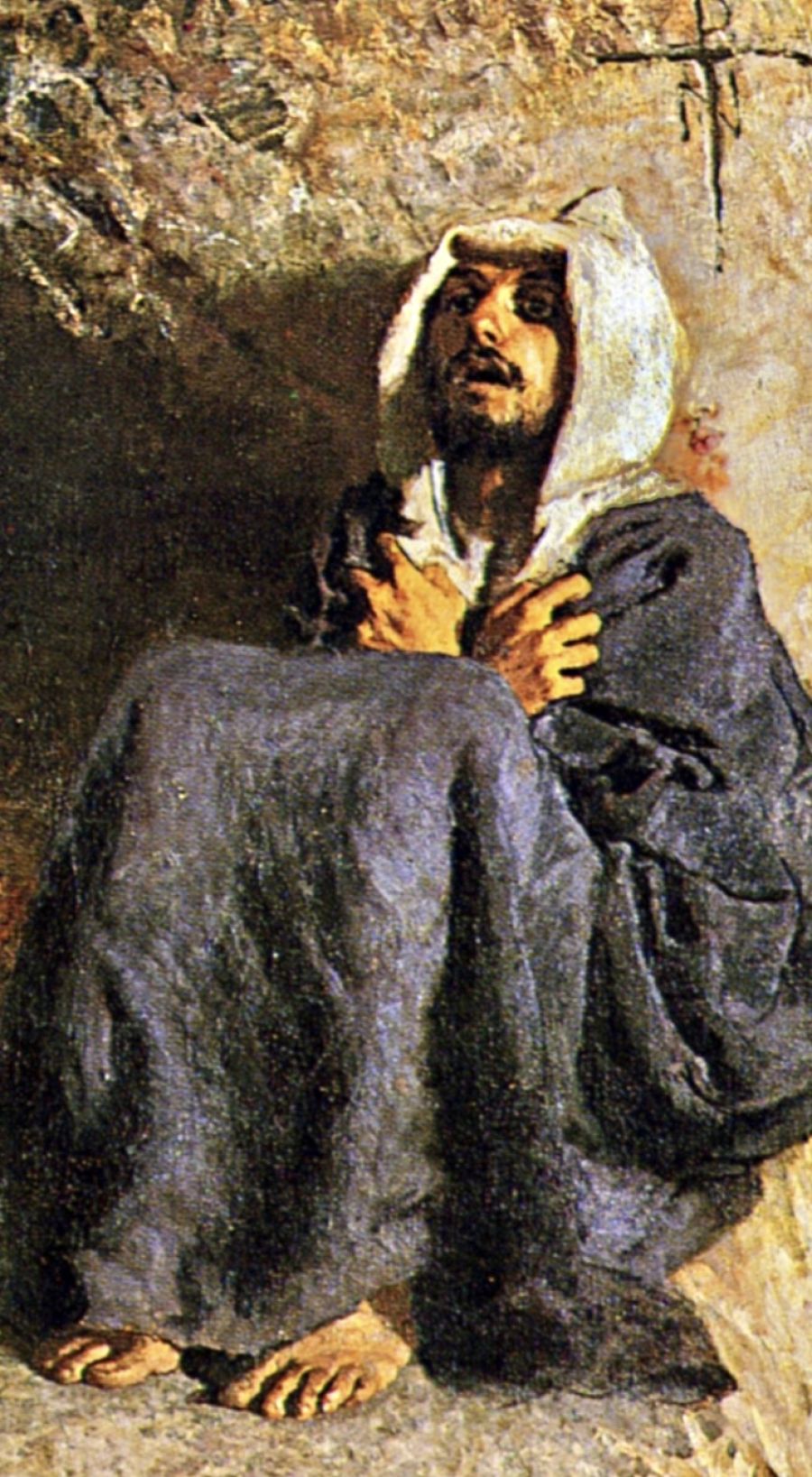
‘Cross-inside’ in Prayer: gaze no longer positioned outside

Sons’ Prayer: performance or Listening?

Mt 6:7-15 (v.13)


«When you pray, do not babble like the pagans, for they think they will be heard because of their wordiness» (Mt 6:7; cf. Lk 11:1).

The God of religions was named with an overabundance of high-sounding honorific epithets, as if he craved ever more numerous ranks of incensers.

The «Father» is not accompanied by prestigious titles. A child doesn’t address the parent as a very high, eternal and omnipotent, but the a reliable family Person who transmits life to him.

And the son doesn’t imagine that he has to offer external cries and acknowledgments: the Father looks at needs, not merits.


«Et ne nos inducas in tentationem»: ancient Prayer of the sons.


«Do not induce us [Lead us not into]» is (in the Latin and Greek sense: «until the end») an ancient Symbol of the ‘reborn in Christ’, in the experience of real life.

In religions there are clearly opposed demons and angels: disordered and dark powers, contrary to the bright and "right" ones.

But by dint of relegating the former, the worst continually resurface, until they win the game and spread.

In the lives of the saints we see these great women and men strangely always under temptation - because they disdain evil, therefore they do not know it.

Gradually, however, the little constant naggings becomes overwhelming crowds.


The persons of Faith do not act according to pre-established and superficial models, not even religious ones; they are aware that they are not heroes or paradigm phenomena.

That's why they rely on. They let intimate problems go by: understood its strength!

This is the meaning of the formula of the Our Father, in its original sense: «and lead us not into [the end of] temptation [trial] (because we know our weakness)».

If, on the other hand, our 'counterpart' becomes a protagonist, a one-sided pivot, a constant afterthought, and a block, we’re done for.


Pain, failures, sadness, frustrations, weaknesses, a thousand anxieties, too many falls, accustom us to experience transgressions as part of ourselves: Condition to be evaluated, not "guilt" to be cut horizontally.

In the process of true salvific transmutation, that signal speaks of us: within a deviation or the eccentricity there is a secret or a knowledge to be found, for a ‘new personal birth’.

Looking at the discomforts and oppositions, we realize that these critical sides of being become like a malleable magma, which approaches our healing more quickly. As if through a permanent, radical conversion… because it involves and belongs to us; not in peripheral mode, but basically, of Seed and Nature.

Absorbed patterns and beliefs don’t allow us to understand that the passionate life is composed of opposing states, of competitive energies - which must not be disguised in order to be considered decent people.


Perceiving and integrating such depths, we lay down the idea and atmosphere of impending danger, devoid of further opportunity; only for death.

We become mature, without dissociation or hysterical states resulting from contrived identifications, nor disesteem for an important part of us.

In short, straits and "crosses" have something to tell us.

They shake the soul to the root, sweep away the absorbed masks, ignite the person, and save the life.

In this way, inconveniences and anxieties help us. They hide capabilities and possibilities that we do not yet see.

In the virtue of the shaky yet unique exceptionality for each person, here is the true journey opening up.

Path of the Father and of the heart, Way that wants to guide us to alternative trajectories, new dimensions of existence.


The difference of the Faith, compared to ancient religiosity [in the sense of the ‘Cross-inside’]?

It’s in the consciousness that only the sick heal, only the incomplete grow.

Only the halting women and men regain expression, evolve. And falling, they snap forward.


[Tuesday 1st wk. in Lent, February 24, 2026]

304 Last modified on Tuesday, 24 February 2026 12:24
don Giuseppe Nespeca

Giuseppe Nespeca è architetto e sacerdote. Cultore della Sacra scrittura è autore della raccolta "Due Fuochi due Vie - Religione e Fede, Vangeli e Tao"; coautore del libro "Dialogo e Solstizio".

Yes, all the "miracles, wonders and signs" of Christ are in function of the revelation of him as Messiah, of him as the Son of God: of him who alone has the power to free man from sin and death. Of him who is truly the Savior of the world (John Paul II)
Sì, tutti i “miracoli, prodigi e segni” di Cristo sono in funzione della rivelazione di lui come Messia, di lui come Figlio di Dio: di lui che, solo, ha il potere di liberare l’uomo dal peccato e dalla morte. Di lui che veramente è il Salvatore del mondo (Giovanni Paolo II)
It is known that faith is man's response to the word of divine revelation. The miracle takes place in organic connection with this revealing word of God. It is a "sign" of his presence and of his work, a particularly intense sign (John Paul II)
È noto che la fede è una risposta dell’uomo alla parola della rivelazione divina. Il miracolo avviene in legame organico con questa parola di Dio rivelante. È un “segno” della sua presenza e del suo operare, un segno, si può dire, particolarmente intenso (Giovanni Paolo II)
In the rite of Baptism, the presentation of the candle lit from the large Paschal candle, a symbol of the Risen Christ, is a sign that helps us to understand what happens in the Sacrament. When our lives are enlightened by the mystery of Christ, we experience the joy of being liberated from all that threatens the full realization (Pope Benedict)
Nel rito del Battesimo, la consegna della candela, accesa al grande cero pasquale simbolo di Cristo Risorto, è un segno che aiuta a cogliere ciò che avviene nel Sacramento. Quando la nostra vita si lascia illuminare dal mistero di Cristo, sperimenta la gioia di essere liberata da tutto ciò che ne minaccia la piena realizzazione (Papa Benedetto)
Doing a good deed almost instinctively gives rise to the desire to be esteemed and admired for the good action, in other words to gain a reward. And on the one hand this closes us in on ourselves and on the other, it brings us out of ourselves because we live oriented to what others think of us or admire in us (Pope Benedict)
Quando si compie qualcosa di buono, quasi istintivamente nasce il desiderio di essere stimati e ammirati per la buona azione, di avere cioè una soddisfazione. E questo, da una parte rinchiude in se stessi, dall’altra porta fuori da se stessi, perché si vive proiettati verso quello che gli altri pensano di noi e ammirano in noi (Papa Benedetto)
Since God has first loved us (cf. 1 Jn 4:10), love is now no longer a mere “command”; it is the response to the gift of love with which God draws near to us [Pope Benedict]
Siccome Dio ci ha amati per primo (cfr 1 Gv 4, 10), l'amore adesso non è più solo un « comandamento », ma è la risposta al dono dell'amore, col quale Dio ci viene incontro [Papa Benedetto]
Another aspect of Lenten spirituality is what we could describe as "combative" […] where the "weapons" of penance and the "battle" against evil are mentioned. Every day, but particularly in Lent, Christians must face a struggle […] (Pope Benedict)
Un altro aspetto della spiritualità quaresimale è quello che potremmo definire "agonistico" […] là dove si parla di "armi" della penitenza e di "combattimento" contro lo spirito del male. Ogni giorno, ma particolarmente in Quaresima, il cristiano deve affrontare una lotta […] (Papa Benedetto)
Jesus wants to help his listeners take the right approach to the prescriptions of the Commandments given to Moses, urging them to be open to God who teaches  us true freedom and responsibility through the Law. It is a matter of living it as an instrument of freedom (Pope Francis)

Due Fuochi due Vie - Vol. 1 Due Fuochi due Vie - Vol. 2 Due Fuochi due Vie - Vol. 3 Due Fuochi due Vie - Vol. 4 Due Fuochi due Vie - Vol. 5 Dialogo e Solstizio I fiammiferi di Maria

duevie.art

don Giuseppe Nespeca

Tel. 333-1329741


Disclaimer

Questo blog non rappresenta una testata giornalistica in quanto viene aggiornato senza alcuna periodicità. Non può pertanto considerarsi un prodotto editoriale ai sensi della legge N°62 del 07/03/2001.
Le immagini sono tratte da internet, ma se il loro uso violasse diritti d'autore, lo si comunichi all'autore del blog che provvederà alla loro pronta rimozione.
L'autore dichiara di non essere responsabile dei commenti lasciati nei post. Eventuali commenti dei lettori, lesivi dell'immagine o dell'onorabilità di persone terze, il cui contenuto fosse ritenuto non idoneo alla pubblicazione verranno insindacabilmente rimossi.






